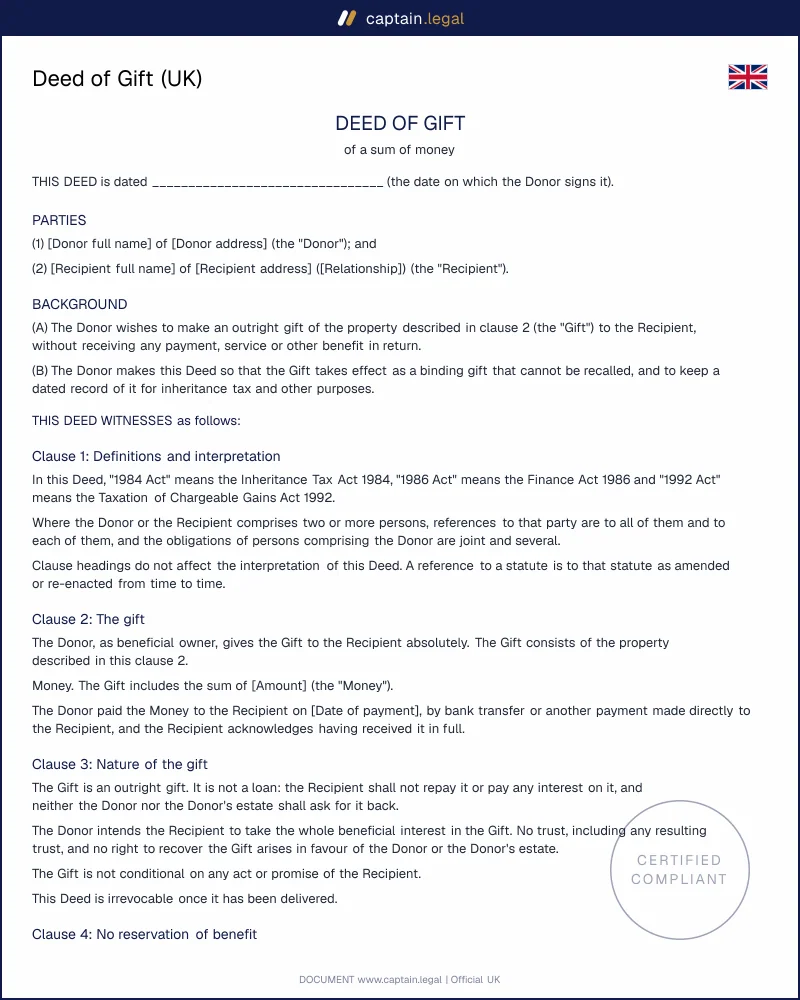
The formal rules come from section 1 of the Law of Property (Miscellaneous Provisions) Act 1989. The document must make clear on its face that it is intended to be a deed, it must be signed by the donor in the presence of a witness who attests the signature, and it must be delivered. The witness has to be physically present when the donor signs, so a signature sent by email to someone who was not in the room is not enough. In practice the witness should be an independent adult who is not a recipient.
Tax is the reason most people bother. Under section 3A of the Inheritance Tax Act 1984, a gift from one individual to another is a potentially exempt transfer. It becomes fully exempt if the donor survives seven years. If the donor dies sooner, the gift is counted against the nil-rate band, and where death falls more than three years after the gift, section 7(4) reduces any tax due on it through taper relief. Exemptions can take a gift out of the calculation from the start: the annual exemption in section 19, the small gifts exemption in section 20, regular gifts out of surplus income under section 21, gifts to a spouse or civil partner under section 18 and wedding gifts under section 22. HMRC sets out these rules in its guidance on inheritance tax and gifts made before death.
Two traps sit next to the exemptions. Section 102 of the Finance Act 1986 treats a gift as still part of the estate if the donor keeps using or benefiting from it. And sections 199 and 204 of the 1984 Act make the recipient primarily liable for any tax that later falls due on the gift, with the executors liable only in limited cases. For capital gains tax, a gift of a valuable item is a disposal at market value under section 17 of the Taxation of Chargeable Gains Act 1992, while sterling is not a chargeable asset at all.

 England & Wales law 2026