Create my document
Login

Choose country

FranceBelgiqueEspañaUnited StatesUnited KingdomMarocDeutschlandItaliaSchweiz
Real Estate

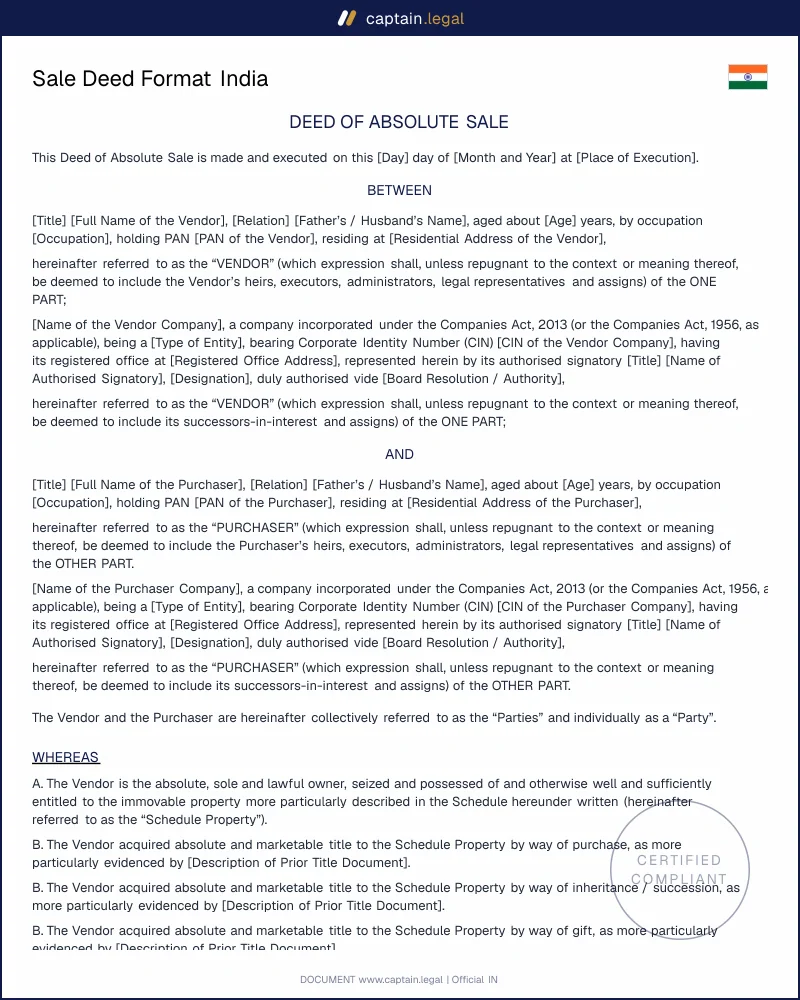
Sale Deed India | Section 54 TPA Compliant

Sale deed for immovable property under Section 54, Transfer of Property Act 1882 and Registration Act 1908. Stamp duty, TDS and registration covered.
4.7/524 reviews50 000+ downloadsInstant download
Share

A sale deed is the instrument that actually transfers ownership of immovable property from a seller to a buyer in India, and unlike an agreement to sell it does the real work of conveyance. When this sale deed is signed, stamped and registered, title passes; until then, no amount of advance money or informal paperwork makes the buyer an owner in the eyes of the law. This page covers what a registered conveyance deed must contain, the statutory framework under the Transfer of Property Act 1882 and the Registration Act 1908, the stamp duty and TDS steps that trip up most buyers, and the State-level variations you need to watch before you book your slot at the Sub-Registrar's office.

Compliant

2026 Legislation

50,000+ clients

trust us

Affordable

From $4.90 / doc

Secure payment

Instant download

Sale Deed India | Section 54 TPA Compliant

Secure payment · No subscription

Fill in the template

What is a sale deed for immovable property?

A sale deed is a written, stamped and registered instrument by which an owner conveys absolute title to land, a flat, or any other immovable property to a buyer for a price. Section 54 of the Transfer of Property Act 1882 defines a sale as a transfer of ownership in exchange for a price paid or promised, and it makes the point that for tangible immovable property worth one hundred rupees or more, that transfer can be made only by a registered instrument. The word "only" is not decorative. The Supreme Court has read it strictly, holding that ownership of such property passes through a registered sale deed and nothing less.

People routinely confuse the sale deed with the agreement to sell, and the difference matters enormously. An agreement to sell is a promise to convey on future terms, often against an advance, and it creates no ownership at all. The sale deed is the conveyance itself: it recites the consideration, confirms that the full price has been received, records the handover of possession, and carries the seller's covenants of clear title. A buyer who holds only an agreement to sell, even a notarised one with a power of attorney attached, holds a contract, not a property. If your transaction has reached the point of payment and possession, you need a registered sale deed, not a substitute. For commercial conveyances of stock or goods rather than land, the sale and purchase agreement for goods under the 1930 Act is the correct instrument instead.

2

When do you need this document?

The plainest case is an outright purchase or sale of a flat, plot, house or commercial unit where the full price is being paid and possession changes hands. Here the sale deed is not optional paperwork; it is the only instrument that moves ownership. A second common situation is the conversion of an earlier agreement to sell into a completed transaction. Many buyers sign an agreement, pay an advance, arrange a home loan, and only then execute the sale deed once funds are in place. The deed is what finally vests title, and the bank disbursing the loan will insist on a registered one before releasing money against the property.

A sale deed also becomes necessary when a property held jointly is being sold, or when one co-owner buys out the others. Each transferring owner must be a party and must sign, because a deed that omits a co-owner conveys only the share of those who signed. Resale of a flat in a society, sale of inherited property after the heirs' shares are settled, and sale by a developer to the first purchaser all run through the same instrument. One edge case worth flagging: sales arranged through a general power of attorney to dodge stamp duty are a trap. In Suraj Lamp & Industries v. State of Haryana (2011) the Supreme Court held that a POA does not transfer title, so a "GPA sale" leaves the buyer without ownership. If a seller offers you a property on a power of attorney rather than a deed, treat it as a warning sign. A separate property power of attorney has legitimate uses for management and representation, but it is not a conveyance.

3

Key clauses included in our template

  • The parties and recitals identify the seller and buyer with full particulars, set out how the seller acquired title, and trace the chain of ownership. A careful recital references the parent or mother deed so a future buyer can verify an unbroken title back through the years, which is exactly what diligent purchasers and lenders examine.
  • The schedule of property describes the asset with precision: survey or plot number, built-up and carpet area, boundaries on all four sides, and any shared rights. Vague descriptions are where disputes start, so the schedule is drafted to match the revenue and society records rather than loose shorthand.
  • The consideration and receipt clause states the agreed price and confirms the mode and timing of payment. It records that the seller has received the consideration in full, which is what closes off later claims that money is still owed and completes the transfer under Section 54.
  • The covenants of title and possession carry the seller's assurance that the property is free from encumbrances, that the seller has the right to sell, and that physical possession is being delivered. These warranties are the buyer's protection if a hidden mortgage or claim surfaces later.
  • The indemnity and encumbrance clause obliges the seller to make good any loss if the title proves defective, and to clear any charge that emerges from before the sale. It pairs naturally with an encumbrance certificate obtained from the Sub-Registrar before signing.
  • The registration and stamp duty clause allocates who bears stamp duty and registration fees, almost always the buyer by custom, and records the parties' agreement to appear before the registering authority within the statutory period.
4

Regional considerations

Maharashtra charges stamp duty under the Maharashtra Stamp Act 1958, with rates that typically run around five to six percent in major urban areas plus a one percent metro cess in cities like Mumbai and Pune. Registration is handled through the IGR Maharashtra portal, and the State has actively pushed online appointment booking and e-registration, so most buyers pre-fill data before attending the Sub-Registrar's office.

Karnataka levies stamp duty under the Karnataka Stamp Act 1957, with concessional slabs that have applied to lower-value residential units in recent years. The State's Kaveri Online Services platform manages registration, and Bengaluru buyers should obtain a fresh encumbrance certificate and confirm the Khata before execution, since Khata transfer and revenue mutation are separate post-registration steps that title alone does not complete.

Delhi applies the Indian Stamp Act 1899 as adapted for the National Capital Territory, and is notable for a lower stamp duty rate for women buyers, a deliberate concession to encourage registration in a woman's name. Deeds are registered through the DORIS system, and the circle rate published by the Revenue Department sets the floor below which consideration cannot be declared for duty purposes.

Tamil Nadu charges among the higher combined stamp duty and registration burdens in the country, governed by the Indian Stamp Act as applied in the State and administered through the TNREGINET portal. Buyers should pay close attention to the guideline value, because duty is computed on the guideline value or the consideration, whichever is higher, and undervaluation invites scrutiny.

Uttar Pradesh registers deeds through the IGRSUP system and, like several northern States, offers a stamp duty rebate where property is purchased in a woman's name up to a prescribed ceiling. Across all these States the underlying Transfer of Property Act 1882 and Registration Act 1908 remain constant; what changes is the rate, the rebate, and the registration platform.

5

How to fill out this sale deed

You begin by entering the seller's and buyer's full details and then describing the property exactly as it appears in the revenue and society records, including the survey number, area, and boundaries. From there the template guides you through the consideration: the agreed price, how it is being paid, and confirmation that the seller acknowledges receipt. Possession and the date of handover follow, then the seller's covenants of clear title and freedom from encumbrances, which you can tighten if a fresh encumbrance certificate has thrown up an old charge. The draft leaves space to name the two witnesses who must attest the seller's signature, since attestation is a formal requirement, not a courtesy. Once the fields are complete you download the deed as Word or PDF, print it on stamp paper or pay the duty through the State's e-stamping facility, and carry it to the Sub-Registrar for registration within four months. If you also need to record the deal before the deed is ready, the contracts category for Indian agreements holds an agreement to sell you can pair with it.

6

Common mistakes to avoid

The costliest error is treating an agreement to sell or a power of attorney as if it were a conveyance. Buyers lured by a cheaper "GPA sale" discover, sometimes years later, that they never owned the property at all, exactly the situation the Supreme Court addressed in Suraj Lamp. The second frequent failure is under-stamping the deed to save money on duty by declaring a price below the circle or guideline value. The registrar matches the declared consideration against the State's guideline value, and a shortfall means the deed is impounded until duty and penalty are paid, leaving the buyer worse off than if they had paid correctly the first time. A third trap is missing the four-month registration window after execution, which can force re-execution and fresh expense.

Buyers also forget the tax step. Where the consideration or stamp duty value is fifty lakh rupees or more and the seller is a resident, the buyer must deduct one percent TDS under Section 194-IA of the Income Tax Act 1961, deposit it through Form 26QB within thirty days of the month-end, and hand the seller a Form 16B certificate; skipping this draws interest and penalty on the buyer, not the seller. Finally, many skip the encumbrance certificate and title chain check, then inherit a mortgage or disputed claim attached to the property. A clean conveyance starts with verifying that there is nothing to convey but clear title. For appointing someone to manage a property you own elsewhere, the personal and family documents section covers the right instrument.

Key takeaways

OWNERSHIP

Title passes only by registered sale deed

An agreement to sell is only a contract; it does not make you the owner. For tangible immovable property of Rs. 100 or more, Section 54 of the Transfer of Property Act, 1882 says the transfer happens only through a registered instrument. So even if you paid an advance or signed a notarised paper with a power of attorney, title does not pass until the sale deed is executed and registered.

REGISTRATION

Miss the four-month window, risk refusal

Registration is not a formality under the Registration Act, 1908. Section 17 makes registration compulsory for documents affecting rights in immovable property of Rs. 100 or more, and Section 49 blocks an unregistered deed from affecting the property or being used as evidence of the transaction. Practically, you must present the executed deed within four months for registration, or you may face penalties or the Sub-Registrar may refuse it.

STAMPING

Under-stamping can freeze your transaction

Before you book your Sub-Registrar slot, check stamp duty under the Indian Stamp Act, 1899 or the applicable State stamp law, because the amount and process vary by State. If the sale deed is under-stamped, it can be impounded and becomes inadmissible until you pay the deficit duty and penalty. That delay can derail possession handover, loan disbursal, and any later claim that the seller conveyed clear title.

Frequently Asked Questions

No. Under Section 54 of the Transfer of Property Act 1882, tangible immovable property worth one hundred rupees or more can be transferred only by a registered instrument, and Section 49 of the Registration Act 1908 makes an unregistered deed inadmissible as evidence of the transfer. An unregistered sale deed does not pass ownership, no matter how carefully it is drafted or how much money has changed hands. Registration is what gives the buyer enforceable title, public notice of ownership, and a document a court will accept. Treat signing and registering as two halves of one transaction; the deed only becomes binding as a conveyance once the Sub-Registrar has registered it.

You must present the deed for registration within four months of execution under the Registration Act 1908. The clock starts on the date the deed is signed, so do not let the document sit while you arrange finances or travel. If the four-month window lapses, registration can be refused or allowed only on payment of a penalty, and in some cases the parties must re-execute the deed. Plan the Sub-Registrar appointment for shortly after signing, with stamp duty already paid and witnesses available, so the whole sequence closes inside the statutory period without scrambling at the deadline.

Yes. The execution of a sale deed requires the seller's signature to be attested by at least two witnesses, each of whom signs the deed and provides identification. This attestation is a formal legal requirement, not an optional step, and a registrar may decline a deed that lacks proper witnessing. The witnesses confirm that they saw the seller sign, which protects the transaction against later claims of forgery or coercion. Bring witnesses with valid photo identity to the registration appointment, since their details, photographs and thumb impressions are usually captured along with those of the buyer and seller during the registration process itself.

By long-standing custom across India the buyer bears both stamp duty and registration fees, though the parties are free to agree otherwise and the template lets you record the allocation. Stamp duty is a State subject under the Indian Stamp Act 1899 and State stamp laws, so the rate depends entirely on where the property sits, and it is calculated on the consideration or the State's circle or guideline value, whichever is higher. Several States offer a reduced rate when the buyer is a woman. Pay the correct duty before registration, because an under-stamped deed can be impounded and remains inadmissible until the shortfall and penalty are cleared.

Yes. The sale deed is available in both Microsoft Word and PDF, so you can complete the editable fields, adjust clauses to match your transaction, and then print the final version on the appropriate stamp paper or proceed through your State's e-stamping facility. The Word format is useful when your property description, schedule or covenants need tailoring, while the PDF gives you a clean, print-ready copy for signature and registration. Both formats reflect the same drafting built around the Transfer of Property Act 1882 and the Registration Act 1908, so whichever you choose, the substance and structure of the conveyance stay the same.

No, and relying on one is a serious mistake. In Suraj Lamp & Industries v. State of Haryana (2011) the Supreme Court held that a general power of attorney does not transfer ownership of immovable property; title passes only through a registered sale deed. A "GPA sale" leaves the so-called buyer holding an authority to act, not an estate in the land, and such arrangements have repeatedly failed in court. A power of attorney is a legitimate tool to let someone manage, let or represent a property on your behalf, but it is never a conveyance. If you are buying, insist on a registered sale deed in your name.

Where the sale consideration or stamp duty value is fifty lakh rupees or more and the seller is a resident, the buyer must deduct one percent TDS under Section 194-IA of the Income Tax Act 1961. The one percent applies to the full consideration, not just the amount above fifty lakh. You deposit it using Form 26QB within thirty days from the end of the month in which the deduction is made, then download Form 16B from the TRACES portal and give it to the seller as the TDS certificate. The buyer does not need a TAN for this; a PAN is enough. Missing the step attracts interest and a late-filing fee on the buyer.

4.7/5

24 verified reviews · 50 000+ downloads

Sale Deed India | Section 54 TPA Compliant
  • Immediate access to the document
  • PDF + Word download
  • Compliant with 2026 legislation
  • Reviewed by lawyers
Fill in the template
Secure payment · No subscription
Updated on June 8, 2026

You might also like

Rent Agreement India
Leave and License Agreement India