Create my document
Login

Choose country

FranceBelgiqueEspañaUnited StatesUnited KingdomMarocDeutschlandItaliaSchweiz
Personal & Family

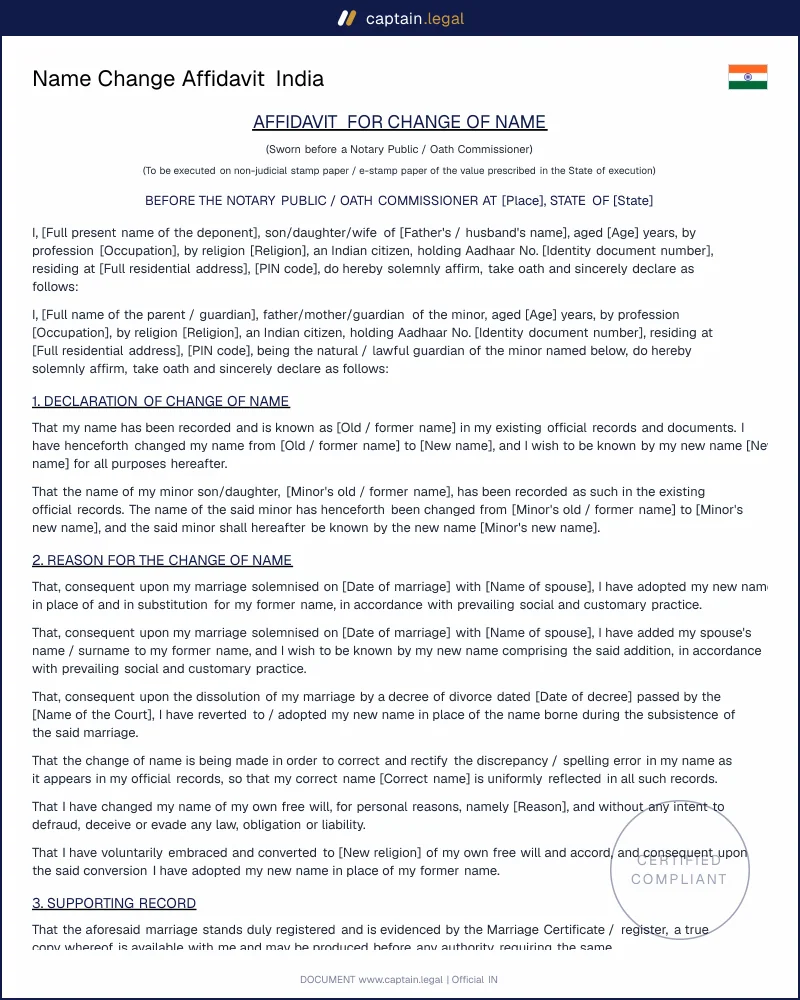
Name Change Affidavit India | Oaths Act 1969

Sworn name change affidavit valid under the Oaths Act 1969 and Section 85 Evidence Act. Notarised format accepted for gazette and record updates.
4.8/525 reviews50 000+ downloadsInstant download
Share

A name change affidavit is a sworn written statement in which you declare, under oath, that you have changed your name and that the old and new names refer to one and the same person. It is the foundation of the entire name-change process in India: the document that every bank, school board, passport office and the Gazette of India asks for before they will record your new identity. Whether the trigger is marriage, divorce, a spelling correction in a school certificate, or a purely personal decision, the affidavit comes first and everything else follows from it. Drafted correctly, sworn before the right officer and worded to the statutory standard, this single page is what gives your name change legal force across the country.

This page explains how a name change affidavit works under Indian law, the statutes that give it weight, the clauses our template builds in, and the mistakes that get affidavits rejected at the notary's desk or the Department of Publication.

Compliant

2026 Legislation

50,000+ clients

trust us

Affordable

From $4.90 / doc

Secure payment

Instant download

Name Change Affidavit India | Oaths Act 1969

Secure payment · No subscription

Fill in the template

What is a name change affidavit?

A name change affidavit is a category of affidavit, and an affidavit is a statement of fact made voluntarily and confirmed by the oath or affirmation of the person making it, the deponent, before an officer authorised to administer oaths. The name change affidavit narrows that general instrument to one purpose: recording that a named person, identified by parentage, age and address, has abandoned an existing name and adopted a new one for all future purposes. It is the legal bridge between your old documents and your new ones.

People often confuse the affidavit with the gazette notification, but they are different stages. The affidavit is the sworn declaration you create and notarise yourself; the gazette notification is the government's published acknowledgment of that declaration. You cannot reach the second without the first. The affidavit is also distinct from a deed poll, a British-style instrument that has no statutory footing in India. Here the affidavit, supported by newspaper publication and gazette entry, is the recognised route. One practical point worth fixing early: an affidavit proves your intention and declaration, not the change itself in the eyes of every authority. Some bodies, particularly for passports and PAN updates, will want the gazette copy as well, so treat the affidavit as the first link in a chain you will need to complete fully. Our name-change formats and supporting affidavits for Indian records are drafted with that whole chain in view.

2

When do you need this document?

The most frequent trigger is marriage. A spouse adopting a new surname, or hyphenating two names, uses the affidavit to declare the change before approaching the passport office, the bank and the employer. Divorce produces the mirror situation, where a person reverts to a maiden or former name and needs the same sworn declaration to unwind the married name from every record. Both are routine, and both still require the full affidavit, publication and gazette sequence rather than a simple letter.

Correction cases form the next large group. A misspelling carried for years across a school leaving certificate, an Aadhaar entry and a service record can be reconciled through an affidavit that records the correct name and expressly states the documents to be aligned. Parents also use it for minors, where the affidavit is sworn by the guardian, and our affidavit and declaration formats for official Indian use accommodate that variant. Personal-choice changes, including numerological adjustments and religious or cultural reasons, are equally valid as long as the motive is honest and not designed to defraud a creditor or escape a liability.

Two edge cases deserve attention. An Overseas Citizen of India or a foreign passport holder cannot simply use the domestic gazette route and must follow a separate procedure tied to citizenship. And anyone with a pending criminal case or an outstanding judgment should expect scrutiny, because a name change cannot be used to defeat process. If litigation is live, disclose the existing name in the affidavit rather than hiding it.

3

Key clauses included in our template

  • The deponent identification block opens the affidavit with your full existing name, age, father's or husband's name, occupation and complete residential address. This is not boilerplate. The Department of Publication and most institutions match these fields against your identity proof, and a mismatch between the affidavit and your Aadhaar or passport is one of the commonest grounds for rejection.
  • The declaration of change states the old name and the new name in unambiguous terms and confirms that both refer to one and the same person. Our template phrases this to the standard the gazette office expects, naming the new name exactly as it should appear on every future document, including initials and their expansions.
  • The reason for change records the honest ground, marriage, divorce, correction or personal choice, in a single clear sentence. Indian practice expects a stated reason, and a vague or evasive one invites questions.
  • The undertaking and indemnity clause is where the deponent confirms the statement is true to personal knowledge and undertakes to be bound by the new name in all dealings. This is the clause that engages Section 227 of the Bharatiya Nyaya Sanhita if anything stated is false.
  • The verification and attestation footer carries the place and date, the deponent's signature in the old name, space for the notary's seal, signature, designation and registration number, and where required the signatures of two witnesses. Our powers of attorney and personal declaration templates follow the same execution discipline so your whole personal-records file stays consistent.
4

Regional considerations

Although the Oaths Act, 1969 and the gazette route apply across India, execution detail varies by State and that variation trips people up. Stamp paper is the clearest example. Several States expect the affidavit to be executed on non-judicial stamp paper of a small denomination fixed by the State stamp schedule, while others accept plain paper with a notarial stamp affixed at attestation. The denomination is modest everywhere, but using the wrong format for your State can mean a fresh affidavit at the gazette counter.

Maharashtra and Delhi see the highest volume of gazette name changes, and both insist on the prescribed proforma being computer-typed rather than handwritten, with the soft copy supplied in editable form. Tamil Nadu, Karnataka and several southern States operate active State Gazettes alongside the Central Gazette, and you should match the gazette to where your records sit: a State-government employee usually needs the relevant State Gazette, while passport and central-service matters point to the Central Gazette published by the Government of India.

Newspaper publication rules also carry a regional flavour. The standard expectation is two advertisements, one in English and one in the regional language of your district, and the choice of the vernacular paper is dictated by your place of residence. Witness and notary availability differs too, with metro cities offering same-day notarisation while district towns may route you through a sub-registrar's office. When the change concerns property records or you intend to delegate the downstream updates, pair the affidavit with the right instrument from our real-estate and property documentation for India, since mutation entries follow their own State stamp rules.

5

How to fill out this name change affidavit

You begin by selecting the reason for your change, because the wording of the declaration shifts slightly between a marriage adoption, a divorce reversion, a correction and a personal choice. From there you enter your existing name exactly as it reads on your primary identity document, then your new name spelled precisely as you want it recorded everywhere afterwards. The form then asks for your age, parentage or spouse's name, occupation and full address, the fields the gazette office cross-checks against your proof.

Next you confirm the place and intended date of swearing, since the affidavit takes effect only once sworn before the notary. The template leaves the signature line in your old name, which is the correct convention, and reserves clearly marked space for the notary's seal and registration number and, where your State asks for them, two witnesses. Once you download the document in Word and PDF, you print it on the stamp paper your State requires, sign before the notary, and keep several attested originals. Those originals then feed the newspaper advertisements and the gazette application. If you cannot attend each downstream office yourself, our banking and representation power of attorney formats let a trusted person act for you on the record updates.

6

Common mistakes to avoid

The error that wastes the most time is a mismatch between the affidavit and the identity proof. People type a casual spelling, an abbreviated father's name or an old address, and the gazette office returns the file. Read every field against your Aadhaar and passport before you swear, because once notarised the affidavit cannot be quietly edited. A close second is swearing before someone who is not authorised: a stamp vendor's endorsement or a witness's signature is not attestation, and only a notary, magistrate or commissioner of oaths empowered under the Oaths Act, 1969 can administer the oath that gives the document weight.

Many applicants also stop at the affidavit and assume the change is complete. It is not. The affidavit declares your intention; the newspaper publication and the gazette entry complete it, and skipping either leaves you with a document several authorities will refuse. Treating the affidavit as a standalone fix for a passport or PAN update is the most expensive version of this mistake. Others draft the reason too loosely, leaving the gazette office guessing, or forget that a live criminal case or judgment must be disclosed rather than concealed. Finally, people throw away the extra attested originals after the first use, then have to swear afresh when the bank, the school board and the provident fund office each demand their own copy. Print more than you think you need, because every institution keeps one.

Key takeaways

PROCESS

Affidavit is the first legal step

The name change affidavit is the sworn declaration that links your old name to your new one, stating both refer to the same person (with parentage, age and address). Banks, school boards, passport offices and the Gazette of India typically ask for it before updating records. Treat it as step one: you cannot move to gazette publication without a properly executed affidavit.

LEGAL BASIS

Swear it before an authorised officer

Its legal weight comes from being made on oath or affirmation under the Oaths Act, 1969. Section 3 allows only authorised officers such as courts, magistrates and notaries to administer the oath; an affidavit sworn before an unauthorised person is void. A registered notary’s attestation (Notaries Act, 1952) is what makes the format acceptable for official submissions and later verification.

RISK

Affidavit alone may not update everything

Do not confuse the affidavit with a gazette notification: the affidavit is your sworn statement, while the gazette is the government’s published acknowledgement of it. The affidavit proves your intention and declaration, but some authorities may still insist on the gazette copy for updates like passport and PAN. Plan the full chain early to avoid rejections and repeated submissions.

Frequently Asked Questions

Yes. Once you sign it before a notary, magistrate or commissioner of oaths authorised under the Oaths Act, 1969, the affidavit becomes a sworn statement carrying full legal weight, and Section 85 of the Indian Evidence Act, 1872 (now the Bharatiya Sakshya Adhiniyam, 2023) gives the notarised document a presumption of regularity. What it binds you to is the truth of its contents: a false statement is perjury under Section 227 of the Bharatiya Nyaya Sanhita, 2023. The affidavit alone establishes your declaration, but for full public recognition of the new name you still complete newspaper publication and the gazette notification.

For a complete and universally accepted name change, yes. The affidavit is the first step; after notarisation you publish an advertisement in two newspapers, typically one in English and one in your regional language, and then apply to the Department of Publication for entry in the official Gazette of India. The notarised affidavit, the original newspaper clippings and the prescribed proforma form the standard package the gazette office processes. Some everyday updates may accept the affidavit on its own, but passport, PAN and central-service records almost always ask for the gazette copy too.

The affidavit itself can be drafted and notarised in a single day. The newspaper advertisements appear within a few days of booking. The gazette publication is the longest stage, commonly 45 to 60 working days from a complete application, and it can stretch to 75 to 90 working days during busy periods or when documents need correction. Preparing the affidavit accurately at the start, with names and addresses matched exactly to your identity proof, is the single most effective way to avoid the delays caused by a returned or queried file.

Yes. For a minor, meaning anyone under eighteen, the affidavit is sworn by the parent or legal guardian on the child's behalf, declaring the existing and new name and the reason. The same publication and gazette steps follow, with the guardian named as the applicant. Schools and examination boards are usually the first records to update, and they will want the notarised affidavit and, for board certificates, the gazette notification. Where both parents are living, having both consent and sign reduces the chance of a later objection.

You download the name change affidavit in both Word and PDF. The Word file lets you confirm or adjust any field before printing, which matters because several States require the gazette proforma to be computer-typed and supplied in editable form. The PDF gives you a clean, print-ready version. You then print on the stamp paper your State prescribes, sign before the notary, and retain several attested originals, since each institution that updates your name will keep its own copy.

It depends on your State and the stage. The affidavit's core requirement is the deponent's signature and the notary's attestation, and in many States that is sufficient for the affidavit itself. The gazette application, however, commonly asks for the prescribed proforma to carry the signatures of two witnesses alongside yours. Our template reserves clearly marked space for witnesses so you can satisfy whichever requirement applies. Check your State's gazette office or notary practice before swearing, because adding witnesses afterwards means re-executing the document.

No, and attempting it carries serious risk. The right to change your name is protected, but it cannot be exercised to defeat a creditor, dodge a liability or escape legal process. If you have a pending criminal case or an outstanding judgment, you must disclose your existing name in the affidavit rather than conceal it, and a change made with intent to deceive can itself attract prosecution under the Bharatiya Nyaya Sanhita, 2023. Authorities cross-check identity at the gazette stage precisely to catch this, so honesty in the stated reason protects you as much as it satisfies the law.

4.8/5

25 verified reviews · 50 000+ downloads

Name Change Affidavit India | Oaths Act 1969
  • Immediate access to the document
  • PDF + Word download
  • Compliant with 2026 legislation
  • Reviewed by lawyers
Fill in the template
Secure payment · No subscription
Updated on June 9, 2026

You might also like

Last Will and Testament India
Gift Deed Format India