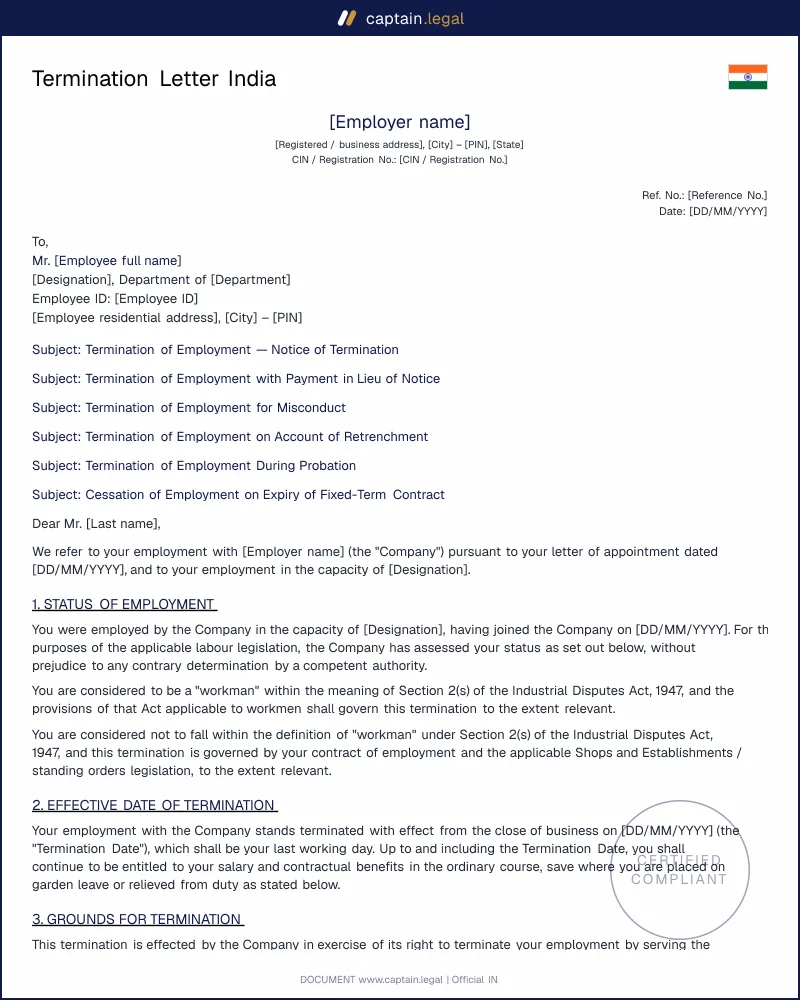
Because conditions of service for commercial establishments are set by State law, the minimum notice and the procedural detail of a termination letter shift from one State to the next, and a format that is sound in one city can be deficient in another.
Maharashtra. The Maharashtra Shops and Establishments (Regulation of Employment and Conditions of Service) Act, 2017 governs most Mumbai and Pune offices, and for employees who have completed a year of service it expects reasoned, documented termination. Employers here are well advised to keep the inquiry record for any for-cause exit, as Maharashtra's industrial adjudication is active and reads silence against the employer.
Karnataka. Under the Karnataka Shops and Commercial Establishments Act, 1961, an employee with six months of continuous service generally cannot be dismissed without a reasonable cause and at least one month's notice or pay in lieu, except for misconduct supported by inquiry. Bengaluru's technology employers frequently trip on the misconduct exception by skipping the inquiry, then losing the matter on procedure rather than merits.
Delhi. The Delhi Shops and Establishments Act, 1954 requires notice for employees with more than three months of service and treats abrupt dismissal without notice as actionable. A Delhi termination letter should always state the notice basis on its face.
Tamil Nadu and Telangana. Both States operate their own Shops and Establishments regimes with comparable notice expectations, and Telangana's rules for Hyderabad establishments mirror the central trend towards documented, reasoned exits. Across every State, where the employee is a workman the Industrial Relations Code, 2020 overrides the contract and imposes the retrenchment procedure regardless of the local Shops Act. When the exit also requires a separate release document, the employment and HR templates for India cover the relieving and experience letters that usually follow.