Create my document
Login

Choose country

FranceBelgiqueEspañaUnited StatesUnited KingdomMarocDeutschlandItaliaSchweiz
Contracts

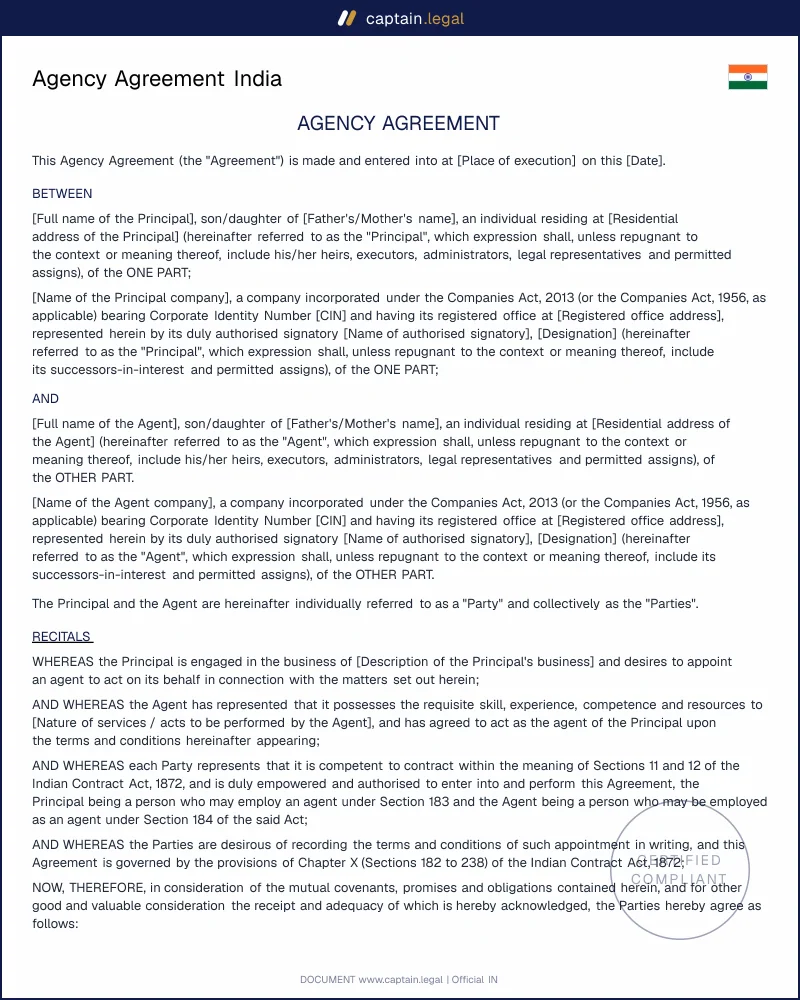
Agency Agreement under Indian Contract Act 1872

Agency agreement drafted to Chapter X (Sections 182-238) of the Indian Contract Act. Express authority, commission, Section 27 limits and valid e-signature.
4.8/531 reviews50 000+ downloadsInstant download
Share

An agency agreement is the contract by which a principal appoints an agent to act on its behalf in dealings with third parties, fixing the scope of authority, the commission, the duties owed both ways and the events that bring the relationship to an end. In India this is one of the oldest recognised commercial relationships, governed squarely by the Indian Contract Act, 1872, and used every day by manufacturers appointing distributors, exporters engaging buying agents, builders authorising sales representatives and companies nominating del credere agents. A well-drafted agency contract is what separates a clean commission claim from a courtroom argument over who actually had authority to bind whom.

This template is built to the language Indian courts expect, with express authority, a defined territory and an exit mechanism that survives a falling-out.

Compliant

2026 Legislation

50,000+ clients

trust us

Affordable

From $4.90 / doc

Secure payment

Instant download

Agency Agreement under Indian Contract Act 1872

Secure payment · No subscription

Fill in the template

What is an agency agreement?

An agency agreement records a contract of agency, defined in Section 182 of the Indian Contract Act, 1872: an agent is a person employed to do any act for another, or to represent another in dealings with third persons, and the person so represented is the principal. The defining feature is representation. The agent does not buy and sell on its own account; it creates a legal relationship directly between the principal and the third party. That single idea is what distinguishes an agent from an independent contractor or a buyer-reseller, and it is the most litigated point in Indian commercial disputes.

People routinely confuse an agency agreement with a distribution agreement, and the distinction carries real consequences. A distributor purchases goods and resells them at its own risk and margin, so the manufacturer has no privity with the end customer. An agent, by contrast, never takes title; it earns commission and binds the principal under Section 226, which provides that contracts entered into through an agent produce the same legal consequences as if the principal had contracted in person. If your document is silent on whether the relationship is agency or sale, an Indian court will look at substance over labels, and the wrong characterisation can shift tax liability, indemnity exposure and the right to sue third parties. Drafting the relationship correctly at the outset is therefore not a formality but the core of the instrument.

2

When do you need this agency agreement?

The most common trigger is appointing a sales or marketing agent to canvass orders in a defined territory, paid on commission rather than salary, where the principal wants the agent to solicit business but reserves the right to accept or reject each order. Manufacturers reaching new States lean on this structure constantly, because it spreads market coverage without the cost and labour law exposure of an employee. The second classic scenario is the commission agent in a mandi or trade hub, who buys or sells goods for the principal and accounts for the proceeds, a relationship as old as Indian commerce itself.

Export and import businesses appoint buying and selling agents abroad and at home, while real estate and infrastructure players use agency contracts to authorise representatives to negotiate and sign on the principal's behalf, almost always backed by a registered power of attorney for any dealing in immovable property. A subtler edge case is the del credere agent, who for an extra commission guarantees the solvency of the buyers it introduces, effectively underwriting the principal's credit risk; that arrangement must be drafted with care because the guarantee element invites scrutiny. The final recurring use is the appointment of a clearing and forwarding agent, where the scope of authority needs tight limits so the agent cannot bind the principal beyond logistics. Many of these appointments sit alongside formal business and incorporation paperwork such as partnership deeds and board resolutions.

3

Key clauses included in our template

  • The appointment and scope of authority clause names the parties, states whether the appointment is sole, exclusive or non-exclusive, and defines exactly what the agent may and may not do. This is where express authority under Section 186 is set down in writing, closing the gap that implied authority would otherwise leave open and protecting the principal from acts it never sanctioned.
  • The territory and product clause fixes the geographic area and the goods or services covered. Without it, an agent can claim commission on sales made anywhere, and Indian courts will not read in a limit the parties failed to write.
  • The commission and accounting clause sets the rate, the event that earns commission (order booked, goods dispatched or payment received), the payment cycle and the agent's duty to render accounts under Section 213. Ambiguity here is the single largest source of agency litigation in India.
  • The duties and standard of care clause binds the agent to follow the principal's directions and act with reasonable diligence per Sections 211 and 212, while the indemnity clause mirrors the principal's obligations under Sections 222 and 223 to cover the agent for lawful acts done in good faith.
  • The term and termination clause sets the duration, the notice period and the grounds for immediate termination, and addresses post-termination commission on orders already in the pipeline. A restrictive covenant barring the agent from competing after termination will usually be struck down under Section 27, so the template confines restraints to the contract term and to genuine trade-secret protection.
4

Regional considerations

Agency agreements are governed by a central statute, so the substance is uniform across India, but the cost and admissibility of the instrument turn on State stamp law, which makes location a practical concern rather than a substantive one.

Maharashtra charges stamp duty under the Maharashtra Stamp Act, 1958, and agreements executed in Mumbai or Pune are commonly adjudicated before execution to fix the duty on high-value agency arrangements, a prudent step given the volume of distribution and commission contracts in the State. Insufficient stamping is a frequent reason documents are returned during enforcement.

Delhi applies the Indian Stamp Act, 1899 as adapted for the NCT, and the practice of e-stamping through the designated authority is now standard, so an agency agreement signed in Delhi should carry the e-stamp certificate before signature to avoid an admissibility objection later.

Karnataka levies duty under the Karnataka Stamp Act, 1957, and Bengaluru's heavy concentration of technology and services principals means agency and channel-partner agreements there often combine commission terms with confidentiality covenants; the Section 27 limit on post-term restraints applies with full force, as the Niranjan Shankar Golikari line of Supreme Court authority confirms.

Tamil Nadu charges duty under its own stamp schedule, and exporters in Chennai routinely appoint overseas selling agents, which raises the additional question of governing law and the place of arbitration; a clear jurisdiction clause naming an Indian seat keeps the agreement enforceable at home. Where any agent is authorised to deal with property, a separate property power of attorney under the Transfer of Property Act and Registration Act is required alongside the agency contract.

5

How to fill out this agency agreement

You start by identifying the principal and the agent in full, with their legal status, whether individual, partnership firm or company, so the capacity requirements of Sections 183 and 184 are satisfied on the face of the document. From there the form asks you to define the scope of authority, prompting you to choose between a sole, exclusive or non-exclusive appointment, then to set the territory and the product or service line. The next stage captures the commercial heart of the deal: the commission rate, the precise event that earns it and the accounting cycle, with the template flagging the Section 213 duty to account.

You then set the term, the notice period and the termination grounds, and the form steers you away from an unenforceable post-termination non-compete by confining restraints to the contract period. Finally you choose the governing law, the dispute-resolution mechanism and the State of execution, which signals the applicable stamp duty so you can arrange e-stamping before signing. The output is ready as Word and PDF, so you can adapt any clause or sign as it stands. If the agent will also be on payroll for any part of the role, pair this with the appropriate employment contract or appointment letter under Indian labour law.

6

Common mistakes to avoid

The mistake practitioners see most often is treating an agency agreement and a distribution agreement as interchangeable. They are not, and copying a distributor's resale clause into an agency contract destroys the Section 226 representation that the principal needs to sue the third party directly. Almost as common is leaving the commission trigger vague: writing "commission on sales" without saying whether the sale is complete at order, dispatch or receipt of payment guarantees a dispute, because each party will read it in its own favour and an Indian court will not rewrite the bargain. A third recurring error is omitting the territory, which lets an agent claim on every sale the principal makes anywhere in the country.

Drafters also overreach on restraint clauses, inserting a sweeping post-termination non-compete that Section 27 renders void; the enforceable approach protects trade secrets and confines competition bars to the contract term, following the reasoning the Supreme Court applied in Niranjan Shankar Golikari. The last frequent failure is procedural rather than substantive: signing the agreement without stamping it to the correct State value. An under-stamped agency agreement is inadmissible in evidence until the deficient duty and penalty are paid, which can stall enforcement at the very moment you need the document to work.

Key takeaways

ROLE

Agency is representation, not resale

Under Section 182, an agent represents the principal in dealings with third parties; it does not trade on its own account. That distinction is where disputes start, especially when parties casually call a distributor an agent. If the document is vague, courts look at the substance over labels, which can shift who can sue the customer, who bears liabilities, and how commission is justified.

AUTHORITY

Define what the agent can bind

Authority is the spine of the agreement. Sections 186-188 allow express and implied authority and extend it to what is necessary to carry out the authorised act. Section 226 then makes contracts entered through the agent operate as if the principal signed in person. A tight scope (territory, acts permitted, limits) reduces the risk of unauthorised commitments becoming the principal’s problem.

EXIT

Termination and irrevocable agency risks

Agency can end by revocation or renunciation, completion of business, or by death or insolvency, as set out in Sections 201-210. The catch is Section 202: if the agent has an interest in the subject matter, the agency becomes irrevocable to the prejudice of that interest unless the contract clearly provides otherwise. Exit wording and notice mechanics avoid a messy break-up.

Frequently Asked Questions

Yes, provided the core conditions of a valid contract under Section 10 are met: free consent, parties competent to contract under Sections 183 and 184, lawful consideration and a lawful object. An agency relationship is recognised throughout Chapter X of the Indian Contract Act, 1872, and interestingly Section 185 confirms that no consideration is even required to create the agency itself. The template is drafted to capture express authority, defined commission and clear termination terms, which is exactly what an Indian court looks for. To be fully admissible in evidence and enforceable in litigation, the signed agreement must also be stamped to the value required by the stamp law of the State where it is executed.

Stamp duty is governed by the Indian Stamp Act, 1899 together with the stamp legislation of the State of execution, so the rate varies from one State to another. An agency or power-of-attorney style instrument attracts duty in most States, and you pay it on the State where the document is signed. The practical point that catches people out is admissibility: an unstamped or insufficiently stamped agreement cannot be relied on in court until the deficient duty and a penalty are paid. The cleanest approach in States with e-stamping, such as Delhi and Karnataka, is to obtain the e-stamp certificate before signature rather than scrambling to regularise the document during a dispute.

You can write one, but you should expect a post-termination non-compete to be unenforceable. Section 27 of the Indian Contract Act declares void any agreement that restrains a person from exercising a lawful trade, profession or business, and Indian courts apply this strictly, refusing to import the English reasonableness test. The Supreme Court in Niranjan Shankar Golikari allowed negative covenants only during the subsistence of the contract, not after it ends. The enforceable path is to confine any restraint to the contract term and to protect genuine confidential information and trade secrets, which courts have upheld as falling outside the Section 27 bar.

An agent represents the principal and never takes title to the goods; it earns commission and binds the principal directly to third parties under Section 226. A distributor buys the goods outright and resells them at its own risk and margin, so there is no privity between the manufacturer and the end customer. The distinction decides who can sue a defaulting third party, how the relationship is taxed and who carries credit risk. Courts in India look at the substance of the arrangement rather than the label on the document, so the clauses must consistently describe one relationship or the other.

Under Sections 201 to 210, an agency ends when the principal revokes the agent's authority, when the agent renounces the business, when the business of the agency is completed, or by the death, unsound mind or insolvency of either party. A revocation cannot take effect retrospectively to defeat acts already lawfully done. The important exception sits in Section 202: where the agent has its own interest in the property forming the subject matter, the agency is irrevocable to the extent of that interest unless the contract expressly says otherwise. A well-drafted termination clause therefore states the notice period and confirms how commission on pending transactions is settled on exit.

Yes. Electronic contracts and electronic signatures are recognised under the Information Technology Act, 2000, and an agency agreement is not among the excluded categories in its Schedule, which are limited to instruments such as wills and negotiable instruments. You can therefore execute the document with a valid digital or electronic signature and it will be as binding as a wet-ink version. The stamping requirement still applies, so you should pair electronic execution with proper e-stamping where the State offers it, keeping a single coherent record that satisfies both validity and admissibility.

The agent's duties are codified in the Contract Act and the template reflects them. Under Sections 211 and 212 the agent must conduct the business according to the principal's lawful directions and act with the skill and diligence reasonably expected in that trade. Section 213 requires the agent to render proper accounts on demand, which is why the accounting clause matters so much in practice. The agent must also communicate with the principal in difficulty and must not make any secret profit or let its own interest conflict with its duty. In return, the principal must indemnify the agent for lawful acts done in good faith under Sections 222 and 223.

It depends on what the agent will do. For ordinary commercial acts, soliciting orders, negotiating sales, accounting for proceeds, the agency agreement alone records the authority. The moment the agent is to deal with immovable property on the principal's behalf, sign a sale deed, present documents for registration or appear before authorities, a separate power of attorney is needed, and for property transactions it generally has to be registered. The two documents work together: the agency agreement sets the commercial relationship and commission, while the power of attorney grants the formal legal authority that third parties and registrars will demand. For property-related authority you can prepare a dedicated power of attorney and related personal and family documents under Indian law.

4.8/5

31 verified reviews · 50 000+ downloads

Agency Agreement under Indian Contract Act 1872
  • Immediate access to the document
  • PDF + Word download
  • Compliant with 2026 legislation
  • Reviewed by lawyers
Fill in the template
Secure payment · No subscription
Updated on June 8, 2026

You might also like

Service Agreement India
Consultancy Agreement India