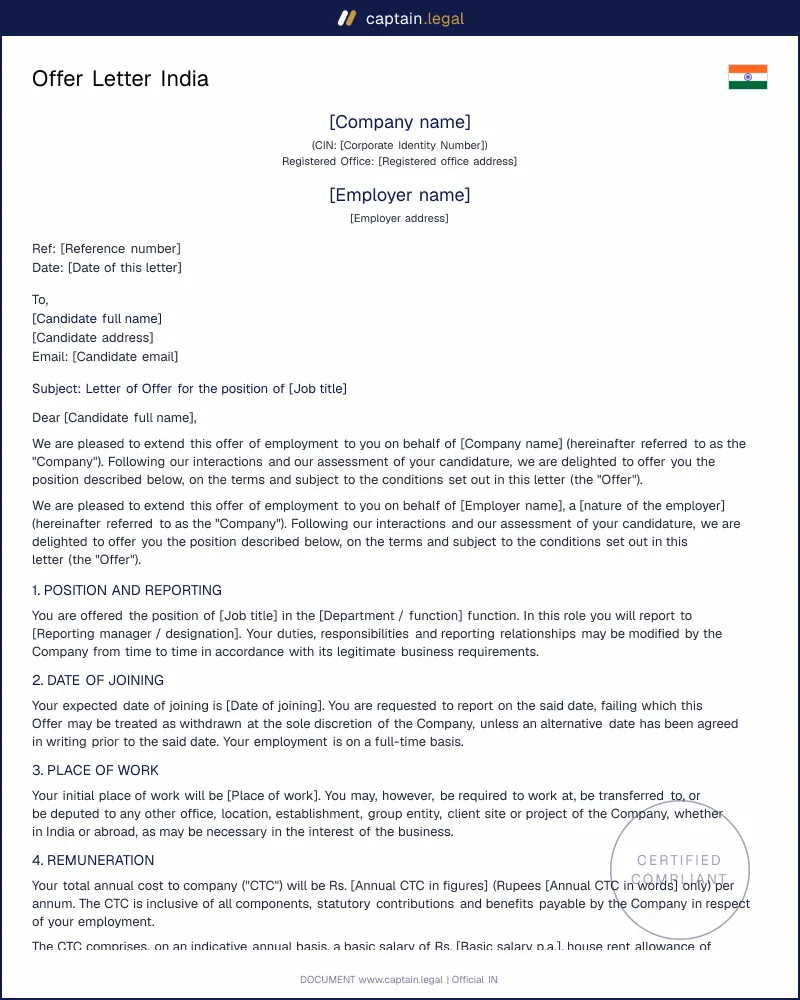
A well-drafted offer letter is the first formal commitment an Indian employer makes to a candidate, and it carries far more legal weight than most companies assume. An offer letter records the position, compensation and joining date before the appointment letter is issued, and it is frequently the document a candidate relies on to resign from an existing job. Under Indian law, once both sides sign, that piece of paper stops being a courtesy and becomes a binding pre-employment agreement enforceable under the Indian Contract Act, 1872. This template is built for sole proprietors, partnerships, LLPs and companies hiring anywhere in India, and it captures the salary structure, conditions and notice terms a court or labour inspector will later expect to see.
Issuing a clean offer protects both parties. The employer fixes the cost-to-company (CTC) breakdown, probation and confidentiality before day one; the candidate gets a written reference point that survives any later dispute about what was promised.
Compliant
2026 Legislation
50,000+ clients
trust us
Affordable
From $4.90 / doc
Secure payment
Instant download
Offer Letter India: Contract Act 1872 Compliant
Secure payment
What is an offer letter in India?
An offer letter is a formal written proposal from an employer to a selected candidate, setting out the role, the compensation and the date of joining, together with the conditions attached to the offer. In contract terms it is a proposal under Section 2(a) of the Indian Contract Act, 1872. The moment the candidate signs and returns it, that proposal is accepted under Section 2(b), lawful consideration exists, and a concluded contract comes into being. Many founders treat the offer letter as a non-binding formality. It is not. Indian courts have repeatedly read a signed offer as a binding promise, and the withdrawal of an accepted offer without legitimate cause has exposed employers to damages, especially where the candidate resigned elsewhere in reliance on it.
People routinely confuse the offer letter with the appointment letter, and the distinction matters in practice. The offer letter precedes joining and confirms that an offer has been made and accepted. The appointment letter is issued on or after the joining date and operates as the full contract of employment, with the complete set of service conditions. Most labour inspectors and courts ask for the appointment letter when a dispute arises, so the prudent employer issues both. For roles where you want a single document to do double duty, our Indian employment contract and appointment letter templates are drafted to fold the offer terms straight into the engagement.
Legal framework
India has no single statute that dictates the format of an offer letter, but several laws converge on it. The foundational text is the Indian Contract Act, 1872. An offer letter is a proposal under Section 2(a); acceptance under Section 2(b) creates an agreement, and once the requirements of Section 10 are met, lawful consideration, free consent, capacity and a lawful object, a valid contract exists. Breach by either side then attracts compensation under Section 73. This is why a signed offer is enforceable even before the first working day, and why an employer who walks back an accepted offer can be made to answer for the candidate's losses.
Layered on top of contract law is the new statutory architecture. India's four Labour Codes came into force on 21 November 2025, consolidating twenty-nine earlier laws. The most relevant for an offer letter is the Code on Wages, 2019, which imposes a uniform definition of wages and the so-called 50% rule: basic pay, dearness allowance and any retaining allowance must together make up at least half of total remuneration, and excluded allowances cannot exceed the other half. Where they do, the excess is added back to wages for provident fund and gratuity purposes. A CTC structure that pushes basic pay down to 30% to shrink PF liability no longer survives audit. The offer letter is the first document a labour inspector uses to verify the CTC breakdown, PF eligibility and the gratuity accrual date, so the salary table you draft here has statutory consequences.
State-level rules also bite. Conditions of service for most commercial establishments are governed by the relevant Shops and Establishments Act, which can cap probation periods and prescribe notice. Statutory deductions follow the Employees' Provident Funds and Miscellaneous Provisions Act, 1952 and the Employees' State Insurance Act, 1948 once headcount thresholds are crossed. For the precise wording of the consolidating wage law, the official Code on Wages 2019 text on the India Code portal is the authoritative reference. Drafting your offer against these texts is closer in spirit to our enforceable service agreement format for India than to a casual welcome email.
When do you need this document?
The standard trigger is a completed hiring decision. You have interviewed, selected a candidate and agreed the broad terms, and you now need to commit them to writing before the appointment letter. This is the moment an offer letter earns its place, because it lets the candidate resign elsewhere with a document in hand rather than a verbal promise. A second common scenario is a lateral hire from a competitor, where the candidate will serve notice at their current employer and wants written assurance of role, CTC and joining date before they burn that bridge. Here the conditions-precedent clause matters most, since the gap between acceptance and joining can run sixty to ninety days.
Campus and bulk recruitment is a third setting. Companies hiring graduating students issue offers months ahead of joining, and the offer letter governs that long interim, including any deferred joining or training stipend. A fourth situation is the regulated or sensitive role, where the offer is genuinely conditional on background verification, document submission or a regulatory clearance, and the letter must say so in terms.
Two edge cases are worth flagging. First, an offer made by email without a clear acceptance mechanism can still bind you if the candidate acts on it, so silence on how to accept is dangerous rather than safe. Second, an unfunded or speculative offer, made before the headcount is approved, is the single most litigated mistake, because the candidate who resigns and is then told the role evaporated has a clean claim for damages. If you also need to protect proprietary information before joining, pair the offer with our India non-disclosure agreement template.
Key clauses included in our template
- The identification of the parties and the role names the employer entity exactly as registered, the candidate, and the designation with reporting line. Vague titles like "executive" invite later disputes about grade and benefits, so the clause fixes the position, department and place of work with precision.
- The compensation and CTC structure sets out basic pay, dearness allowance, house rent allowance and other components in a transparent table. The clause is drafted to respect the Code on Wages, 2019 fifty-percent floor on wages, so your PF and gratuity exposure is correct from the first payslip rather than reconstructed during an audit.
- The joining date and conditions precedent records the expected date of joining and lists what must happen first, such as background verification, submission of relieving documents and any regulatory clearance. This is what converts a potentially arbitrary withdrawal into a contractually permitted one in narrow, defined situations.
- The probation and confirmation clause states the probation length, the standard being three to six months subject to the applicable Shops and Establishments Act, and the criteria for confirmation. It avoids the trap of an indefinite probation that some states will not enforce.
- The notice period and termination clause fixes the notice each side must serve, both during and after probation, keeping it consistent with state rules and the eventual appointment letter.
- The statutory deductions and benefits clause confirms that PF will be deducted at 12% of basic plus DA with a matching employer contribution, and that ESI applies to eligible employees, removing ambiguity about what is CTC and what is take-home.
Regional considerations
Because conditions of service sit largely with the states, the same offer letter behaves differently across India. In Maharashtra, the Maharashtra Shops and Establishments (Regulation of Employment and Conditions of Service) Act, 2017 governs most Mumbai and Pune commercial offices, sets registration duties on the employer and influences permissible probation and notice. An offer letter for a Mumbai role should align its notice clause with this Act rather than borrowing a generic template.
In Karnataka, the Karnataka Shops and Commercial Establishments Act, 1961 applies across Bengaluru's large IT and startup base, and the State has been an early mover on the Labour Codes' implementing rules. Offers for Bengaluru engineering roles routinely carry detailed confidentiality and intellectual-property language, but employers must remember that any post-employment non-compete is void under Section 27 of the Indian Contract Act, 1872, however the offer is worded.
In Delhi, the Delhi Shops and Establishments Act, 1954 sets the baseline, and proximity to central ministries means regulated-sector offers often hinge on a clearance as a condition precedent. Tamil Nadu offers, governed by the Tamil Nadu Shops and Establishments Act, 1947, frequently involve manufacturing and back-office roles where ESI coverage is engaged early because wage levels sit near the eligibility ceiling. Across all states, stamp duty is not a concern here: an offer letter attracts no stamp duty in any Indian state, unlike the property instruments covered in our Indian real estate and property document templates.
How to fill out this offer letter
You begin by entering the employer's registered name and the candidate's details, then selecting the designation, department and reporting manager so the role is unambiguous from the first line. From there, the form opens the compensation section, where you build the CTC by entering basic pay, allowances and statutory components; the structure is laid out so that basic plus dearness allowance stays at or above the fifty-percent threshold the Code on Wages, 2019 now requires. You then set the joining date and choose which conditions precedent apply, whether background verification, document submission or a regulatory clearance, which lets the letter permit withdrawal in those defined situations without exposing you to a damages claim.
After that, you fix the probation length and the notice periods for each side, and the form prompts you to confirm PF and ESI applicability based on your headcount and the candidate's wage level. You finish by reviewing the acceptance block, which tells the candidate how and by when to signify acceptance, then download the letter in Word and PDF. If your hiring volume is high, you can save the structure and reuse it, much as you would with the consolidated documents in our full India legal document catalogue.
Common mistakes to avoid
The costliest error is the speculative offer. An employer who issues a letter before the headcount is sanctioned, then withdraws it once the candidate has resigned elsewhere, hands that candidate a textbook claim for damages under Section 73. Closely related is the silent acceptance mechanism: a letter that never says how or by when to accept can still bind the employer if the candidate acts on it, so leaving acceptance vague creates risk rather than flexibility. A third frequent mistake is mis-structuring the CTC, typically by inflating allowances to suppress basic pay; under the Code on Wages, 2019 the excess is simply added back to wages, and the saving evaporates while the audit exposure grows.
The fourth recurring failure is the overbroad non-compete. Drafters routinely copy a clause that bars the new hire from joining any competitor after leaving, forgetting that Section 27 of the Indian Contract Act, 1872 renders post-employment restraints void. A reasonable confidentiality and non-solicitation clause stands; a blanket ban does not. Finally, many employers conflate the offer letter with the appointment letter and issue only one. Since inspectors and courts usually ask for the appointment letter in a dispute, the safer practice is to issue both, treating the offer as the pre-joining commitment and the appointment letter as the operative contract.
Frequently Asked Questions
35 verified reviews · 50 000+ downloads
- Immediate access to the document
- PDF + Word download
- Compliant with 2026 legislation
- Reviewed by lawyers
You might also like