Create my document
Login

Choose country

FranceBelgiqueEspañaUnited StatesUnited KingdomMarocDeutschlandItaliaSchweiz
Notices & Compliance

Legal Notice for Breach of Contract: Sections 73-74 ICA

Breach of contract notice format aligned with the Indian Contract Act 1872, CPC Section 80 and the Limitation Act 1963. Advocate-grade template, Word & PDF.
4.8/541 reviews50 000+ downloadsInstant download
Share

A breach of contract notice is the formal first strike in an Indian contractual dispute: a written communication that records the agreement, identifies the obligation that was not performed, and calls upon the defaulting party to perform or compensate within a fixed period. Businesses, professionals and individuals use it to recover unpaid invoices, force delayed deliveries, or place a counterparty on notice before filing a civil suit. Drafted properly, a legal notice for breach of contract often resolves the matter without a single court hearing. Drafted casually, it can weaken the very claim it was meant to protect. This template gives you the structure Indian advocates actually use, aligned with the Indian Contract Act, 1872 and ready to serve.

Compliant

2026 Legislation

50,000+ clients

trust us

Affordable

From $4.90 / doc

Secure payment

Instant download

Legal Notice for Breach of Contract: Sections 73-74 ICA

Secure payment · No subscription

Fill in the template

What is a breach of contract notice?

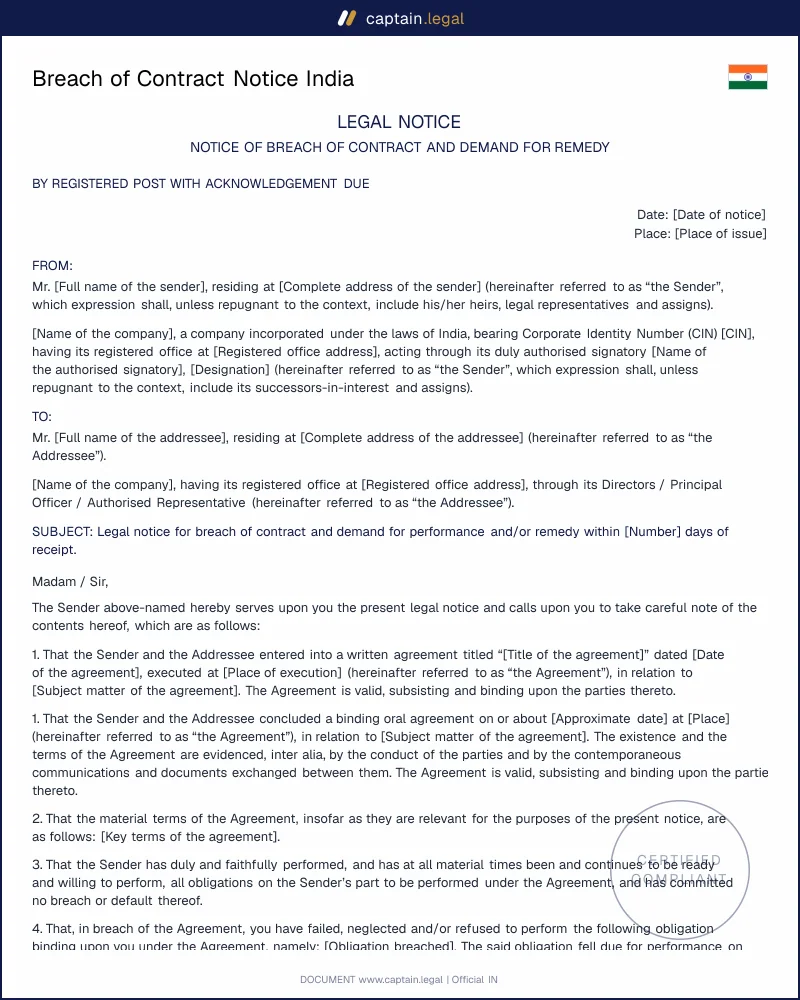
A breach of contract notice is a formal written demand sent by the aggrieved party to the party in default, setting out the contract, the specific obligation breached, the loss suffered, and a clear demand: perform the obligation, pay compensation, or both, within a stipulated cure period. In Indian practice it is usually styled a legal notice and served through an advocate, although nothing in law prevents a party from issuing it directly. What matters is the content, not the letterhead.

The notice is distinct from a simple payment reminder. A reminder requests; a breach notice asserts a legal right and announces consequences. It is also distinct from a notice of termination, which ends the contract rather than demanding its performance, and from a Section 138 cheque bounce notice, which follows the special regime of the Negotiable Instruments Act, 1881 with its own thirty-day deadline. A breach of contract notice sits upstream of all of these: it is the document that converts a commercial grievance into a recorded legal claim. Courts read it later as evidence of when the dispute crystallised, what was demanded, and whether the defaulting party was given a fair opportunity to cure. That evidentiary weight is why the drafting deserves the same care as a plaint.

2

When do you need this document?

The most frequent trigger is non-payment. A client has accepted deliverables under a service agreement compliant with Indian law and the invoice has aged past sixty or ninety days; a breach notice fixing a fifteen-day payment deadline is usually the step that produces the cheque. The second scenario is non-delivery or defective delivery of goods, where a supplier has missed the contractual date or shipped non-conforming stock. Here the notice should quote the delivery clause verbatim and quantify the substitute procurement cost, because that figure becomes the Section 73 claim.

Service deficiencies form the third cluster: a contractor abandoning a site, a vendor missing agreed service levels, a franchisee operating outside territory. A cure-or-comply demand gives the defaulter a defined window to remedy the lapse before termination. The fourth scenario is anticipatory breach, where the counterparty declares in advance that it will not perform; Section 39 allows you to treat the contract as repudiated, but a notice recording that election protects you from the argument that you abandoned the deal yourself.

Two edge cases deserve attention. If the defaulting party is a government department or public sector undertaking, skipping the Section 80 CPC notice is fatal to the suit, not merely an irregularity. And if the contract contains an arbitration clause, the breach notice often doubles as the Section 21 invocation under the Arbitration and Conciliation Act, 1996, so the wording must expressly invoke arbitration if that route is intended.

3

Key clauses included in our template

  • The identification of the parties and the contract reproduces the full names, addresses and capacities of both sides, along with the date and title of the agreement breached. Indian courts expect the notice to identify the contract with enough precision that the recipient cannot plead confusion; a vague reference to "our arrangement" invites exactly that defence.
  • The recital of the obligation breached quotes the specific clause and describes the default in factual terms with dates. This paragraph carries the evidentiary load: when the matter reaches trial, the judge compares the plaint against the notice, and inconsistencies between the two are cross-examination material.
  • The statement of loss and quantification sets out the amount claimed under Section 73 or the liquidated sum under Section 74, with the arithmetic shown. A bald figure without computation is the single most attacked element of poorly drafted notices.
  • The demand and cure period fixes a definite deadline, typically fifteen to thirty days, and states precisely what performance or payment will discharge the demand. Open-ended language like "at the earliest" has no legal bite.
  • The consequence clause announces the next step: civil suit, specific performance, arbitration invocation, or interest claims under the Interest Act, 1978. The same architecture appears across our commercial templates, including the sale and purchase of goods agreement under the Sale of Goods Act, 1930, so notice and contract speak the same language.
  • The reservation of rights preserves all other remedies and clarifies that nothing in the notice is a waiver, which protects you if the dispute later expands.
4

Serving the notice across India

Service is where strong claims die quietly. The safest mode remains Registered Post with Acknowledgement Due, because the postal receipt and the signed AD card create a presumption of service under Section 27 of the General Clauses Act, 1897. Speed post and reputed couriers with delivery tracking are accepted by most courts as supplementary proof, and email service is increasingly recognised, particularly where the contract designates an email address for notices. Best practice in Indian law firms is to serve by registered post and email simultaneously, then preserve the tracking record and the dispatch register entry.

Jurisdiction deserves a sentence in the notice itself. Under Section 20 CPC, a suit may be filed where the defendant resides or carries on business, or where the cause of action arose; if the contract contains an exclusive jurisdiction clause naming Mumbai, Delhi, Bengaluru or any other seat, the notice should be consistent with it. For commercial disputes of a specified value, the Commercial Courts Act, 2015 routes the matter to dedicated commercial divisions in the High Courts of Bombay, Delhi, Madras and Calcutta and to commercial courts at the district level elsewhere, and the Section 12A mediation requirement applies before institution. Parties in states with high pendency, Uttar Pradesh and Bihar in particular, should weigh the arbitration route at the notice stage itself, since the notice is the natural place to invoke an existing arbitration clause.

5

How to fill out this breach of contract notice

You start by entering the details of both parties and selecting whether the sender is an individual, a firm or a company, which adjusts the signature block and the description of capacity. The form then asks for the contract particulars: title, date, and the clause breached, with a free-text field where you describe the default in your own words. From there you quantify the claim, choosing between actual loss under Section 73 and a stipulated sum under Section 74, and the template inserts the matching statutory language. You then fix the cure period, fifteen days being the most common choice in commercial practice, and select the consequences to be announced: civil suit, specific performance, arbitration or interest. The final screen generates the notice in Word and PDF, ready for printing on plain paper or advocate letterhead. The whole process takes a few minutes, and the same guided flow powers every template in our catalogue of Indian legal documents, so the experience is identical whether you are drafting a notice today or an agreement tomorrow.

6

Common mistakes to avoid

The classic error is the emotional notice. Paragraphs of grievance, accusations of fraud, threats of criminal prosecution for what is a civil default: all of it reads badly in court and can even invite a counter-notice for defamation. The notice should read like a pleading, factual and cold. The second mistake is inconsistency with the contract: demanding interest the agreement never provided, or fixing a cure period shorter than the one the contract itself prescribes. Judges notice. The third is the missing computation; a demand for "Rs. 12,40,000 towards losses" without a breakdown gives the defaulter an easy reply and signals weak preparation.

Service errors form the second family. Sending the notice to a branch office instead of the registered office of a company, relying on WhatsApp alone, or failing to preserve the postal receipt all undermine the presumption of service you will need later. Timing matters too: the three-year limitation period under the Limitation Act keeps running while you negotiate, and parties who exchange notices for two and a half years often discover the suit is nearly time-barred. Finally, parties frequently serve a perfect notice and then act inconsistently with it, continuing to accept part performance without reservation. Conduct after the notice is evidence; if you accept delayed deliveries unconditionally, the breach claim erodes. Our library of legal notices and demand letters for Indian practice is structured to keep the demand, the deadline and the consequences aligned.

Key takeaways

Purpose

A legal notice turns a grievance into a claim

A breach of contract notice is not a polite reminder. It records the contract, pinpoints the exact obligation not performed, states the loss, and demands performance and/or compensation within a cure period. Courts later treat it as evidence of when the dispute crystallised and whether the defaulting party got a fair chance to comply, so casual drafting can weaken the case.

Contract Act

Anchor demands to Sections 37, 39, 73-74

Frame your demands around the Indian Contract Act, 1872: Section 37 (duty to perform), Section 39 (right to treat refusal as putting an end to the contract), and Sections 73-74 (compensation). Under Section 73, claim losses that arise naturally or were in both parties’ contemplation. If the contract names liquidated damages or a penalty, Section 74 limits recovery to reasonable compensation, not exceeding the stated sum.

Procedure

Check mandatory notice and limitation risks

Pre-suit notice is not always compulsory between private parties, but key regimes change the strategy. If you are suing the Government or a public officer, Section 80 CPC requires two months’ prior notice. For eligible commercial disputes, Section 12A of the Commercial Courts Act, 2015 pushes pre-institution mediation unless urgent interim relief is sought. Limitation remains unforgiving: a breach claim is ordinarily within three years, and a notice does not pause that clock.

Frequently Asked Questions

The notice itself does not bind the recipient to pay; it is a demand, not a decree. Its legal force is evidentiary and procedural. It records the date the dispute crystallised, proves the defaulter was given an opportunity to cure, and supports claims for interest from the date of demand. Where statute requires prior notice, as with suits against the Government under Section 80 CPC, the notice is a binding pre-condition and its absence can get the suit dismissed. A notice drafted on this template carries the same legal weight as one drafted in a law office, because validity depends on content, service and proof of dispatch, not on who typed it.

No statute requires it. Any party can issue a breach notice in their own name, and courts treat a party-issued notice exactly as they treat an advocate's notice. An advocate's letterhead adds psychological pressure and ensures the statutory references are correct, which is precisely what this template builds in: the Section 73 and Section 74 language, the cure period structure and the reservation of rights are already drafted. For high-value disputes or matters heading to arbitration, having an advocate review the completed notice before dispatch is a sensible middle path that costs far less than full drafting.

Fifteen days is the standard cure period in Indian commercial practice, and thirty days is common for complex performance obligations like construction or software delivery. Check the contract first: if it prescribes a notice or cure period, follow it exactly, because a shorter deadline than the contractual one can render your termination wrongful. For suits against the Government, Section 80 CPC fixes the waiting period at two months and you cannot shorten it. Whatever period you choose, state a precise number of days from receipt of the notice, not vague language like "immediately" or "at the earliest", which courts treat as fixing no deadline at all.

Silence after the cure period expires opens every remedy the notice announced. You may file a civil suit for damages under Section 73, seek specific performance under the Specific Relief Act, 1963, or invoke arbitration if the contract provides for it. For commercial disputes above the threshold value, you must first attempt pre-institution mediation under Section 12A of the Commercial Courts Act, 2015, unless you seek urgent interim relief. Tactically, an unanswered notice strengthens your case: the court sees a party who raised the claim, quantified it, offered a cure window and was met with silence. Many defendants who ignore the notice settle once the summons arrives.

Yes. Employment agreements are contracts under the Indian Contract Act, 1872, and a breach notice works for unpaid salary, withheld dues, violated notice-period clauses or breach of confidentiality undertakings by a former employee. The analysis changes where labour legislation applies, since workmen covered by the Industrial Relations Code have separate statutory remedies that often displace a civil suit. For employer-side defaults around exit and settlement, the documents in our Employment & HR templates for India cover the related paperwork, from termination letters to full and final settlement records that prevent these disputes from arising at all.

The completed notice is delivered instantly in both Word (.docx) and PDF. The Word version lets you adjust wording, add annexures or move the text onto an advocate's letterhead before dispatch; the PDF is print-ready for service by Registered Post AD. Both versions carry identical content, including the statutory citations and the cure period you selected. Keep the PDF unaltered as your record copy, since the version you dispatch should match the version you later exhibit in court, and store the postal receipt and AD card with it.

No, and this is the most expensive misconception in contract disputes. Under the Limitation Act, 1963, a suit for breach of contract must generally be filed within three years from the date of breach, and issuing a notice does not pause or extend that period. Only a written acknowledgement of liability by the defaulter under Section 18, or a part payment under Section 19, resets the clock. If negotiations drag on after your notice, diarise the limitation date and file before it passes; a strong claim served with a perfect notice is worthless once time-barred.

4.8/5

41 verified reviews · 50 000+ downloads

Legal Notice for Breach of Contract: Sections 73-74 ICA
  • Immediate access to the document
  • PDF + Word download
  • Compliant with 2026 legislation
  • Reviewed by lawyers
Fill in the template
Secure payment · No subscription
Updated on June 10, 2026

You might also like

GST Compliance Declaration Format India
Tenant Eviction Notice India