Create my document
Login

Choose country

FranceBelgiqueEspañaUnited StatesUnited KingdomMarocDeutschlandItaliaSchweiz
Real Estate

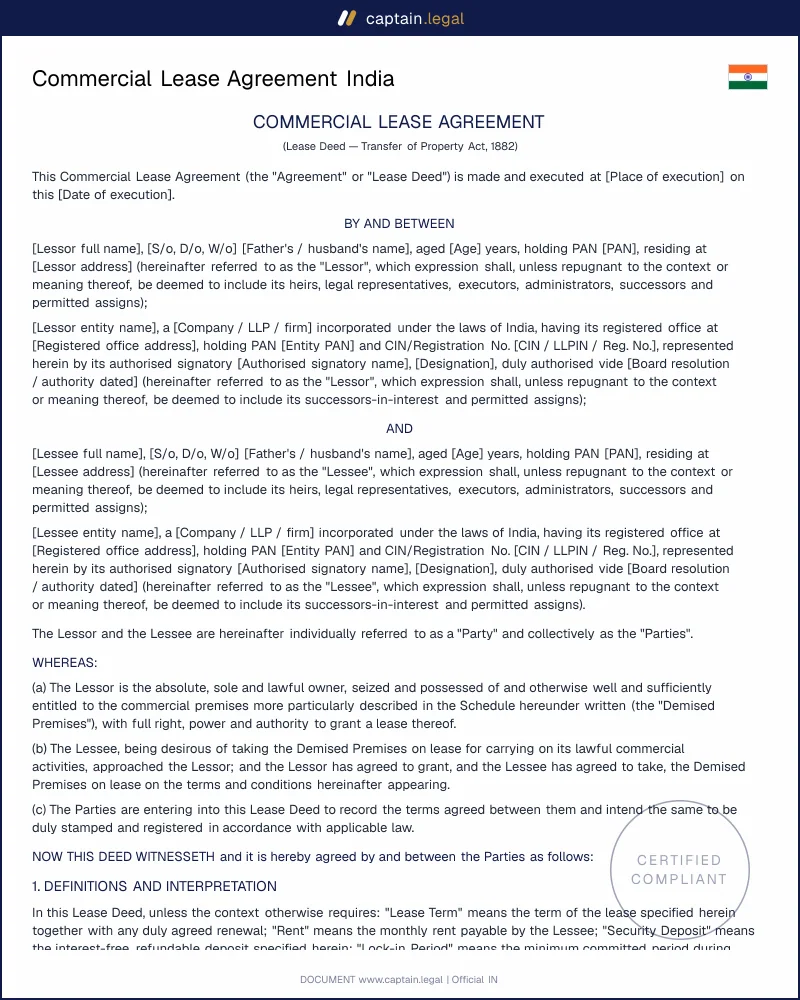
Commercial Lease Agreement India (TOPA 1882, MTA 2021)

Commercial lease drafted for the Transfer of Property Act 1882 and Model Tenancy Act 2021. Six-month deposit cap, registration under Section 17.
4.7/532 reviews50 000+ downloadsInstant download
Share

A commercial lease agreement is the contract that governs how a tenant occupies business premises in India, fixing the rent, the term, the lock-in period, the security deposit and the permitted use of the property. It is the document a landlord and a business tenant sign when a shop, office, warehouse or showroom changes hands on rent rather than on sale. Unlike a casual leave and licence arrangement, a commercial lease creates an interest in the property and, once its term crosses a year, brings registration and stamp duty squarely into play. This page explains the commercial lease agreement under Indian property law, the statutes that control it, the clauses that actually decide disputes, and the State-level traps that catch even experienced landlords.

A well-drafted lease is what separates a clean exit from years of litigation. Get the lock-in, the deposit and the renewal mechanics right at the start, and the relationship usually runs its course without a courtroom.

Compliant

2026 Legislation

50,000+ clients

trust us

Affordable

From $4.90 / doc

Secure payment

Instant download

Commercial Lease Agreement India (TOPA 1882, MTA 2021)

Secure payment · No subscription

Fill in the template

What is a commercial lease agreement?

A commercial lease agreement is a lease of immovable property let for business purposes, governed by the Transfer of Property Act, 1882. Section 105 of that Act defines a lease as a transfer of the right to enjoy property for a term, in consideration of rent or premium. The defining feature is that it creates an interest in the property for the tenant, who acquires exclusive possession for the agreed period. That is the legal line that separates a lease from a licence.

The distinction matters more in India than most landlords assume. A leave and licence grants only permission to use the premises, with possession staying legally with the owner, which is why it sits outside several rent-control and registration burdens. A lease transfers possession, so it attracts the full weight of the Transfer of Property Act and the Registration Act, 1908. Courts look at substance, not the label on the document : if a so-called licence gives the occupier exclusive possession and the right to exclude the owner, a judge will read it as a lease whatever the heading says. For commercial premises taken for several years, with a lock-in and a fit-out, a lease is usually the honest and safer characterisation. Our commercial lease agreement template for India is drafted on that footing, with the term, lock-in and permitted use written to hold up if the arrangement is ever tested as a lease rather than a licence.

2

When do you need this document?

The most common trigger is letting business premises for a fixed term, where a company takes an office, a retailer takes a showroom or a logistics operator takes a warehouse and both sides want the rent, escalation and exit terms locked down rather than left to oral understanding. Anything beyond a short stopgap belongs in writing, because once the arrangement runs past a year it must be registered to be provable.

A second scenario is the lock-in and fit-out situation, where the tenant pours money into interiors and the landlord wants assurance the premises will not be vacated in six months. Here the lock-in period and the security deposit do the heavy lifting, and a vague draft invites a fight over early exit. A third is the rent-escalation relationship, typically a three or five year term with a built-in annual or biennial increase, where the revision formula has to be unambiguous or it becomes the first thing litigated. Landlords letting to a chain or franchisee will also want a clean lease before the tenant signs its own downstream service agreement under the Indian Contract Act 1872 with suppliers operating from the site.

Two edge cases deserve a flag. Premises let to a tenant who intends to sublet or run multiple sub-brands need an express clause on assignment, since the Model Tenancy Act and most leases prohibit subletting without written consent. And where a landlord cannot attend registration in person, a property power of attorney is sometimes used, but a POA is a tool to manage or represent, never a substitute for a registered conveyance, a point the Supreme Court drove home in Suraj Lamp & Industries v. State of Haryana.

3

Key clauses included in our template

  • The parties and the demised premises are identified with precision : the full legal name of each party, the exact address, the carpet or built-up area, and a schedule describing the premises. A lease that misdescribes the property or names only a trade name rather than the legal entity is a recurring source of disputes when one side wants out.
  • The term and the lock-in period are drafted as two distinct things. The term is the full duration of the lease; the lock-in is the minimum period during which neither side may walk away without paying out the balance. Our draft states the lock-in in months, ties an early-exit penalty to it, and clarifies whether notice can even be served during lock-in.
  • The rent and revision clause fixes the monthly rent and the escalation, expressed as a clear percentage or formula on a stated frequency. Where the Model Tenancy Act applies, the clause respects the three months' written notice the landlord must give before any revision, so the increase is not later struck down as procedurally bad.
  • The security deposit clause records the amount, the interest position and the refund timeline. For non-residential premises under the Model Tenancy Act, 2021, the deposit is capped at six months' rent, and the draft pegs the figure to that ceiling in adopting States while leaving room for market practice elsewhere.
  • The permitted use clause confines the tenant to the agreed business activity, which protects the landlord against change of use that breaches zoning, society rules or the building's sanctioned plan. A bare "commercial use" is replaced with the specific activity intended.
  • The maintenance, repairs and termination clauses allocate structural repairs to the landlord and day-to-day upkeep to the tenant, set out notice periods, and spell out what happens on holding over after expiry, drawing on the Transfer of Property Act default rules where the parties are silent.
4

Regional considerations

Stamp duty and registration are where a single national template stops being enough, because both turn on State law. Maharashtra treats leave and licence and lease documents strictly : under Section 55 of the Maharashtra Rent Control Act, 1999 every tenancy agreement must be in writing and registered regardless of duration, and stamp duty on a leave and licence runs at 0.25 percent of the total rent for the period under Article 36A of the Bombay Stamp Act, 1958, with refundable deposits drawing duty on a notional ten percent interest. A Mumbai or Pune landlord who relies on the eleven-month no-registration habit is exposed the moment the document is read as a multi-year lease.

Karnataka follows the Registration Act threshold, so a commercial lease in Bengaluru exceeding one year must be registered, and stamp duty is calculated on the average annual rent and the lease term under the Karnataka Stamp Act, 1957. The market habit of long deposits, often running to ten months in Bengaluru, sits uneasily with the Model Tenancy Act six-month cap once Karnataka aligns its rules, so deposit figures should be documented carefully. Whatever a landlord in any city demands by way of deposit, the figure should be stated in the lease and tied to the statutory ceiling where the MTA applies.

Delhi charges stamp duty on commercial leases under Schedule 1-A of the Indian Stamp Act, 1899 as applicable to the NCT, with the rate rising for longer terms, and a multi-year commercial lease must be registered under Section 17. Tamil Nadu and Telangana likewise apply the one-year registration trigger with their own State stamp schedules, and Telangana's online registration regime makes an unregistered long lease conspicuous. Because the Model Tenancy Act, 2021 is a model law that each State adopts, amends or ignores, the practical first step before signing is to confirm whether the State has notified its own tenancy law, still runs an old Rent Control Act, or leaves the field to the Transfer of Property Act. Our real estate and rental agreements category for India groups the related drafts so the right one can be matched to the State in question.

5

How to fill out this commercial lease agreement

You start by selecting the role you are in, landlord or tenant, and entering the legal names and addresses of both parties exactly as they will appear on the registered deed. From there the form asks for the premises details, the carpet or built-up area and the permitted business use, then moves to the commercial terms : the monthly rent, the escalation percentage and frequency, the term and the all-important lock-in period. The draft adjusts the security deposit prompt to the six-month non-residential ceiling under the Model Tenancy Act where it applies, and flags the three-month rent-revision notice so the revision clause is procedurally sound.

Once the figures are in, the form generates a clean lease ready to be printed on the correct stamp value for your State and lodged for registration where the term exceeds one year. You decide the notice periods, the maintenance split and any sublet or assignment permission, and the document assembles those choices into a coherent deed. The output downloads as both Word and PDF, so you can adapt a clause, send it to the other side for review, or take it straight to the sub-registrar. If you also need to appoint someone to attend registration, our property power of attorney and related personal documents sit in a separate category for that purpose.

6

Common mistakes to avoid

The most expensive error is leaving a multi-year lease unregistered to save stamp duty. It feels economical until a dispute arises, and then Section 49 of the Registration Act renders the document inadmissible to prove its own terms, so the carefully drafted lock-in and escalation simply vanish as evidence. Almost as common is confusing a leave and licence with a lease : landlords copy a licence template for a five-year commercial tenancy with fit-out and exclusive possession, and a court later reads it as a lease anyway, leaving the document under-stamped and improperly registered. Treating the lock-in and the term as the same thing is a third recurring slip, producing a lease where neither side can tell whether early exit is even permitted or what it costs.

Landlords also routinely over-collect on the deposit. Demanding ten or twelve months' rent is still common in metros, but in States that have adopted the Model Tenancy Act, 2021 the non-residential cap is six months' rent, and an over-collection can be challenged before the Rent Authority. Finally, many drafts forget the permitted use clause or leave it as a vague "commercial purpose", which lets a tenant change the activity in a way that breaches the building's sanctioned plan or a co-operative society's bye-laws, and exposes the landlord to penalties that were entirely avoidable. A precise lease, correctly stamped and registered, closes every one of these gaps. The same discipline applies across other Indian instruments, which is why our contracts category for India keeps each template aligned to its governing statute.

Key takeaways

LEGAL NATURE

A lease creates property interest

A commercial lease is not just permission to occupy. Under Section 105 of the Transfer of Property Act, 1882, it transfers the right to enjoy the premises and usually gives the tenant exclusive possession for the term. Calling it a leave and licence will not save you if the substance shows a lease. Courts read the real bargain, not the heading.

REGISTRATION

Over one year means compulsory registration

If the lease is from year to year, exceeds one year, or reserves yearly rent, Section 107 of the Transfer of Property Act, 1882 requires a registered instrument. Section 17 of the Registration Act, 1908 makes registration compulsory in these cases. Miss it, and the document may not legally create the term you think you agreed to.

DISPUTE RISK

Unregistered lease can fail in court

The cost of skipping registration shows up when a dispute starts. Under Section 49 of the Registration Act, 1908, a lease that ought to be registered but is not can become inadmissible to prove the transaction and its terms. The Supreme Court in Anthony v. K.C. Ittoop and Sons confirmed that an unregistered instrument cannot bring a lease exceeding one year into existence.

Frequently Asked Questions

Yes, a properly executed commercial lease agreement is legally binding under the Transfer of Property Act, 1882. The catch is form. Section 107 of that Act requires a lease exceeding one year to be made by a registered instrument, and Section 17 of the Registration Act, 1908 makes registration compulsory for such leases. A lease that is signed, correctly stamped under your State's stamp law and registered with the sub-registrar is fully enforceable. One that should have been registered but was not can be held inadmissible to prove its terms, so registration is what turns a signed page into a binding, provable lease for any term above a year.

There is no fixed maximum under central law; commercial leases commonly run for three, five, nine or more years, often with a lock-in and renewal option. What changes with duration is the formality. A lease for a term up to one year can in principle be oral with delivery of possession, though writing is always wiser. The moment the term exceeds one year, Section 17 of the Registration Act makes registration compulsory, and stamp duty rises with the lease term under most State schedules. Longer leases simply attract more duty and stricter documentation, not a legal ceiling on the term itself.

Under the Model Tenancy Act, 2021, the security deposit for non-residential premises is capped at six months' rent, against two months for residential premises. That cap applies in States that have adopted or aligned with the Model Act. In metros like Mumbai and Bengaluru, market practice has historically pushed deposits to ten or twelve months, but in adopting States a tenant can challenge an excess before the Rent Authority. The safest course is to state the deposit clearly in the lease and keep it within the six-month ceiling wherever the Model Tenancy framework governs the premises.

A lock-in period is the minimum stretch during which neither party can terminate the lease without consequence, usually paying out the rent for the balance of that period. It protects the landlord, who has lost other tenants, and reflects the tenant's fit-out investment. The lock-in is distinct from the lease term : a five-year lease might carry a two-year lock-in, after which either side can exit on notice. Read the lock-in clause closely, because a poorly drafted one leaves both sides unsure whether notice can even be served during the locked period or what early exit actually costs.

If the term exceeds one year, yes. Section 17 of the Registration Act, 1908 makes registration compulsory for leases from year to year or for any term above one year. Some States go further : Section 55 of the Maharashtra Rent Control Act, 1999 requires every tenancy agreement to be registered regardless of duration. Registration must follow proper stamping, since Section 17 of the Indian Stamp Act, 1899 bars a public officer from accepting an instrument that is not duly stamped. An unregistered long lease can be inadmissible as evidence, so registration is not optional paperwork but the step that makes the lease provable.

Only as the lease allows, and within any applicable statutory notice. A well-drafted commercial lease fixes the escalation as a percentage and frequency, so the increase is automatic and contractual. Where the Model Tenancy Act, 2021 applies, a landlord must give three months' written notice before any revision, and if the tenant does not object after that notice the revision is treated as accepted. Without a revision clause and proper notice, a landlord generally cannot raise the rent mid-term, which is exactly why the escalation formula should be written in plain figures at the outset.

The commercial lease agreement downloads as both Word and PDF. The Word version lets you adjust a clause, insert a State-specific schedule or fine-tune the permitted-use wording before execution, while the PDF is ready to print on the correct stamp value and carry to the sub-registrar for registration. Having both formats means you can send the draft to the other side for review, incorporate their comments, and then finalise a clean copy for stamping and registration without rebuilding the document from scratch.

4.7/5

32 verified reviews · 50 000+ downloads

Commercial Lease Agreement India (TOPA 1882, MTA 2021)
  • Immediate access to the document
  • PDF + Word download
  • Compliant with 2026 legislation
  • Reviewed by lawyers
Fill in the template
Secure payment · No subscription
Updated on June 8, 2026

You might also like

Agreement to Sell Format India
Rent Agreement India