Create my document
Login

Choose country

FranceBelgiqueEspañaUnited StatesUnited KingdomMarocDeutschlandItaliaSchweiz
Business

Founders' Agreement India | Contract Act 1872

Founders' agreement aligned with the Indian Contract Act 1872 and Section 27 limits on non-competes. Vesting, leaver terms and IP assignment.
4.7/539 reviews50 000+ downloadsInstant download
Share

A founders' agreement is the contract that the founding team of an Indian startup signs at or before incorporation to fix equity, vesting, roles, intellectual property ownership and exit before money or outside pressure complicates the conversation. It is the single document that decides who owns what, who does what, and what happens when a co-founder walks away. Investors will ask for it during due diligence, and a clean founders' agreement signals that the cap table is sound. This page explains how a co-founders agreement works under Indian law, which clauses are non-negotiable, and how to draft one that holds up when a dispute arrives.

Most founder fallouts are not about the idea. They are about equity that was never written down, a co-founder who left in month three and kept a full stake, or source code that legally belongs to a freelancer nobody assigned. A founders' agreement closes those gaps while everyone still trusts each other. Negotiating it after a fight has started is far harder, because the goodwill needed to agree on fair terms is already gone.

Compliant

2026 Legislation

50,000+ clients

trust us

Affordable

From $4.90 / doc

Secure payment

Instant download

Founders' Agreement India | Contract Act 1872

Secure payment · No subscription

Fill in the template

What is a founders' agreement?

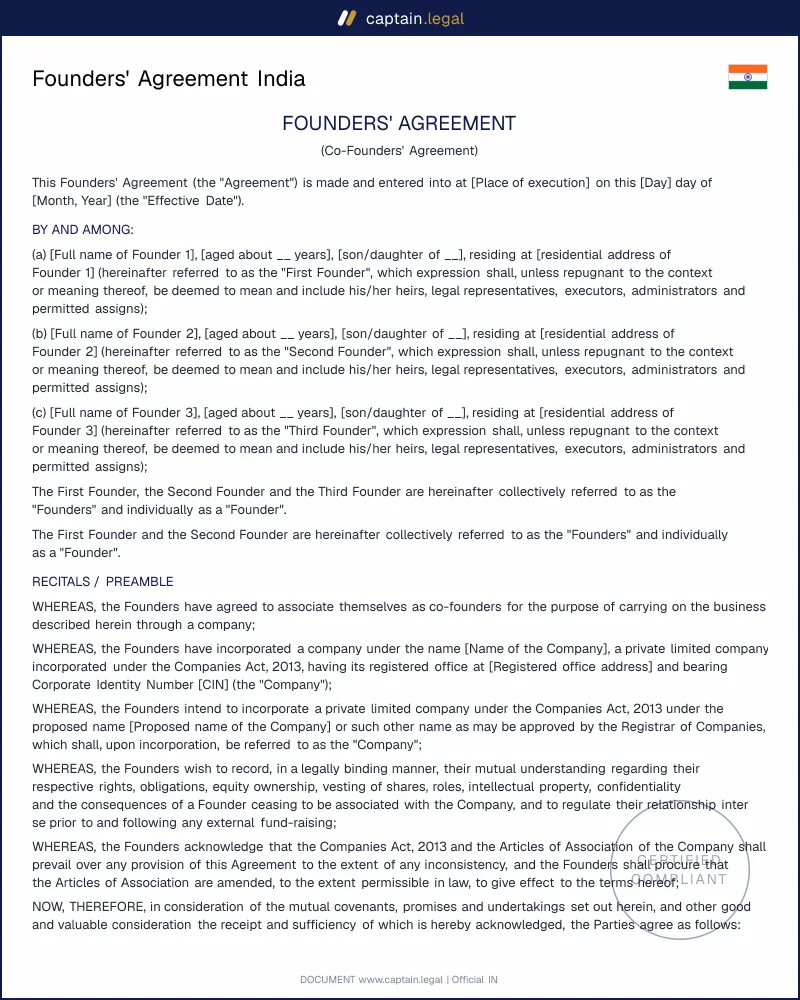
A founders' agreement, also called a co-founders agreement, is a private contract between the people starting a business together. It records each founder's equity share, the basis for that split, their roles and time commitment, the vesting schedule that governs how equity is earned, the assignment of intellectual property to the company, and the mechanics of what happens when a founder exits. In Indian startup practice it is usually signed at the idea stage or just before the company is incorporated under the Companies Act, 2013.

It is worth separating it cleanly from two neighbouring documents. A founders' agreement binds the founding team and is generally signed before any investor enters the picture. A shareholders' agreement comes later: it binds every shareholder, including funds that join in subsequent rounds, and governs ongoing rights such as reserved matters, board seats and transfer restrictions. The two must agree with each other, because contradictions between them surface painfully during a funding round. The third document is the Articles of Association, the company's binding constitution filed with the Registrar. Where a private founders' agreement conflicts with the Articles, the Articles prevail, which is why share-transfer and pre-emption terms eventually need to be mirrored into them. A useful companion at formation is a shareholders agreement for an Indian Private Limited company, which extends founder terms once outside capital arrives.

2

When do you need this document?

The obvious moment is two or more people deciding to build something together. Before a line of code is written or a rupee is contributed, the founders should fix who gets what and on what basis, because equity argued about later is equity argued about under pressure. The split usually weighs monetary investment, full-time commitment, existing intellectual property and industry network, and writing down the reasoning is as valuable as the percentages themselves.

A second trigger is the run-up to incorporation. Founders forming a Private Limited company or an LLP want the agreement signed first, so that vesting and IP assignment are already in place when shares are issued. Applying vesting retrospectively to shares already allotted needs each founder's fresh consent and is procedurally awkward, which is why signing early is the cleaner path. If the team is incorporating, the founder terms should feed straight into the incorporation and company governance documents in the business category.

A third scenario is bringing in an early advisor or a non-founding contributor who will receive equity. Their grant, vesting and IP assignment belong in a separate advisor agreement, but the founders' agreement should anticipate the dilution and name the reserved equity pool. The edge case that surprises people is the solo founder who plans to add a co-founder within months: signing a short agreement at day one, with the second founder's terms pre-agreed, prevents the classic dispute where the late joiner expects a fifty-fifty split the original founder never intended. A related edge case is the founder who contributes pre-existing IP, such as code written before the company existed, where the assignment clause must reach back to cover that prior work explicitly.

3

Key clauses included in our template

  • The equity split and its basis records each founder's ownership percentage and, just as importantly, the rationale: cash invested, time committed, IP brought in, and network. Stating the basis protects the split during investor due diligence and during any later dispute over fairness.
  • The vesting schedule is the spine of the agreement. The Indian market standard is a four-year schedule with a one-year cliff, meaning a founder who leaves before twelve months earns no equity at all, and the remainder vests monthly or quarterly thereafter. Unvested shares return to the company or the other founders.
  • The good leaver and bad leaver mechanics decide what a departing founder keeps. A good leaver who resigns on fair terms may retain vested shares or even receive accelerated vesting, while a bad leaver dismissed for cause may be required to forfeit unvested shares or sell at a discount. Defining what counts as "cause" with precision is what keeps these terms out of litigation.
  • The intellectual property assignment transfers to the company all IP created by the founders, including work done before incorporation. Without it, the company holds no title to its core asset, and this clause is recognised under India's IP statutes.
  • The confidentiality and restraint terms bind founders to protect trade secrets during and after their involvement. Drafted as confidentiality and reasonably scoped non-solicitation rather than a blanket non-compete, they survive Section 27 scrutiny.
  • The roles, decision-making and deadlock clause sets each founder's responsibilities, the matters needing unanimous consent, and a route out of a fifty-fifty stalemate, alongside an amendment clause requiring written consent of all founders.
4

Regional considerations

Founders' agreements are governed by central law, so the substantive rules are uniform across India, but two practical points vary by state and by sector. The first is stamp duty. Because the Indian Stamp Act, 1899 operates alongside state stamp legislation, the duty payable on a co-founders agreement differs depending on where it is executed. A team incorporating in Maharashtra will stamp under the Maharashtra Stamp Act, with values that differ from those a team in Karnataka or Delhi would pay, and executing on the correct value in the correct state is what keeps the document admissible in evidence. Founders frequently underpay here, then discover the gap only when they need to rely on the agreement in court.

The second is the choice of jurisdiction and seat for dispute resolution. A startup headquartered in Bengaluru will usually name the Karnataka courts or an arbitration seat in Bengaluru, while a Mumbai or Delhi NCR team will choose its own forum. This is not a formality: the named seat decides which High Court supervises any arbitration and how quickly interim relief can be obtained. For cross-border teams, where a founder is resident outside India, the FEMA, 1999 pricing and reporting rules attach to the equity, and the agreement should flag that the foreign founder's shareholding is subject to those conditions. When the agreement also needs to handle disclosure to outside parties, founders often pair it with a non-disclosure agreement enforceable under the Contract Act 1872.

5

How to fill out this founders' agreement

You begin by entering the founders and the company details, including whether the entity is already incorporated or still at the idea stage, because that choice changes how the equity and vesting clauses are framed. From there the form asks for each founder's equity percentage and the basis for it, then builds the vesting schedule around the standard four-year term with a one-year cliff, which you can adjust to your team's arrangement. The next stage captures roles and time commitment, the list of decisions that require unanimous founder consent, and the deadlock mechanism.

The intellectual property section prompts you to confirm that all founder-created work, including anything built before incorporation, is assigned to the company, and the confidentiality and restraint terms are drafted to stay within Section 27 limits rather than reaching for an unenforceable blanket non-compete. You then set the good leaver and bad leaver outcomes and the governing law and dispute-resolution seat. The output is ready as Word and PDF, so you can execute it on stamp paper of the value applicable in your state. If you are also preparing offer letters for early hires, the employment and appointment documents for India sit naturally alongside the founder paperwork.

6

Common mistakes to avoid

The mistake that destroys the most companies is omitting a vesting schedule altogether. A founder who leaves in month three with a full equity stake holds a dead weight on the cap table that no investor will accept, and recovering those shares without a vesting clause is close to impossible. Almost as damaging is the missing or weak IP assignment, which leaves the company without title to its own product; founders routinely assume that because they built it, the company owns it, when Indian law says the creator keeps ownership absent an express assignment. A third frequent error is drafting a sweeping post-exit non-compete that Section 27 renders void, then relying on it as if it were enforceable.

The quieter errors do their damage later. Founders sign a clean agreement, then never align it with the shareholders' agreement and Articles when funding arrives, creating contradictions that stall the round. Many execute the document without stamping it correctly, only to find it inadmissible when they finally need to enforce it. Others leave "cause" undefined in the leaver clauses, so a contested departure turns into a fight over what the word meant. Each of these is avoidable with terms drafted to current Indian practice. When founders later formalise board approvals, those decisions belong in the resolutions and governance records in the business templates, and the full library sits in the complete catalogue of Indian legal documents.

Key takeaways

Contract Act

It binds once a valid contract

A founders agreement has no special statute, but it is enforceable under the Indian Contract Act, 1872 if it has offer, acceptance, lawful consideration and free consent. It is a private contract, so it can bind the founders even though it is not filed with the Registrar of Companies. That is the legal backbone for vesting, leaver terms, confidentiality and IP assignment between the signatories.

Cap table

Lock equity and exits early

This is the document that fixes who owns what, who does what, and what happens if a co-founder exits. It avoids the common startup blow-up where someone leaves in month three but still holds a full stake because the split was never recorded. Signing at the idea stage or just before incorporation keeps the conversation fair, before money and deadlines harden positions.

IP ownership

Assign all creator IP to company

Without an express assignment, the person who created the code, design or content may still own it, especially where work was done by an independent creator or freelancer. The founders agreement should transfer founder-created intellectual property to the company, aligning with Indian IP laws such as the Copyright Act, 1957, the Patents Act, 1970 and the Trade Marks Act, 1999. Otherwise, the company may not legally own its own product during due diligence.

Frequently Asked Questions

Yes. A founders' agreement is a valid contract under the Indian Contract Act, 1872, the moment it has offer, acceptance, lawful consideration and free consent, and it is enforceable between the signatories like any other contract even though it is never filed with the Registrar of Companies. Most core provisions, including the vesting schedule, IP assignment, confidentiality and the good leaver and bad leaver mechanics, are enforceable as contractual rights between the founders. The main exception is a post-exit non-compete, which Section 27 generally voids. Note also that where a clause conflicts with the company's Articles of Association, the Articles prevail, so transfer terms should be mirrored into them.

Sign it at the idea stage or just before incorporation, while everyone still agrees and nobody has a reason to dispute the terms. Signing early fixes equity, roles, vesting and IP ownership before money, code or outside pressure complicate the conversation. It matters especially that the document is in place before shares are issued, because applying a vesting schedule retrospectively to shares already allotted requires each founder's fresh consent and is procedurally difficult. Negotiating after a dispute has started is far harder, since the goodwill needed to settle on fair terms has usually evaporated by then.

It must be stamped, but it does not need to be registered with any government body. Under the Indian Stamp Act, 1899, the agreement should be executed on stamp paper of the value that applies in the state where it is signed, and because stamp duty is a state subject the amount varies across India. An unstamped or under-stamped agreement is not admissible as evidence in court until the deficient duty and any penalty are paid. Registration is optional and rarely done for a founders' agreement, but correct stamping is what lets you actually rely on the document if a dispute reaches a courtroom.

Vesting is the schedule over which a founder earns their equity rather than receiving it all at once. The Indian market standard is a four-year schedule with a one-year cliff: a founder who leaves before completing twelve months earns nothing, which protects the rest of the team from a quick departure, and the balance then vests in monthly or quarterly instalments. Some agreements add acceleration, where unvested equity vests early on a defined event such as a sale of the company. Unvested shares belonging to a departing founder return to the company or the remaining founders under the leaver terms.

Only in narrow form. Section 27 of the Indian Contract Act, 1872, voids agreements in restraint of trade, so a clause barring a founder from working in the industry after they leave is generally unenforceable. The Supreme Court in Niranjan Shankar Golikari v. Century Spinning and Manufacturing Co. Ltd. drew the distinction clearly: a restraint operating while the founder is still engaged with the company can be valid if reasonable, whereas a post-exit restraint generally cannot. Confidentiality obligations and a tightly scoped non-solicitation clause stand on much firmer ground and are the better tools for protecting the business.

The completed founders' agreement is available as both Word and PDF. The Word version lets you make final edits, add founder-specific terms or adjust the vesting numbers to your team's arrangement before execution, while the PDF is the clean copy you print on stamp paper and sign. Having both means you can adapt the document to your situation and still produce a tidy executed version, then keep the signed PDF with your founder records and your cap table from the point of incorporation onward.

That depends on the leaver terms and on how much has vested. Vested shares are generally retained, while unvested shares return to the company or the other founders. The agreement then distinguishes a good leaver, who departs on fair terms and may keep vested equity or even receive accelerated vesting, from a bad leaver dismissed for cause or in breach, who may be required to forfeit unvested shares or sell them back at a discount. The decisive detail is the definition of "cause", which should be written precisely, because a vague leaver clause turns an already tense departure into a second dispute about what the words meant.

4.7/5

39 verified reviews · 50 000+ downloads

Founders' Agreement India | Contract Act 1872
  • Immediate access to the document
  • PDF + Word download
  • Compliant with 2026 legislation
  • Reviewed by lawyers
Fill in the template
Secure payment · No subscription
Updated on June 8, 2026

You might also like

Shareholders Agreement India
Share Purchase Agreement India