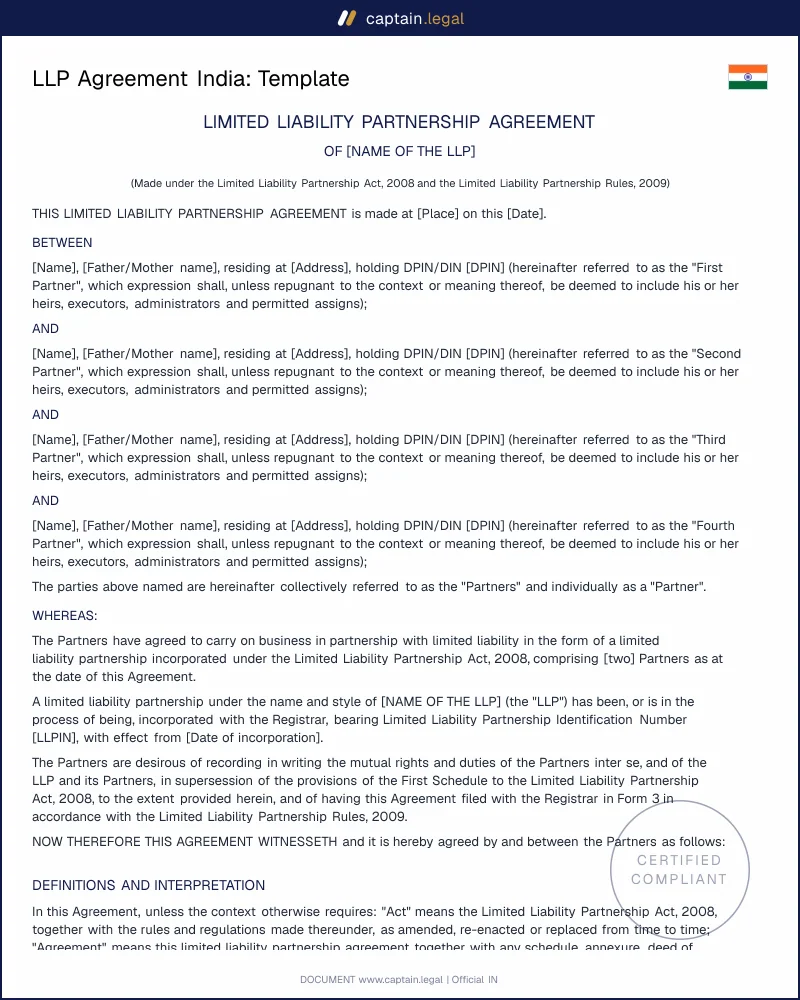
The governing statute is the Limited Liability Partnership Act, 2008, read with the LLP Rules, 2009. The central provision is Section 23, which makes the agreement the document that governs the mutual rights and duties of the partners and of the LLP towards them. Section 23(2) requires that the agreement, and any later change to it, be filed with the Registrar in the prescribed form. That form is e-Form 3, and under Rule 21 of the LLP Rules, 2009 it must be filed within thirty days of incorporation, with a copy of the executed agreement attached. The same thirty-day window applies again every time the partners amend the agreement, counted from the date the change is ratified by all partners.
Two consequences flow from this that founders underestimate. First, if you never file an agreement, the LLP does not fall into a vacuum: the default rules in the First Schedule automatically apply. Those defaults share profits equally among partners regardless of capital, give every partner an equal say in management and deny any partner a salary. For a firm where one partner put in most of the money and another runs the operations day to day, that result is rarely what anyone intended. Second, the agreement carries no legal weight as a registered instrument until it is properly stamped and filed; an unstamped agreement is poor evidence in court.
Execution has its own formalities. The agreement must be printed on non-judicial stamp paper of the correct value, signed by all partners and notarised. The stamp duty is not a token amount and it varies by state, a point we return to below. The authority for all of this, including the form of the agreement and the registration mechanism, is set out in the Act itself, available in full on the Ministry of Corporate Affairs official portal for LLP law. The thirty-day deadline is strict and there is no exemption based on the size of the LLP, its turnover or its number of partners.