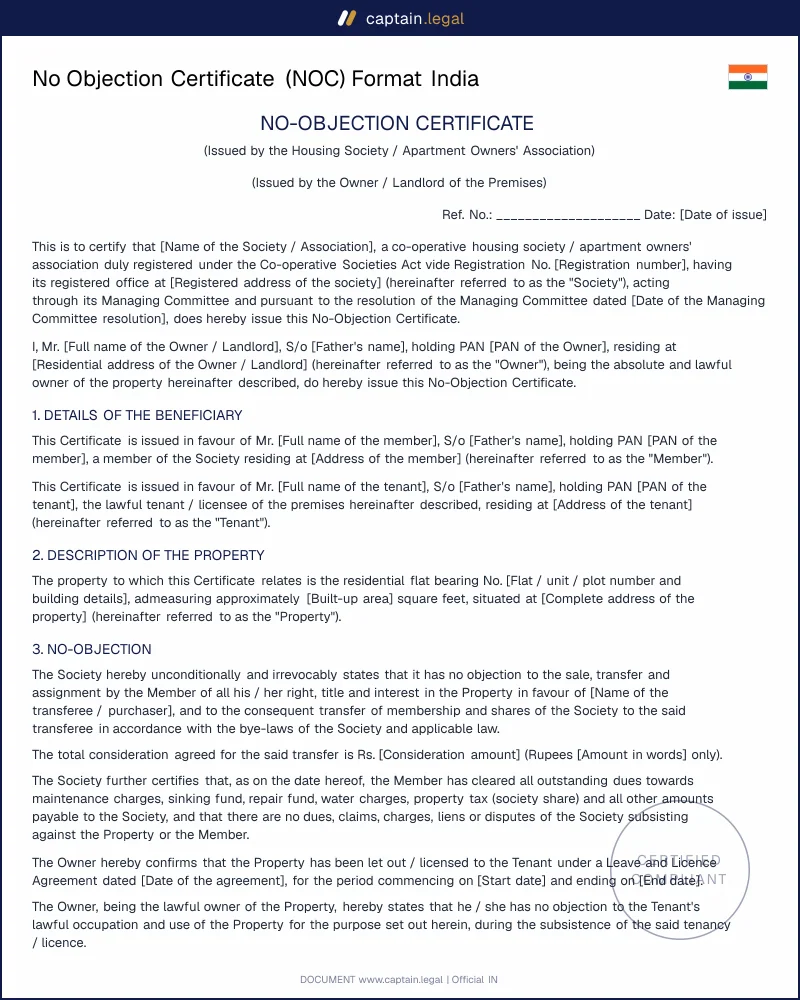
Maharashtra runs the most formalised cooperative regime in the country. Under the Maharashtra Co-operative Societies Act, 1960 and the Model Bye-laws, a member must give the society at least eight days' written intimation before sub-letting, and the transfer NOC must reference the committee resolution and the cleared-dues position. Sub-registrars in Mumbai and Pune routinely scrutinise the office-bearer's authority, so a NOC signed without the resolution number is frequently impounded at the counter.
Delhi leans heavily on tenant police verification. The Delhi Police treat the landlord's NOC and the tenant verification form as a package, and several housing societies and RWAs in the NCR will not issue a residence or sub-letting NOC until verification is complete. For commercial use, the Delhi Master Plan conversion rules mean a landlord's NOC for a registered office may need to align with the permitted mixed-use status of the colony.
Karnataka societies governed by the Karnataka Co-operative Societies Act, 1959 follow a similar dues-clearance and committee-consent route, and Bengaluru's strong corporate-tenant base makes the landlord's registered-office NOC one of the most requested formats in the State. Apartment associations registered under the Karnataka Apartment Ownership Act, 1972 issue the equivalent certificate through the managing committee rather than a cooperative society.
Tamil Nadu and Telangana broadly mirror this pattern through their own cooperative statutes, with the practical difference that stamp and registration practice at the local sub-registrar drives how much detail the NOC must carry. Across every State the rule holds: the certificate must match the issuing body's bye-laws and name the correct signatory, or it fails on submission.