Create my document
Login

Choose country

FranceBelgiqueEspañaUnited StatesUnited KingdomMarocDeutschlandItaliaSchweiz
Notices & Compliance

Cheque Bounce Notice: Get the 30-Day Deadline Right

A cheque bounced? Serve a Section 138 notice within 30 days, demand the exact amount, give the drawer 15 days to pay. Court-ready format in PDF and Word.
4.9/518 reviews50 000+ downloadsInstant download
Share

A cheque bounce notice under Section 138 of the Negotiable Instruments Act, 1881 is the single most important step a payee takes after a cheque is dishonoured, because no complaint can ever reach a Magistrate's Court without it. This is the formal written demand you serve on the drawer, recording the dishonoured instrument and calling for payment of the exact cheque amount within fifteen days. Get the legally enforceable debt wording, the cheque particulars and the statutory deadline right, and you have built the foundation of a strong cheque bounce case. Get any of them wrong, and the best lawyer in the country cannot save the prosecution. This template is drafted to the exact statutory language so that nothing is left to chance.

The notice is deceptively simple to look at and unforgiving in practice. Courts in India dismiss hundreds of Section 138 complaints every year not because the debt was disputed, but because the notice was served a day late, named the wrong party, or asked for a rounded-off figure instead of the precise sum on the cheque.

Compliant

2026 Legislation

50,000+ clients

trust us

Affordable

From $4.90 / doc

Secure payment

Instant download

Cheque Bounce Notice: Get the 30-Day Deadline Right

Secure payment · No subscription

Fill in the template

What is a cheque bounce notice under Section 138?

A cheque bounce notice is a written legal demand sent by the payee, or the holder in due course, to the drawer of a cheque that the bank has returned unpaid. It is the mandatory statutory intimation that converts a private grievance into a prosecutable offence under Section 138 of the Negotiable Instruments Act, 1881. The notice does one job and must do it cleanly: inform the drawer that a specified cheque was dishonoured and demand payment of that exact amount within fifteen days of receipt.

People often confuse this document with an ordinary demand letter or a general legal notice, and the difference matters. A demand letter for an unpaid invoice rests on contract and can be worded loosely. A Section 138 notice is a creature of statute, and its contents are dictated by the Act and a long line of Supreme Court rulings. It must identify the cheque by number, date, amount, the drawee bank and the reason for return shown on the bank memo. It must assert that the cheque was issued towards a legally enforceable debt or liability, because a cheque given as a gift, a loan with no consideration, or for a time-barred debt falls outside Section 138 altogether. The drawer's failure to pay within the fifteen-day window, not the bounce itself, is what completes the offence and starts your clock for filing the complaint. If you also need to record the underlying loan that the cheque was meant to repay, our promissory note format under Section 4 of the NI Act pairs naturally with this notice as documentary proof of the debt.

2

When do you need this document?

The textbook trigger is a cheque returned for insufficient funds, the most litigated ground under the Act and the one judges see daily. The bank stamps a return memo, hands it back with the cheque, and your thirty-day window opens the moment that memo reaches you. The second common situation is a cheque returned because the amount exceeds the arrangement with the bank, which the section treats on the same footing as a shortage of funds. A third, often overlooked, is a cheque dishonoured for a signature mismatch or a stopped payment where there were no genuine funds behind it; the Supreme Court in Lakshmi Dyechem held that such technical returns still attract Section 138 when the dishonour effectively defeats payment.

Business owners reach for this notice when a client's post-dated cheque towards an invoice bounces, when an EMI cheque on a loan is dishonoured, or when a security cheque is presented after a default and comes back unpaid. One edge case worth flagging is the time-barred debt: if the underlying liability is older than three years and was not legally enforceable on the date of the cheque, the notice and any complaint that follows will collapse, because Section 138 only protects a legally enforceable debt or liability. Another is the closed-account cheque, which courts have squarely brought within the section. If your dispute is really about an unpaid commercial invoice rather than a bounced cheque, a tailored service agreement under the Indian Contract Act 1872 and a straightforward recovery demand may be the better route before any cheque is even deposited.

3

Key clauses included in our template

  • The identification of the parties names the payee and the drawer in full, with complete addresses, because a notice sent to a stale or wrong address invites the drawer to plead non-service. Where a company drew the cheque, the template arraigns the company and names the directors in charge, in line with Section 141 and the Aneeta Hada rule.
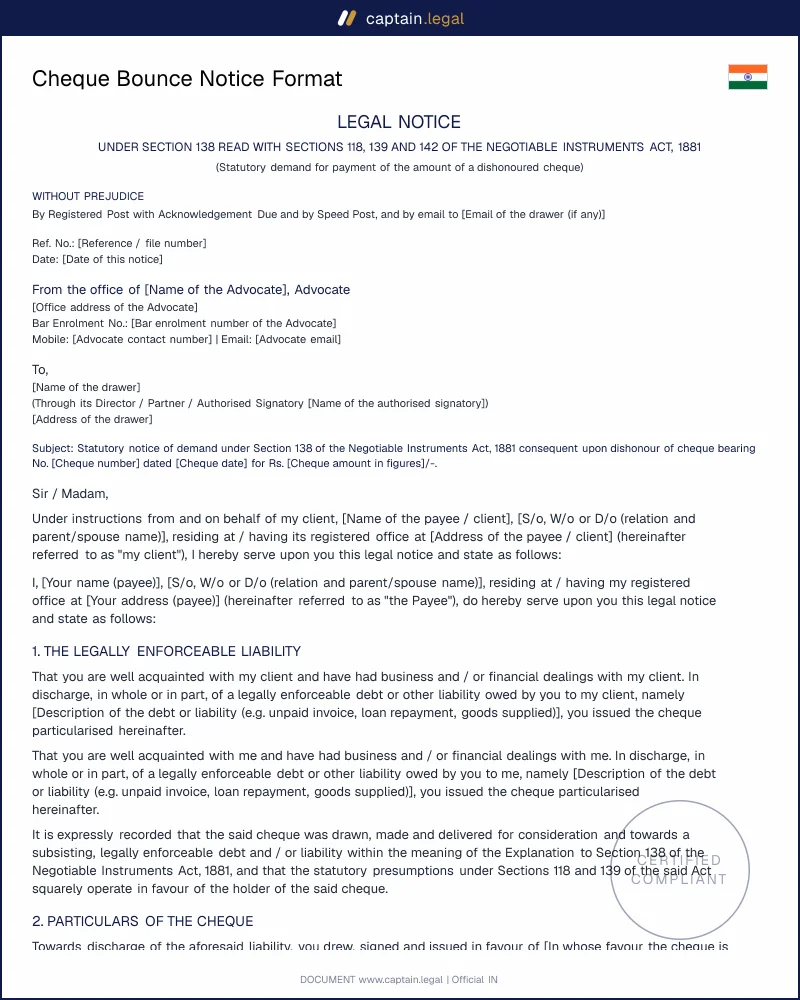
  • The cheque particulars set out the cheque number, its date, the exact amount in figures and words, the name of the drawee bank and branch, and the date of presentation. This precision is not cosmetic; a notice that misstates the amount by even a rupee has been held defective, and the demand must be for the precise sum the cheque carried.
  • The statement of the legally enforceable debt recites the transaction that gave rise to the cheque, the loan, the invoice, the supply of goods, so that the Section 139 presumption operates in your favour. Vague phrasing like "money owed" is replaced with the specific liability and its date.
  • The dishonour details reproduce the reason printed on the bank return memo and the date you received it, fixing the start of your thirty-day notice window beyond argument.
  • The demand and the fifteen-day deadline form the operative heart of the notice, calling on the drawer to pay the cheque amount within fifteen days of receipt, with a clear warning that failure will lead to prosecution under Section 138 and a civil claim for recovery.
  • The mode of service clause records that the notice is sent by registered post with acknowledgement due, the safest route, since the Supreme Court treats a refused or unclaimed registered notice as duly served.
4

Regional considerations

Section 138 is a central enactment, so the offence and its timelines are identical from Kashmir to Kanyakumari, but the practical experience of pursuing a cheque bounce case varies by state and city. Maharashtra, and Mumbai in particular, runs some of the busiest cheque bounce dockets in the country, and the Bombay High Court has issued detailed directions on summary trial procedure that move matters faster than in many other states. A complainant in Mumbai should expect strict adherence to the statutory limitation and should serve the notice through registered post that can be tracked, because metropolitan magistrates rarely entertain pleas of late service.

Delhi channels a large share of its Section 138 matters through dedicated metropolitan magistrate courts and has actively promoted Lok Adalat settlement and compounding under Section 147, which lets the parties close the case at almost any stage on payment. A drawer in Delhi who pays during the proceedings can often have the matter compounded, so the notice should leave that door open while preserving the threat of prosecution.

Karnataka, with Bengaluru's heavy commercial cheque traffic, sees frequent disputes over post-dated and security cheques issued in financing and startup transactions, where the legally enforceable debt question is fought hard. Drafting the debt recital carefully matters more here than almost anywhere else. Tamil Nadu and Gujarat courts have leaned into the summary trial and interim compensation powers under Section 143A, under which a court may direct the drawer to deposit up to twenty percent of the cheque amount while the case runs. Wherever the cheque was drawn, the cause of action for filing generally lies where your bank that returned the cheque is located, a jurisdictional point settled by the 2015 amendment that you should confirm before filing. If your matter touches a company's internal authority to issue or honour cheques, the board resolution pack under Section 179 of the Companies Act 2013 is the document directors use to record that authority.

5

How to fill out this cheque bounce notice

You begin by entering the payee's details and the drawer's full name and address exactly as they appear on the cheque and in your records, since the notice must reach the right person at the right place. From there the template asks for the cheque particulars, and you copy the cheque number, date, amount and drawee bank straight from the instrument and the return memo, taking care that the figure matches to the rupee. You then describe the underlying transaction in the debt recital, naming the loan, invoice or supply that the cheque was meant to discharge, so the statutory presumption works for you.

The next field captures the dishonour, where you enter the reason printed on the bank memo and the date you received it, which the document uses to anchor your thirty-day deadline. The demand paragraph then assembles automatically, calling for payment within fifteen days and flagging the consequences of default. Once you have reviewed the draft, you download it as a ready PDF or an editable Word file, print it on your or your advocate's letterhead, sign it, and dispatch it by registered post with acknowledgement due while keeping the postal receipt. For a company complainant, you may want the signatory's authority recorded first, and our appointment and authority documents for Indian businesses help establish who may act on the company's behalf.

6

Common mistakes to avoid

The error that sinks the most cases is missing the thirty-day deadline to send the notice after the return memo, or the matching failure to wait out the full fifteen days before filing the complaint. Both are jurisdictional, and a Magistrate has no discretion to condone them; a premature complaint is as fatal as a late notice. Closely behind is the misdescription of the cheque amount, where the demand asks for a rounded figure, includes interest the cheque never carried, or misstates the sum, any of which lets the drawer argue the notice was not a proper Section 138 demand. Sending the notice to a wrong or outdated address is the next trap, and although a refused registered notice is treated as served, a notice sent to an address you cannot prove the drawer occupied gives the defence a real opening.

Complainants also stumble on the legally enforceable debt requirement, attempting to recover a time-barred loan or a debt the law does not enforce, which takes the entire transaction outside the section. Where a company issued the cheque, leaving the company out of the array of accused and naming only a director has wrecked otherwise sound prosecutions, because the company must be arraigned as a principal accused. Finally, never use casual email or a WhatsApp message as your only notice; while such messages are valuable evidence of admission, the safe and court-tested mode of service remains registered post with acknowledgement due, supported by the postal receipt and tracking.

Key takeaways

DEADLINES

Miss the timeline, lose the case

A Section 138 notice is not optional; it is the gateway to prosecution. You must send the written demand notice within 30 days from receiving the bank return memo, and the drawer gets 15 days from receipt to pay. Only after those 15 days lapse does the offence crystallise, and then Section 142 gives you one month to file the complaint.

NOTICE CONTENT

Demand the exact cheque amount

The notice must mirror the cheque and bank memo. Mention cheque number, date, amount, drawee bank, and the return reason as shown in the memo. Ask for the precise sum on the cheque, not a rounded figure, and ensure the correct legal person is addressed. Courts regularly dismiss matters where the amount, party name, or particulars are wrong.

LEGAL BASIS

Link the cheque to a lawful debt

Section 138 works only where the cheque was issued towards a legally enforceable debt or liability. Your notice should clearly state that the cheque was issued against such liability, which aligns with the Indian Contract Act, 1872 concept of enforceable agreements supported by consideration. Cheques given as gifts, without consideration, or for time-barred dues can fall outside Section 138.

Frequently Asked Questions

Yes. The template is drafted to the requirements of Section 138 of the Negotiable Instruments Act, 1881 and the settled position taken by Indian courts on the contents and service of the demand notice. It contains the mandatory elements a Magistrate looks for: the cheque particulars, the assertion of a legally enforceable debt, the reproduction of the bank's dishonour reason, and a clear demand for payment of the exact amount within fifteen days. A notice that carries these elements and is served by a provable mode forms the lawful foundation of a complaint. What gives it force in court is not the paper itself but compliance with the statutory deadlines and accurate particulars, both of which the template is built to capture.

You have thirty days from the date you receive the bank's cheque return memo to dispatch the demand notice to the drawer. This window is strict and runs from receipt of the memo, not from the date the cheque was deposited or the date printed on the memo. Missing it is fatal, because the cause of action under Section 138 depends on a notice served within this period. Once the notice reaches the drawer, the drawer has fifteen days to pay. If payment does not arrive in that fifteen-day window, the offence is complete, and you then have one month to file your complaint before the Magistrate. Keep the postal receipt and tracking record, as these prove the date of service.

The notice must demand the exact amount written on the dishonoured cheque, stated in both figures and words, with no rounding and no added interest baked into the demand figure. It must also recite the underlying legally enforceable debt or liability the cheque was issued to discharge, naming the loan, invoice or transaction and its date. This recital matters because Section 139 presumes the cheque was issued towards a debt, and a clear statement strengthens that presumption. A demand for the wrong sum, or one that fails to identify a lawful debt, can render the entire notice defective and defeat a complaint that would otherwise have succeeded.

You can send copies by email or WhatsApp as a supplement, and such messages are often excellent evidence that the drawer received and acknowledged the demand. The safe primary mode of service, however, is registered post with acknowledgement due, sent to the drawer's correct address. Indian courts have consistently held that a registered notice refused or returned unclaimed is treated as duly served, which closes off the common defence of non-receipt. Relying on email or messaging alone exposes you to a dispute over whether proper service occurred, so use registered post as the backbone and keep the receipt and tracking details with your file.

The notice is available as a ready-to-use PDF and as an editable Word document, so you can print and sign it immediately or adjust the wording with your advocate before dispatch. The Word version is useful when the underlying transaction has unusual features that need a tailored debt recital, while the PDF suits a clean, final notice ready for registered post. Either way, you should print the final notice on letterhead, sign it, and send it by registered post with acknowledgement due, retaining the postal receipt as proof of the date of service.

If the drawer fails to pay the cheque amount within fifteen days of receiving the notice, the offence under Section 138 is complete, and the cause of action arises on the sixteenth day. From that date you have one month to file a criminal complaint before the appropriate Magistrate under Section 142. The court can order punishment of up to two years' imprisonment, a fine of up to twice the cheque amount, or both, and under Section 143A it may direct the drawer to deposit interim compensation while the case proceeds. You may also pursue a separate civil suit to recover the sum, since the criminal remedy does not bar a money recovery action.

Yes. Where a cheque is drawn on a company's account, Section 141 makes the company itself liable along with every person who was in charge of and responsible for the conduct of its business at the relevant time, typically the directors who signed or authorised the cheque. The Supreme Court has held that the company must be arraigned as a principal accused; naming only a director while leaving out the company can be fatal to the prosecution. To establish who held signing authority, companies often rely on a formal board resolution recording the delegation, which keeps the liability question clean if the cheque later bounces.

4.9/5

18 verified reviews · 50 000+ downloads

Cheque Bounce Notice: Get the 30-Day Deadline Right
  • Immediate access to the document
  • PDF + Word download
  • Compliant with 2026 legislation
  • Reviewed by lawyers
Fill in the template
Secure payment · No subscription
Updated on June 9, 2026

You might also like

Demand Notice for Money Recovery India
Unpaid Salary Legal Notice India