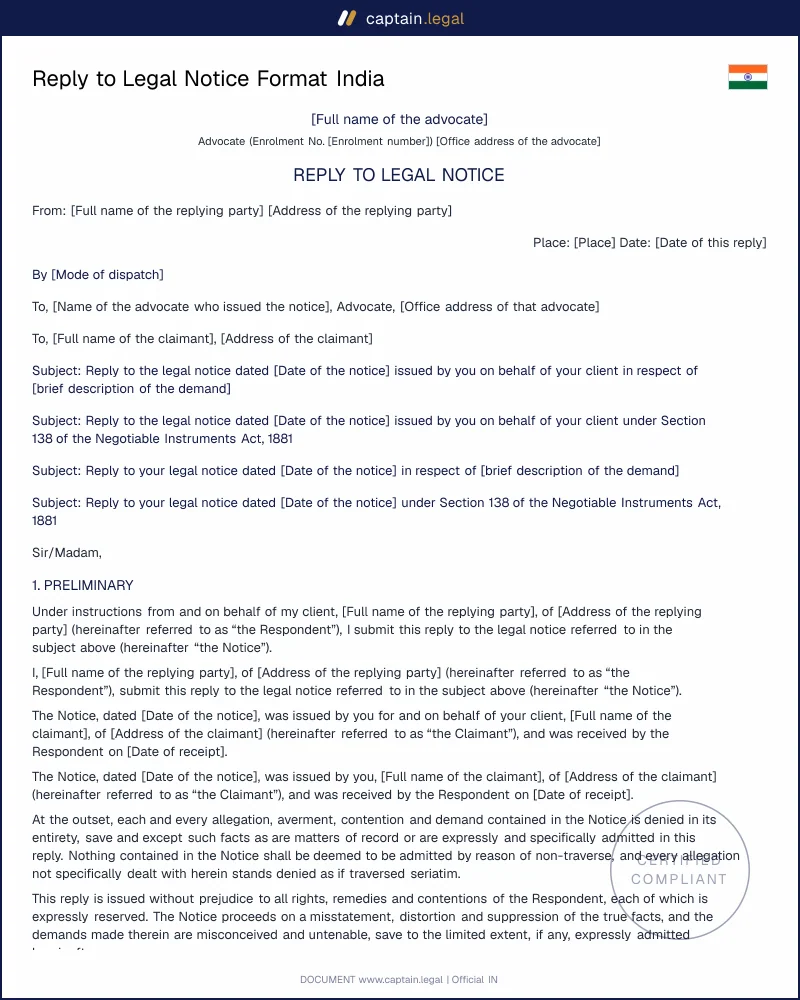
Maharashtra sees the heaviest volume of commercial notice exchanges, and replies destined for Mumbai litigation should anticipate the Commercial Courts Act, 2015 threshold and the Bombay High Court's strict reading of pre-institution mediation under Section 12A. Cheque bounce replies carry particular weight here because Mumbai magistrate courts handle an outsized share of Section 138 complaints, and a reasoned reply raising a stop-payment or security-cheque defence is frequently the document that persuades a complainant to settle at the pre-summons stage. Replies in tenancy matters should track the Maharashtra Rent Control Act, 1999 rather than general transfer-of-property language.
Delhi practice is shaped by the Delhi High Court's commercial division and by the capital's concentration of recovery litigation. Advocates here expect a reply within 15 to 30 days as a matter of professional courtesy even where no statute fixes a deadline, and an unexplained delay is used against the recipient in interim proceedings. Consumer disputes are significant in volume; a reply contesting pecuniary jurisdiction under the Consumer Protection Act, 2019 should compute the consideration paid, not the value of the goods, following the Supreme Court's reading of the Act.
Karnataka disputes increasingly arise from technology and services contracts governed by arbitration clauses. A reply sent from Bengaluru should state at the outset whether the recipient invokes the arbitration agreement, because answering on the merits without that reservation invites an argument of waiver under the Arbitration and Conciliation Act, 1996. The Karnataka High Court has also pressed parties towards mediation under the Mediation Act, 2023, and a reply that proposes it signals good faith without conceding liability.
Tamil Nadu retains a strong culture of advocate-issued notices in property and family matters. Replies in Chennai property disputes should engage with documentation registered under the Registration Act, 1908, since unregistered instruments are routinely challenged at the threshold. Tamil Nadu has also notified rules under the Model Tenancy Act framework for new tenancies, so tenancy replies should confirm which regime governs the agreement in question before addressing arrears or eviction.