Create my document
Login

Choose country

FranceBelgiqueEspañaUnited StatesUnited KingdomMarocDeutschlandItaliaSchweiz
Contracts

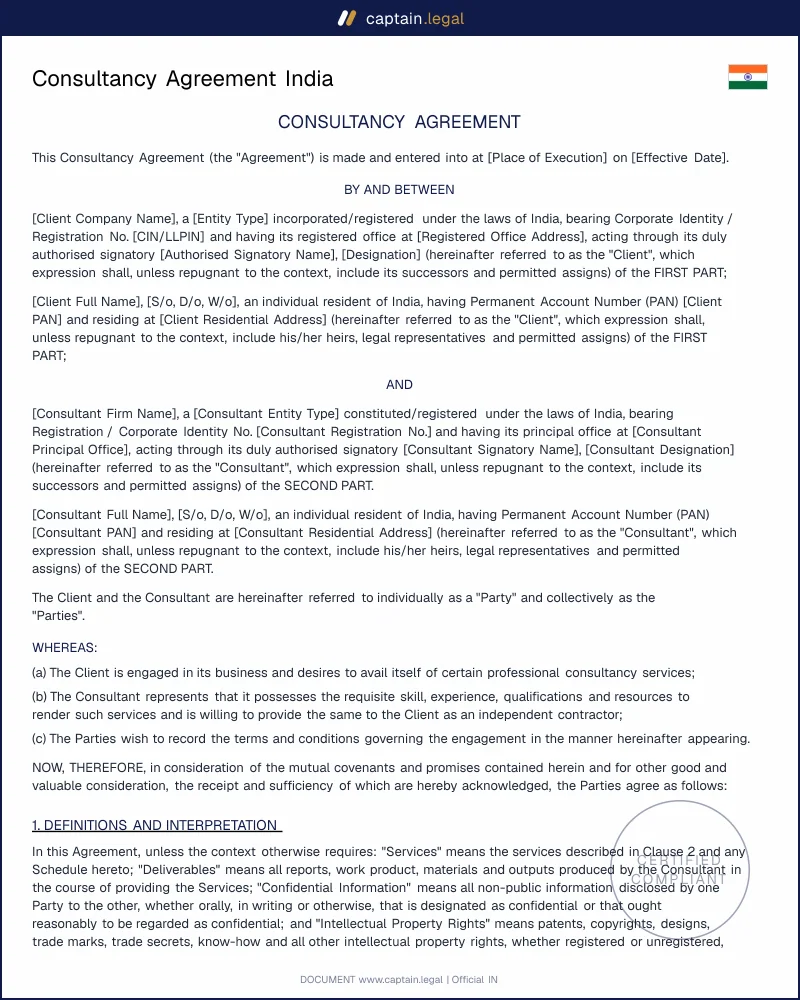
Consultancy Agreement India: Contract Act 1872 Compliant

Independent consultant contract built on the Indian Contract Act 1872 and Section 19 Copyright Act. Enforceable IP assignment, non-compete and tax terms.
4.7/536 reviews50 000+ downloadsInstant download
Share

A consultancy agreement is the contract you sign before bringing in an outside expert, and in India it does far more than record a fee. It engages an independent consultant, fixes the scope of work, sets payment terms, assigns intellectual property and, just as importantly, states in plain words that the consultant is not your employee. Drafted around the Indian Contract Act 1872, a clean consultancy agreement is the document a founder, an HR head or a finance team relies on when a deliverable slips or a dispute over ownership lands on the table. It protects both sides by saying exactly who owes what, by when, and on whose terms.

Compliant

2026 Legislation

50,000+ clients

trust us

Affordable

From $4.90 / doc

Secure payment

Instant download

Consultancy Agreement India: Contract Act 1872 Compliant

Secure payment · No subscription

Fill in the template

What is a consultancy agreement?

A consultancy agreement is a contract under which a person or a firm provides specialised advice or services to a client in exchange for a fee, without entering an employer-employee relationship. The consultant works as an independent contractor: they control how the work gets done, carry their own tax and compliance burden, and hand over a defined deliverable rather than their daily attendance. This is the line that matters most in India, because the legal consequences of getting the relationship wrong reach into tax, labour and copyright law all at once.

People often confuse a consultancy agreement with an employment contract or a generic service agreement, and the difference is not cosmetic. An employment contract creates a contract of service, which pulls in statutory dues such as provident fund, gratuity and protection under labour legislation. A consultancy agreement creates a contract for service, which keeps the consultant outside that net. A plain service agreement, by contrast, may cover a one-off vendor supply with no ongoing advisory relationship. The Supreme Court drew the working test for this distinction long ago in Dharangadhara Chemical Works Ltd. v. State of Saurashtra, where the control test decided whether the engager dictated not just what was done but how it was done. If your contract gives you the right to control the consultant's hours, methods and supervision the way you would an employee, a court may treat the relationship as employment regardless of the label on the cover page. The wording of the employment contracts and appointment letters in our Employment and HR category is built for exactly the opposite intent, which is why the two documents should never be mixed up.

2

When do you need this document?

The most common trigger is bringing in outside expertise for a defined project: a management consultant advising on a restructuring, a marketing strategist running a quarterly campaign, or a financial adviser preparing an investor deck. In each case the client wants the output, not a payroll headcount, and the consultancy agreement is what keeps the engagement clean. The second frequent scenario is the technical or creative engagement, where a software architect, a designer or a content specialist builds something the business will own and reuse. Here the intellectual property clause is the heart of the contract, not an afterthought.

A third situation is the recurring retainer, where a consultant is engaged month after month for advisory work. This is precisely where the relationship can quietly drift toward looking like employment, so the agreement should restate the independent status and avoid fixed daily hours. Foreign companies engaging an Indian consultant form a fourth category, and they often pair the contract with careful attention to permanent-establishment risk and cross-border payment terms. Two edge cases are worth flagging. When a single client takes most of a consultant's time and controls their working method, tax authorities and labour forums may reclassify the arrangement as disguised employment, exposing the client to back-dated statutory dues. And where the consultant in turn engages twenty or more workers on the client's premises, the Contract Labour (Regulation and Abolition) Act 1970 can apply, bringing licensing obligations that the contract should anticipate.

3

Key clauses included in our template

  • The scope of work and deliverables clause defines precisely what the consultant will produce, by which milestones, and to what standard. Vague phrasing like "general advisory support" invites disputes; the template forces a specific, dated description so that performance and breach can both be measured against a clear benchmark.
  • The fees and payment terms clause sets the consideration, the invoicing cycle and the payment window, and it flags the TDS at 10 percent under Section 194J and any GST treatment. It also addresses expenses and what happens to payment if a milestone is missed or the engagement ends early.
  • The independent contractor status clause states in express words that the consultant is not an employee, controls their own method of work, and bears their own tax and statutory compliance. This is the clause that answers the control test and helps rebut any later claim of disguised employment.
  • The intellectual property assignment clause transfers ownership of the work product to the client. Under Section 17 of the Copyright Act 1957 the author is normally the first owner, so without an express written assignment a client who pays a freelancer may not own what it paid for. The template assigns rights in writing as Section 19 requires, identifying the work and the rights, duration and territory.
  • The confidentiality and non-solicitation clause protects trade secrets, client lists and pricing during and after the term, and it is drafted to stay within the bounds of Section 27 so it remains enforceable.
  • The term and termination clause sets the duration, notice periods, and the consequences of early exit, including return of materials and survival of confidentiality and IP obligations.
4

Regional and sectoral considerations

Stamp duty is the variable that catches most parties off guard, because it is fixed by each State rather than nationally. Maharashtra levies stamp duty on agreements under the Maharashtra Stamp Act 1958, and a consultancy agreement executed in Mumbai is commonly stamped on a fixed value, with e-stamping through the authorised portal the practical route. Executing the agreement in the State where it will be used and stamping it at the local rate avoids the evidentiary problem later. Karnataka and Delhi run their own schedules, so a contract drafted for a Bengaluru technology client and one for a Delhi advisory firm may attract different duty even where the commercial terms are identical.

Sector matters as much as State. For technology and creative consultants, the Copyright Act 1957 assignment clause is decisive, and a software consultancy in Bengaluru or Hyderabad should treat the IP clause as non-negotiable. For consultants engaged by listed companies and large corporates, governance expectations are higher, and the engagement may need to align with board approvals and related-party rules under the Companies Act 2013, which our shareholders agreements and board resolutions in the Business and Incorporation category are designed to support. Financial and tax consultants should pay close attention to the GST registration threshold and the professional-services TDS rate, since misclassifying the payment head is a frequent and costly error. Across every State and sector, the Indian Contract Act 1872 essentials remain constant, but the stamp duty, the IP treatment and the compliance overlay shift with where and for whom the work is done.

5

How to fill out this consultancy agreement

You start by identifying the parties, entering the legal name and address of the client and the consultant, and stating whether the consultant is an individual professional or a firm. From there the template asks you to describe the scope of work and the deliverables, and the more specific you are at this stage the stronger the contract becomes. You then set the fee structure, the invoicing cycle and the payment window, and the form prompts you on the Section 194J TDS position and GST where relevant.

The next part fixes the term, the notice period and the termination triggers, and lets you decide which obligations survive the end of the engagement. The intellectual property section is where you confirm that the work product is assigned to the client in writing, which the Copyright Act 1957 requires for the transfer to hold. You finish with the confidentiality, non-solicitation and governing-law clauses, choosing the State whose courts will hear any dispute. Once the fields are complete the document is ready to download as Word and PDF, so you can adjust any clause before signing or send it straight for execution. If you need a related document for the same engagement, the non-disclosure agreements and other contract templates in our Contracts and Agreements category sit alongside this one.

6

Common mistakes to avoid

The single most damaging mistake is leaving the intellectual property clause out or drafting it loosely. Businesses routinely assume that paying for software, a design or a report means they own it, but under Section 17 of the Copyright Act 1957 the consultant remains the first owner unless there is an express written assignment that meets Section 19. A client who skips this clause may discover, mid-dispute, that it cannot use the very work it commissioned. The second frequent error is drafting an aggressive non-compete that ignores Section 27 of the Contract Act, producing a clause that looks protective but is void and gives the client a false sense of security.

A third mistake is letting the contract describe an employment relationship in all but name, with fixed daily hours, close supervision and an exclusivity that fails the control test, which opens the door to reclassification and back-dated statutory dues. Many parties also forget stamping, then find the agreement inadmissible when they most need it as evidence. Finally, vague payment and deliverable terms cause more consultancy disputes than any other single factor; replacing "as required" and "reasonable fees" with dated milestones and exact amounts removes most of the ambiguity before it can become a fight. The legal notices and demand letters in our Notices and Compliance category are the documents you fall back on when a clear agreement is nonetheless breached.

Key takeaways

STATUS

Call it consultancy, draft it like one

A consultancy agreement must clearly create a contract for service, not a contract of service. The consultant controls how work is done and delivers outputs, not attendance. If your clauses give you employee-like control over hours, methods and supervision, a court may treat it as employment despite the label, applying the control test noted in Dharangadhara Chemical Works Ltd. v. State of Saurashtra.

CONTRACT ACT

Section 10 and free consent matter

This agreement stands on the Indian Contract Act, 1872. Under Section 10, you need a clear offer and acceptance, lawful consideration (the fee) and a lawful object. Capacity under Section 11 (majority age and sound mind) must be met. Free consent under Sections 13 to 19 should be clean, because coercion, fraud or misrepresentation can make the contract voidable for the affected party.

RESTRICTIONS

Non-compete is limited; tax is not

Be careful with restraints. Section 27 of the Indian Contract Act makes post-termination non-competes hard to enforce, while confidentiality and non-solicitation are usually more defensible, and in-term restraints get a better hearing. Separately, the money trail needs correct compliance: for professional fees, the client typically deducts TDS at 10% under Section 194J of the Income Tax Act, 1961, and GST may apply if the consultant crosses the registration threshold.

Frequently Asked Questions

Yes. A consultancy agreement is fully enforceable once it satisfies Section 10 of the Indian Contract Act 1872, which requires free consent, lawful consideration, competent parties and a lawful object. A signed agreement with a defined scope, an agreed fee and clear terms creates binding obligations on both sides. To rely on it in court you should also stamp it under the applicable State stamp law, since an unstamped instrument can be refused as evidence until the duty and penalty are paid. An agreement signed electronically is equally valid under the Information Technology Act 2000, so e-signed consultancy contracts hold up just as paper ones do.

The difference is the nature of the relationship. A consultancy agreement creates a contract for service, where an independent consultant controls how the work is done and carries their own tax and compliance. An employment contract creates a contract of service, which brings statutory dues such as provident fund and gratuity and labour-law protection. Indian courts apply the control test from Dharangadhara Chemical Works Ltd. v. State of Saurashtra to decide which one you actually have, looking past the label to the real degree of control. If you supervise a consultant like an employee, the contract risks being treated as employment.

By default the consultant does. Under Section 17 of the Copyright Act 1957 the author of a work is its first owner, and commissioning or paying for the work does not by itself transfer ownership. To own the deliverables, the client needs an express written assignment in the contract that satisfies Section 19, identifying the work and specifying the rights, duration and territory assigned. This is why a strong IP clause is essential rather than optional. Without it, a business that paid a freelance developer or designer may find it does not legally own the result.

You can download the completed consultancy agreement in both Word and PDF. The Word version lets you fine-tune any clause, add a schedule of deliverables or adjust the fee structure before signing, while the PDF is the clean, fixed copy you send for signature or filing. Having both formats means you can adapt the document to a specific engagement and then lock the final version. Electronic execution is valid in India, so once both parties sign, including by e-signature, the downloaded agreement is ready to rely on.

In most States, yes. Stamp duty on agreements is governed by State stamp legislation and the Indian Stamp Act 1899, and the rate varies from one State to another. A consultancy agreement is commonly stamped on a fixed value, and e-stamping through the authorised State portal is the usual route. The practical reason to stamp it is evidentiary: an unstamped or under-stamped agreement can be held inadmissible in court until you pay the duty plus penalty. Stamp the agreement in the State where it is executed and at that State's prescribed rate.

You can, but with care. Section 27 of the Indian Contract Act 1872 voids any agreement that restrains a person from carrying on a lawful profession or trade, so a broad non-compete that binds the consultant after the engagement ends is usually unenforceable. Restraints that operate only during the term of the engagement are treated more favourably. A well-drafted confidentiality clause and a reasonable non-solicitation clause generally hold up, which is why the template relies on those to protect the business rather than on a sweeping post-termination ban that a court is likely to strike down.

It should state the fee, the invoicing cycle and the payment window, and address the tax treatment clearly. A client paying for professional services deducts TDS at 10 percent under Section 194J of the Income Tax Act 1961, so the contract should record how this applies. A consultant whose turnover crosses the registration threshold must charge GST under the Central Goods and Services Tax Act 2017, and the agreement should set out who bears it. Spelling out milestones, expenses and the consequences of a missed deadline removes the ambiguity that causes most fee disputes.

4.7/5

36 verified reviews · 50 000+ downloads

Consultancy Agreement India: Contract Act 1872 Compliant
  • Immediate access to the document
  • PDF + Word download
  • Compliant with 2026 legislation
  • Reviewed by lawyers
Fill in the template
Secure payment · No subscription
Updated on June 8, 2026

You might also like

Franchise Agreement India
Non-Disclosure Agreement (NDA) India