Create my document
Login

Choose country

FranceBelgiqueEspañaUnited StatesUnited KingdomMarocDeutschlandItaliaSchweiz
Real Estate

Rent Receipt HRA: Section 10(13A) & Rule 2A Format

An HRA rent receipt drafted to Section 10(13A) and Rule 2A, with landlord PAN rules above Rs 1 lakh and revenue stamp guidance for cash payments.
4.7/529 reviews50 000+ downloadsInstant download
Share

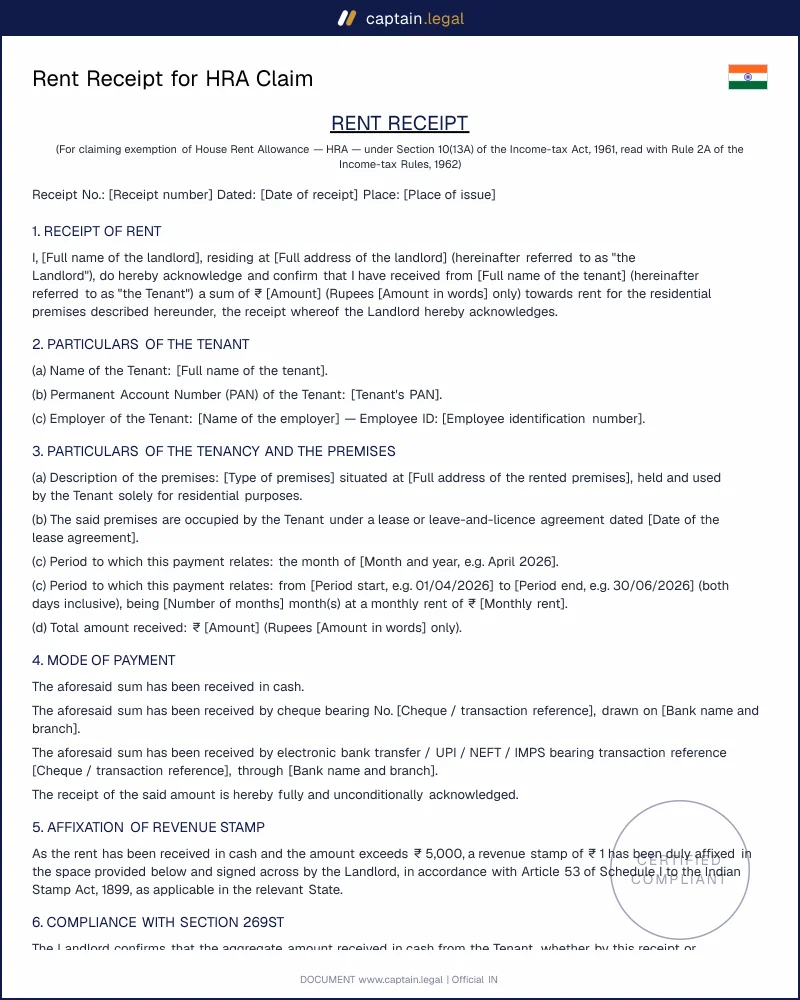
A rent receipt is the salaried tenant's single most important proof when claiming House Rent Allowance, and the format that satisfies the Income Tax Department is narrower than most people assume. A receipt that omits the landlord's signature, the exact month, or the PAN where the law demands it will not survive employer verification or a later scrutiny. This template produces an HRA-claim-format rent receipt built to the wording of Section 10(13A) and Rule 2A of the Income-tax Act, so the deduction stands when your payroll team, or the Assessing Officer, looks closely.

Designed for salaried employees in metro and non-metro cities, it carries every field the assessment expects: amount in figures and words, the period covered, the mode of payment, the rented address, and the landlord's identity and PAN.

Compliant

2026 Legislation

50,000+ clients

trust us

Affordable

From $4.90 / doc

Secure payment

Instant download

Rent Receipt HRA: Section 10(13A) & Rule 2A Format

Secure payment · No subscription

Fill in the template

What is a rent receipt in HRA claim format?

A rent receipt is the landlord's written acknowledgement that a specified sum of rent has been received from the tenant for a stated period and property. In the HRA context it stops being a casual chit and becomes a tax document. The Income-tax Department treats it as primary evidence that you actually paid the rent you are claiming exemption on under Section 10(13A), and the standard departmental layout even carries the heading "Receipt of House Rent Payment (See Section 10(13A) and Rule 2A)".

People often confuse a rent receipt with a rent agreement, and the two do different jobs. The agreement is the contract that proves a tenancy exists and fixes the rent; the receipt proves the money was paid, month after month. An HRA claim needs both, not one or the other. A tenant who submits only an agreement, with no receipts, has shown the obligation to pay but not the payment itself, which is precisely the gap an Assessing Officer probes. The receipt closes it by recording each transaction with a date and a signature. Where rent is paid in cash and the monthly amount exceeds Rs 5,000, the receipt should also carry a revenue stamp across which the landlord signs, a small formality that practitioners treat as non-negotiable for clean documentation. Captain.Legal's format folds these requirements into a single page you can issue monthly or as a consolidated annual set.

2

When do you need this document?

The everyday trigger is the annual investment-proof exercise your employer runs, usually between December and February, when payroll asks for rent receipts to compute the HRA exemption in your Form 16. Most companies want receipts for the full financial year, often quarterly batches, and a missing month means that slice of rent simply drops out of the exemption. The second common scenario arrives at ITR filing, where you substantiate the exemption independently of the employer, especially if HR processed it incorrectly or you changed jobs mid-year and need to reconcile two Form 16s.

A receipt becomes critical the moment scrutiny enters the picture. The Department has, in recent years, cracked down hard on fabricated rent claims, and a notice asking you to justify HRA is no longer rare. Tenants who paid by bank transfer or UPI are in the strongest position, because the receipt and the bank statement corroborate each other; cash payers lean entirely on the stamped receipt, which is why its formatting matters so much. Two edge cases recur in practice. The first is rent paid to a parent or close relative, which is permitted but invites suspicion: the arrangement needs a real agreement, real money actually transferred, and receipts that look like arm's-length documents, because the relationship-disclosure rule now puts these claims under a brighter light. The second is the salaried employee who simultaneously services a home loan on a property in a different city; both benefits can be claimed, but only if the rented accommodation and the owned property are genuinely distinct, and the receipts must clearly tie to the rented address. When the underlying arrangement is informal, formalising it through a property document drafted for Indian law protects the claim before any query lands.

3

Key clauses included in our template

  • The acknowledgement of rent received states the exact sum in figures and in words, the way the departmental format requires, because a receipt that disagrees with itself between numerals and words is the first thing an officer flags. The amount is tied to a single, named month and financial year, so a year's receipts read as a coherent series rather than a vague lump.
  • The tenant and landlord identification names both parties in full, with the landlord's address, and reserves a clear field for the landlord's PAN. Where annual rent crosses Rs 1,00,000 the PAN line is treated as compulsory, and where the landlord lacks one the format accommodates the self-declaration route under CBDT Circular No. 8/2013.
  • The rented property address is set out precisely, matching the address in your rent agreement and your own records, since a mismatch between the receipt address and the agreement is a frequent cause of rejected claims.
  • The period and mode of payment record whether rent was paid in cash, by cheque, bank transfer or UPI, and over which month or quarter. Digital modes are encouraged in the wording because they leave an independent trail that strengthens the claim under scrutiny.
  • The revenue stamp and signature block sits where the landlord signs, with a prompt to affix a revenue stamp on cash receipts above Rs 5,000. An unsigned receipt is worthless as proof, so the signature field is positioned to make omission obvious.
4

Regional considerations

Metro cities (Delhi, Mumbai, Chennai, Kolkata). Tenants in the four classic metros qualify for the higher fifty percent of salary ceiling in the Rule 2A computation, which usually makes the exemption considerably larger than in smaller towns. Because rents here routinely exceed Rs 1,00,000 a year, the landlord's PAN is effectively always required, and high-rise societies sometimes route rent through management companies, in which case the receipt must name the actual recipient of the rent and reflect that entity's PAN.

The new metros (Bengaluru, Pune, Hyderabad, Ahmedabad). Under the rules effective from the 2026-27 assessment year, these four cities now also attract the fifty-percent benefit, a meaningful upgrade for the large salaried populations in Bengaluru's and Hyderabad's tech corridors. Tenants here should make sure receipts issued for earlier periods are not mistakenly computed at the old forty-percent rate when they file, and that the city is recorded accurately on each receipt.

Non-metro cities and towns. Everywhere outside the eight notified cities the exemption is capped at forty percent of salary. The documentary discipline is identical, and tenants in smaller markets, where cash rent is more common, lean heavily on the stamped, signed receipt because bank-transfer corroboration is often absent. Do not assume a smaller town means lighter scrutiny; the relationship-disclosure and PAN rules apply uniformly regardless of location.

5

How to fill out this rent receipt

You begin by entering the financial year and the month the receipt covers, then the tenant's and landlord's names exactly as they appear on official records. From there the form asks for the rent amount, which it renders in both figures and words for you, and the full address of the rented property so it lines up with your agreement. You select the mode of payment, and if you choose cash, the format prompts you to add a revenue stamp where the monthly amount crosses Rs 5,000. When you indicate that annual rent exceeds Rs 1,00,000, a field for the landlord's PAN becomes prominent, with an alternative path for the self-declaration if the landlord has none. The finished receipt downloads as Word and PDF, so you can issue a clean monthly version, batch a full year for your employer's investment-proof window, or adapt the wording where TDS under Section 194-IB applies. If you also need the underlying contract, the same workflow links to an employment or salary-related document for India for tenants reconciling HRA against their pay structure.

6

Common mistakes to avoid

The error that sinks the most claims is the missing or mismatched PAN. Tenants paying more than Rs 1,00,000 a year who hand in receipts without the landlord's PAN, or with a PAN that the landlord has not actually declared rental income against, find the exemption withheld at the employer stage and questioned at ITR. Equally common is the receipt that does not match the agreement: a different address, a rent figure that drifts from the contracted amount, or a period that overlaps inconsistently. Officers read those gaps as fabrication. Backdating a full year of receipts in one sitting, all in identical ink with sequential handwriting, is another giveaway that practitioners see flagged repeatedly.

The subtler mistakes are about substance, not paperwork. Claiming HRA for rent paid to a spouse, or to a parent where no money genuinely changes hands, collapses the moment the relationship-disclosure rule and a bank-statement check are applied. Forgetting the revenue stamp on cash receipts above Rs 5,000 weakens an otherwise valid document. And tenants frequently overlook that the exemption lives only in the old tax regime, so receipts diligently collected under the new regime claim nothing at all. A receipt is only as good as the tenancy behind it, which is why it should sit alongside a registered or notarised agreement; you can pair it with a contract template aligned to Indian law to keep the file complete.

Key takeaways

HRA proof

Rent receipt is primary tax evidence

For HRA exemption under Section 10(13A) read with Rule 2A, the receipt is not a casual note; it is the document your employer and, later, the Assessing Officer will rely on to confirm you actually paid rent. If it misses basics like the exact month, date, rented address, amount (figures and words), mode of payment, and the landlord’s signature, the claim can fail at verification.

PAN threshold

Above Rs 1,00,000, PAN is mandatory

If your annual rent crosses Rs 1,00,000 (about Rs 8,333 per month), you must furnish the landlord’s PAN for the exemption to be processed in Form 16. If the landlord has no PAN, a signed self-declaration is needed (as per CBDT Circular No. 8/2013 practice). If the landlord has a PAN but refuses to share it, a declaration will not substitute it and the exemption may be denied.

Practicalities

Receipt and agreement serve different jobs

A rent agreement and rent receipts are not interchangeable. The agreement is the contract creating the tenancy and fixing rent (think Indian Contract Act, 1872 basics on enforceable agreements), while the receipt records each payment made. Submitting only the agreement shows the obligation, not the payment. Also, where rent is paid in cash and the monthly amount exceeds Rs 5,000, attach a revenue stamp and have the landlord sign across it for clean documentation.

Frequently Asked Questions

Yes. The template follows the layout the Income-tax Department recognises, citing Section 10(13A) and Rule 2A, and captures every field an employer or Assessing Officer expects: amount in figures and words, the month and financial year, the property address, the mode of payment, and the landlord's signature and PAN. Validity depends on the contents being true and complete, so the receipt must reflect rent actually paid and match your rent agreement. Used correctly, with the landlord's PAN where annual rent exceeds Rs 1,00,000 and a revenue stamp on cash receipts above Rs 5,000, it stands as proper documentary proof during both employer verification and ITR scrutiny.

Only above a threshold, but the threshold catches most urban tenants. Where the rent you pay in a financial year exceeds Rs 1,00,000, around Rs 8,333 a month, the landlord's PAN is mandatory, and your employer will not allow the exemption in Form 16 without it. Below that amount you can claim on receipts alone. If your landlord genuinely has no PAN, a signed self-declaration to that effect is accepted under CBDT Circular No. 8/2013. The one situation that fails is a landlord who has a PAN but refuses to disclose it, because a declaration cannot substitute for a PAN that actually exists.

The receipt downloads in both Word and PDF. The Word version lets you adjust names, amounts and periods quickly, which is convenient when you are generating a full financial year of monthly receipts or correcting a single month. The PDF version is the clean, fixed copy you hand to your employer's payroll team during the investment-proof window or keep on file for ITR. Many tenants generate monthly receipts in Word, have the landlord sign each, then save the signed set as PDFs so the documentation is locked and ready if a query ever arrives.

Most employers ask for receipts covering the full financial year, often grouped quarterly, so a typical claim involves either twelve monthly receipts or four quarterly ones. Each receipt should state the exact month or period it covers, because a gap in the sequence means that portion of rent falls out of the exemption computation. For ITR purposes you are not always required to upload every receipt, but you must be able to produce the complete set if the Department raises a query, so keeping all twelve months, signed and consistent, is the safe practice rather than assembling them hastily later.

Yes, this is permitted, but it draws scrutiny and must be handled cleanly. The rent has to be real, ideally paid by bank transfer so the trail is independent, supported by a genuine rent agreement and properly issued receipts. The parent must also report the rent as income in their own return. Under the rules from the 2026-27 assessment year, you must disclose the relationship when claiming, which sharpens the Department's attention on such arrangements. Receipts that look like genuine arm's-length documents, with the relative's PAN where the annual amount crosses Rs 1,00,000, are essential to surviving any verification.

A revenue stamp is required on receipts where rent is paid in cash and the amount exceeds Rs 5,000 for that period, with the landlord signing across the stamp. For payments made by cheque, bank transfer or UPI, the revenue stamp is not strictly necessary because the banking channel itself evidences the transaction, though many tenants affix one regardless for a tidier record. The template prompts you at the point where a stamp is needed, so you do not discover the omission only when payroll returns the receipts. An unstamped high-value cash receipt is the kind of detail that weakens an otherwise solid claim.

No. HRA exemption under Section 10(13A) is available only under the old tax regime. If you have opted into the new regime, your rent receipts, however perfect, will not reduce your tax, because the exemption simply does not exist there. This catches many salaried employees who collect a year of receipts and then realise too late that their regime choice cancelled the benefit. Before investing effort in documentation, confirm you are filing under the old regime; if you are, the rent receipt becomes one of the most valuable single pages in your tax file, and the calculation follows the least-of-three formula in Rule 2A.

4.7/5

29 verified reviews · 50 000+ downloads

Rent Receipt HRA: Section 10(13A) & Rule 2A Format
  • Immediate access to the document
  • PDF + Word download
  • Compliant with 2026 legislation
  • Reviewed by lawyers
Fill in the template
Secure payment · No subscription
Updated on June 8, 2026

You might also like

Rent Agreement India
Property Power of Attorney India