Create my document
Login

Choose country

FranceBelgiqueEspañaUnited StatesUnited KingdomMarocDeutschlandItaliaSchweiz
Real Estate

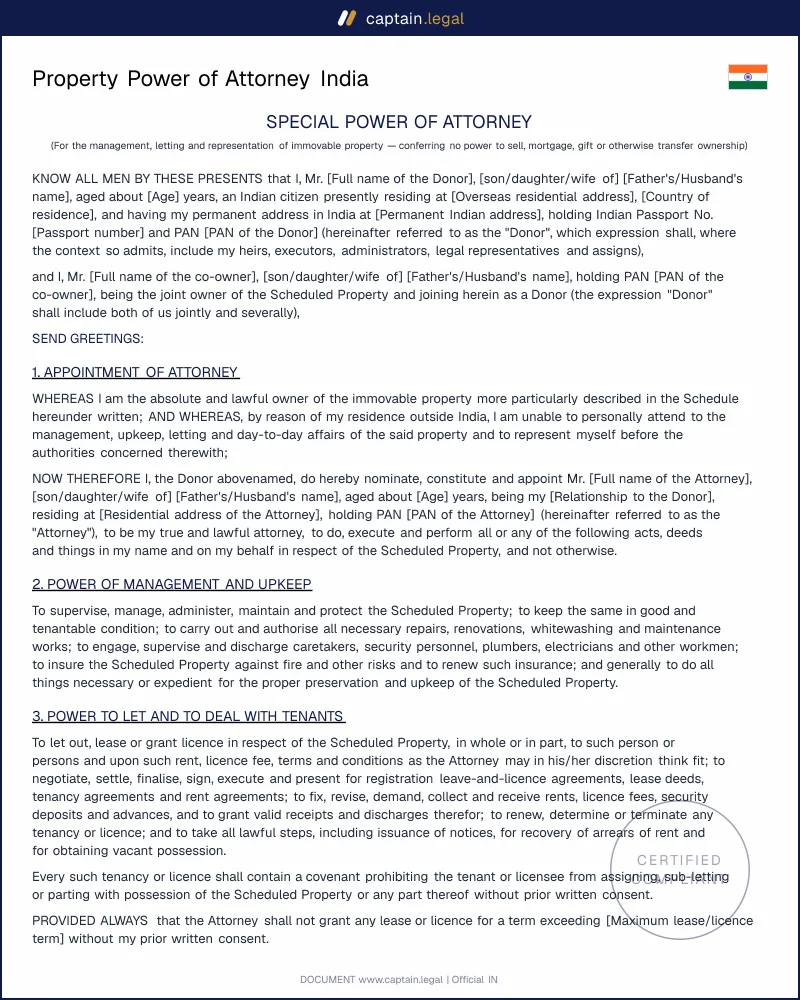
Special Power of Attorney (Property), India: 1882 Act

Property SPA drafted under the Powers of Attorney Act 1882 and Registration Act 1908. No title transfer, tight scope, registry-ready for NRIs. PDF & Word.
4.9/528 reviews50 000+ downloadsInstant download
Share

A Property Power of Attorney (Special) is a legal instrument by which an owner (the principal or donor) authorises a named, trusted person (the agent or attorney) to manage, let, collect rent on, or otherwise represent a specific immovable property in India, without transferring any ownership in it. It is the instrument of choice for Non-Resident Indians who cannot be physically present to deal with a flat, plot or commercial unit back home. Unlike a general power of attorney, a special power of attorney confines the agent to the precise acts you spell out, which keeps the scope tight and the risk of misuse low. Drafted under the Powers of Attorney Act, 1882, this template gives you a property POA that holds up before banks, builders and the Sub-Registrar.

The document does one job well: it lets someone act for you on one property, for defined purposes, while you keep full title. It is not a sale, and it cannot pass ownership. That distinction sits at the heart of every safe POA arrangement, and it is the first thing an Indian conveyancing lawyer will check.

Compliant

2026 Legislation

50,000+ clients

trust us

Affordable

From $4.90 / doc

Secure payment

Instant download

Special Power of Attorney (Property), India: 1882 Act

Secure payment · No subscription

Fill in the template

What is a Property Power of Attorney (Special)?

A Property Power of Attorney (Special), often written as an SPA or Special PoA, is an agency document. The principal grants the agent authority to perform one or more clearly listed acts in relation to a single identified property: managing it, letting it, collecting rent, paying property tax and society dues, dealing with a builder, or appearing before a registering authority for a named transaction. The agent acts in the principal's name and the principal remains the owner throughout.

The line that confuses most people is the one between a special and a general power of attorney. A General Power of Attorney (GPA) hands over broad, open-ended authority across many matters and often many assets, which is convenient but dangerous when it travels beyond what the owner actually intended. A special power of attorney is narrow by design: it names the property, names the acts, and stops there. For an owner abroad who simply wants a relative to rent out a flat in Pune and bank the rent, the special form is almost always the correct and safer choice. The other common confusion is with a sale. A POA never conveys title. Even where it authorises the agent to deal with the property, ownership moves only through a properly stamped and registered conveyance, never through the power itself. Treat this document as a management and representation tool, not a shortcut around a sale deed.

2

When do you need this document?

The most frequent trigger is the Non-Resident Indian who owns property at home and lives abroad. You bought a flat in Bengaluru, you are based in Dubai or London, and you need a brother or a parent to handle the tenant, sign the leave-and-license agreement, collect the rent and deal with the housing society. A special POA naming that one property and those exact acts does the job without exposing the rest of your affairs. The second common situation is the owner who is in India but cannot attend in person for a particular step, such as appearing before the Sub-Registrar to present a document, or taking possession of a flat from a developer on a fixed handover date.

Property management while you travel is another clear case. Long postings, extended medical treatment abroad, or simply living in another State can all make day-to-day oversight impractical, and a tightly drawn POA lets a trusted agent pay the property tax, settle utility bills and respond to the society on your behalf. One edge case worth flagging concerns jointly owned property: every co-owner whose interest is affected must execute the POA, because an agent cannot act for an owner who has not granted authority. Another is the NRI from a non-Hague country, where consular attestation at the Indian mission replaces the apostille route, a detail that decides whether the Sub-Registrar accepts the document at all. When the underlying purpose is to actually sell, you have moved beyond representation, and you should look instead at our sale and purchase document formats for India.

3

Key clauses included in our template

  • The identification of the principal and the agent is set out in full, with names as they appear on identity documents, parentage, age, nationality and complete addresses. A mismatch between the name on the POA and the name on the title or passport is one of the most common reasons a document is rejected for apostille or at the registry, so the template prompts you for the exact spellings.
  • The description of the property is drafted with the same precision a conveyancer would use: full address, survey or plot number, built-up area, and the schedule details that uniquely identify the unit. A POA that authorises acts over a vaguely described property invites objection, and the Registration Act, 1908 expects a clear identification of the immovable property concerned.
  • The scope of authority lists each act the agent may perform and nothing more, which is the defining feature of a special power. Typical entries include letting the property, signing a leave and license or rent agreement, collecting rent and deposits, paying taxes and society dues, and appearing before named authorities. Anything not listed is not authorised.
  • The express exclusion of any power to sell, mortgage or gift is built in unless you deliberately add it, which protects an owner abroad from the single largest risk: an agent purporting to dispose of the property. This clause is what keeps a management POA from being read as a disposal POA.
  • The duration and revocation terms fix how long the authority lasts and confirm the principal's right to revoke under the Indian Contract Act, 1872, along with the practical step of giving notice to the agent and, where the POA was registered, recording the revocation.
  • The execution and attestation block is structured for signature before a Notary Public with two independent witnesses, and it carries the jurisdiction wording an NRI needs so the document can be apostilled or consularised for use in India.
4

Regional considerations

Stamp duty and registration practice are State subjects, so the same POA is handled differently depending on where the property sits. In Maharashtra, the registration administration is among the strictest in the country; the Maharashtra Stamp Act, 1958 sets the duty, and Sub-Registrars in Mumbai and Pune routinely expect a property POA touching transfer-related acts to be registered rather than merely notarised, with biometric verification of the parties at the office.

In Karnataka, property POAs for Bengaluru are stamped under the Karnataka Stamp Act, 1957 and processed through the State registration portal, and registry staff scrutinise NRI documents closely for proper apostille or consular attestation before accepting them. Owners letting property here should align the POA with the city's standard eleven-month leave-and-license practice.

In Delhi, the Indian Stamp Act, 1899 as applied to the National Capital Territory governs duty, and following the Suraj Lamp ruling the Delhi administration tightened its approach to POA-based property dealings, so an SPA confined to management and letting is far less likely to attract objection than anything resembling a GPA sale. In Tamil Nadu, registration under the State's well-developed Sub-Registrar network is the norm for property-related powers, and the registering authority expects the schedule of property to match revenue records exactly. Always confirm the current duty and registration requirement for the specific State before the agent acts, because a document that is fine in one State can be impounded in another. For owners who also need to formalise the tenancy itself, our overview of personal and family legal documents for India covers the related powers of attorney and affidavit formats.

5

How to fill out this Property Power of Attorney (Special)

You start by entering the principal's details exactly as they appear on the passport or PAN, then the agent's details with the same care, because Indian registries and apostille authorities reject documents where the names do not match the supporting identity proof. From there you describe the property: address, survey or plot number, area and the schedule particulars that pin down the exact unit. The template then asks you to select the specific powers you are granting, and here you keep the list as narrow as your purpose allows, ticking only the acts your agent genuinely needs. You set the duration, decide whether the power is revocable, and add the exclusion confirming the agent cannot sell, mortgage or gift the property. The form generates a clean document in PDF and Word with a properly structured attestation block for two witnesses and a Notary Public. If you are abroad, you print it, sign it before a notary, and then route it for apostille or consular attestation depending on your country before sending the original to India for stamping and, where required, registration. You can review the broader category of property and rental document templates for India if you need a companion rent agreement for the agent to use.

6

Common mistakes to avoid

The single most damaging error is treating a power of attorney as a sale. Owners abroad are sometimes persuaded to grant a sweeping GPA "to save registration," only to discover that the Suraj Lamp ruling means no title ever passed and the buyer's payment bought nothing enforceable. A special POA confined to management and representation avoids this entirely. The second frequent mistake is granting more authority than the situation needs; a power that says "to do all acts in respect of my properties" is a general power in disguise, and it hands the agent the keys to assets you never meant to expose. Name the property, name the acts, and stop.

Execution defects come next. An NRI who signs without a notary, or without the two independent witnesses, or who skips the apostille or consular attestation, will find the Sub-Registrar or the bank simply refuses the document. Stamp duty is the quiet trap: many people notarise abroad and forget that the original must reach India and be adjudicated and stamped within roughly three months, after which the document is liable to penalty and inadmissibility. Finally, owners forget revocation hygiene, leaving an old POA live for years after the need has passed. If you registered the power, register the revocation, and always give the agent written notice. Our notices and compliance document formats include the kind of formal notice useful for communicating a revocation.

Key takeaways

TITLE

A Special POA never transfers ownership

This document only authorises an attorney to act for you; it does not sell, gift, or convey title in the immovable property. You remain the owner throughout, and any ownership change still needs a properly stamped and registered conveyance deed. Use the SPA as a management and representation tool, not as a shortcut around a sale deed.

SCOPE

Keep powers property-specific and limited

A Special Power of Attorney is meant to be narrow by design: one identified property and only the specific acts you list, such as letting, collecting rent, paying property tax or society dues, dealing with a builder, or appearing before the Sub-Registrar for a named task. This reduces misuse compared to a broad General POA, especially for NRIs managing property from abroad.

FORMALITIES

Stamping, notarisation and registration decide usability

Even a well-drafted SPA can fail in practice if the formalities are missed. Stamp duty applies under the Indian Stamp Act, 1899 as modified by the relevant State; an under-stamped POA can be impounded and becomes inadmissible until duty and penalty are paid. For proof and acceptance, notarisation helps, and where authority touches transfer-related acts, Sub-Registrars often require registration under the Registration Act, 1908.

Frequently Asked Questions

Yes, when it is executed correctly. The template is drafted under the Powers of Attorney Act, 1882 and the agency provisions of the Indian Contract Act, 1872, which together give a properly signed POA the same effect as if the principal had acted personally within the granted scope. Binding force depends on three things being right: clear identification of parties and property, signature before a Notary Public with witnesses, and compliance with the State's stamp duty and, where the powers touch transfer of immovable property, registration. A POA that authorises only management and letting is usually accepted on notarisation, while anything broader is safest when registered at the Sub-Registrar's office.

No, and this is the most important point to understand. A power of attorney is an instrument of agency, not of conveyance. It lets your agent act for you, but it leaves title exactly where it was. The Supreme Court confirmed in Suraj Lamp & Industries v. State of Haryana (2011) that a sale executed through a general power of attorney does not by itself pass ownership, and that immovable property can be transferred only by a registered sale deed. Treat this document as a tool to manage, let or represent your property, never as a substitute for a proper registered conveyance.

You print the completed document and sign it before a Notary Public in your country of residence, in the presence of two independent witnesses who are not beneficiaries. The document then needs authentication for use in India: if you live in a Hague Convention country such as the UK, USA, Canada, UAE or Singapore, an apostille from the designated authority is the standard route; if your country is not a signatory, the Indian Embassy or Consulate must attest it. The original is then couriered to India, where it must be adjudicated and stamped, and registered if it concerns transfer of immovable property.

The Property Power of Attorney (Special) is available in both Word and PDF. The Word version is convenient when you want a lawyer to fine-tune the schedule of property or the scope of powers before you sign, while the PDF is ready to print for notarisation and attestation. Because Indian registries and apostille authorities are exacting about exact names and clean formatting, having an editable Word copy on hand is genuinely useful for last-minute corrections.

Once a POA executed abroad reaches India, it generally has to be presented for adjudication and stamping within three months of arrival, under the framework of the Indian Stamp Act, 1899 as applied by the relevant State. Miss that window and the document becomes liable to penalty and can be treated as inadmissible until the duty and penalty are paid. The safest practice is to plan the courier and the visit to the Collector of Stamps or Sub-Registrar before the agent needs to act, so the instrument is fully effective when the first deadline, such as a builder handover or a tenant signing, actually falls.

Yes, and that is the whole purpose of a special power of attorney. Unlike a general power, the special form authorises only the specific acts you list and nothing beyond them. You can permit your agent to let the property, sign a rent or leave-and-license agreement, collect rent and deposits, and pay taxes and society dues, while expressly excluding any power to sell, mortgage or gift. Drafting the scope tightly is the single best protection against misuse, because an agent simply cannot perform an act the document does not name.

Yes. Under the Indian Contract Act, 1872 a principal can revoke a power of attorney, subject to the limited exception of a power coupled with an interest. To make revocation effective you should give the agent clear written notice, and if the original POA was registered, you should register the deed of revocation as well so that third parties such as banks and registries are put on notice. Until you communicate the revocation, the agent's acts within scope may still bind you, so prompt and documented cancellation matters.

4.9/5

28 verified reviews · 50 000+ downloads

Special Power of Attorney (Property), India: 1882 Act
  • Immediate access to the document
  • PDF + Word download
  • Compliant with 2026 legislation
  • Reviewed by lawyers
Fill in the template
Secure payment · No subscription
Updated on June 8, 2026

You might also like

Rent Receipt for HRA Claim
Sale Deed Format India