Create my document
Login

Choose country

FranceBelgiqueEspañaUnited StatesUnited KingdomMarocDeutschlandItaliaSchweiz
Contracts

Franchise Agreement India: Law, Clauses & FEMA

Indian franchise agreement built on the Contract Act 1872, Trade Marks Act 1999 and FEMA. Drafted for enforceability, ready as editable PDF and Word.
4.7/519 reviews50 000+ downloadsInstant download
Share

A franchise agreement is the contract that lets a franchisee run a business under the franchisor's brand, trade marks and operating system in exchange for an upfront fee and ongoing royalties. It is the single most important document in any franchise relationship, because India has no dedicated franchise statute and the agreement itself becomes the parties' rule book on territory, fees, brand standards and exit. Whether you are a domestic brand expanding through area developers or a foreign franchisor entering India under the FDI route, a precisely drafted franchise agreement decides whether your trade mark licence, royalty stream and termination rights will actually hold up in an Indian court.

This page explains what an enforceable franchise agreement looks like in India, the statutes that shape it, the clauses our template includes and the mistakes that send franchise disputes to litigation.

Compliant

2026 Legislation

50,000+ clients

trust us

Affordable

From $4.90 / doc

Secure payment

Instant download

Franchise Agreement India: Law, Clauses & FEMA

Secure payment · No subscription

Fill in the template

What is a franchise agreement?

A franchise agreement is a commercial contract under which a franchisor grants a franchisee the right to operate a business using the franchisor's brand identity, trade marks, know-how and standardised systems, against payment of a franchise fee and recurring royalties. Indian courts treat it as a licensing arrangement, not a sale of goods: in the well-known Pan Parag line of reasoning, granting the right to use a trade mark or trade name does not transfer ownership of anything. The franchisee buys access to a proven format, the franchisor keeps the asset.

People often confuse a franchise agreement with a plain distributorship or a dealership, and the distinction matters. A distributor buys and resells the supplier's products on its own account, with little control over how it runs the shop. A franchisee, by contrast, surrenders day-to-day autonomy : it must follow the franchisor's operations manual, branding, pricing guidance and quality standards, and in return gets the brand pull and the system. A franchise is therefore closer to a brand and systems licence bundled with continuing operational control, which is exactly why the contract has to be drafted with care. For a related arrangement where one business simply sells another's goods, see our distribution and supply contract templates, and for the underlying brand protection the format relies on, an employment non-compete and confidentiality clause often supports the wider franchise structure.

2

When do you need this document?

The clearest trigger is brand expansion through third parties. A founder who has run two or three profitable outlets and now wants others to replicate the format under the same name needs a franchise agreement before a single new store opens, because everything from the royalty percentage to the brand-standard audit rights lives in that contract. The same applies in reverse : an entrepreneur signing up to operate a known brand should never start fit-out or pay a franchise fee on a handshake or an email chain. The investment in a franchised outlet is substantial, and an unwritten understanding gives almost no protection if the relationship sours.

Foreign entry is the next major scenario. An overseas brand granting master franchise rights for the whole of India, or appointing separate area developers region by region, must paper the deal carefully so that royalty repatriation passes FEMA scrutiny and the trade mark licence survives in court. A single master-franchisee can still be treated as a franchisee for IP and tax purposes, so the structure cannot be left vague.

Two edge cases legitimately need extra attention. First, multi-state franchising in India runs into state-level shop and establishment laws, food safety licensing and stamp duty that varies by State, so a one-size template executed in one State may be under-stamped in another. Second, professional-service franchises in healthcare or education face State regulatory regimes that sit on top of the contract. Where the underlying business is incorporated rather than a proprietorship, pair the franchise terms with the right business incorporation and company formation documents.

3

Key clauses included in our template

  • The grant of rights and territory clause defines exactly what the franchisee may do, under which trade marks, and within what geographic area. It states whether the territory is exclusive, non-exclusive or sole, and whether the franchisor retains the right to open company-owned outlets or sell online into the area, the single most common source of franchise friction.
  • The fees and royalty clause sets the upfront franchise fee, the running royalty (commonly a percentage of gross sales) and any marketing-fund contribution, with audit rights so the franchisor can verify reported turnover. For foreign franchisors it flags withholding tax under Section 195 of the Income-tax Act and the FEMA route for remittance.
  • The trade mark and IP licence clause grants a limited, revocable right to use the brand, requires registered-user recording under the Trade Marks Act 1999, and prohibits any use that damages the mark's reputation. It keeps ownership firmly with the franchisor.
  • The brand standards and operations clause binds the franchisee to the operations manual, quality benchmarks, approved suppliers and inspection rights, the operational backbone that distinguishes a franchise from a distributorship.
  • The term, renewal and termination clause fixes an initial term (typically five to ten years), renewal mechanics, cure periods, and the triggers for termination such as royalty arrears, brand-standard breach or insolvency.
  • The post-term obligations clause handles de-identification (signage, packaging, social handles, IT systems), confidentiality that survives expiry, and a Section 27-compliant restraint drafted narrowly rather than as an overbroad non-compete that a court would void.
4

Regional considerations

Franchising in India is governed centrally on contract and IP, but the practical compliance layer is heavily State-driven, which is why the same agreement behaves differently across the country.

Maharashtra is the most demanding on stamping. Instruments executed in the State attract stamp duty under the Maharashtra Stamp Act 1958, and an under-stamped franchise agreement can be held inadmissible in evidence until the duty and penalty are paid. A franchise agreement signed in Mumbai must be stamped on its value before it is relied on in any dispute, so franchisors running multi-city rollouts cannot reuse a single Delhi-stamped copy across States.

Delhi NCR is the natural hub for master and area-development deals, particularly for foreign brands entering the food and retail sectors. Here the FEMA and RBI reporting discipline bites hardest, because royalty and franchise-fee remittances to an overseas franchisor must move through the automatic route and be reported correctly, failing which payments stall at the authorised dealer bank.

Karnataka, and Bengaluru in particular, concentrates technology, education and quick-service franchises, where copyright over software and training content and data-handling obligations carry extra weight alongside the trade mark licence. Tamil Nadu sees heavy food and beverage franchising, where State food-safety licensing under FSSAI rules sits on top of the agreement and the supplier-approval clause becomes commercially sensitive. Across all States, GST registration is generally required in each State where the franchisee actually operates, not merely where the franchisor is based, so the tax clause should never assume a single registration covers a national network.

5

How to fill out this franchise agreement

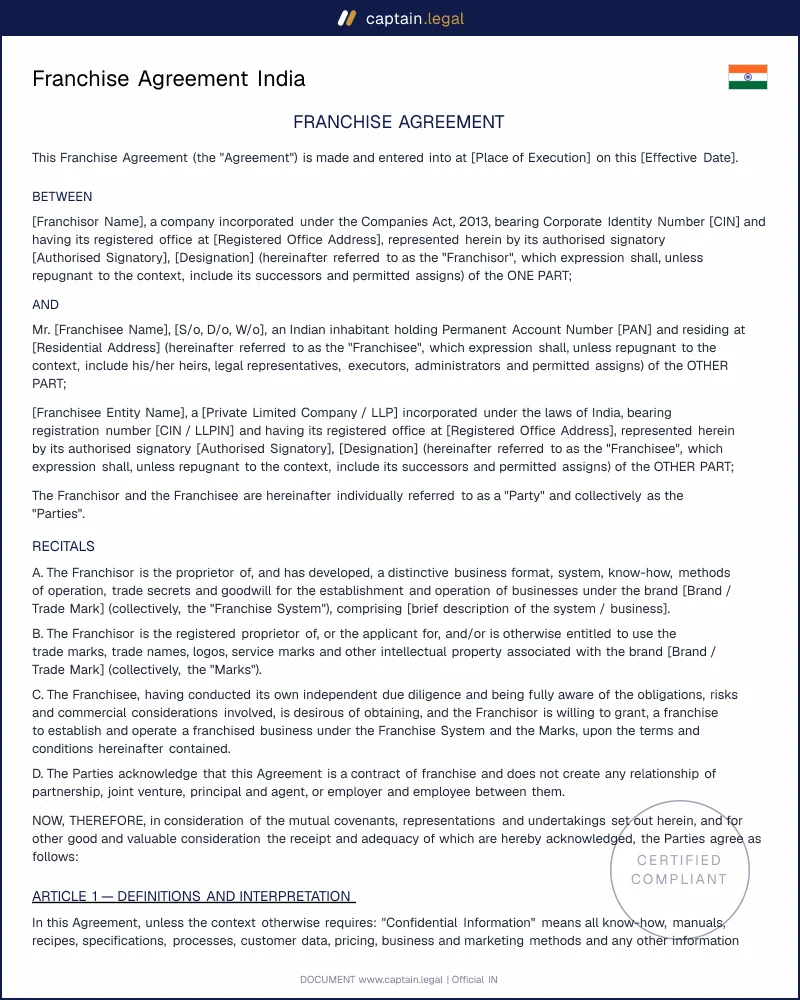
You start by choosing your role, franchisor or franchisee, because the template adjusts the protective language to whichever side you are on. From there you enter the parties' full legal names and constitution (proprietorship, partnership, LLP or company), then describe the franchised business and the trade marks being licensed, including registration numbers where the marks are registered. The form then walks you through the territory and whether it is exclusive, the term and renewal options, and the fee structure, where you set the upfront franchise fee, the royalty rate and any marketing contribution.

Next you define the operational obligations, the brand standards, the supplier and audit rights, and the events that allow either side to terminate. If you are dealing with a foreign franchisor, the template surfaces the FEMA and withholding-tax fields so the royalty clause is built correctly from the start. Once the fields are complete, you review the generated draft, adjust any clause language directly, and download the finished agreement in Word and PDF ready for signature and stamping. If you also need the brand-protection groundwork before you franchise, our trade mark and confidentiality agreement templates and the broader catalogue of Indian legal documents cover the surrounding paperwork.

6

Common mistakes to avoid

The most expensive error is skipping the registered-user recording for the trade mark. Franchisors assume that naming the mark in the contract is enough, then discover that an unrecorded licence is far weaker when they try to stop a departed franchisee from using the brand. Closely related is the overbroad post-term non-compete : drafters lift a clause that bars the ex-franchisee from any similar trade for years across the country, and the court voids it under Section 27, leaving the franchisor with nothing. The fix is to lean on enforceable confidentiality and trade-secret protection, which survives expiry, rather than a restraint the law refuses to honour.

Foreign franchisors trip on FEMA. They agree a royalty in the contract but leave the remittance mechanics silent, and the franchisee's bank then refuses to release payments because the structure was never built for the automatic route. Domestic players make the quieter mistake of under-stamping : a single agreement stamped in one State is treated as insufficiently stamped when produced in another, so it cannot be used in evidence until the shortfall and penalty are cleared. Finally, many agreements ignore the Competition Act and load in exclusive-supply and resale-price terms that look tidy but expose both parties to vertical-restraint scrutiny. Each of these is avoidable with a properly structured contract template and a deliberate review before signing.

Key takeaways

LEGAL BASIS

No Franchise Act, contract is rulebook

India has no dedicated franchise statute, so your franchise agreement carries the entire relationship. Enforceability starts with the Indian Contract Act, 1872: Section 10 requires free consent, lawful consideration and lawful object, and Section 11 bars minors from contracting. The franchise fee and ongoing royalties are the consideration, so they must be clearly stated and tied to the rights granted.

IP LICENCE

You license the brand, not sell it

Indian courts treat a franchise as a licensing arrangement, not a sale of goods: the franchisor keeps ownership of the trade marks and system, while the franchisee gets permission to use them. Under the Trade Marks Act, 1999, licensed use needs proper structuring and recording of the franchisee as a permitted user (Sections 48 and 49), or brand control and enforcement can get messy later.

RISK AREA

Post-term non-compete is often void

The clause that most often lands parties in court is the post-term non-compete. Section 27 of the Indian Contract Act, 1872 generally voids agreements that restrain someone from carrying on a lawful trade, and the Supreme Court’s Gujarat Bottling line of reasoning is frequently cited in disputes. If your exit terms rely on broad restraint rather than tight IP and confidentiality protections, termination can turn into prolonged litigation.

Frequently Asked Questions

Yes. A franchise agreement is fully enforceable once it satisfies the Indian Contract Act 1872 : free consent between competent parties, lawful consideration in the form of the franchise fee and royalty, and a lawful object. India has no separate franchise statute, so the contract itself carries the entire weight of the relationship, which makes precise drafting essential. Provided the parties are competent, the terms are clear and the trade mark licence is properly recorded under the Trade Marks Act 1999, an Indian court will enforce the agreement. A template that follows the statutory requirements and is correctly signed and stamped is binding from execution.

Most Indian franchise agreements run for an initial term of five to ten years, with one or more renewal options built in. The term is a commercial choice rather than a statutory one, since no law fixes a minimum or maximum. Franchisors often align the term with the franchisee's expected payback on the fit-out and franchise fee, so a capital-heavy format may carry a longer first term. Renewal usually depends on the franchisee meeting brand standards and being current on royalties. The agreement should also state the cure periods and termination triggers clearly, so neither side is left guessing about how the relationship ends.

This is the trap that catches most franchisors. Under Section 27 of the Indian Contract Act, any agreement that restrains a person from carrying on a lawful trade is void to that extent, and the Supreme Court in Gujarat Bottling Co. v. Coca Cola confirmed that restraints operating during the term are generally fine, while post-term restraints usually are not. A broad clause barring the ex-franchisee from any competing business for years will likely be struck down. The reliable approach is a narrowly drafted restraint tied to goodwill, backed by confidentiality and trade-secret protection, which remains enforceable after the agreement ends.

There is no central franchise registry in India, so the agreement does not need to be registered as a franchise. It does, however, attract stamp duty under the relevant State stamp law, and the rate varies from State to State. An under-stamped agreement can be inadmissible in evidence until the duty and penalty are paid, so stamp it on its value in the State where it is executed. Separately, the trade mark licence should be recorded with the Trade Marks Registry so the franchisee's permitted use is properly documented. Foreign franchisors must also ensure FEMA reporting for royalty remittances.

Both. Once you complete the guided fields, the franchise agreement is generated and available to download as a fully editable Word file and as a ready-to-sign PDF. The Word version lets you fine-tune individual clauses, adjust the royalty mechanics or add a schedule of approved suppliers, while the PDF is suited for execution and stamping. Because the agreement is built around the Indian Contract Act 1872 and the IP statutes, you can use it as drafted or adapt it to your specific format without starting from a blank page.

Yes. Foreign franchisors commonly enter India by granting master or area-development rights, and most sectors allow franchise-linked FDI through the automatic route. Single-brand retail permits up to 100% FDI, while multi-brand retail carries a lower cap, so the structure depends on the sector. The key compliance point is FEMA 1999 together with the RBI Master Directions : royalty and franchise-fee remittances must move through the automatic route and be reported correctly, and the franchisee must withhold tax under Section 195 of the Income-tax Act on payments abroad. The agreement should be drafted from the outset to satisfy these rules.

Franchise disputes in India typically rely on arbitration rather than court litigation, because the Arbitration and Conciliation Act 1996 offers a faster route than congested civil courts. A well-drafted arbitration clause naming the seat, the number of arbitrators and the governing law can compress a dispute that might otherwise take years. For urgent brand-standard or IP breaches, the franchisor can seek an injunction, now the default remedy under the Specific Relief (Amendment) Act 2018, to stop misuse of the mark while the merits are decided. Building both the arbitration clause and the injunction right into the agreement is the most effective protection.

4.7/5

19 verified reviews · 50 000+ downloads

Franchise Agreement India: Law, Clauses & FEMA
  • Immediate access to the document
  • PDF + Word download
  • Compliant with 2026 legislation
  • Reviewed by lawyers
Fill in the template
Secure payment · No subscription
Updated on June 8, 2026

You might also like

Non-Disclosure Agreement (NDA) India
Agency Agreement India