Create my document
Login

Choose country

FranceBelgiqueEspañaUnited StatesUnited KingdomMarocDeutschlandItaliaSchweiz
Contracts

Promissory Note India: Section 4 NI Act 1881

Draft a promissory note that meets Section 4 of the Negotiable Instruments Act 1881, the Stamp Act 1899 and the 3-year Limitation Act window.
4.7/536 reviews50 000+ downloadsInstant download
Share

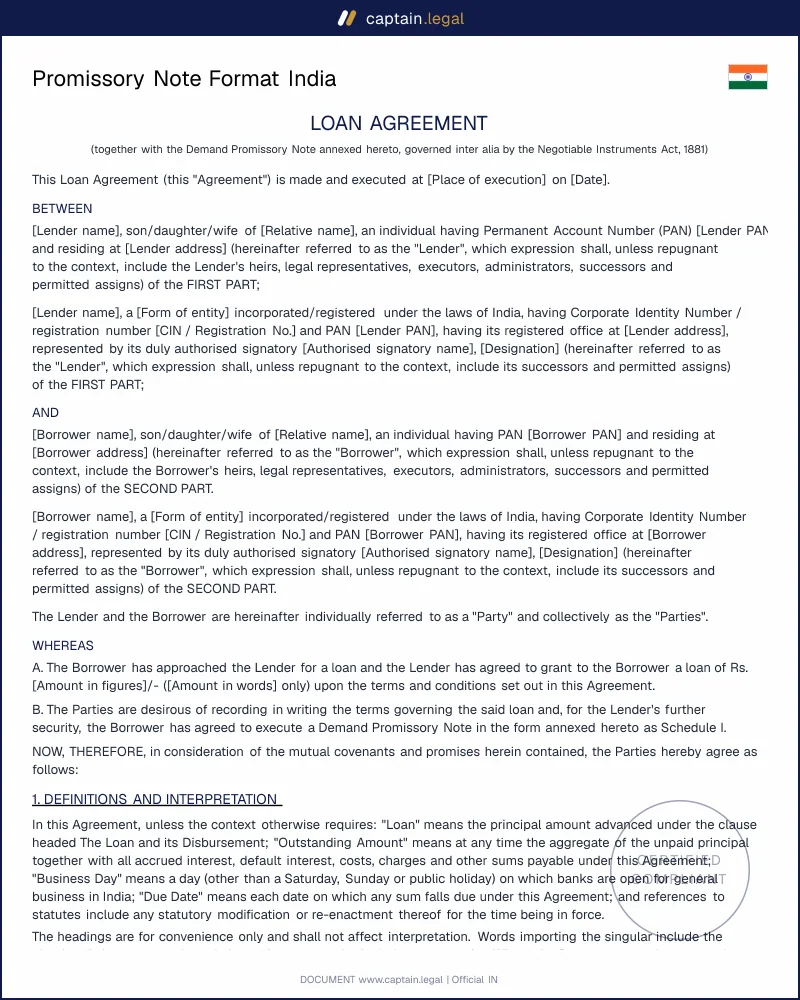
A promissory note is a written, signed promise to pay a fixed sum of money, used across India to record everything from a loan between family members to a bank's term-loan documentation. In a single page it captures the principal, the interest rate, the repayment schedule and what happens on default, turning a verbal understanding into an instrument a court will recognise. This loan and promissory note agreement is built for lenders and borrowers who want certainty in writing, drafted around Section 4 of the Negotiable Instruments Act, 1881 and the stamping rules that decide whether your document is admissible when you actually need it.

Most disputes over money lent are not about whether the loan happened. They are about the terms nobody bothered to write down. A clean note closes that gap before it opens.

Compliant

2026 Legislation

50,000+ clients

trust us

Affordable

From $4.90 / doc

Secure payment

Instant download

Promissory Note India: Section 4 NI Act 1881

Secure payment · No subscription

Fill in the template

What is a loan and promissory note agreement?

A promissory note is defined by Section 4 of the Negotiable Instruments Act, 1881 as an instrument in writing, other than a bank-note or currency-note, containing an unconditional undertaking signed by the maker to pay a certain sum of money to a named person, to that person's order, or to the bearer. The two essentials people miss are unconditional and certain sum. A note that says "I will pay if my business does well" is not a promissory note at all, because the promise is contingent. The amount must be definite on the face of the document.

A loan agreement is the broader instrument. It can run to several pages, set out covenants, security, events of default and dispute resolution, and it binds both parties under the Indian Contract Act, 1872. A promissory note is shorter and one-directional: only the borrower signs, only the borrower promises. In practice, banks use both together, a demand promissory note sitting alongside a full loan agreement, because each does a different job. The note is the clean, negotiable evidence of debt; the agreement carries the commercial terms. For an informal loan between individuals, a well-drafted note that also records interest and a repayment schedule often does the work of both. You can also pair it with a demand letter for unpaid dues if repayment stalls.

2

When do you need this document?

The everyday case is a personal loan between people who trust each other, which is precisely why nothing gets written down. A note protects the relationship by removing ambiguity: the principal, the rate, the dates. The next most common situation is a business advance, where a company lends to a director, a vendor or an associate concern and wants a clean instrument of debt rather than an entry buried in a ledger. Here the note often travels with a fuller service or commercial agreement that frames the wider relationship.

Lenders outside the banking system rely on it heavily. A private financier, a chit operator or an investor putting working capital into a startup will take a promissory note because it is short, signed only by the borrower, and easy to produce in court. Repayment by instalments is the fourth scenario, and it carries a trap worth flagging: under the Limitation Act, each instalment can have its own three-year clock unless the note says the whole sum falls due on a single default. Draft the acceleration clause carefully or you may find part of your claim time-barred while the rest survives.

One edge case legitimises a careful draft. Where a guarantor signs alongside the borrower, limitation against the guarantor runs from the date you formally invoke the guarantee, not from the date it was signed, so an old guarantee can still be live if you have not yet called on it.

3

Key clauses included in our template

  • The principal and the unconditional promise to pay sit at the top, worded to satisfy Section 4. The sum is stated in figures and words, and the undertaking is absolute, with no "if" or "subject to" that would strip the document of its character as a promissory note.
  • The interest clause fixes the rate, the method of calculation and whether interest runs from the date of the note or the date of default. Leaving interest silent does not make the loan interest-free in every case, but it invites argument, so the template states the position plainly.
  • The repayment schedule sets out whether the note is payable on demand, on a fixed date or in instalments, with the acceleration language that makes the full balance due on a single missed payment. This is where the limitation trap is closed.
  • The default and remedies clause records the consequences of non-payment, including default interest and the lender's right to sue, drafted to sit comfortably with Section 74 of the Indian Contract Act so that any penalty reads as a reasonable pre-estimate rather than an unenforceable punishment.
  • The stamping and execution block prompts you to affix the State-correct stamp and date the note properly, the single step that decides admissibility.
  • The governing law and jurisdiction clause anchors the note to Indian law and a named court, useful when borrower and lender sit in different States. A matching power of attorney for financial matters can be added where someone signs on another's behalf.
4

Regional considerations

Stamp duty on a promissory note is a State subject, so the single most important regional variable is the rate and the manner of stamping in the State of execution. Maharashtra levies duty under the Maharashtra Stamp Act and is strict on impounding insufficiently stamped instruments, a frequent issue in Mumbai's lending market. Tamil Nadu and other southern States have produced much of the leading case law on what counts as a promissory note versus a simple acknowledgment of debt, so the wording of the operative promise matters more there than most lenders assume. Karnataka, with Bengaluru's dense startup financing activity, sees promissory notes paired with convertible instruments, where the unconditional-promise requirement must be preserved or the note loses its NI Act protection.

In Delhi and the National Capital Region, e-stamping through the authorised collecting agencies is the norm, and the note should carry the e-stamp certificate matching its value and date. West Bengal retains its own schedule under the Indian Stamp Act as locally amended. Across every State the principle is identical even where the figure differs: stamp on the value, stamp in the State of execution, and stamp at the time of execution. A note stamped after a dispute arises is admitted only after duty and penalty are cleared, and the penalty can dwarf the original duty.

5

How to fill out this loan and promissory note agreement

You begin by naming the parties, the maker who promises to pay and the payee who is owed, with full addresses, because a note that names the borrower vaguely invites a challenge to identity. From there you enter the principal in figures and words, then choose the interest treatment: a fixed annual rate, simple or compound, and the date from which it runs. The guided form then asks how repayment works, on demand, on a fixed date or by instalments, and adjusts the acceleration and limitation wording to match your choice.

Next you set the default terms, including any default rate of interest and the lender's right to recover, and you select the governing State and court. The tool flags the stamping step before you finish, reminding you to apply the correct State stamp at execution rather than leaving it for later. You then download the completed note in Word and PDF, sign it, have the borrower sign as maker, and affix the stamp. If you need to chase payment afterwards, the same workflow lets you generate a matching legal notice for recovery of money.

6

Common mistakes to avoid

The mistake that ends the most cases is bad stamping. Lenders treat the stamp as a formality and discover, years later, that an insufficiently stamped note cannot go into evidence until the duty and a heavy penalty are paid, sometimes after the underlying claim has already weakened. The second is leaving the promise conditional. A note that promises to pay "after I sell my property" or "out of profits" fails the Section 4 test of an unconditional undertaking, and what the lender holds is no longer a promissory note at all, losing the procedural advantages that come with one.

Limitation causes the third cluster of failures. A lender sits on a demand note for more than three years, the claim becomes time-barred, and the only rescue is a written acknowledgment obtained in time under Section 18 of the Limitation Act. Instalment notes drafted without a clean acceleration clause produce the same result piecemeal. Two further errors recur: naming the borrower so loosely that identity can be disputed, and assuming the cheque-bounce remedy under Section 138 applies to a promissory note. It does not. A promissory note is enforced by a civil suit for recovery, not by the criminal cheque-dishonour route, and confusing the two wastes months.

Key takeaways

SECTION 4

Unconditional promise for a certain sum

To qualify as a promissory note under Section 4 of the Negotiable Instruments Act, 1881, the writing must carry an unconditional undertaking to pay a certain sum of money, and it must be signed by the maker (borrower). If you add conditions like “only if my business does well”, or leave the amount unclear, you lose the status and the easy enforceability.

STAMP DUTY

Stamp it correctly or it may fail

Stamping under the Indian Stamp Act, 1899 is not a formality. Stamp duty on a promissory note depends on the relevant State schedule, and it should be affixed at the time of execution in the State where the note is made. An unstamped or insufficiently stamped note is inadmissible in evidence until duty and penalty are paid, which can derail recovery when you need the document most.

LIMITATION

Three-year clock decides your remedy

Limitation can quietly kill an otherwise solid claim. Under the Limitation Act, 1963, a suit on a demand promissory note must be filed within three years from the date of the note. If the note is payable at a fixed time, the three years run from when that time expires. If you miss the window, the debt may still be owed, but court enforcement is barred.

Frequently Asked Questions

Yes, provided three conditions are met. The note must satisfy Section 4 of the Negotiable Instruments Act, 1881 with an unconditional promise to pay a certain sum, it must be supported by lawful consideration and signed by a party competent to contract under the Indian Contract Act, 1872, and it must be properly stamped under the Indian Stamp Act, 1899. Our template is drafted to meet the first two conditions out of the box, with the operative promise worded to preserve its character as a promissory note. The stamping is the one step you complete yourself, because the rate is set by your State. A correctly stamped, signed note is enforceable through a civil suit for recovery.

Stamp duty on a promissory note is fixed by the State where the note is executed, under the Indian Stamp Act, 1899 read with the relevant State schedule, so there is no single national figure. You stamp on the value of the note and at the time you execute it, using physical revenue stamps or e-stamping where your State offers it. Do not postpone stamping. An unstamped or under-stamped note is inadmissible in evidence until you pay the deficient duty plus a penalty, which can run to several times the original amount. Check your State's current rate with the local sub-registrar or stamp authority before you sign.

The Limitation Act, 1963 gives you three years. For a note payable on demand, the three years run from the date of the note. For a note payable at a fixed time, they run from the day that fixed time expires. If you let the period lapse the debt is not extinguished, but you lose the right to sue, which makes recovery practically impossible. A written and signed acknowledgment of the debt by the borrower under Section 18 before the period ends starts a fresh three-year window. Diary the limitation date the moment you make the loan.

These are two separate remedies and people routinely confuse them. If repayment is made by cheque and the cheque is dishonoured, you may have a criminal complaint under Section 138 of the Negotiable Instruments Act, 1881, which carries its own notice and timeline. The promissory note itself is enforced differently, by a civil suit for recovery of the sum promised. One does not replace the other. Be careful with part-payments too: accepting partial repayment and then presenting an old cheque for the full amount can defeat a Section 138 complaint, because the cheque no longer reflects a legally enforceable debt for that figure.

A promissory note is short and one-sided. Only the borrower signs, and it records a single unconditional promise to pay, which makes it easy to produce and enforce. A loan agreement is broader, signed by both parties, and can carry covenants, security, representations, default events and detailed dispute-resolution terms under the Indian Contract Act, 1872. For an informal loan, a well-drafted note that also captures interest and repayment often suffices. For a structured or secured loan you want both, the agreement for the commercial terms and the note as clean evidence of the debt. Our template lets you record interest and a schedule so a single note can do most of the work for a private loan.

A promissory note is not a compulsorily attestable document under Indian law, and courts have held that the presence or absence of witnesses does not affect its validity, nor does adding signatures later amount to a material alteration. So you do not strictly need witnesses or a notary for the note to be valid and enforceable. That said, a witness or notarisation adds evidentiary weight if the borrower later disputes signing, and it costs little. The two things you genuinely cannot skip are the borrower's signature as maker and correct stamping. Those decide validity and admissibility; witnesses simply strengthen your proof.

Yes, you can and should state the interest rate expressly, including whether it is simple or compound and the date from which it runs. The template prompts for all of this. There is no single national ceiling for private lending interest, but courts can reduce a rate they find unconscionable or penal, and a default rate dressed up as a penalty may be cut down under Section 74 of the Indian Contract Act, 1872 to a reasonable pre-estimate of loss. State money-lending legislation may also apply if you lend as a business rather than as a one-off. Keep the rate commercially reasonable and stated clearly, and it will hold.

You receive the completed loan and promissory note agreement in both Word and PDF. The PDF is ready to print, sign and stamp immediately, which suits most private loans where you simply want a clean signed instrument. The Word version lets you adjust any clause before finalising, useful when a borrower's circumstances need a tailored repayment schedule or an extra covenant. Whichever format you use, the document is the same legally sound draft. Print the final version, have the maker sign it, affix the State-correct stamp at execution, and keep the original safe, because on a promissory note the holder of the signed original is in the strongest position.

4.7/5

36 verified reviews · 50 000+ downloads

Promissory Note India: Section 4 NI Act 1881
  • Immediate access to the document
  • PDF + Word download
  • Compliant with 2026 legislation
  • Reviewed by lawyers
Fill in the template
Secure payment · No subscription
Updated on June 8, 2026

You might also like

Service Agreement India
Non-Disclosure Agreement (NDA) India