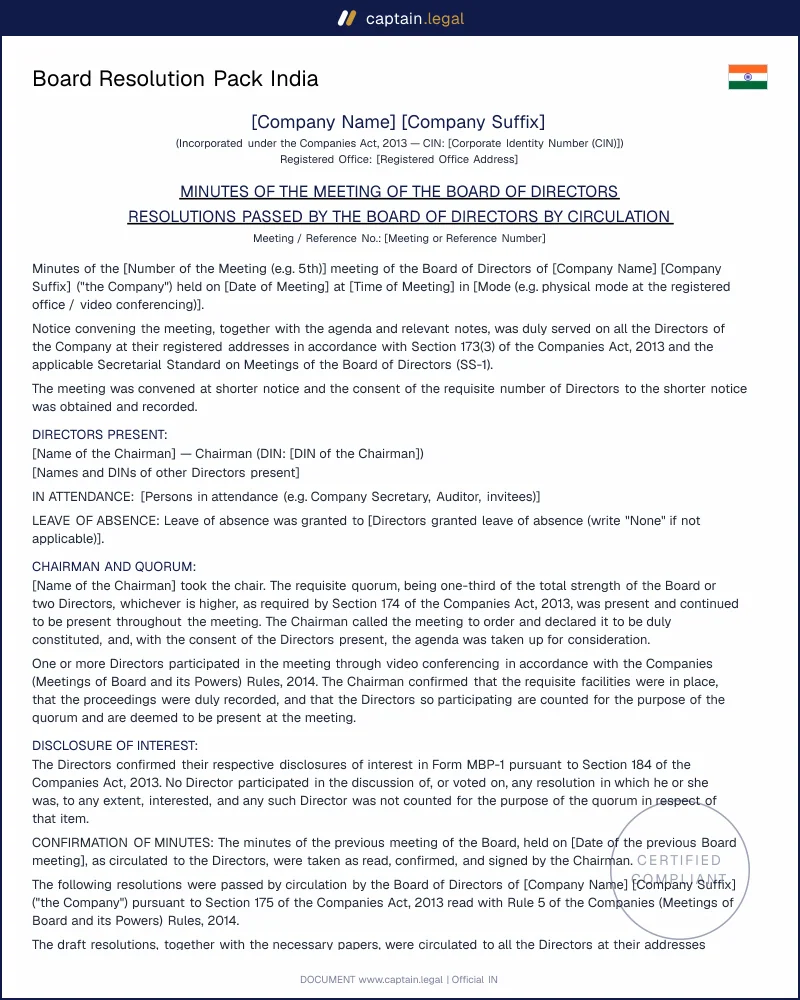
The Board's authority flows from Section 179 of the Companies Act, 2013, read with Rule 8 of the Companies (Meetings of Board and its Powers) Rules, 2014. Section 179(3) lists the powers a Board may exercise only by a resolution passed at a properly convened meeting, not by circulation: making calls on shares, authorising buy-back under Section 68, issuing securities including debentures under clause (c), borrowing monies under clause (d), investing the company's funds, granting loans, approving financial statements and the Board's report, and diversifying the business. A banking-authority resolution rests on Section 179(3)(d) and the company's articles, and it is the document every scheduled bank in India will demand before opening a current account in the company's name.
Quorum is governed by Section 174, which fixes the quorum for a board meeting at one-third of the total strength or two directors, whichever is higher. A resolution passed without quorum is void, so the minutes must state the number of directors present. Where the matter is urgent and a meeting is impractical, Section 175 permits a resolution by circulation, though the Section 179(3) powers above cannot travel that route. Once passed, Section 118 and Secretarial Standard SS-1 require the resolution to be entered in the minute book and the minutes finalised within thirty days of the meeting, signed by the chairman.
Filing obligations deserve close attention. Certain Section 179(3) resolutions must ordinarily be filed with the Registrar in Form MGT-14 within thirty days, but private companies are exempted from filing MGT-14 for board resolutions passed under Section 179(3) by virtue of the exemption notification dated 5 June 2015. That exemption does not extend to shareholder special resolutions, which still go on the public record. You can confirm the operative wording against the official text on the Ministry of Corporate Affairs portal for the Companies Act, the authoritative source for the Act and its rules.