Create my document
Login

Choose country

FranceBelgiqueEspañaUnited StatesUnited KingdomMarocDeutschlandItaliaSchweiz
Personal & Family

Gap Affidavit India: Oaths Act 1969 Compliant

Sworn gap affidavit under the Oaths Act 1969 and Notaries Act 1952. Notary-attested format with verification clause, valid nationwide.
4.7/532 reviews50 000+ downloadsInstant download
Share

A gap affidavit is a sworn self-declaration on non-judicial stamp paper in which a person explains an interruption in their studies or employment, confirms the exact dates of the break, states the reason behind it and declares that they engaged in no unlawful activity during that period. In India it is the standard way to account for a career break or an academic gap when an employer, a university or a visa officer asks for a formal explanation. The document is signed before a Notary Public and carries the weight of an oath. This affidavit for gap in education or employment is routinely requested during campus admissions, lateral hiring, professional-college enrolment and study-visa processing, and a clean, correctly attested version often decides how quickly an application moves forward.

Most candidates discover they need one only when an HR team or an admissions cell flags a discontinuity on the resume or the marksheet. Drafting it well, with the right statutory footing, is what separates a document that is accepted at the counter from one that bounces back for re-execution.

Compliant

2026 Legislation

50,000+ clients

trust us

Affordable

From $4.90 / doc

Secure payment

Instant download

Gap Affidavit India: Oaths Act 1969 Compliant

Secure payment · No subscription

Fill in the template

What is a gap affidavit?

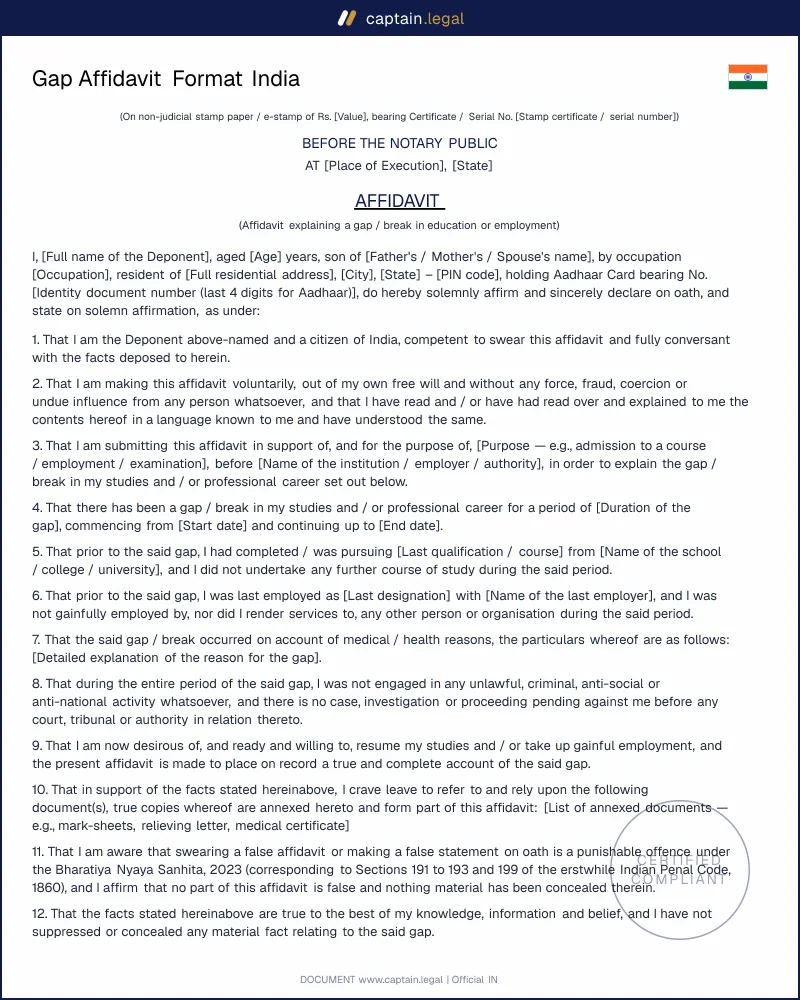
A gap affidavit is a written statement of fact made on oath. The person making it, called the deponent, swears that everything stated is true to their personal knowledge, then signs in the presence of an officer authorised to administer oaths. Once that officer attests it with seal and registration number, the paper stops being a private letter and becomes a legally recognised sworn declaration. The substance is narrow: who you are, the precise window of the gap, what you did during it, and a confirmation of good conduct.

People often confuse this with a gap certificate issued by a college, and the distinction matters in practice. A college-issued gap certificate is an administrative letter from your previous institution; many universities and almost all employers will not accept it on its own and instead insist on a notarised affidavit, because the affidavit attaches criminal liability for falsehood and the letter does not. The affidavit is also broader, since it covers employment breaks that no school would ever certify. If the institution's own portal carries a prescribed form, use that form rather than a generic affidavit, because admissions cells reject mismatched formats far more often than they reject the content. Where no prescribed form exists, the open affidavit drafted on stamp paper is the universally accepted route, recognised across Indian universities, employers and consulates without a central issuing authority behind it.

2

When do you need this document?

The most frequent trigger is a break between two academic qualifications, the classic case being a student who paused after Class 12 to prepare for NEET or JEE and now needs to account for the missing year at the time of college admission. Professional colleges and government institutions ask for it almost reflexively, and they expect the affidavit dates to line up exactly with the marksheet dates. The second common scenario is an employment gap on a resume: an HR team running a background check spots several months without a payslip or an EPF contribution and asks the candidate to explain the interval before the offer is confirmed. Lateral hires and returns from a sabbatical fall into the same bucket, where the affidavit becomes the formal record that the gap was for a legitimate purpose.

Two further situations recur in practice. Study-visa applications to most foreign consulates require a notarised gap explanation, and here the affidavit must match the statement of purpose date for date, because a mismatch between the two documents is the single most common reason a visa officer raises the question at interview. Education-loan sanctioning is the quieter fourth case, since banks reviewing a borrower's continuity will often condition disbursal on a clean account of any break. An edge case worth flagging is the candidate who worked informally or freelanced during the gap: that period is not strictly "unemployment", and the affidavit should describe it accurately as self-employment or contract work rather than forcing it into a tidy but false "no activity" box, because the supporting proof attached later must corroborate whatever the affidavit claims.

3

Key clauses included in our template

  • The deponent identification block opens the affidavit with your full legal name exactly as it appears on your Aadhaar or PAN, your parentage, age and complete residential address. Counters reject affidavits where the name differs even slightly from the supporting ID, so this clause is drafted to mirror your official records rather than a shortened or anglicised version.
  • The statement of the gap period records the precise start and end dates of the break in the format an Indian authority expects, for example 15 June 2022 to 14 July 2023. Vague phrasing like "about a year" is replaced by exact dates because these have to reconcile with your marksheet, relieving letter or last payslip without any discrepancy.
  • The reason for the gap sets out the genuine ground in a single clear paragraph, whether it was competitive-exam preparation, a medical condition, family responsibility, financial constraint or an upskilling course. The clause is written to be specific enough to be credible yet limited to facts you can actually prove, since a reason that cannot be backed by a document invites a follow-up question.
  • The declaration of good conduct is the clause institutions specifically look for, confirming that during the stated period you were not involved in any unlawful or criminal activity. This is the assurance an employer or university relies on, and it is phrased as a sworn statement rather than a casual claim.
  • The verification clause closes the affidavit by certifying that the contents are true to the deponent's personal knowledge, with belief-based facts clearly identified as such. A missing or unsigned verification is one of the commonest grounds on which an affidavit is treated as defective, so our family and personal affidavit formats build it in by default.
4

Regional considerations

Stamp duty and execution practice are governed at the State level, so the same gap affidavit can attract a slightly different process depending on where you swear it. Maharashtra is one of the stricter States on execution: affidavits are commonly printed on stamp paper purchased through the e-SBTR or franking route, and Mumbai and Pune admissions cells are particular about a legible notary seal and registration number. A candidate who is also handling a tenancy or address matter in the State will find the leave and licence and rent documentation for Maharashtra follows the same e-stamping logic, which makes the affidavit process familiar.

Karnataka routes most non-judicial stamp paper through the e-Stamping system operated via authorised vendors, and Bengaluru's large pool of IT employers means employment-gap affidavits are processed in volume; the practical risk here is a notary whose appointment area is narrow, so confirm the attesting officer's jurisdiction. Delhi treats the affidavit as straightforward, with Oath Commissioners and Notaries widely available near the district courts, but central-government institutions in the capital scrutinise the good-conduct clause closely. Tamil Nadu and Telangana both rely on e-stamping and accept notarised affidavits readily, though Chennai universities sometimes prefer their own admission-portal form over an open affidavit. Across every State the underlying law is identical, since the Oaths Act and Notaries Act are central statutes; what varies is the stamp value, the vendor channel and the local appetite for a prescribed format. When the affidavit supports a name discrepancy alongside the gap, pairing it with the appropriate name-change and declaration formats avoids a second trip to the notary.

5

How to fill out this gap affidavit

You start by entering your personal details exactly as they read on your official identity document, because the affidavit is checked against that ID at the counter and any mismatch sends it back. From there you set the two dates that bound the gap, taking them straight from your last marksheet, relieving letter or final payslip so they reconcile cleanly with the record the institution already holds. Next you state the reason in plain terms and select whether the break was academic, professional or both, after which the affidavit folds in the standard good-conduct declaration and the verification clause automatically. Once the draft is complete you download it as Word or PDF, print it on non-judicial stamp paper of the value applicable in your State, and carry your ID together with any supporting proof such as a medical certificate or work-experience letter. The final and non-negotiable step happens in person: you sign before a Notary Public or Oath Commissioner, who administers the oath and attests the document with seal and registration number. Only after that attestation does the paper become a valid affidavit. If you also need a companion document for the same application, the employment relieving and experience letters for India slot neatly alongside the affidavit.

6

Common mistakes to avoid

The mistake that derails the most applications is a date mismatch between the affidavit and the underlying records. People round the gap to "one year" or copy an approximate period from memory, and the admissions cell or HR team spots the discrepancy against the marksheet or the EPF statement immediately. The cure is to lift the exact dates from the source document and never paraphrase them. A close second is skipping notarisation or treating it as a formality that can be done later; an un-attested affidavit has no legal standing, will not be accepted, and cannot simply be amended afterwards, since a sworn statement can only be corrected through a fresh affidavit rather than a struck-through line.

The third recurring error is using the wrong format. Several Australian and German universities, and a number of Indian professional colleges, publish their own gap form on the admissions portal and will refuse a generic affidavit no matter how well drafted, so checking the portal before buying stamp paper saves a wasted execution. The fourth is the temptation to soften the truth, describing a freelance stint as full unemployment or inventing a tidier reason, which is both risky and pointless: the supporting proof attached later has to corroborate the affidavit, and a false sworn statement exposes the deponent to perjury liability. The last avoidable slip is an unsigned verification clause or an affidavit sworn before an officer outside their jurisdiction, either of which renders the document defective on its face. A quick read of the personal and family legal document overview for India shows the attestation standards these institutions apply.

Key takeaways

PURPOSE

Explain the gap with exact dates

A gap affidavit is a sworn self-declaration on non-judicial stamp paper to explain a break in studies or employment. It should clearly state who you are, the precise start and end dates of the gap, the reason, and what you did during that period, including a declaration of good conduct. This is commonly asked by HR, admissions, and visa teams when they spot discontinuities.

FORMAT

Notarised oath, not a college letter

Do not confuse a gap affidavit with a gap certificate from a college. Many universities and most employers want a notarised affidavit because it is made on oath, signed by the deponent in front of a Notary Public, and includes verification with the notary seal and registration details. If an institution provides its own prescribed format on its portal, use that format to avoid rejection.

LEGAL RISK

False statements can trigger perjury liability

Because it is sworn, a gap affidavit is not a casual explanation letter. The oath is administered under the Oaths Act, 1969 (Section 4), and the notary’s authority comes from the Notaries Act, 1952, giving the document nationwide recognition. If you state incorrect dates or invent reasons, it can move beyond an application issue into criminal exposure for a false declaration on oath.

Frequently Asked Questions

Yes. A gap affidavit is a sworn statement and, once attested by a Notary Public or Oath Commissioner under the Oaths Act, 1969, it carries full legal weight and is presumed authentic across India under the Notaries Act, 1952. Its binding character comes precisely from the oath: by signing, the deponent accepts that a false statement is perjury under Section 227 of the Bharatiya Nyaya Sanhita, 2023, punishable with imprisonment up to seven years and fine. That is why an employer or university treats a notarised affidavit as reliable proof where it would not accept an ordinary letter. An un-notarised draft, by contrast, has no legal standing at all.

You can download the document in both Word and PDF, which covers the two ways the affidavit is actually used. The Word version lets you adjust any wording an institution's portal specifically requires before you print, while the PDF gives you a clean, fixed copy for your own records and for sharing. Either format still has to be printed on non-judicial stamp paper and signed in person before a notary, because the attestation cannot happen on a screen. Keeping a scanned copy of the fully executed and stamped affidavit is sensible, since you will often need to show the original at a counter but submit a copy with the application.

The drafting itself takes only a few minutes once you have your dates and reason ready. The notarisation is what governs the timeline, and in most cities it is same-day: you carry the printed affidavit on stamp paper to a Notary Public or Oath Commissioner, who administers the oath and attests it on the spot. Allow extra time only where you need to buy stamp paper through a State e-stamping vendor first, which can add a short queue. There is no waiting period or cooling-off built into the law, so the limiting factor is simply reaching an authorised officer with your ID and supporting documents in hand.

You attach proof of identity and proof of the gap itself. Identity is established with your Aadhaar, PAN, voter ID or driving licence, and the copy must match the name on the affidavit exactly. For the gap, you attach whatever corroborates your stated reason and dates: a previous marksheet or transfer certificate for an academic break, a medical certificate for a health reason, or a relieving letter and work-experience proof if you were employed. Where you worked or interned during the period, those documents matter, and the work-experience certificate formats for India line up directly with what the affidavit declares.

Under the Oaths Act, 1969 and the Notaries Act, 1952, the affidavit may be sworn before a Notary Public appointed under the 1952 Act, a Commissioner of Oaths appointed by a High Court or Court of Session, or a Judge or Magistrate within their jurisdiction. For Indians abroad, consular officers at Indian missions hold attestation powers. For a routine education or employment gap, a Notary Public is the usual and most accessible route, and the attesting officer must add their seal and registration number. An affidavit attested by anyone outside these categories has no validity, so confirming the officer's authority before you sign protects you from a rejected document.

Yes, a single affidavit can cover a combined break, which is common for someone who left studies, worked informally, then returned to education. The key is that the affidavit must describe each segment accurately with its own dates and reason rather than collapsing everything into one vague period. Treating a freelance or contract stretch honestly as self-employment, instead of labelling the whole interval "unemployment", keeps the affidavit consistent with the supporting proof you attach. As long as every date reconciles with your records and the verification clause is signed, one well-drafted affidavit serves both purposes without needing a second document.

The affidavit does not carry an expiry date in the legal sense; it remains a true record of a fixed, completed period, so it stays valid for the gap it describes indefinitely. In practice, some institutions ask for a recently executed affidavit, meaning one notarised close to the application date, simply to confirm the declaration is current and signed by the same person. If an admissions cell or employer specifies a freshness window, the simplest course is to swear a new affidavit on fresh stamp paper rather than argue the point, since re-execution is quick and inexpensive.

A false gap affidavit exposes the deponent to criminal liability, not just rejection. Because the statement is made on oath, a deliberate falsehood is perjury under Section 227 of the Bharatiya Nyaya Sanhita, 2023, carrying imprisonment that can extend to seven years along with a fine. Beyond the criminal angle, the institution that relied on the affidavit can withdraw an admission or an offer and may treat the application as fraudulent. A correction cannot be made by amending the original; it requires a completely fresh affidavit, and filing that correction does not erase liability already attached to the earlier false statement. The safe approach is to state only what you can prove and to attach the documents that back it.

4.7/5

32 verified reviews · 50 000+ downloads

Gap Affidavit India: Oaths Act 1969 Compliant
  • Immediate access to the document
  • PDF + Word download
  • Compliant with 2026 legislation
  • Reviewed by lawyers
Fill in the template
Secure payment · No subscription
Updated on June 9, 2026

You might also like

Last Will and Testament India
Income Affidavit India