Create my document
Login

Choose country

FranceBelgiqueEspañaUnited StatesUnited KingdomMarocDeutschlandItaliaSchweiz
Employment & HR

Salary Slip Format India: Section 33 Code on Wages

Issue a wage slip that meets Section 33 of the Code on Wages 2019. Correct basic, PF and TDS breakup under the new Labour Codes. Word and PDF.
4.7/517 reviews50 000+ downloadsInstant download
Share

A salary slip, also called a payslip, is the monthly statement an Indian employer issues to an employee setting out gross earnings, every component of the pay structure, the statutory deductions applied, and the net amount actually paid. It is the single most requested income document in the country : banks ask for the last three to six months before sanctioning a home or personal loan, embassies attach it to visa files, and the income tax department treats it as primary evidence when you file your return. A compliant salary slip format records basic pay, House Rent Allowance, provident fund and the full deduction trail in a layout that an auditor, a loan officer or a visa officer can read without explanation. The document is not a courtesy gesture from HR. Issuing it is a legal duty.

This template produces a payslip that stands up to scrutiny from a bank, an embassy and the labour department alike, built around the wage structure India now follows after the new Labour Codes came into force.

Compliant

2026 Legislation

50,000+ clients

trust us

Affordable

From $4.90 / doc

Secure payment

Instant download

Salary Slip Format India: Section 33 Code on Wages

Secure payment · No subscription

Fill in the template

What is a salary slip and why does it matter?

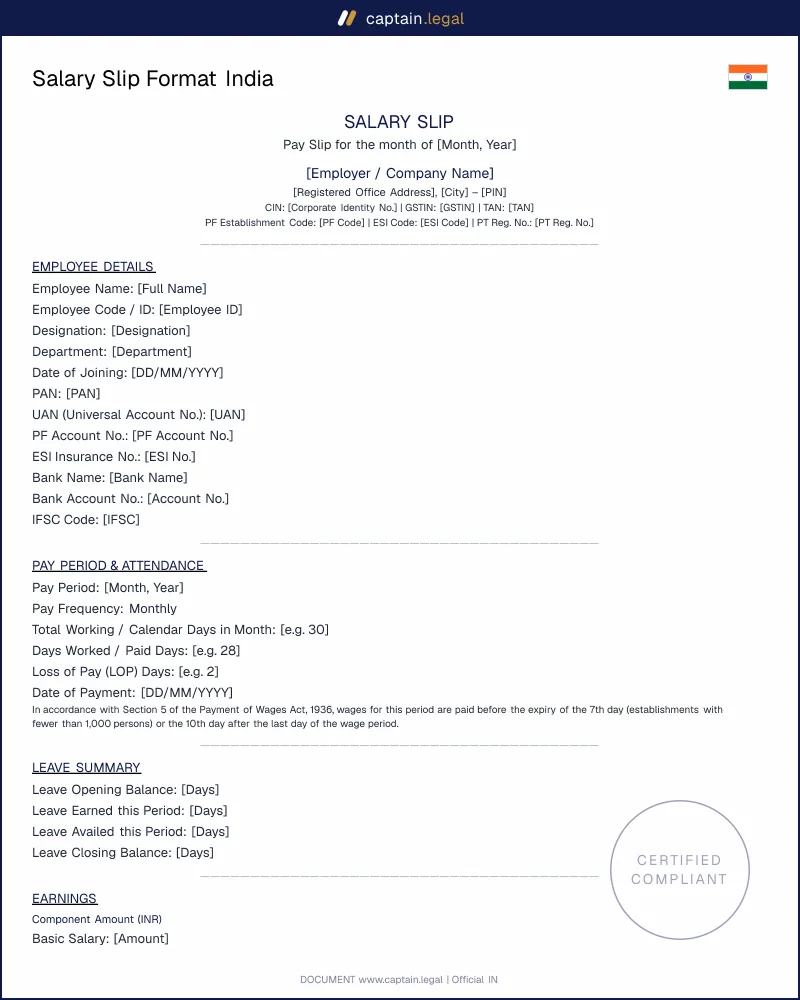
A salary slip is a dated, employer-issued record of one wage period, typically a calendar month, showing what the employee earned and what was withheld. It splits into three blocks that every Indian payroll follows : the earnings side listing Basic, HRA, Dearness Allowance, special and conveyance allowances ; the deductions side listing employee Provident Fund, ESI where applicable, Professional Tax and TDS ; and a summary stating gross earnings, total deductions and net salary payable, usually printed in both figures and words.

People confuse the payslip with the CTC sheet and the Form 16, and the distinction matters. The CTC breakup is an annual projection handed over at the offer stage and includes the employer's own PF and gratuity contributions, which never appear as your take-home. Form 16 is the year-end TDS certificate the employer files for tax purposes. The salary slip sits between them as the monthly proof of what was actually credited to your bank account. A bank assessing a loan reads the payslip, not the CTC letter, because it wants the real net figure. If your basic pay shows as a suspiciously small fraction of gross, expect the loan officer to question it, since lenders treat artificially low basic as a sign of an inflated allowance structure. For the contract that fixes this structure in the first place, see our employment contract and appointment letter for India.

2

When do you need this document?

The everyday trigger is the monthly payroll run. Every salaried employee is entitled to a payslip for the wage period, and an employer who skips it is exposed the moment a dispute or an inspection arises. Beyond routine issuance, the highest-stakes use is the loan application. Banks and NBFCs ask for the most recent three to six months of slips to verify income before sanctioning a home loan, a personal loan or a credit card, and they reject slips that are unsigned or lack the company letterhead.

Visa processing is the next big one. Consular officers for the Schengen, UK, US and Gulf routes treat the payslip as proof of stable employment and means, usually paired with bank statements showing the same net credit. Then comes the annual ritual of income tax filing, where the slip reconciles your declared salary against Form 16 and your Form 26AS. Tenancy is an underrated use : landlords in metros increasingly ask prospective tenants for recent slips, and the HRA line on your payslip is also what you rely on when claiming the rent exemption, which is why a clean rent receipt for an HRA claim should match the figures on your slip. One edge case worth flagging : an employee on loss of pay leave should still receive a slip, because the LOP line is precisely what a lender will scrutinise to understand a dip in net pay.

3

Key clauses included in our template

  • The employer and employee identification block carries the company name and registered address, the employee name, designation, employee code, PAN, UAN (the universal PF account number) and the bank account into which salary is credited. Lenders and visa officers check that the name and account match the supporting bank statement, so a mismatch here is a common reason for rejection.
  • The earnings side itemises Basic (now typically held at or above 50% of gross to satisfy the Code on Wages wage definition), House Rent Allowance, Dearness Allowance, Special Allowance, Conveyance and Medical Allowance. Each line is shown separately rather than rolled into a single figure, because partial tax exemptions on HRA and conveyance depend on the component being visible.
  • The deductions side lists employee Provident Fund at 12% of basic (capped where basic is taken at the ₹15,000 statutory ceiling, giving a maximum employee contribution of ₹1,800), ESI at 0.75% of gross for employees drawing up to ₹21,000 a month, Professional Tax per the state slab, and TDS deducted under the income tax law. The template keeps zero-value lines visible for transparency.
  • The attendance and pay-period block records the wage month, total paid days, LOP days and the date of payment, because a lender reading a lower net amount needs the LOP figure to explain it.
  • The net pay summary states gross earnings, total deductions and net salary payable, printed in both figures and words, with the payment mode noted as bank transfer alongside the last four digits of the account. This is the figure a bank underwrites against.
4

State-specific considerations

Payslip law in India layers a central code over State-level rules, and the part that varies most by state is Professional Tax, a deduction levied by states rather than the centre.

Maharashtra levies Professional Tax under the Maharashtra State Tax on Professions, Trades, Callings and Employments Act, 1975, with monthly slabs that top out at ₹200 (and ₹300 in the final month of the year for higher earners). A Mumbai or Pune payslip without a PT line is immediately suspect to a local bank, and employers registered under the Maharashtra Shops and Establishments Act must reflect the deduction every month.

Karnataka deducts Professional Tax under its own Profession Tax Act for employees in Bengaluru and across the state, currently exempting lower earners and capping the deduction at ₹200 a month. Given the IT workforce concentration, Bengaluru payslips are among the most heavily scrutinised by visa consulates, so the UAN and PAN fields must be populated correctly.

Tamil Nadu administers Professional Tax through local bodies such as the Greater Chennai Corporation on a half-yearly basis, which means the PT deduction often appears as a larger periodic figure rather than a small monthly one, a difference a Chennai employee should expect to see.

Delhi does not levy Professional Tax at all, so a compliant Delhi payslip will simply omit the PT line, and its presence on a Delhi slip is itself an error. The PF and ESI lines, being central, appear identically across all states.

5

How to fill out this salary slip

You begin by entering the company details and the wage month, then add the employee's identification, including PAN and UAN, so the slip ties back to the EPFO and tax records. From there you enter the agreed salary structure : the form lets you set Basic, HRA, DA and the allowances, and it flags the position if basic falls below the 50% threshold the Code on Wages now expects. Once the earnings are in, the template applies the statutory deductions, calculating employee Provident Fund at 12% of basic against the ₹15,000 ceiling, ESI where the employee draws up to ₹21,000, the Professional Tax slab for the selected state, and the TDS figure you supply from payroll. You then record paid days and any LOP, and the slip computes gross, total deductions and net salary payable in figures and words. The output downloads as a Word file you can put on company letterhead and as a finished PDF, the format banks and consulates accept. If you are also setting up the underlying engagement, the linked offer letter aligned with the Code on Wages keeps the promised structure consistent with what later appears on the slip.

6

Common mistakes to avoid

The most damaging error is calculating Provident Fund on the wrong base. PF is 12% of basic pay, not of gross or CTC, and keeping basic artificially low to shrink the PF outflow is exactly the practice the Code on Wages 50% rule now penalises by deeming the excess allowances back into wages. Employers who left basic at a quarter of CTC are finding their PF, gratuity and ESI bases recalculated, and a payslip that still shows a token basic will not survive an inspection. A close second is omitting the PAN and UAN, which makes the slip useless for tax reconciliation and for the employee's own EPFO claims.

Another frequent failure is issuing an unsigned slip or one without the company letterhead, which banks reject outright as proof of income. Employers also stumble on Professional Tax by applying the wrong state slab or, in Delhi's case, deducting PT where none is due. Finally, many leave off zero-value lines or hide the LOP figure, when transparency is precisely what makes the document credible. A lender seeing a lower net pay needs the LOP line to understand it ; without it the slip raises a question instead of answering one. Keep payroll records for at least three years, since the limitation period for wage claims under the Code is now three years.

Key takeaways

LEGAL DUTY

Payslips are mandatory under Section 33

From 21 November 2025, the Code on Wages, 2019 governs wage records. Section 33 requires every employer to maintain wage registers and issue wage slips in the prescribed form to all workers. This is not an HR courtesy; it is a compliance obligation tied to statutory record-keeping. Non-maintenance can attract a fine up to ₹10,000, apart from other wage-related penalties.

PAY STRUCTURE

The 50% rule can change basics

The Code on Wages uses a standard definition of wages in Section 2(y): basic pay plus dearness allowance. If excluded allowances like HRA and conveyance together exceed 50% of total remuneration, the excess is treated as wages. That reshapes the base on which PF, ESI and gratuity are computed, and has pushed many employers to move away from a 20–30% basic-heavy allowance structure.

PRACTICAL USE

Banks and visas rely on net pay

A salary slip is the monthly proof of what was earned, what was deducted (PF, ESI where applicable, Professional Tax, TDS), and what was actually credited as take-home. Banks often ask for the last three to six months for loan processing, and embassies attach it to visa applications. Do not confuse it with CTC projections or Form 16; lenders read the payslip and may question an unusually low basic.

Frequently Asked Questions

Yes. Issuing a payslip is a statutory duty, not an HR courtesy. Until late 2025 the obligation sat in the Payment of Wages Act, 1936 ; since 21 November 2025 it rests on Section 33 of the Code on Wages, 2019, which requires every employer to maintain a wage register and issue wage slips in the prescribed form to all workers, regardless of salary level. Non-maintenance of records can attract a fine up to ₹10,000, and underpayment of wages exposes the employer to far larger penalties. State Shops and Establishments rules reinforce the same requirement, so an employer who fails to issue slips is exposed on both central and state fronts.

A compliant Indian salary slip shows three blocks. The earnings side lists Basic, HRA, Dearness Allowance and any special, conveyance or medical allowances. The deductions side lists employee Provident Fund, ESI where the employee qualifies, Professional Tax per the state slab, and TDS. The summary states gross earnings, total deductions and net salary payable in both figures and words. Identification details, the employee PAN, the UAN, paid days and the wage month complete the document. Each component appears as a separate line because partial tax exemptions on HRA depend on the figure being visible.

Employee Provident Fund is 12% of basic pay, not of gross salary or CTC. Where basic is taken at the statutory ceiling of ₹15,000, the employee contribution caps at ₹1,800 a month. The employer contributes a matching 12%, split between the pension scheme and the PF account, and that employer share is part of your CTC but never your take-home. Calculating PF on gross or on CTC is a classic error that distorts the slip and triggers questions from EPFO and from lenders. Since the Code on Wages 50% rule raises the basic in many structures, the absolute PF figure has risen for employees whose basic was previously kept low.

Yes, that is one of its primary uses. Banks and NBFCs typically require the last three to six months of payslips as proof of income for home loans, personal loans and credit cards, and they expect each slip to carry the company letterhead and an authorised signature with the net figure matching your bank statement. Visa consulates for the Schengen, UK, US and Gulf routes treat the payslip as evidence of stable employment and means. To pass both, the slip must be clean, signed, and consistent with your bank credits and your Form 16.

Both. The template generates an editable Word file so you can place the slip on your company letterhead and adjust components month to month, and a finished PDF that is the format banks, embassies and the income tax portal accept without query. The Word version is useful for payroll teams running the same structure across employees, while the PDF is the version you hand to a third party. Keep a stored copy for at least three years, the limitation period for wage claims under the Code on Wages.

TDS on salary is income tax deducted at source each month and remitted by the employer against your PAN. From 1 April 2026, salary TDS is governed by Section 392 of the Income Tax Act, 2025, which replaced the corresponding provision of the older income tax statute. The monthly TDS line on your slip is an estimate spread across the year based on your projected income and declared investments, and it reconciles against your annual Form 16 and Form 26AS at filing time. If your declared deductions change mid-year, the monthly TDS figure on later slips will adjust accordingly.

Under the Code on Wages, 2019, the wage period cannot exceed a month, and wages must be paid within the timelines the Code and its rules prescribe, broadly mirroring the earlier rule that establishments pay by the seventh of the following month, with larger establishments allowed slightly longer. The payslip should accompany or closely follow payment for that wage period. On exit, the Code expects a prompt full and final settlement, and the relieving documentation should record the date and the settled amount. An employer who delays wages or withholds the slip is in breach and exposed to the Code's penalties.

4.7/5

17 verified reviews · 50 000+ downloads

Salary Slip Format India: Section 33 Code on Wages
  • Immediate access to the document
  • PDF + Word download
  • Compliant with 2026 legislation
  • Reviewed by lawyers
Fill in the template
Secure payment · No subscription
Updated on June 9, 2026

You might also like

Offer Letter India
Termination Letter India