Create my document
Login

Choose country

FranceBelgiqueEspañaUnited StatesUnited KingdomMarocDeutschlandItaliaSchweiz
Business

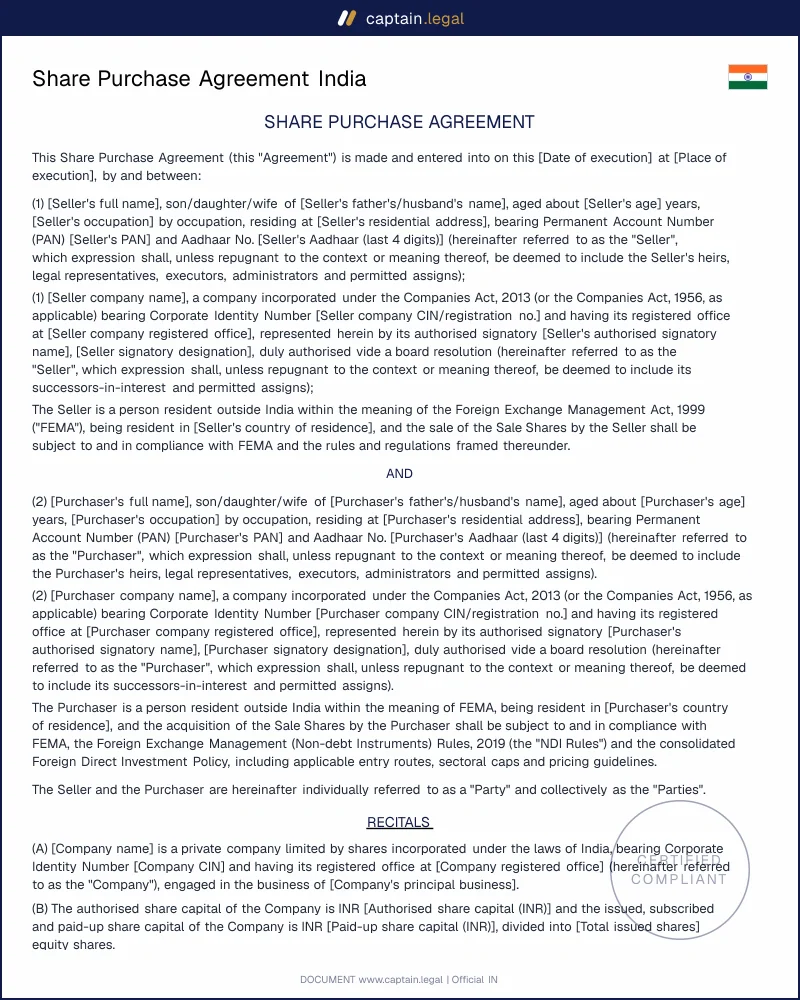
Share Purchase Agreement India | Companies Act 2013 SPA

SPA template aligned with the Companies Act 2013 and Indian Contract Act 1872. Covers Form SH-4 transfer, FEMA pricing and warranties. Word and PDF.
4.7/518 reviews50 000+ downloadsInstant download
Share

A Share Purchase Agreement (SPA) is the master contract that governs the sale of shares in a company, fixing the price, the seller's warranties, the conditions that must be met before completion and the mechanics of closing itself. In India it is the document every founder, investor and acquirer reaches for at the moment of an entry or an exit, because the transfer of shares carries title, voting rights and a slice of the company's liabilities all at once. A buyer who pays without a signed share purchase agreement inherits whatever skeletons sit in the company's cupboard. This template gives you a lawyer-grade SPA built for an Indian private limited company, ready to adapt to your transaction and to sit alongside the statutory Form SH-4 the law actually requires.

The page below walks through what the agreement does, the statutes that frame it, the clauses our template includes and the regional and regulatory traps that catch first-time dealmakers.

Compliant

2026 Legislation

50,000+ clients

trust us

Affordable

From $4.90 / doc

Secure payment

Instant download

Share Purchase Agreement India | Companies Act 2013 SPA

Secure payment · No subscription

Fill in the template

What is a share purchase agreement?

A share purchase agreement is a binding contract under which one or more shareholders sell, and a buyer agrees to acquire, a defined block of shares in a target company at an agreed consideration. It records far more than a price. The SPA captures the representations and warranties the seller gives about the company, the conditions precedent that must be satisfied before money changes hands, the indemnities that allocate risk for hidden liabilities, and the closing steps that move legal title from transferor to transferee. In a private limited company, where shares are not freely traded, this document is the spine of the entire transaction.

It is worth separating the SPA from the instruments that sit beneath it. The SPA is the commercial agreement; the actual transfer of shares is effected by Form SH-4, the statutory instrument of transfer, and reflected in the company's register of members once the board approves it. People also confuse a share purchase agreement with a share subscription agreement: subscription is the issue of new shares by the company for fresh capital, whereas a purchase is a secondary sale between an existing holder and a buyer, with no new money reaching the company. The SPA is also distinct from a shareholders agreement, which governs the ongoing relationship between owners rather than a one-off transfer. If you are buying into an existing cap table, you will often sign both: a purchase agreement to acquire the shares and a shareholders agreement governing transfer restrictions and reserved matters to govern life afterwards.

2

When do you need this document?

The textbook trigger is an investor exit or entry. A founder selling a stake to a private equity fund, or an angel cashing out when a venture round closes, needs an SPA to fix the price, the warranties and the closing conditions before a rupee moves. The reverse case is just as common: a strategic buyer acquiring a controlling block from existing promoters, where the agreement becomes the buyer's main protection against undisclosed debt, tax exposure or pending litigation inside the target.

Founder reshuffles are the next frequent scenario. When a co-founder leaves and the remaining team buys back the departing shares, an SPA documents the buy-back terms cleanly and avoids the bitter disputes that follow a handshake deal. Family-run companies use the same instrument for succession, transferring shares between generations with the consideration and tax position recorded properly. A buyer should always read the target's articles first, because a private company's articles of association and founder resolutions usually carry a right of first refusal or pre-emption clause that the selling shareholder must clear before any outside sale.

Two edge cases deserve a flag. First, where one party is resident outside India, the SPA must build in FEMA compliance as a condition precedent, because a price below fair value on a resident-to-non-resident sale is a regulatory breach, not merely a commercial misjudgement. Second, in companies whose shares are still in physical form, the SPA must be paired with a stamped SH-4; relying on the agreement alone leaves the buyer off the register of members and legally exposed.

3

Key clauses included in our template

  • The parties and recitals clause names every selling shareholder, the buyer and the target company with precision, and sets out the background to the deal. In a multi-seller exit this matters more than it looks, because warranties given "severally" rather than "jointly" decide whom the buyer can sue if a representation turns out to be false.
  • The consideration and payment mechanics clause fixes the price per share, the aggregate amount, and the schedule for payment, including any escrow or deferred tranche. Where a non-resident is involved, this clause is drafted to respect the RBI's fair value pricing guidelines so the transaction clears FC-TRS reporting without a query.
  • The representations and warranties clause is the heart of the SPA. The seller confirms title to the shares, the absence of encumbrances, the accuracy of the accounts, tax compliance and the absence of undisclosed litigation. Each warranty is qualified by a disclosure schedule that lists known exceptions, and a bring-down mechanism repeats the warranties as true at closing.
  • The conditions precedent clause lists what must happen before completion: board and shareholder approvals, third-party consents, regulatory clearances such as CCI or FEMA, and the waiver of any pre-emption rights in the articles.
  • The indemnity clause allocates risk for breaches and for specified liabilities such as retrospective tax demands, usually with a cap, a de minimis threshold and a survival period that outlasts closing.
  • The closing and post-closing covenants clause sets the date and place of completion, the documents to be exchanged including the executed Form SH-4, and obligations such as non-compete and running the business in the ordinary course between signing and closing.
4

Regional considerations

Stamp duty on share transfers is where regional variation bites hardest, because the Indian Stamp Act operates against a backdrop of state-level practice on collection and franking. The headline rate of 0.25% on physical transfers under Article 62 is uniform for the duty itself, but the method of payment differs from state to state. In Maharashtra, transactions routed through a registered office in Mumbai are commonly franked or paid through the state's e-stamping system, and a deal team should confirm the current franking practice before execution rather than assuming adhesive stamps will be accepted.

In Karnataka, where a great many startup targets are incorporated in Bengaluru, the same 0.25% applies but practitioners should verify the prevailing e-stamping route on the state portal, since an unstamped or under-stamped SH-4 is treated as invalid and will stall the board's approval. Delhi transactions follow the central rate with payment typically effected through authorised stamp vendors or e-stamping, and the registered office location, not the parties' residence, fixes which state's machinery applies.

The dematerialised position cuts across all states and is worth stating plainly. Where shares are held in demat form, transfer happens through the depository and stamp duty is collected automatically at the lower depository rate, removing the SH-4 and physical stamping step entirely. Confirm whether the target's shares are physical or demat before drafting, because it changes both the stamping cost and the closing mechanics. For cross-border deals, no state variation overrides the central FEMA layer: a resident-to-non-resident sale must still clear RBI pricing and FC-TRS reporting regardless of where the registered office sits, and a service agreement or commercial contract under the Indian Contract Act cannot be substituted for that filing.

5

How to fill out this share purchase agreement

You start by entering the details of the target company and confirming whether its shares are held in physical or dematerialised form, because that single answer decides whether a stamped Form SH-4 and physical stamping will be part of your closing. From there the template asks you to name every selling shareholder and the buyer, then to record the number and class of shares, the price per share and the aggregate consideration. The form prompts you to set the payment mechanism, including any escrow or deferred amount, and flags whether a FEMA layer applies because one party is resident outside India.

Next you populate the warranties and attach a disclosure schedule listing any known exceptions to them, which is the buyer's evidence of what was disclosed during due diligence. You then set the conditions precedent, choosing from board approval, pre-emption waivers and any CCI or regulatory clearance the deal needs, and you fix the indemnity cap, threshold and survival period. The closing section captures the date, the documents to exchange and the post-closing covenants. The output downloads as a clean Word and PDF file you can finalise with counsel, and you can pair it with the memorandum of understanding template for early-stage deal terms if you need a term sheet first.

6

Common mistakes to avoid

The most expensive error is treating the SPA as the transfer itself. Buyers sign, pay and assume they own the shares, only to discover months later that no stamped Form SH-4 was ever lodged and that they are not on the register of members. Title to shares in a private company moves only when the board approves a properly stamped instrument under Section 56, so a beautifully drafted SPA without the SH-4 step is half a transaction. The twin of this mistake is under-stamping: paying less than 0.25% of consideration or market value, whichever is higher, renders the instrument invalid and stalls registration until the shortfall and any penalty are cleared.

Cross-border deals attract their own pitfalls. Sellers and buyers routinely forget that a resident-to-non-resident transfer below fair value breaches the RBI's pricing guidelines, and that Form FC-TRS must be filed within sixty days, with a Late Submission Fee biting on delay. Weak warranties are the third recurring problem: vague representations with no disclosure schedule and no indemnity cap leave the buyer with no real remedy when a hidden tax demand surfaces. A non-resident seller's capital-gains position and the buyer's withholding-tax obligation are often left out entirely, and a clause borrowed from a generic NDA template enforceable under the Indian Contract Act is no substitute for tax-specific drafting. Finally, ignoring pre-emption rights buried in the articles can void the whole sale, because the selling shareholder was never free to sell to an outsider in the first place.

Key takeaways

CONTRACT LAW

The SPA is the binding deal

The Share Purchase Agreement is the master contract for a secondary sale of shares, and it stands on the Indian Contract Act, 1872: offer, acceptance, lawful consideration and enforceability. It fixes the consideration, sets conditions precedent before completion, and records representations, warranties and indemnities. If you pay without a signed SPA, you may end up carrying undisclosed liabilities with limited recourse.

COMPANIES ACT

SH-4 is what transfers title

An SPA alone does not move legal title in an Indian private limited company. Section 56 of the Companies Act, 2013 requires a duly executed and stamped instrument of transfer in Form SH-4 (as prescribed under the 2014 Rules) to be delivered to the company within sixty days of execution. The board must approve the transfer and the register of members must be updated.

COMPLIANCE RISK

Miss the process and face penalties

The closing mechanics are not paperwork for later; they decide whether you actually become a member on the company’s books. If the SH-4 is not properly lodged and registered, the transfer is not binding on the company, even if the SPA is signed and money has moved. Section 56(6) also carries monetary penalties, stated here as ranging from ₹25,000 to ₹5,00,000.

Frequently Asked Questions

Yes. A share purchase agreement is a contract enforceable under the Indian Contract Act, 1872, provided it has lawful consideration, competent parties and free consent. Once signed, the SPA binds the seller and buyer to their obligations, including the warranties and indemnities. What the SPA does not do on its own is transfer legal title to the shares. Under Section 56 of the Companies Act, 2013, title passes only when a stamped Form SH-4 is lodged with the company, the board approves the transfer and the register of members is updated. So the SPA is binding as a contract, but you still need the statutory transfer steps to make the buyer a registered shareholder. You can see related governance documents in the business and incorporation documents category.

In most cases, yes. The SPA is the commercial agreement, but the transfer of physical shares is effected through Form SH-4, the statutory instrument prescribed under Rule 11 of the Companies (Share Capital and Debentures) Rules, 2014. The company will not register the buyer as a member without a duly executed and stamped SH-4 delivered within sixty days. The one exception is dematerialised shares, where transfer happens through the depository and no physical SH-4 is required. For a resident-to-non-resident transfer, the RBI has indicated that where a stamped SH-4 accompanies the FC-TRS filing, a separate SPA need not be attached, though parties usually keep both for their records.

For shares held in physical form, Article 62 of the Indian Stamp Act, 1899 sets duty at 0.25% of the consideration or market value, whichever is higher, payable on the Form SH-4. The duty is affixed before or at the time of signing, and the stamps must be cancelled so they cannot be reused. An unstamped or under-stamped instrument is invalid and will stall registration. Some states route payment through e-stamping or franking rather than adhesive stamps, so confirm the practice in the state where the company's registered office sits. Dematerialised transfers carry a much lower rate, collected automatically by the depository, with no separate SH-4 stamping.

The template downloads as both an editable Word file and a print-ready PDF. The Word version lets you adjust the parties, consideration, warranties, conditions precedent and indemnity terms to fit your transaction, and to attach a disclosure schedule. The PDF is the clean version you circulate for signature. Because Indian share transfers also require a stamped Form SH-4 and, for cross-border deals, an FC-TRS filing, you should treat the SPA as the commercial backbone and arrange the statutory instruments alongside it. Many users finalise the draft with their company secretary or counsel before execution.

The SPA fixes the closing date, but the statutory clock runs separately. Once the SH-4 is executed, it must reach the company within sixty days, the board must approve the transfer, and a new share certificate must issue within one month of the board's approval. For cross-border deals, the FC-TRS filing on the RBI's FIRMS portal must be completed within sixty days of the transfer or the remittance, whichever is earlier. In practice, a clean domestic transfer with all approvals in hand can close in a few weeks, while a deal needing CCI clearance or FEMA valuation can take considerably longer because of the regulatory conditions precedent.

Yes, subject to FEMA. A non-resident can acquire shares in an Indian company provided foreign investment is permitted in that sector under the automatic or government route, the sectoral cap is not breached, and the price respects the RBI's pricing guidelines. On a resident-to-non-resident sale, the price must not be below fair value, certified by a SEBI-registered merchant banker or chartered accountant, and the transaction must be reported in Form FC-TRS within sixty days. The SPA should build these as conditions precedent so the deal does not close in breach of exchange-control law. Capital-gains tax and any withholding obligation also need to be addressed in the agreement.

A share purchase moves existing shares from a current holder to a buyer, so the money goes to the selling shareholder and the company's share capital does not change. A share subscription is the issue of new shares by the company itself, so fresh capital comes into the company and the cap table expands. The two documents protect different things: a purchase agreement focuses on the seller's title and warranties about the existing company, while a subscription agreement focuses on the terms of the new issue and the rights attaching to the new shares. Investors entering through a fresh round usually subscribe; investors buying out a founder purchase.

4.7/5

18 verified reviews · 50 000+ downloads

Share Purchase Agreement India | Companies Act 2013 SPA
  • Immediate access to the document
  • PDF + Word download
  • Compliant with 2026 legislation
  • Reviewed by lawyers
Fill in the template
Secure payment · No subscription
Updated on June 8, 2026

You might also like

MOA & AOA Template India
LLP Agreement India: Template