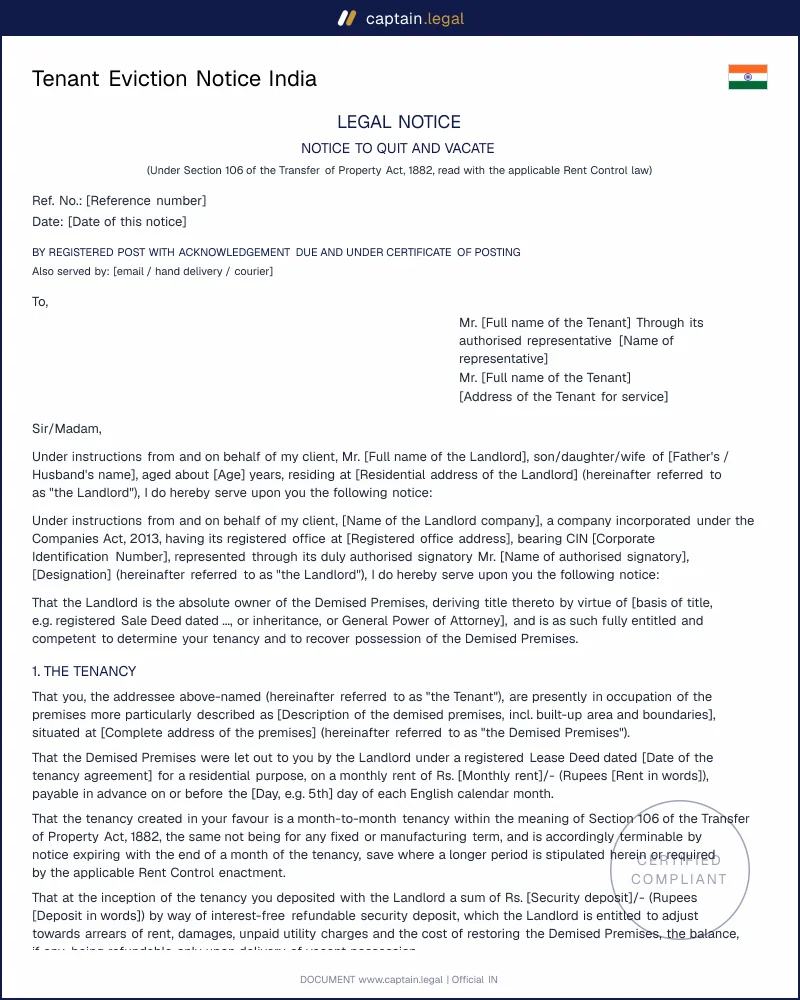
Two layers of law govern eviction in India, and identifying which one applies to your tenancy is the first job of any competent draftsman. The general law sits in Section 106 of the Transfer of Property Act, 1882, which fixes notice periods in the absence of a contract, local law or usage to the contrary. A lease for agricultural or manufacturing purposes is presumed to be year to year, terminable by six months' notice; a lease for any other purpose, including ordinary residential and most commercial lettings, is presumed to be month to month, terminable by fifteen days' notice. The notice must be in writing, signed by or on behalf of the lessor, and served on the tenant. A notice issued by one of several co-owners on behalf of all is valid, and courts read these notices liberally: a minor inaccuracy or omission will not by itself invalidate service, a principle the Section 106 case law has settled repeatedly.
The second layer is the state Rent Control Act, and where it applies it largely displaces Section 106. Land and tenancy fall under the State List of the Seventh Schedule, so each state legislates its own regime. The Delhi Rent Control Act, 1958, the Maharashtra Rent Control Act, 1999, the Tamil Nadu Regulation of Rights and Responsibilities of Landlords and Tenants Act, 2017 and the Karnataka Rent Act each set out the only grounds on which a protected tenant may be evicted, typically non-payment of rent, bona fide personal requirement, unauthorised subletting, misuse, or structural damage. Where a Rent Act governs, mere expiry of a notice period does not entitle the landlord to possession; an order of the Rent Controller or Rent Court on a recognised ground is mandatory. The newer Model Tenancy Act, 2021, which several states have begun adopting through their own rules, channels disputes to a three-tier Rent Authority, Rent Court and Rent Tribunal structure and permits eviction for arrears exceeding two months, among other grounds. For the statutory text and the latest amendments, the India Code repository maintained by the Government of India is the authoritative source. When a tenancy straddles a commercial lease, our commercial lease agreement aligned with TOPA 1882 and the Model Tenancy Act shows how the underlying terms shape the notice that ends them.