Create my document
Login

Choose country

FranceBelgiqueEspañaUnited StatesUnited KingdomMarocDeutschlandItaliaSchweiz
Real Estate

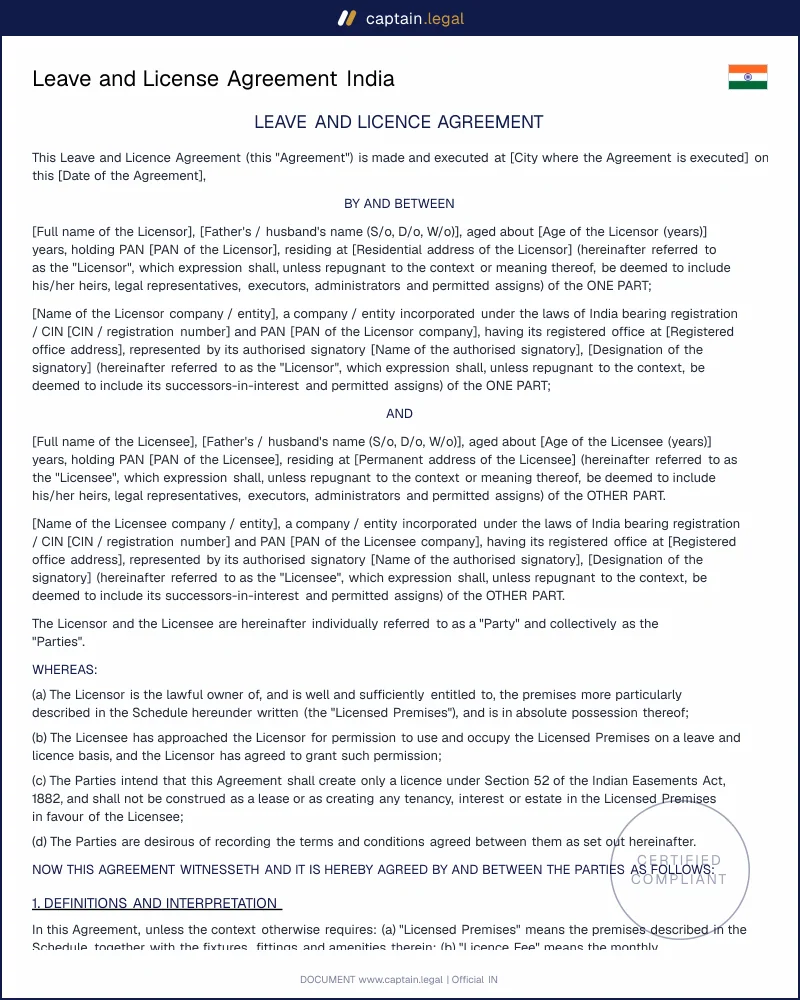
Leave and License Agreement: Easements Act 1882 Format

Drafted under Section 52 of the Indian Easements Act 1882. Covers state stamp duty, Maharashtra registration rules and lock-in. Word and PDF.
4.8/526 reviews50 000+ downloadsInstant download
Share

A leave and license agreement is the document most Indian landlords reach for when letting a residential flat, and the eleven-month version is by far the most requested. It grants the licensee permission to occupy the premises for a fixed term while keeping the property firmly in the licensor's hands, fixing the rent, the security deposit, the term, the maintenance split and the lock-in, all without crossing the line into a protected tenancy. The eleven-month duration is not arbitrary: it sits just below the threshold that triggers compulsory registration in most States, which is precisely why owners prefer it over a conventional rent or lease agreement.

This page explains what the document does, the statute behind it, when it makes sense, the clauses our template carries and the State-level traps that catch most first-time licensors.

Compliant

2026 Legislation

50,000+ clients

trust us

Affordable

From $4.90 / doc

Secure payment

Instant download

Leave and License Agreement: Easements Act 1882 Format

Secure payment · No subscription

Fill in the template

What is a leave and license agreement?

A leave and license agreement is a contract under which the owner, called the licensor, permits another person, the licensee, to use and occupy a property for a limited period in exchange for a license fee. The defining feature is what it does not do: it creates no interest in the property and confers no exclusive possession. The licensee gets a personal permission to stay, revocable on the agreed terms, not a legal estate in the premises.

That distinction is the whole point. A lease or rent agreement transfers an interest in the property and gives the tenant exclusive possession, which makes eviction slow and often governed by protective rent-control machinery. A license does none of that. The licensor retains legal possession throughout, and recovering the premises at the end of the term is far simpler than ejecting a statutory tenant. Indian landlords learned this the hard way over decades of rent-control litigation, and the leave and license route became the standard workaround in residential lettings.

The eleven-month term reinforces the structure. Keep the term at eleven months and you stay below the twelve-month registration trigger in most States, which is why our template defaults to that length while leaving the field editable for those who deliberately want a longer, registered arrangement. For a related instrument used when an owner cannot manage the property in person, see our property power of attorney format for India.

2

When do you need this document?

The everyday trigger is a residential letting where the owner wants income without surrendering control. A salaried owner letting out a second flat, a family relocating for a few years, an NRI letting a city apartment through a relative: in each case the leave and license keeps the exit clean and the rent-control exposure low. The eleven-month term suits this profile because it can be renewed by a fresh agreement rather than rolling into a protected tenancy.

Commercial occupiers form the second large group. Co-working operators, retail kiosks inside malls and short-horizon office users often prefer a license precisely because it can be revoked on notice without the drawn-out process a lease invites. Owners letting shops in cooperative housing societies use it for the same reason, usually alongside the society's own sub-letting permission forms.

Two edge cases deserve attention. First, the paying-guest or shared-accommodation arrangement, where the licensor lets individual rooms while retaining run of common areas; the license framing fits this better than any tenancy because exclusive possession never passes. Second, the lock-in period scenario, where a landlord who has spent on fit-out wants a guaranteed minimum term. A well-drafted lock-in clause protects that investment, and pairing the letting with proper rent receipts and property documents for India keeps the paper trail intact for house-rent-allowance claims and dispute defence alike.

3

Key clauses included in our template

  • The parties and premises clause names the licensor and licensee in full and describes the property with enough precision to identify it, including the built-up area and the portions, if any, kept out of the license. Vague description is the first thing a court picks apart when possession is contested.
  • The license fee and security deposit clause fixes the monthly fee, the escalation if any, the interest-free deposit and the mechanics of its refund on hand-back. It separates fee from deposit deliberately, because conflating them invites both tax confusion and disputes at exit.
  • The term and lock-in clause sets the eleven-month duration, the lock-in within which neither side may walk away without consequence, and the notice each party must give to terminate. This is the clause that keeps the agreement a license and not a tenancy, so its drafting is unforgiving.
  • The maintenance and utilities clause allocates society charges, property tax, electricity, water and repairs between the parties, which is the single most common source of friction in Indian lettings.
  • The revocation and possession clause records the licensor's right to recover the premises on expiry or breach, mirrors Section 52 of the Easements Act and forecloses any argument that the licensee acquired a possessory interest.
4

Regional considerations

Maharashtra runs the strictest regime. Under Section 55 of the Maharashtra Rent Control Act, 1999, every leave and license agreement must be registered with the Sub-Registrar irrespective of term, and the duty to register sits with the licensor. Stamp duty under Article 36A of the Maharashtra Stamp Act, 1958 is computed on the total consideration across the license period, and the State offers convenient e-registration through its online portal. An owner in Mumbai or Pune who skips registration on the assumption that eleven months is exempt is exposed to penalty and to a weakened position in any possession action.

Delhi treats the eleven-month leave and license as a genuine way to stay below compulsory registration, but stamping remains essential for the instrument to be admissible in evidence. Owners across the National Capital Region routinely keep the term short for exactly this reason, while still paying the applicable duty to preserve enforceability.

Karnataka keeps the framework comparatively light under the Karnataka Stamp Act, 1957, with Bengaluru landlords typically using eleven-month agreements that are stamped but not always registered for shorter terms. The same caution applies: an unstamped document buys nothing in court.

Uttar Pradesh has no dedicated statutory provision for leave and license, yet such agreements are valid under the Indian Easements Act, 1882, with stamp duty levied under the State's stamp legislation. Owners here should be especially careful with drafting, since the absence of a bespoke statute means everything turns on the contract's own language and on Section 52.

5

How to fill out this leave and license agreement

You begin by identifying the State where the property is located, because that single choice drives the registration position and the stamp-duty treatment the template flags for you. From there you enter the licensor and licensee details, then describe the premises with the address, area and any excluded portions. The form then asks for the commercial core: the monthly license fee, any escalation, the security deposit and the refund mechanics. Next you set the term, defaulting to eleven months, the lock-in period and the notice each side must serve to terminate. The maintenance and utilities split comes next, followed by any house rules for shared or society premises. Once the fields are complete, the document assembles into a clean instrument you can download as Word or PDF, ready to be printed on stamp paper or run through your State's e-registration where that applies. If the same owner is also setting up a company to hold property, our business and incorporation documents for India cover the corporate side.

6

Common mistakes to avoid

The most damaging error is assuming the eleven-month term makes registration unnecessary everywhere. It does not. In Maharashtra registration is compulsory regardless of duration, and an owner who relies on the shortcut there can be penalised and left with a hard-to-enforce document. The second frequent slip is under-stamping or skipping the stamp paper altogether to save a small sum; an under-stamped agreement is inadmissible until the duty and penalty are cleared, which is precisely the moment a landlord least wants to be paying both. The third is loose drafting that blurs license into tenancy, granting exclusive possession in language that a court can read as a lease and dragging the owner into rent-control territory.

Owners also stumble on renewals and maintenance. A leave and license does not auto-renew, so allowing the licensee to stay on after expiry without a fresh agreement invites a claim of holding over and the legal tangle that follows. Failing to allocate society charges, property tax and utilities clearly leaves both sides arguing over bills that the contract should have settled. A clean exit also depends on documenting the deposit refund against any deductions, which is why keeping organised real estate and rental paperwork for Indian property matters as much as the agreement itself.

Key takeaways

LEGAL NATURE

A licence, not a lease, by design

A leave and licence is built on Section 52 of the Indian Easements Act, 1882: it permits occupation without creating any interest in the flat and without exclusive possession. That is why owners prefer it over a lease, which transfers an interest and can pull the arrangement into rent-control style disputes. The occupier’s right is a personal permission, revocable on agreed terms.

TERM PLANNING

Eleven months is a registration strategy

The common eleven-month term is chosen to stay below the Registration Act, 1908 trigger that makes leases exceeding one year compulsorily registrable in many States. Keep in mind this is a convention, not a guarantee: the template may be edited for longer, registered arrangements when needed. If you cross the one-year line, plan for registration formalities and timelines upfront.

STATE COMPLIANCE

Maharashtra and stamp duty can bite

State-level rules can override assumptions. In Maharashtra, Section 55 of the Maharashtra Rent Control Act, 1999 requires every leave and licence agreement to be registered, even for eleven months, and places the registration responsibility on the licensor. Separately, stamp duty is State-specific; an under-stamped instrument can be impounded and become inadmissible in evidence until deficit duty and penalty are paid, weakening any possession dispute.

Frequently Asked Questions

Yes. The agreement is enforceable as a contract under Section 52 of the Indian Easements Act, 1882, which gives the licensee a valid permission to occupy and the licensor a clear right to recover possession on the agreed terms. To be admissible in court it must be properly stamped under the applicable State stamp law, and in States like Maharashtra it must also be registered. A correctly drafted, stamped and, where required, registered agreement stands up fully in a possession dispute. The eleven-month term does not weaken its binding force; it simply keeps the arrangement outside the compulsory-registration trigger in most States.

It depends on the State. The Registration Act, 1908 makes registration compulsory for leases exceeding one year, so an eleven-month term generally falls below that threshold. Maharashtra is the major exception: under Section 55 of the Maharashtra Rent Control Act, 1999, every leave and license agreement must be registered regardless of term, with the licensor responsible for doing so. Several other States encourage but do not strictly mandate registration for short terms. Whatever the registration position, you must still pay stamp duty for the document to be admissible in evidence.

A lease transfers an interest in the property and gives the tenant exclusive possession, which makes eviction slow and frequently subject to protective rent-control law. A leave and license creates no such interest; it is a personal permission to occupy, revocable on the agreed terms, with the licensor keeping legal possession throughout. That is why landlords prefer it for residential lettings: recovering the premises at the end of the term is far simpler. The licensee, in turn, cannot claim tenancy rights or ownership no matter how long the occupation runs.

Stamp duty is a State subject, so both the rate and the calculation differ across India. In Maharashtra, for example, duty is computed at a small percentage of the total consideration, meaning the aggregate license fee over the term plus a portion of the deposit. The licensee usually bears the stamp duty by convention, though the agreement can allocate it otherwise. The critical point is that an under-stamped instrument can be impounded and is inadmissible until the deficient duty and a penalty are paid, so paying the correct duty upfront is far cheaper than fixing it during a dispute.

Yes. The completed leave and license agreement is available as both an editable Word file and a ready-to-use PDF. The Word version lets you adjust clauses for rent, term, lock-in or maintenance to fit your specific letting, while the PDF is suited to printing directly onto stamp paper or uploading to a State e-registration portal. Having both formats means you can finalise the document, get it executed and proceed to stamping or registration without redrafting from scratch.

The notice period is set by the agreement itself, not by a fixed statutory rule, and one to two months is the common range in Indian practice. During any lock-in period, early termination by either side may trigger a penalty or forfeiture of part of the deposit, which is exactly what the lock-in is designed to deter. After the lock-in, either party can usually exit by serving the agreed written notice. Because a leave and license does not renew automatically, the licensee must vacate at the end of the term unless a fresh agreement is signed, so plan the exit well before expiry.

No, provided the agreement is drafted correctly. Because a license under Section 52 of the Easements Act creates no interest in the property and no exclusive possession, the licensee cannot convert occupation into a protected tenancy or claim ownership through long use. The risk arises only when sloppy drafting grants exclusive possession in substance, which a court may then read as a lease. Keeping the revocation, possession and term clauses tight is what preserves the license character and shuts down any future tenancy claim.

4.8/5

26 verified reviews · 50 000+ downloads

Leave and License Agreement: Easements Act 1882 Format
  • Immediate access to the document
  • PDF + Word download
  • Compliant with 2026 legislation
  • Reviewed by lawyers
Fill in the template
Secure payment · No subscription
Updated on June 8, 2026

You might also like

Agreement to Sell Format India
Rent Receipt for HRA Claim