Create my document
Login

Choose country

FranceBelgiqueEspañaUnited StatesUnited KingdomMarocDeutschlandItaliaSchweiz
Business

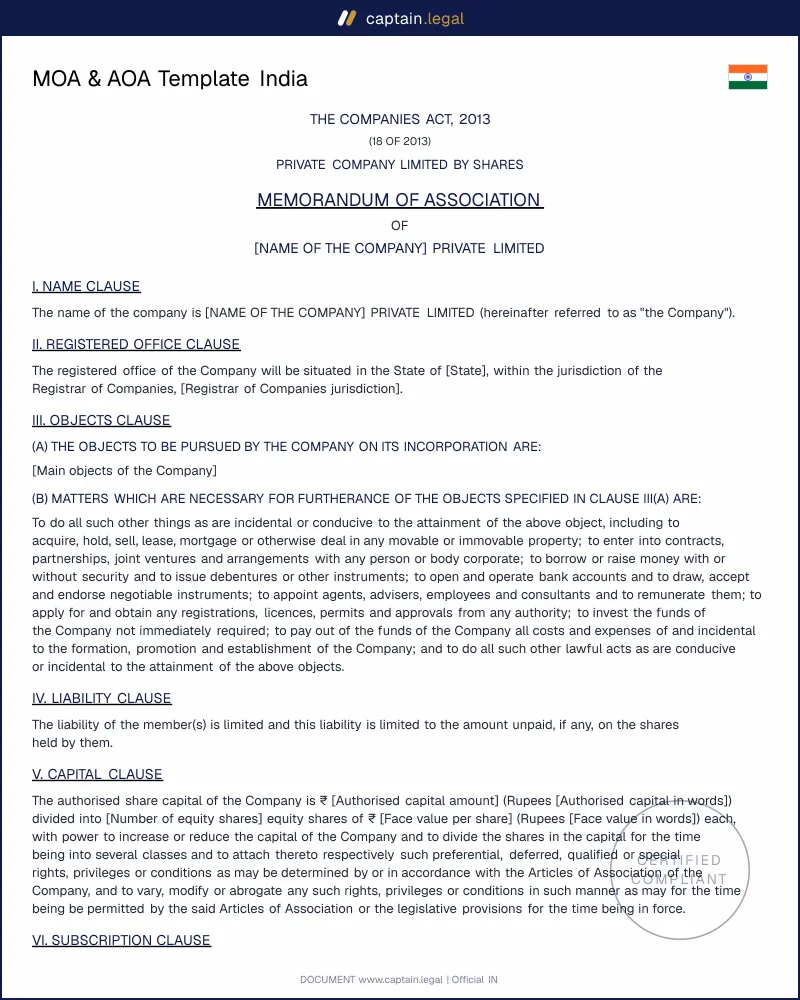
MOA & AOA: Companies Act 2013, Section 4 & Table F

Memorandum and Articles of Association drafted to Section 4 and Section 5 of the Companies Act 2013, with Table F articles and the two-part objects clause.
4.7/527 reviews50 000+ downloadsInstant download
Share

A Memorandum of Association (MOA) and Articles of Association (AOA) are the two founding charters that every Private Limited company in India must file with the Registrar of Companies (ROC) through the SPICe+ (INC-32) process on the Ministry of Corporate Affairs (MCA) portal. The MOA fixes the company's name, registered State, objects and capital, while the AOA writes the internal rulebook: how directors are appointed, how shares move, how meetings run. Together they are the constitutional backbone the Companies Act 2013 demands before a Certificate of Incorporation can issue. This page is for founders, promoters and company secretaries who need a clean, filing-ready MOA and AOA that survives ROC scrutiny the first time, without the back-and-forth of a resubmission remark.

Most incorporation delays trace back to two documents drafted as an afterthought. A loose objects clause or an AOA that contradicts a side shareholders arrangement will cost you weeks. Getting both right at the outset is the cheapest insurance a new company can buy.

Compliant

2026 Legislation

50,000+ clients

trust us

Affordable

From $4.90 / doc

Secure payment

Instant download

MOA & AOA: Companies Act 2013, Section 4 & Table F

Secure payment · No subscription

Fill in the template

What is a Memorandum and Articles of Association?

The Memorandum of Association is the company's charter with the outside world. Under Section 4 of the Companies Act 2013 it must carry five mandatory clauses: the name clause ending in "Private Limited", the registered office clause naming the State, the objects clause, the liability clause and the capital clause. A subscriber sheet closes the document, recording each first shareholder, the shares each takes and the witness who attests their signatures. The MOA defines what the company may lawfully do; an act beyond it is ultra vires and, historically, void against the company. Anything not written into the objects clause is, in principle, off-limits until the MOA is formally altered under Section 13.

The Articles of Association are the internal constitution. While the MOA faces outward, the AOA governs the relationship between the company, its directors and its members: share transfer restrictions, the power to issue further shares, board composition, quorum for meetings, dividend mechanics and the use of the common seal. Section 5 permits a company to adopt the model articles in Table F of Schedule I in full, in part, or to draft its own. The two documents are not interchangeable. Where the MOA is broadly fixed and hard to change, the AOA is the working rulebook you will return to every time the board acts. A founder who confuses the objects clause of the MOA with a management provision that belongs in the AOA invites a resubmission notice from the ROC.

2

When do you need this document?

The clearest trigger is a fresh incorporation. The moment two or more promoters decide to form a Private Limited company, the MOA and AOA become non-negotiable attachments to the SPICe+ application, and incorporation cannot proceed without them. A second, frequent scenario is converting an existing structure, where partners running a firm under the Indian Partnership Act 1932 want limited liability and outside investment, and so incorporate a company that needs its own charter rather than the partnership's partnership deed under the Indian Partnership Act 1932. The objects of the old business have to be re-expressed in statutory MOA language, which is rarely a copy-paste exercise.

You also revisit these documents whenever the company outgrows them. A startup raising its first institutional round will find investors insisting on amended articles that bolt on pre-emption rights, anti-dilution protection, reserved matters and board nomination rights, none of which sit comfortably in Table F as adopted. Adding a new line of business that falls outside the registered objects forces an MOA alteration under Section 13, complete with a special resolution and an MGT-14 filing. One edge case worth flagging: where a subscriber is a foreign national or a body corporate based outside India, the eMOA and eAOA route is unavailable and apostilled physical copies must be attached instead, a detail that catches many cross-border founders mid-filing. Another arises with a One Person Company, whose MOA must additionally carry a nominee clause naming the person who takes over on the sole member's death, a requirement absent from a multi-member Private Limited charter.

3

Key clauses included in our template

  • The name clause of the MOA states the approved company name exactly as reserved through SPICe+ Part A or the RUN service, ending in "Private Limited". A mismatch between the reserved name and the name in the MOA is one of the most common resubmission triggers, so the template locks the two together.
  • The registered office clause names only the State in which the registered office is situated, not the full address. The exact address is notified separately within thirty days of incorporation under Section 12, and the template keeps the MOA clause deliberately at State level to avoid an unnecessary later alteration.
  • The objects clause is drafted in the two-part structure the Companies Act 2013 now mandates: the main objects pursued on incorporation, and the matters necessary in furtherance of them. The template gives you room to state your principal business with enough specificity to satisfy banks and licensing authorities, while warning against the abolished "other objects" catch-all.
  • The liability and capital clauses confirm that members' liability is limited to the amount unpaid on their shares and set the authorised share capital divided into shares of a fixed nominal value. The subscriber sheet then records each first shareholder, the shares subscribed and the attesting witness, all of which the eMOA requires to be digitally signed.
  • The share transfer and pre-emption articles in the AOA restrict the right to transfer shares, the defining feature of a private company under Section 2(68), and give existing members first refusal before any outsider can come in. These provisions are where the articles most often need tailoring beyond Table F.
  • The board and meeting articles fix the number of directors, the quorum for board and general meetings, the chair's casting vote and the procedure for resolutions, drawing on Table F but adjusted to the founders' actual governance intentions.
4

Regional considerations

Although the Companies Act 2013 and the SPICe+ process are uniform across India, the MOA's registered office clause fixes the company to a single State, and that choice carries State-level consequences that the charter itself triggers. Stamp duty on the MOA and AOA is a State subject, levied under each State's Stamp Act, and the SPICe+ system computes it automatically from the State of the registered office and the authorised capital. Maharashtra, for instance, applies a different MOA and AOA stamp slab from Delhi or Karnataka, and a company incorporating in Mumbai will see a materially different stamp computation from one registering in Bengaluru, even with identical capital. Founders sometimes assume stamp duty is a flat national figure; it is not, and the registered State you write into the MOA decides it.

Professional tax registration through SPICe+ is also State-specific. It is mandatory at incorporation only for companies registered in Maharashtra, Karnataka and West Bengal, so a company choosing a registered office in one of those States picks up an additional integrated registration that a company in, say, Gujarat does not. The choice of State further determines which ROC jurisdiction processes the file and which Regional Director hears any later application, such as a registered office shift from one State to another, which requires a Section 13 alteration and Regional Director approval. Where founders operate across States, the registered office named in the MOA should reflect the genuine principal place of decision-making, because the address proof and utility bill attached to SPICe+ must corroborate it, and a board resolution for opening a company bank account and other post-incorporation filings will all key off that registered State. None of this changes the statutory form of the MOA and AOA, but the State you commit to in the charter quietly sets your stamp cost, your registration obligations and your compliance home for the life of the company.

5

How to fill out this Memorandum and Articles of Association

You begin by confirming the company name reserved through SPICe+ Part A, because the MOA name clause must match it character for character. From there the template asks for the State of the registered office, which feeds the stamp duty computation and the ROC jurisdiction, and you state the principal business in the objects clause in plain, specific terms rather than reaching for a generic catch-all the Companies Act 2013 no longer permits. The capital clause is next, where you set the authorised capital and the nominal value per share, with no minimum imposed by statute. You then record each subscriber, the number of shares each takes and the witness details, since the eMOA will need every subscriber's Digital Signature Certificate affixed. On the AOA side, you decide how far to adopt Table F and where to depart from it, tailoring the share transfer, pre-emption and board provisions to your founders' arrangement. Before you file, reconcile the AOA against any non-disclosure agreement enforceable under the Contract Act 1872 or investor side letter so nothing in the articles contradicts a separate signed instrument. The finished MOA and AOA download as Word and PDF, ready to convert into the eMOA (INC-33) and eAOA (INC-34) attachments or to upload directly where physical copies apply.

6

Common mistakes to avoid

The most damaging error is treating the objects clause as boilerplate. Founders still draft it on the old 1956 Act model with a sprawling "other objects" section, and the ROC bounces it because that category no longer exists under Section 4. A clause that is too narrow is just as costly the other way: a company whose objects omit a business it actually intends to run cannot lawfully enter contracts for it, and unwinding that needs a Section 13 special resolution and an MGT-14 filing months later. The second recurring failure is a contradiction between the AOA and a separately negotiated shareholders agreement. When the articles say one thing about share transfers and the side agreement says another, the articles win against third parties, and the founders discover their carefully negotiated rights are unenforceable where it matters.

Procedural slips account for most resubmissions. A name in the MOA that does not match the reserved name to the letter, a missing or invalid Digital Signature Certificate on a subscriber's eMOA, or a witness who has not properly attested the subscriber sheet will each draw a resubmission remark and reset your timeline. The eMOA and eAOA route is available only where all up to seven subscribers are Indian residents with valid DSCs; a single foreign or body-corporate subscriber forces the apostilled physical-attachment route instead. Finally, many founders forget that incorporation is the start, not the end: notifying the exact registered office address within thirty days under Section 12, filing the board and shareholder resolutions for appointments and allotments, and maintaining the statutory registers are obligations the charter sets in motion the day the Certificate of Incorporation issues.

Key takeaways

ROC filing

MOA and AOA must go in first

A Private Limited company cannot get its Certificate of Incorporation unless both the MOA and AOA are filed with the Registrar of Companies through SPICe+ (INC-32) on the MCA portal. In the usual case (up to seven Indian-resident individual subscribers), this is done as eMOA (INC-33) and eAOA (INC-34) with digital signatures, not as separate Word uploads. Miss the format, expect resubmission.

Section 4

The MOA sets hard legal limits

Under Section 4 of the Companies Act 2013, the MOA must contain the name (ending in Private Limited), registered State, objects, liability and capital clauses, plus the subscriber sheet showing each first shareholder’s shares and a witness. The objects clause is not a brochure; it defines what the company may lawfully do. Anything outside it is treated as beyond authority, and you are stuck until you alter the MOA under Section 13.

Governance

Use the AOA as your operating rulebook

The AOA governs internal mechanics: director appointment, share transfer restrictions, issuance of further shares, quorum and meeting conduct, dividends and even the common seal. Section 5 lets you adopt Table F model articles fully, partly, or draft customised articles, but contradictions with side shareholder arrangements can trigger ROC remarks and future disputes. Keep objects in the MOA and management provisions in the AOA to avoid delays and confusion.

Frequently Asked Questions

Yes, when completed accurately and filed correctly. The MOA and AOA only acquire legal force once the Registrar of Companies registers them and issues the Certificate of Incorporation under Section 7 of the Companies Act 2013. The template gives you a statute-compliant draft with all five mandatory MOA clauses and Table F-based articles, but binding effect comes from the digital signatures of every subscriber, proper witness attestation and submission through SPICe+. Until the ROC registers the documents, they are a draft. After registration, the MOA and AOA bind the company and every member as if each had signed them individually, which is precisely why accuracy at the drafting stage matters so much.

The MOA is the company's charter facing the outside world, fixing its name, registered State, objects, liability and capital under Section 4. It defines what the company is permitted to do, and acts beyond it are ultra vires. The AOA is the internal rulebook under Section 5, governing how the company runs itself: director appointments, share transfers, meeting procedure, dividends and the common seal. A useful test is direction. The MOA looks outward at the company's purpose and powers, while the AOA looks inward at management and member relations. The MOA is broadly fixed and harder to alter; the AOA is the working constitution you consult whenever the board acts.

Yes, and it needs care. Section 4(1)(c) requires the MOA to state the objects for which the company is incorporated, drafted in two parts: the main objects and matters necessary in furtherance of them. The Companies Act 2013 removed the old "other objects" category, so you cannot warehouse unrelated future businesses in a catch-all. While the objects can be stated broadly, banks, licensing bodies and tender authorities routinely read the clause before dealing with the company, so vague or mismatched objects create practical obstacles. A precise objects clause that genuinely covers your intended business is the safer course, with alteration available later under Section 13 if you expand.

The completed MOA and AOA download in both Microsoft Word and PDF. The editable Word version lets you make final adjustments to the objects clause, the capital figures or the bespoke articles before signing, while the PDF gives you a clean copy for records. For a standard Private Limited company with up to seven Indian-resident subscribers, these become the basis for the eMOA (INC-33) and eAOA (INC-34) filed electronically through SPICe+. Where the apostilled physical-attachment route applies, the PDF is what you attach to the form. Either way you keep an editable master that you can amend if the documents ever need a Section 13 alteration.

Once a complete, error-free SPICe+ application is filed with valid digital signatures, the Registrar of Companies typically processes incorporation within a few working days, often three to seven, though timelines vary with ROC workload and whether the file draws a resubmission remark. A clean submission is the single biggest factor. Name mismatches, defective DSCs, an objects clause in the abolished three-tier format or an unattested subscriber sheet each trigger a resubmission that resets the clock. The MOA and AOA only take legal effect on the date stated in the Certificate of Incorporation, so a first-time-right filing is worth the extra care at the drafting stage.

Yes, but the process differs for each. Altering the MOA, for example changing the name, the registered office State, the objects or the capital, requires a special resolution under Section 13, filing of MGT-14 with the ROC, and in some cases approval from the Regional Director or central authorities. Altering the AOA also needs a special resolution under Section 14. Neither is automatic, and certain clauses, such as the subscription clause of the MOA, cannot be altered at all. Because alteration is slower and costlier than getting it right at incorporation, founders who anticipate growth often build appropriate headroom into the objects and capital clauses from the outset, then use the business and incorporation document templates aligned with Indian law to manage the later filings.

4.7/5

27 verified reviews · 50 000+ downloads

MOA & AOA: Companies Act 2013, Section 4 & Table F
  • Immediate access to the document
  • PDF + Word download
  • Compliant with 2026 legislation
  • Reviewed by lawyers
Fill in the template
Secure payment · No subscription
Updated on June 8, 2026

You might also like

LLP Agreement India: Template
Founders' Agreement India