Create my document
Login

Choose country

FranceBelgiqueEspañaUnited StatesUnited KingdomMarocDeutschlandItaliaSchweiz
Personal & Family

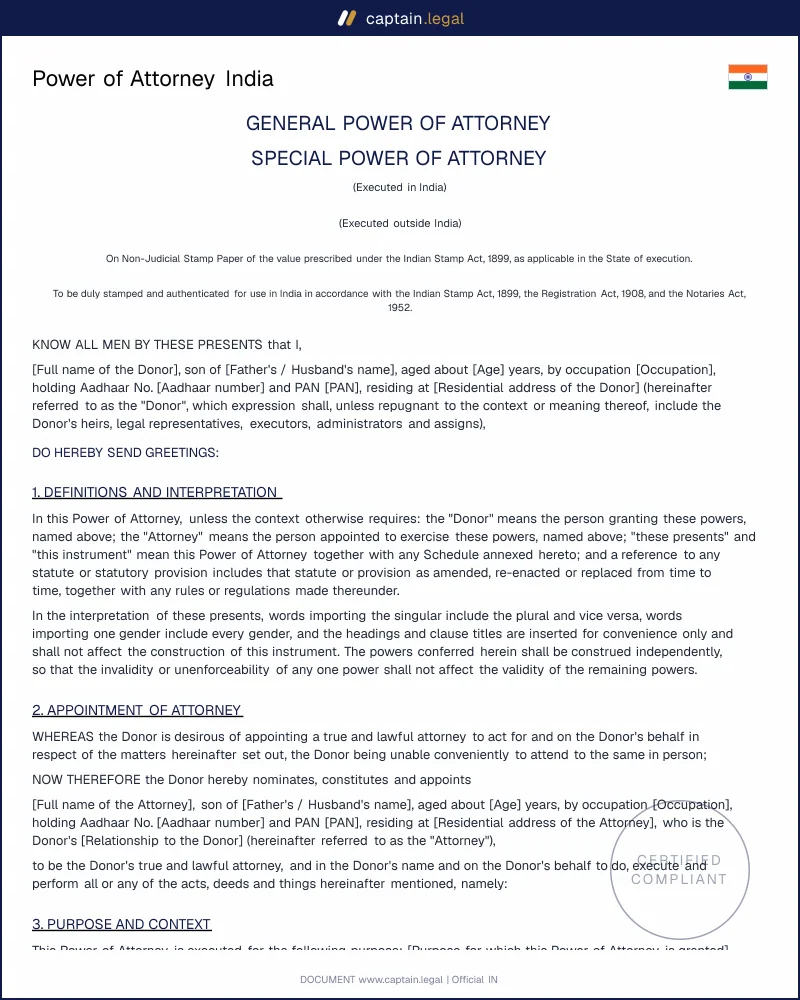
Power of Attorney India: 1882 Act & Suraj Lamp Rules

Draft a valid POA under the Powers of Attorney Act 1882 and Contract Act 1872, with the registration rules after Suraj Lamp explained.
4.8/538 reviews50 000+ downloadsInstant download
Share

A power of attorney lets you appoint someone you trust to act in your name, whether that means operating a bank account, signing papers before a government office, or completing a single property transaction while you are abroad or unwell. The instrument exists in two forms in India: a general power of attorney that hands over wide authority across your affairs, and a special (or specific) power of attorney confined to one defined task. This template is built for both, with the scope, witnessing and revocation clauses that Indian courts and sub-registrars expect, so the document holds up when your attorney actually presents it.

Whether you are an NRI managing a flat in Pune from Dubai, a parent authorising a child to operate a savings account, or a businessperson delegating a routine filing, the right power of attorney protects you as much as it empowers your agent. The difference between a document that works and one that gets rejected at the counter usually comes down to drafting precision, correct stamping and, where property is involved, registration.

Compliant

2026 Legislation

50,000+ clients

trust us

Affordable

From $4.90 / doc

Secure payment

Instant download

Power of Attorney India: 1882 Act & Suraj Lamp Rules

Secure payment · No subscription

Fill in the template

What is a power of attorney in India?

A power of attorney is a written instrument by which one person, the principal (also called the donor), authorises another, the attorney or agent (also called the donee), to act on the principal's behalf. It does not give away your rights; it lets someone exercise them for you, within the four corners of what you write down. The relationship is one of agency, which is why the document is read together with the law of agency in the Indian Contract Act, 1872 and not the Powers of Attorney Act, 1882 alone.

The practical fork is between scope. A general power of attorney confers broad authority, typically to manage finances, operate accounts, deal with property, and represent the principal across multiple matters. A special power of attorney is narrow by design : it authorises one act or one class of acts, such as collecting rent on a single property, appearing before a specific authority, or executing one sale deed. Practitioners almost always steer clients toward the special form unless genuinely wide powers are needed, because a GPA in the wrong hands is an open cheque. The narrower the scope, the lower your exposure if the relationship sours or the agent oversteps. Our template forces you to define the powers explicitly rather than relying on vague catch-all wording that courts read down.

2

When do you need this document?

The most common trigger is physical absence. NRIs use a power of attorney constantly to let a relative in India operate a bank account, file documents, or manage a tenant while they live overseas. The instrument has to be airtight here because the agent acts entirely unsupervised, and a poorly drafted scope clause is exactly what a bank's legal cell rejects. A related scenario is managing property you cannot personally attend to : authorising someone to collect rent, deal with the housing society, or appear before a municipal office while you are elsewhere. For a tenancy, pairing the POA with a properly drafted leave and licence agreement under the Easements Act 1882 keeps both the authority and the underlying arrangement clean.

The third bucket is single transactions where a special power of attorney shines. You are completing a vehicle transfer, registering a particular document, or executing one sale deed on behalf of a co-owner who is travelling. Here the document should name the exact act and expire when that act is done. Granting a general power for what is really a one-time job is the classic over-authorisation mistake, and it leaves you exposed long after the task is finished.

One edge case worth flagging concerns illness and ageing. India does not have a robust durable power of attorney regime like Western jurisdictions; under Section 201 of the Indian Contract Act, an ordinary POA stands revoked the moment the principal becomes of unsound mind. So a power of attorney is not a substitute for proper succession planning. If your real concern is what happens after you die, you need a will drafted under the Indian Succession Act 1925, not a POA, because the agency terminates on death.

3

Key clauses included in our template

  • The identification and recitals open the deed by naming the principal and the attorney in full, with addresses and identity proof references such as Aadhaar or passport, and stating the principal's competence to contract. Sub-registrars and banks check this block first, and a mismatch between the name on the POA and the name on the linked account or property record is a frequent ground for rejection.
  • The grant of powers is the heart of the instrument and is drafted to match your choice of general or special authority. Each power the attorney may exercise is spelled out as a specific clause, from operating a named bank account to appearing before a particular tribunal, because Indian courts read powers of attorney strictly and refuse to imply authority that was not expressly conferred.
  • The scope and limitation clause sets the boundaries the attorney may not cross, the duration of the authority, and any conditions on its exercise. This is where you cap the agent's reach, and a clear limitation here is your strongest protection against misuse.
  • The ratification clause confirms that lawful acts done by the attorney within scope bind the principal, mirroring Section 2 of the Powers of Attorney Act, 1882, so third parties dealing with your agent know their dealings are secure.
  • The revocation and termination clause records that the power is revocable at the principal's will under Section 201 of the Contract Act unless it is coupled with an interest under Section 202, and confirms automatic termination on the death or insanity of either party.
  • The execution block provides for the principal's signature, the date and place, two attesting witnesses, and the space for notarisation or the sub-registrar's endorsement where registration applies.
4

Regional considerations

Stamp duty and registration practice are State subjects, so the same power of attorney can cost and register quite differently depending on where it is executed and where the property or the attorney sits. In Maharashtra, stamp duty on a power of attorney is governed by the Maharashtra Stamp Act, 1958, with concessional treatment where the POA is given to a close family member for immovable property, but the standard adjudication and registration discipline at the Sub-Registrar is strict, particularly in Mumbai and Pune. NRIs sending a POA into the State should budget time for adjudication of stamp duty before the instrument is accepted.

In Delhi, a POA touching immovable property must be registered, and the Indian Stamp Act, 1899 as applied in the capital governs duty; the Delhi sub-registrars have been especially cautious since Suraj Lamp, and an NRI POA executed abroad is only valid for registration once stamp duty has been paid in India. Karnataka follows the Karnataka Stamp Act, 1957, and Bengaluru registrants frequently deal with POAs from overseas principals, so consular attestation and timely stamping matter. In Tamil Nadu, registration of property-related powers is enforced firmly, and the State levies its own scale of duty under the Indian Stamp Act as locally amended.

A common thread across States is that a notarised POA suffices for banking, company and litigation matters, but a property POA must be registered at the Sub-Registrar in whose jurisdiction the attorney or the property is located. For a transaction that will end in a conveyance, it is worth lining up the agreement to sell format for India and the eventual sale deed compliant with Section 54 of the Transfer of Property Act at the same time, so the registered POA, the agreement and the deed all carry consistent particulars.

5

How to fill out this power of attorney

You begin by choosing whether you need a general power of attorney or a special one, and the template adjusts the scope section to match. From there you enter the principal's details, the attorney's details, and the identity references for both, taking care that the names exactly match the bank, property or government records the document will be presented against. You then define the powers, either selecting broad categories for a GPA or describing the single authorised act for a special power, and you set the duration and any limits you want to impose.

The template then guides you through the witnessing and execution block, prompting for two witnesses and leaving the correct space for notarisation. Before the document is final, you must decide on stamping and registration : for banking, representation or company work, notarisation on the correct State stamp paper is enough, but for anything touching immovable property you take the printed instrument to the Sub-Registrar for registration. Once your particulars are in, you download the finished document in Word and PDF so you can print it on stamp paper, sign before your witnesses and notary, and proceed to the sub-registrar where required.

6

Common mistakes to avoid

The mistake that wrecks more powers of attorney than any other is over-granting authority. People reach for a general power when a special one would do, handing an agent the keys to everything for a job that needed authority over one account or one transaction. The narrower instrument is almost always the safer choice, and the second classic error compounds the first : leaving the scope clause vague. Wording like "to do all acts necessary" invites the attorney to act beyond what you intended and, because courts construe powers of attorney strictly, may equally fail to confer the specific authority a bank or registrar actually requires. The third recurring failure is treating a notarised POA as sufficient for property, then discovering at the conveyance stage that the unregistered instrument cannot support a registered sale deed after Suraj Lamp.

People also forget that a power of attorney is fragile. It is revoked automatically on the death or insanity of the principal, so it is not a tool for old-age planning or inheritance. Failing to formally revoke a POA once its purpose is served leaves a live authority floating in the hands of someone who no longer needs it, which is why a proper revocation deed matters. Finally, NRIs often skip the stamping deadline, executing a clean instrument abroad but failing to pay Indian stamp duty within the prescribed window, which renders the document unusable when the attorney finally presents it. If your delegation is really about confidential business dealings, consider whether an IP assignment and confidentiality agreement for India is the better instrument instead.

Key takeaways

SCOPE

Prefer a Special POA over a GPA

A power of attorney is only as safe as its scope. A General POA can hand over wide control of banking, filings and property dealings, and can be misused like an open cheque. A Special POA limits the agent to one defined act, such as collecting rent for one flat or appearing before one authority, which reduces exposure if the relationship turns sour.

LEGAL BASIS

POA creates an agency under Contract Act

A POA is not a transfer of your rights; it appoints an agent to act for you within what you have written. Courts read it with the agency rules in Chapter X of the Indian Contract Act, 1872, including revocation and termination under Sections 201 to 210. The Powers of Attorney Act, 1882 (including Section 2) supports acts done in the agent’s name binding the principal.

FORMALITIES

Stamping, witnesses, notarisation, and registration matter

Many POAs fail at the counter because the execution steps are skipped. Sign as principal, ideally in front of two witnesses, and use non-judicial stamp paper of the value prescribed by your State Stamp law. Notarisation is standard and helps with proof under the Indian Evidence Act, 1872. For NRIs, consular or local notarised attestation is followed by stamping in India within three months of receipt.

Frequently Asked Questions

Yes, provided it is executed correctly. A power of attorney drawn up under the Powers of Attorney Act, 1882 and the agency provisions of the Indian Contract Act, 1872 is binding once the principal signs it, ideally before two witnesses, on the correct State stamp paper. For banking, representation and most personal matters, notarisation makes it presumptively valid under the Indian Evidence Act, 1872. Where the document concerns immovable property, it becomes fully effective only after registration before the Sub-Registrar under Section 17 of the Registration Act, 1908. The template builds in the scope, witnessing and execution clauses that Indian authorities check, so the binding force depends on your completing those formalities, not on the drafting.

A general power of attorney grants wide authority across multiple matters, letting your agent manage finances, operate accounts, deal with property and represent you generally. A special (or specific) power of attorney is confined to a single act or a defined class of acts, such as collecting rent on one property or executing one sale deed. The practical guidance is to prefer the special form whenever you can, because Indian courts construe powers of attorney narrowly and a general power exposes you to far greater risk if the agent oversteps. Our template lets you choose either at the outset and adjusts the scope clauses accordingly.

It depends entirely on the subject matter. For banking, company filings, court representation and most everyday matters, a notarised power of attorney on the correct stamp paper is sufficient and registration is not required. Registration becomes mandatory the moment the instrument deals with immovable property, under Section 17 of the Registration Act, 1908 and the reasoning in Suraj Lamp & Industries v. State of Haryana. A property POA must be registered at the Sub-Registrar's office in whose jurisdiction the attorney or the property is located, and stamp duty, which varies by State, becomes payable at that stage.

Not in the way many people assume. After Suraj Lamp & Industries v. State of Haryana (2012), a power of attorney cannot itself transfer ownership of immovable property; only a registered sale deed can do that. What your attorney can do, if the POA expressly grants the power and the instrument is itself registered, is sign and execute the sale deed on your behalf. The buyer's title then passes through that registered deed, not through the POA. So the document authorises the act of selling, but the conveyance still has to be completed by a properly stamped and registered sale deed.

You download the completed power of attorney in both Word and PDF formats. The Word version lets you make final adjustments to names, addresses and scope before printing, while the PDF is ready to print directly. Because Indian powers of attorney are executed on non-judicial stamp paper, you print the document onto stamp paper of the value your State prescribes, then sign it before your witnesses and a notary, and proceed to the Sub-Registrar for registration where the subject matter requires it. Having both formats means you can edit and finalise without delay.

A power of attorney stays in force until something ends it. A special power naturally expires once its defined purpose is fulfilled, for example when the single transaction it authorised is complete. A general power continues until it is revoked. Under Section 201 of the Indian Contract Act, 1872, the authority also terminates automatically on the death of either the principal or the attorney, or if either becomes of unsound mind or insolvent. India does not recognise a durable power in the broad Western sense, so a POA cannot survive the principal's mental incapacity unless it is coupled with an interest under Section 202.

The principal can revoke a power of attorney at any time under Section 201 of the Indian Contract Act, 1872, and no reason is required unless the power is coupled with an interest under Section 202, in which case the agent's consent is needed. In practice you draft a revocation deed stating when and why the authority ends, sign it before witnesses, and serve it on the attorney, ideally by registered post so you have proof of notice. If the original power of attorney was registered, the revocation deed must also be registered at the Sub-Registrar to be effective against third parties. Notifying any bank, society or authority that dealt with the agent closes the loop.

Yes, and it is one of the most common uses of the instrument. An NRI executes the power of attorney on plain paper before the Indian Consulate or a local notary in the country of residence. Once it reaches India, the document must be stamped, with duty paid within three months of receipt under the Indian Stamp Act, 1899, and where it concerns immovable property it must then be registered at the Sub-Registrar where the attorney or property is located. The consular attestation gives the document its presumption of valid execution, but the Indian stamping and registration steps are what make it usable on the ground.

4.8/5

38 verified reviews · 50 000+ downloads

Power of Attorney India: 1882 Act & Suraj Lamp Rules
  • Immediate access to the document
  • PDF + Word download
  • Compliant with 2026 legislation
  • Reviewed by lawyers
Fill in the template
Secure payment · No subscription
Updated on June 9, 2026

You might also like

Last Will and Testament India
General Affidavit Format India