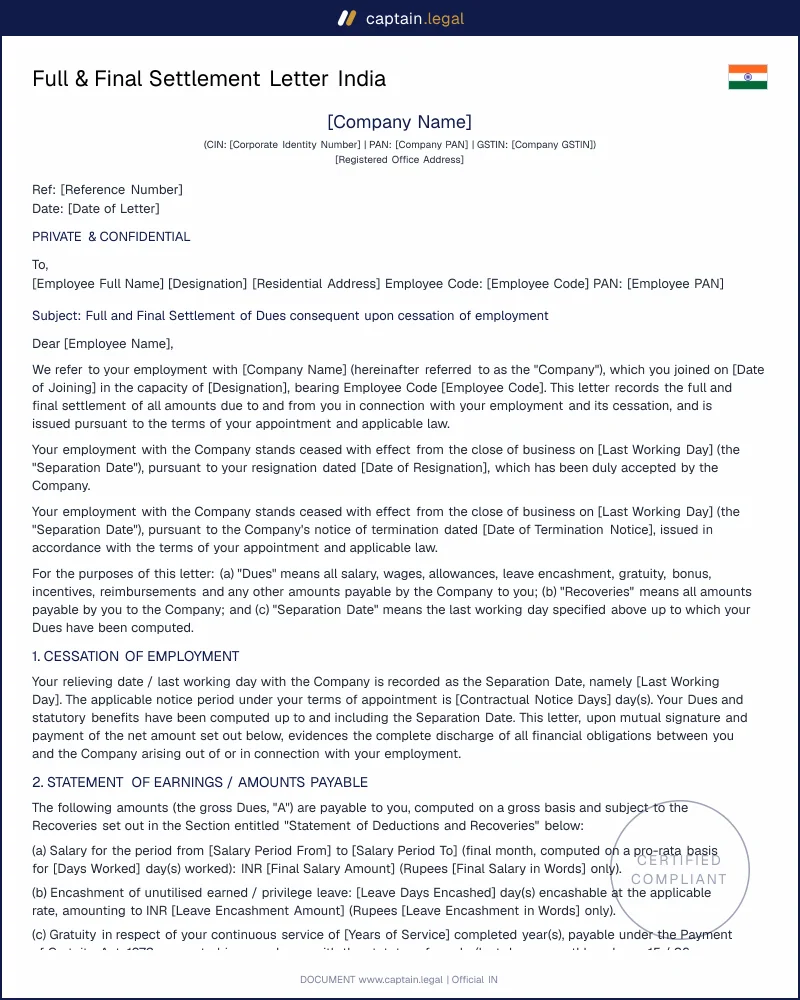
The single most important change to F&F settlements is the timeline. Under Section 17(2) of the Code on Wages, 2019, brought into force on 21 November 2025, all wages payable to an employee who has resigned, been dismissed, removed, retrenched, or rendered unemployed by closure of the establishment must be paid within two working days of the last working day. This replaced the old industry habit of 30 to 60 day settlement cycles, and it applies uniformly to every employee regardless of salary level or designation. The earlier wage-ceiling limitation is gone. An employer who sits on the dues now exposes itself to a claim, and Section 17 read with the Code's penalty provisions backs the obligation with graded fines.
Not every head of pay rides on the two-day clock. Gratuity keeps its own timeline : under Section 7(3) of the Payment of Gratuity Act, 1972 the employer must pay it within thirty days of it becoming payable, with simple interest running if the deadline is missed, and the entitlement arises only after five years of continuous service. Provident fund withdrawals follow the EPFO's own processing windows. So a well-drafted F&F letter separates the wage component, due in two working days, from the gratuity and PF components that follow their statutory paths.
Deductions are not at the employer's discretion either. Section 18 of the Code on Wages limits what may be subtracted from wages, and total deductions in a wage period generally cannot exceed fifty percent. The statutory text and the two-day rule are set out in the official consolidation published by the Code on Wages on the India Code portal. For workmen, retrenchment compensation under Section 25F of the Industrial Disputes Act is computed at fifteen days' average pay for every completed year of service and must appear in the settlement. Treating it as optional is the fastest way to have a termination set aside.