Create my document
Login

Choose country

FranceBelgiqueEspañaUnited StatesUnited KingdomMarocDeutschlandItaliaSchweiz
Contracts

Memorandum of Understanding (MoU) Under Indian Law

MoU drafting under the Indian Contract Act 1872, Section 10. Binding vs non-binding clauses, stamp duty and electronic execution covered. Word and PDF.
4.8/535 reviews50 000+ downloadsInstant download
Share

A memorandum of understanding (MoU) is a written record of the intentions and mutual expectations shared by two or more parties before they sign a definitive contract. In India it is the document businesses reach for at the threshold of a deal, when the commercial direction is clear but the detailed terms are still being negotiated. It can be wholly non-binding, wholly binding, or a careful blend of both, and which one you end up with depends entirely on how the clauses are drafted. Used well, an MoU sets the road map, records who does what, and protects each side from misunderstandings while the lawyers finish the long-form agreement.

The trouble is that most parties treat an MoU as a casual handshake on paper, then discover in a courtroom that a clause they thought was aspirational was read as a promise. The opposite mistake is just as common: a party assumes the whole document binds them, freezes its commercial options, and loses negotiating room it never had to give up. A well-drafted memorandum of understanding tells the reader, on its face, exactly which obligations bite now and which wait for the final contract.

Compliant

2026 Legislation

50,000+ clients

trust us

Affordable

From $4.90 / doc

Secure payment

Instant download

Memorandum of Understanding (MoU) Under Indian Law

Secure payment · No subscription

Fill in the template

What is a memorandum of understanding in India?

A memorandum of understanding is a preliminary instrument that captures the agreed commercial intent of the parties ahead of a definitive contract. It typically records the purpose of the proposed transaction, the broad responsibilities of each side, an exclusivity or confidentiality arrangement during negotiations, and a timeline towards signing the final deal. People also call it a letter of intent, a heads of agreement, or simply an MoU, and the labels are largely interchangeable in Indian practice. What matters is not the title but the substance of the clauses.

The line that confuses most parties is the one between an MoU and a binding contract. Under Indian law, every agreement is not a contract; only an agreement that satisfies Section 10 of the Indian Contract Act 1872 becomes enforceable. An MoU is enforceable only when it carries the essential elements of a contract: offer and acceptance, free consent, lawful consideration, lawful object, competent parties, and an intention to create legal relations. Where those elements are present and the parties clearly meant to be bound, courts will treat the document as a contract regardless of the "understanding" label. Where the document is expressly stated to be non-binding and creates no obligation beyond good-faith negotiation, it generally will not be enforced as a contract. For a structured set of service agreements and commercial contracts under the Indian Contract Act 1872, the MoU is usually the first step in that chain.

2

When do you need this document?

The most frequent trigger is a joint venture or strategic partnership where two companies have agreed on the broad commercial shape of a deal but need months to finalise the definitive contract. The MoU locks in the intent, sets an exclusivity period, and stops either side from quietly shopping the deal elsewhere while talks continue. A second common scenario is a merger or acquisition, where the buyer and target sign an MoU recording the indicative price, the due diligence access, and a confidentiality undertaking before the share purchase agreement is drawn up.

Government and institutional dealings are a category of their own. Public bodies, universities and PSUs routinely sign MoUs to record cooperation on a project, and these often sit deliberately on the non-binding side because no party wants to commit public funds prematurely. Vendors and distributors use MoUs to frame a supply relationship before negotiating the full sale and purchase or distribution agreement that will govern day-to-day orders.

Two edge cases deserve attention. An MoU in a real-estate transaction is treated with suspicion by courts precisely because parties try to use it as a backdoor sale agreement to dodge stamp duty and registration; if it records a present transfer of an interest in property it may need registration to be admissible. The second is the startup term sheet dressed up as an MoU, where founders and investors record valuation and key terms. Here the binding clauses, usually confidentiality and exclusivity, must be carved out expressly from the non-binding commercial heads, or the whole thing risks being read as a premature investment contract.

3

Key clauses included in our template

  • The recitals and purpose open the document by naming the parties and stating, in plain commercial language, what the proposed transaction is and why the parties are recording their understanding. This section frames everything that follows and gives a court the context it needs to read the rest of the document correctly.
  • The binding and non-binding clause is the heart of an Indian MoU. It states expressly which provisions create legal obligations now (typically confidentiality, exclusivity, costs and governing law) and which are merely a statement of intent pending the definitive contract. Without this carve-out, a party is left arguing about intention after the fact.
  • The confidentiality undertaking protects the information exchanged during negotiations, defining what counts as confidential and how long the obligation survives. It is one of the provisions that is almost always drafted to bind immediately, even in an otherwise non-binding MoU.
  • The exclusivity or lock-out provision prevents a party from negotiating the same deal with a third party for a fixed window, giving both sides the comfort to invest in due diligence. Indian courts will enforce a clearly worded exclusivity clause as a standalone obligation.
  • The consideration and cost-sharing clause records who bears the expenses of negotiation and, where the MoU is intended to bind, identifies the lawful consideration that Section 10 requires. A non-binding MoU still benefits from a clear statement that each side bears its own costs.
  • The governing law, jurisdiction and dispute resolution clause fixes that the MoU is read under Indian law, names the courts or the seat of arbitration, and decides whether disputes go to a court or to arbitration under the Arbitration and Conciliation Act 1996.
4

Regional considerations

Stamp duty is where the State you operate in changes the calculus, because the Indian Stamp Act 1899 leaves the rate to State legislation. In Maharashtra, an MoU that records an agreement and is executed in the State attracts duty under the Maharashtra Stamp Act 1958, and Mumbai deals are routinely stamped to keep the instrument admissible before the Bombay High Court. Practitioners there are especially careful with property-flavoured MoUs, which the registration authorities scrutinise closely.

In Karnataka, the Karnataka Stamp Act 1957 governs, and Bengaluru's dense startup and IT-services ecosystem produces a high volume of MoUs and term sheets. The recurring local issue is the term sheet that blends binding confidentiality with non-binding valuation heads, and Karnataka practitioners draft the carve-out tightly to avoid a premature-contract argument.

In Delhi, MoUs are stamped under the Indian Stamp Act 1899 as applied to the National Capital Territory, and the volume of government and institutional cooperation MoUs is unusually high. Here the drafting convention leans towards expressly non-binding language, because public bodies rarely want a cooperation record read as a funding commitment.

In Tamil Nadu, the Tamil Nadu stamp regime applies and Chennai's manufacturing and automotive supply chains generate vendor MoUs that frame long supply relationships. The local caution is to keep the MoU from accidentally fixing price and quantity in a way that converts it into an enforceable supply contract before the parties intend. Across every State, the safe rule is to stamp on execution and never assume a uniform national rate. Many of these MoUs feed directly into a shareholders agreement or partnership deed under the Companies Act 2013 once the deal closes.

5

How to fill out this memorandum of understanding

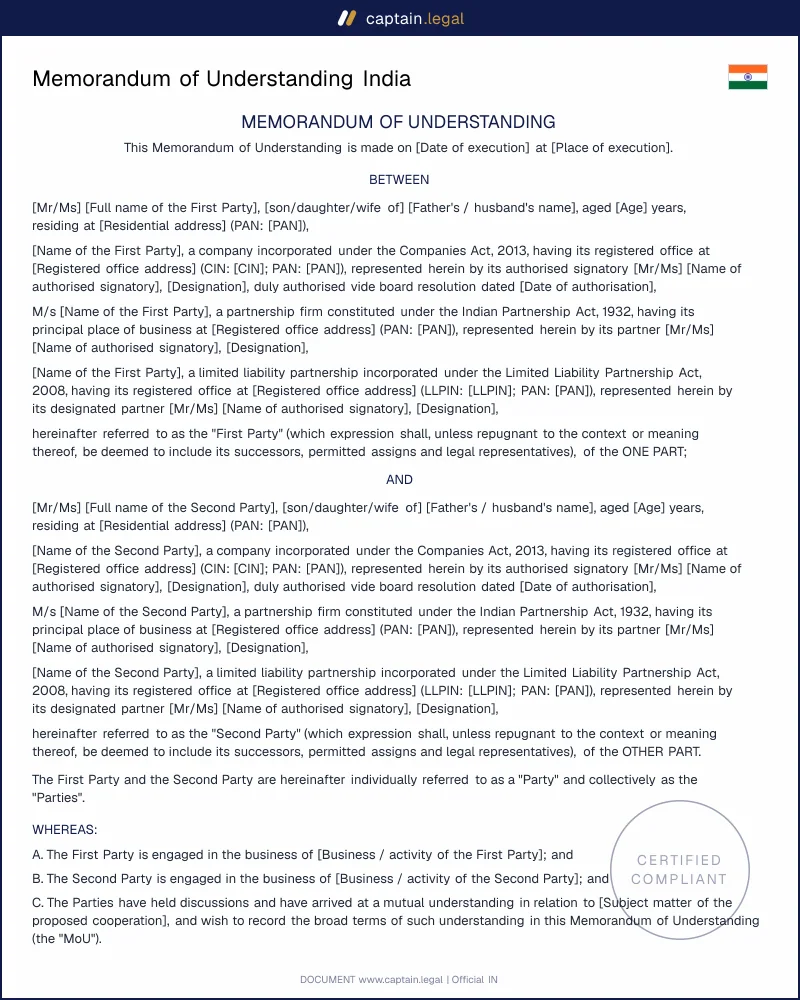
You start by entering the full legal names and addresses of every party, because an MoU naming only one signatory of a multi-party arrangement is a frequent source of later dispute. From there you describe the purpose of the understanding in plain commercial terms, since this is the clause a court reads first to gauge intention. The form then asks you to set the binding and non-binding split, the single most important choice in the document, by ticking which provisions take effect immediately and which await the definitive contract.

Next you fix the operative terms: the exclusivity period if any, the duration of the confidentiality obligation, the timeline to the final contract, and the cost-sharing arrangement. You then select the governing State, which matters for both stamp duty and jurisdiction, and choose whether disputes go to court or to arbitration. The template adjusts the closing clauses to your choices and leaves space for the date and signatures. Once complete, you can download it and arrange stamping in the relevant State. If the relationship later moves into hiring, the same parties often need an employment contract or appointment letter under Indian labour law.

6

Common mistakes to avoid

The single costliest error is silence on the binding question. Parties sign an MoU that says nothing about whether its terms create obligations, then litigate for years over whether a "best efforts" sentence was a promise. An Indian MoU should state, in one unambiguous clause, exactly which provisions bind and which do not. The second recurring mistake is skipping the stamp duty, on the assumption that an "understanding" is too informal to need stamping. When the document is later produced as evidence, the court refuses to look at it until the duty and a penalty are paid, and a deal can collapse in the meantime.

A third trap is using an MoU to disguise a property sale or a present transfer of an interest in land, which invites both registration problems and tax scrutiny. Parties also forget capacity and consideration: an MoU meant to bind but lacking lawful consideration, or signed by someone without authority, fails the Section 10 test entirely. Finally, many draft the confidentiality and exclusivity clauses loosely, then are surprised when a court declines to enforce vague language. Precision in these two clauses is what separates a protective MoU from a decorative one. For the broader compliance picture, a legal notice or demand letter under Indian law is often the next document if the other side breaches a binding term.

Key takeaways

BINDING STATUS

Drafting decides whether your MoU binds

In India, an MoU can be non-binding, binding, or mixed; it turns on what the clauses actually say, not the title. If it contains the essentials under Section 10 of the Indian Contract Act 1872 and shows an intention to create legal relations, a court may treat it as an enforceable contract. Write clearly which obligations apply now and which are only for negotiation.

LEGAL TEST

Section 10 plus objective intention test

Section 10 is the gatekeeper: offer and acceptance, free consent, lawful consideration and object, competent parties, and intention to create legal relations. Courts look at intention objectively, not what someone privately assumed. The Brikram Kishore Parida v. Penudhar Jena approach means a clause that reads like a promise can bind even if a party thought it was aspirational. Avoid vague language where you want flexibility.

REMEDIES

Breach can trigger more than damages

If your MoU meets Section 10, the consequences can be serious. A wronged party may seek damages, and in suitable cases can push for specific performance under the Specific Relief Act 1963 where money compensation is not readily quantifiable. Promissory estoppel may also arise where one side has relied on the other’s assurances. Treat the document like litigation could follow, and draft accordingly.

Frequently Asked Questions

It depends entirely on how the MoU is drafted. An MoU is not automatically binding, but it becomes an enforceable contract when it satisfies Section 10 of the Indian Contract Act 1872: offer and acceptance, free consent, competent parties, lawful consideration, lawful object, and an intention to create legal relations. Courts apply an objective test of intention, so a document can bind you even if you privately thought it was aspirational. The safest approach is an express clause stating which provisions are binding now and which await the final contract. A purely non-binding MoU that records only good-faith negotiation generally will not be enforced as a contract.

The practical difference is enforceability. A contract is an agreement that the parties intended to be legally binding and that meets the Section 10 requirements, so a court will enforce it. An MoU records a mutual understanding at an earlier stage and may be binding, non-binding, or partly each. Many MoUs deliberately keep the commercial heads non-binding while making confidentiality and exclusivity bind immediately. In substance, a fully binding MoU and a contract are the same thing; the label does not change the legal analysis. What the court examines is the language, the conduct of the parties, and whether they objectively intended legal relations.

Stamping is not what creates the MoU, but it is what lets you use it. Under the Indian Stamp Act 1899 and State stamp laws, many MoUs attract stamp duty, and the rate varies from State to State. An unstamped or insufficiently stamped instrument can be held inadmissible in evidence until you pay the duty plus a penalty, which can stall a dispute at the worst possible moment. Stamp the MoU on its correct value and in the State where it is executed, ideally at the time of signing. Property-related MoUs draw the closest scrutiny and may also require registration.

Yes. An MoU executed online and signed with a valid electronic signature is recognised under the Information Technology Act 2000. The main exceptions are the document categories in Schedule I to that Act, such as wills and negotiable instruments, which still need a wet-ink signature. For an ordinary commercial MoU between businesses, electronic execution is both lawful and routine. You should still attend to stamping, because moving the signature online does not remove the stamp duty obligation under the relevant State law. Keeping a clear audit trail of who signed and when strengthens the document if its execution is ever questioned.

You receive the completed MoU in both Word and PDF formats. The PDF is ready to print, sign and stamp as-is, which suits parties who want to execute the document immediately without further editing. The Word version lets you adapt specific clauses, add transaction-specific schedules, or refine the binding and non-binding carve-out with your own advisers before signing. Having both means you can move straight to signature for a standard deal or fine-tune the language for a more complex arrangement. Either format is suitable for stamping and for production as evidence, provided the document is properly executed.

An MoU lasts for the period the parties choose, and a well-drafted one says so expressly. Most commercial MoUs set a fixed term tied to the negotiation window, often a few weeks to a few months, after which the understanding lapses unless a definitive contract is signed. The confidentiality clause usually survives that expiry for a longer stated period, because the need to protect disclosed information outlives the negotiation itself. An exclusivity clause typically runs for the same window as the negotiation. If no term is stated, a court may read in a reasonable period, which is exactly the uncertainty a clear duration clause avoids.

You can, but only to the extent the MoU was binding. If the relevant clause met the Section 10 requirements and the parties intended legal relations, you can sue for breach and, where damages are not readily quantifiable, seek specific performance under the Specific Relief Act 1963. Promissory estoppel may also help where you acted in reliance on the understanding and suffered loss. If the walked-away party only breached a clause expressly marked non-binding, a court will generally decline to enforce it. This is precisely why the binding and non-binding split is the clause you cannot afford to leave vague.

4.8/5

35 verified reviews · 50 000+ downloads

Memorandum of Understanding (MoU) Under Indian Law
  • Immediate access to the document
  • PDF + Word download
  • Compliant with 2026 legislation
  • Reviewed by lawyers
Fill in the template
Secure payment · No subscription
Updated on June 7, 2026

You might also like

Non-Disclosure Agreement (NDA) India
Sale and Purchase Agreement for Goods India