Create my document
Login

Choose country

FranceBelgiqueEspañaUnited StatesUnited KingdomMarocDeutschlandItaliaSchweiz
Business

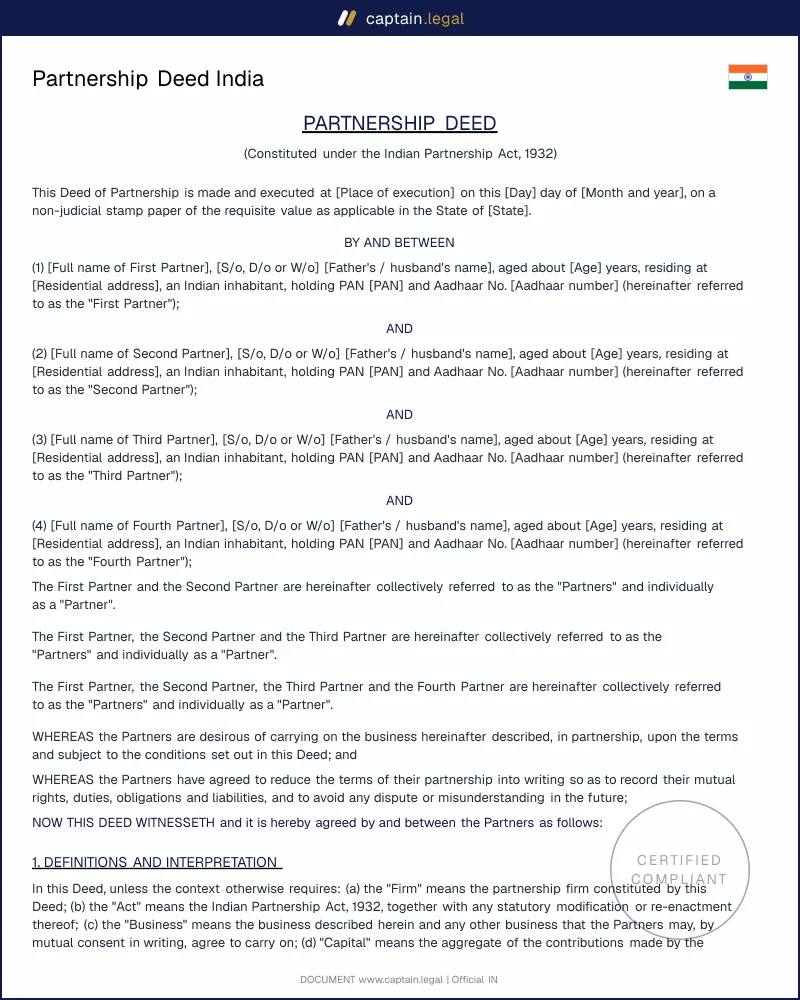
Partnership Deed Under Indian Partnership Act 1932

Draft a legally sound Partnership Deed aligned with the Indian Partnership Act 1932. Capital, profit sharing, registration and dissolution covered.
4.8/519 reviews50 000+ downloadsInstant download
Share

A Partnership Deed is the written contract that governs a firm formed under the Indian Partnership Act, 1932. It records who the partners are, what each one contributes, how profits and losses are split, who manages what, and how the firm is dissolved when a partner leaves or dies. For founders who want to run a business together without the cost and compliance burden of incorporation, it remains the simplest and most widely created business document in India. A clear partnership agreement is also the difference between a clean exit and years of litigation, because Indian courts read the deed first and the partners' intentions second. This template covers capital, profit-sharing ratios, managerial roles, admission and retirement of partners, and the dissolution mechanics that most homemade deeds forget.

Compliant

2026 Legislation

50,000+ clients

trust us

Affordable

From $4.90 / doc

Secure payment

Instant download

Partnership Deed Under Indian Partnership Act 1932

Secure payment · No subscription

Fill in the template

What is a partnership deed in India?

A partnership deed is the instrument that puts a partnership in writing. Under Section 4 of the Indian Partnership Act, 1932, a partnership is the relation between persons who have agreed to share the profits of a business carried on by all or any of them acting for all. The deed is the document that proves that relation exists and fixes its terms. The law does not force you to have a written deed; an oral partnership is legally valid. In practice an oral arrangement is almost worthless once money is at stake, because there is nothing to produce when partners disagree over their share of profit or the scope of a partner's authority.

People often confuse a partnership deed with an LLP agreement, and the two are not interchangeable. An LLP agreement governs a Limited Liability Partnership incorporated under the LLP Act, 2008, where partners enjoy limited liability and the entity has separate legal personality. A general partnership under the 1932 Act has neither: every partner is jointly and severally liable for the firm's debts, to the full extent of personal assets. That single difference, unlimited personal liability, is the most important thing a founder should understand before signing. The deed cannot cap liability toward outsiders; it can only allocate the burden internally between partners. If liability protection is the goal, you want the firm's documents from our Business and incorporation documents for India catalogue rather than a general partnership deed.

2

When do you need this document?

The most common trigger is two or more people deciding to run a business together without incorporating, where the 1932 Act partnership is chosen for its low compliance and quick setup. A typical case is a family trading business, a professional services outfit, or a small manufacturing unit where the founders want flexibility on profit-sharing and do not need outside investors. The deed becomes essential the moment capital is unequal, because the statutory default of equal sharing rarely matches what the partners actually agreed verbally.

A second scenario is the admission of a new partner into an existing firm, where a fresh or supplementary deed records the incoming partner's contribution, profit share and the date from which they share in goodwill. Retirement and death of a partner are the mirror image: without express clauses, the firm technically dissolves on a partner's death under Section 42, which can be catastrophic for an ongoing business. A well-drafted deed includes a continuation clause so the surviving partners can carry on. Conversion is another frequent reason to revisit the deed, since many firms outgrow the general partnership and convert to an LLP or a Private Limited company once liability exposure or funding needs grow. If that is on your horizon, our memorandum of understanding template under Indian law is often used to record founder intentions ahead of the formal conversion. The edge case worth flagging is the partnership at will: where the deed fixes no duration, any partner can dissolve the firm by written notice under Section 43, which gives an exiting partner far more leverage than founders usually expect.

3

Key clauses included in our template

  • The name and constitution of the firm fixes the firm name, the principal place of business and the names and addresses of every partner. The firm name must not imply patronage of government and must not be identical to an existing registered firm in the same state, a check that trips up founders who pick a name without searching the Register of Firms first.
  • The capital contribution clause records exactly what each partner brings in, whether cash, property or goodwill, and whether interest is payable on capital. This is the clause that overrides the statutory presumption of equal sharing, so it must state both the amount and the agreed treatment of further capital calls.
  • The profit and loss sharing ratio sets the percentage each partner takes, which need not match the capital ratio. The deed should make clear whether losses follow the same ratio as profits, because Section 13 otherwise presumes they do, and partners frequently intend a different split.
  • The management and authority clause allocates day-to-day control, signing powers and the limits of each partner's authority to bind the firm. Without it, Section 18 treats every partner as an agent of the firm, meaning any partner can commit the others to a contract.
  • The admission, retirement and death clause governs how partners join and leave, the notice required, the valuation of an outgoing partner's share, and crucially whether the firm continues on death. This is the single most litigated area and the one homemade deeds handle worst.
  • The dissolution and accounts clause sets out the events that wind up the firm, the order in which assets are applied under Section 48, and the arbitration route for settling disputes. A clean arbitration clause keeps the inevitable disagreement out of the slower civil courts.
4

Regional considerations

Stamp duty on a partnership deed is a state subject, so the amount payable depends entirely on where the firm is based, and using the wrong stamp paper value is one of the most frequent reasons a deed is challenged. In Maharashtra, duty is structured around the firm's capital: a deed with capital up to fifty thousand rupees attracts a fixed charge, while higher capital is charged at a percentage subject to a statutory ceiling. Founders in Mumbai and Pune routinely underpay by treating the lower slab as a flat rate for all deeds, which leaves the instrument vulnerable when produced in evidence.

In Delhi, the practice is to execute the deed on stamp paper of a modest fixed minimum value, with the Registrar of Firms for the National Capital Territory handling registration. The fixed-value approach makes Delhi simpler than the capital-linked states, but it does not reduce the importance of registering, given the Section 69 bar applies identically across the country.

Karnataka follows a largely flat stamp-duty model for partnership deeds rather than a capital-linked slab, which makes the upfront cost predictable but means partners should confirm the current figure with the sub-registrar before execution, since state schedules are revised periodically. Tamil Nadu keeps registration fees low and broadly fixed, and the Tamil Nadu Registrar processes firm registration through a comparatively quick counter process. Across every state the underlying point is the same: the deed must be on correctly valued, recently issued stamp paper, generally not older than six months from the date of issue, or the firm risks both penalty and inadmissibility. Because schedules differ and change, partners operating in more than one state should verify the applicable rate with the local Registrar of Firms rather than assuming a national standard. For firms that also handle commercial supply arrangements, pairing the deed with a properly stamped sale and purchase of goods agreement under the 1930 Act avoids inconsistent stamping across the firm's core documents.

5

How to fill out this partnership deed

You start by entering the firm name and the principal place of business, which tells the template which state's stamping and registration notes to surface. From there you add each partner's full name, address and the nature of their contribution, and the form prompts you to state whether interest on capital is payable so the capital clause is complete rather than implied. The next step sets the profit-sharing ratio and asks separately whether losses follow the same ratio, which closes the gap that the statutory default would otherwise fill against your intention.

You then allocate management roles and signing authority, define the bank operation rules, and choose whether the firm is for a fixed term or at will, a choice that directly affects how easily a partner can force dissolution. The admission, retirement and death section lets you switch on a continuation clause so the death of a partner does not automatically wind up the business. The template finishes with the dissolution sequence and an arbitration clause, then generates the deed ready for execution on stamp paper. If you also need internal approvals once the firm is running, our employment contracts and HR documents for India slot in alongside the deed without rework.

6

Common mistakes to avoid

The most damaging mistake is treating registration as optional in the casual sense, when Section 69 turns non-registration into a near-total bar on suing to enforce the firm's rights. Founders who skip registration to save a small fee discover the cost only when a debtor refuses to pay and the firm cannot file suit. The second recurring error is leaving the profit and loss ratio vague or omitting losses altogether, which hands the dispute straight to the statutory presumption of equal sharing under Section 13, regardless of who contributed the capital. A third is forgetting the continuation clause, so the firm legally dissolves on a partner's death and the survivors find themselves negotiating from scratch with the deceased partner's legal heirs.

Stamping errors are quietly the most common of all. Using stamp paper of the wrong value, or stamp paper older than the permitted window, can render the deed inadmissible until the deficiency and penalty are cleared, which is exactly the wrong moment to discover the problem. Partners also tend to copy a generic deed without a dispute-resolution clause, then litigate routine disagreements in overburdened civil courts instead of resolving them through arbitration. Finally, founders frequently confuse the general partnership with limited-liability structures and sign a deed assuming their personal assets are protected. They are not. A general partnership exposes every partner to unlimited personal liability for the firm's debts, and no clause in the deed can change that toward outsiders. If that exposure is unacceptable, the right move is to choose a different vehicle before signing, not to patch the deed afterward, and our wider shareholders and incorporation documents for India catalogue covers those alternatives.

Key takeaways

LIABILITY

Partners risk personal assets for firm debts

A general partnership under the Indian Partnership Act, 1932 does not give limited liability. Each partner can be jointly and severally liable to outsiders for the firm’s debts, even beyond their capital contribution. The deed cannot cap this exposure against third parties; it only decides how partners share the burden internally. If you want liability protection, a different structure is needed, not clever drafting.

REGISTRATION

Unregistered firms lose the right to sue

Registration is optional on paper, but Section 69 creates a hard disability: an unregistered firm cannot sue a third party to enforce contractual rights, and an unregistered partner cannot sue the firm or co-partners for rights under the Act. Courts apply this strictly (V. Subramaniam v. Rajesh Raghuvandra Rao, 2009). Registering after a dispute starts does not fix a suit filed while unregistered.

DRAFTING

Silence in the deed triggers default rules

The deed is the first document a court will read to understand your partnership, and gaps are filled by the Act’s default provisions (Sections 9 to 17). A thin deed can backfire, for example by pushing you into equal profit-sharing even if one partner funded most of the capital. Put capital contribution, profit and loss ratio, management powers, admission/retirement, and dissolution mechanics clearly in writing to avoid fights later.

Frequently Asked Questions

Yes. A partnership deed executed and signed by the partners is a valid and binding contract between them under the Indian Partnership Act, 1932, even if the firm is unregistered. The catch is enforcement against outsiders. Under Section 69, an unregistered firm cannot sue a third party to enforce a contractual right, and an unregistered partner cannot sue the firm or co-partners on a right conferred by the Act. The deed still binds the partners internally, but the firm loses its ability to litigate in most situations until it is registered with the Registrar of Firms. For practical purposes, treat registration as essential rather than optional.

Registration is not legally compulsory, but the consequences of not registering make it close to unavoidable for any firm that expects to enforce contracts. You register with the Registrar of Firms of the state where the firm carries on business, by filing a statement under Section 58 in the prescribed form, signed by all partners and accompanied by the deed and prescribed fee. The Registrar enters the firm in the Register of Firms and issues a certificate. You can register at the outset or later, but registering only after a dispute arises will not rescue a suit that was already barred when it was filed.

It depends entirely on the state, because stamp duty is governed by the relevant State Stamp Act, not a single national rate. Some states charge a flat amount, while others scale the duty to the firm's capital subject to a ceiling. The deed must be executed on non-judicial stamp paper of the correct value, and that paper generally must not be older than six months from its date of issue. Underpaying is a real risk, since an inadequately stamped deed can be held inadmissible in evidence until the shortfall and a penalty are paid. Always confirm the current figure with your local sub-registrar before execution.

By default, Section 42 of the Indian Partnership Act, 1932 provides that a firm is dissolved on the death of a partner unless the deed says otherwise. That default can be disastrous for a working business, which is why a well-drafted deed includes a continuation clause allowing the surviving partners to carry on, usually with a mechanism to value and pay out the outgoing partner's share. For a firm at will, any partner can also trigger dissolution simply by giving written notice under Section 43. Building clear admission, retirement and death provisions into the deed is the only reliable way to keep a partner's exit from collapsing the firm.

Yes. Once you complete the guided fields, the deed is generated and available to download in both editable Word format and ready-to-print PDF. The Word version lets you make final adjustments to partner names, capital figures or bespoke clauses before printing on stamp paper, while the PDF is suited to direct execution and filing. Because the deed must be signed on appropriately valued non-judicial stamp paper for the relevant state, you typically print the completed document onto stamp paper and have all partners sign it in the presence of witnesses where required.

They govern two different legal structures. A partnership deed sets up a general partnership under the Indian Partnership Act, 1932, where partners carry unlimited personal liability for the firm's debts. An LLP agreement sets up a Limited Liability Partnership under the LLP Act, 2008, an incorporated entity with separate legal personality where each partner's liability is limited to their agreed contribution. An LLP must be registered with the Registrar and its agreement filed after incorporation, whereas a general partnership's registration is optional. If protecting personal assets matters, the LLP or a company is usually the better route; if simplicity and low compliance are the priority, the general partnership deed is the standard choice.

Drafting and executing the deed itself takes very little time once the partners have agreed terms, often a single sitting to complete the document, print it on stamp paper and sign. Registration with the Registrar of Firms is the variable. Some states process firm registration through a quick counter system within days, while others take a few weeks depending on the workload of the office and whether the application is complete. The practical bottleneck is rarely the drafting; it is gathering accurate partner details, agreeing the profit ratio and capital, and paying the correct stamp duty before the deed can be validly executed.

4.8/5

19 verified reviews · 50 000+ downloads

Partnership Deed Under Indian Partnership Act 1932
  • Immediate access to the document
  • PDF + Word download
  • Compliant with 2026 legislation
  • Reviewed by lawyers
Fill in the template
Secure payment · No subscription
Updated on June 8, 2026

You might also like

MOA & AOA Template India
LLP Agreement India: Template