Create my document
Login

Choose country

FranceBelgiqueEspañaUnited StatesUnited KingdomMarocDeutschlandItaliaSchweiz
Notices & Compliance

Money Recovery Demand Notice | Order 37 CPC Ready

Advocate-grade demand notice aligned with the Limitation Act 1963, Order 37 CPC and MSMED Act interest rules. Quantified claim, 15-day ultimatum, proof of service.
4.8/536 reviews50 000+ downloadsInstant download
Share

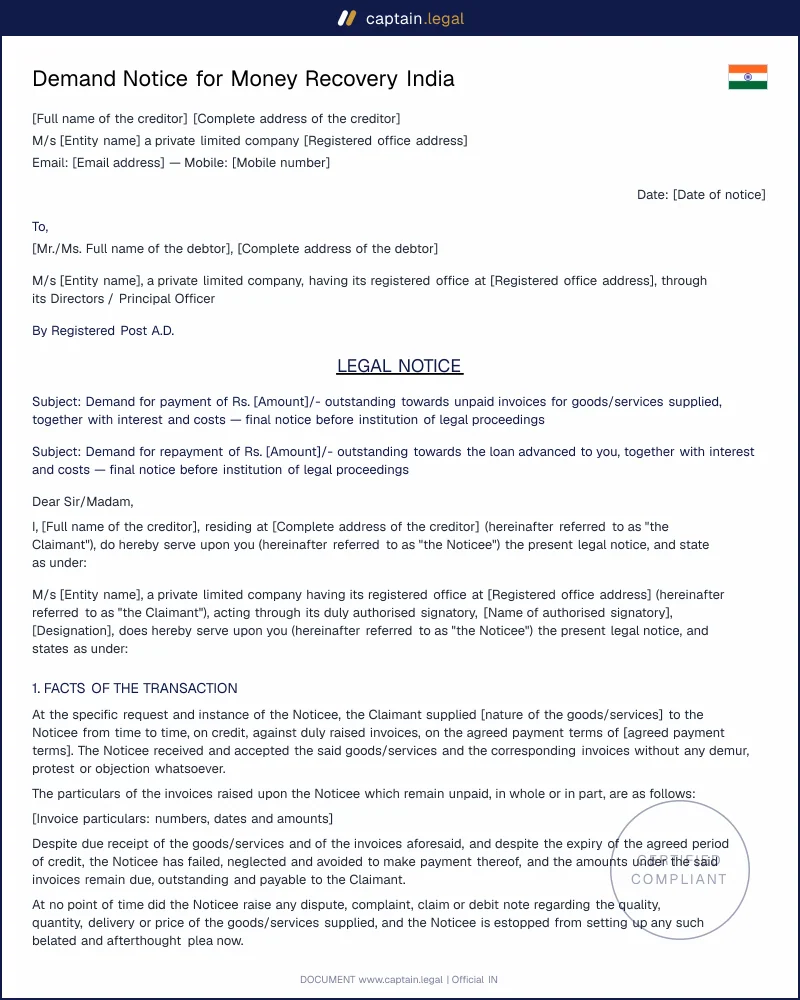
A demand notice for recovery of money is the formal written warning a creditor sends before going to court: it identifies the debtor, states the exact amount due, narrates the facts that created the debt and fixes a final deadline for payment. Used for unpaid invoices, dishonoured dues under a contract or a personal loan that was never repaid, it is in most cases the single cheapest step that actually produces payment. Indian courts and tribunals also read it as proof that you gave the other side a fair chance to settle. This template gives you a recovery notice drafted to the standard an advocate would use, ready to adapt to a business debt, a friendly loan or a supplier dispute, and to send by registered post the same day.

Compliant

2026 Legislation

50,000+ clients

trust us

Affordable

From $4.90 / doc

Secure payment

Instant download

Money Recovery Demand Notice | Order 37 CPC Ready

Secure payment · No subscription

Fill in the template

What is a demand notice for recovery of money?

A demand notice, often called a legal notice for recovery of money, is a pre-litigation communication through which a creditor formally calls upon a debtor to pay a liquidated sum within a stated period, failing which civil or criminal proceedings will follow. It is not a court filing. It creates no decree by itself. Its power lies elsewhere: it interrupts the debtor's comfortable silence, it crystallises the claim in writing, and it becomes Exhibit A when the matter reaches a judge. In practice, a significant share of recovery disputes in India settle at the notice stage, because the debtor's advocate reads the document and advises that the claim is well founded.

The demand notice should not be confused with neighbouring documents. A cheque bounce notice under Section 138 of the Negotiable Instruments Act 1881 is a creature of statute with rigid deadlines, available only when a cheque has been dishonoured. A statutory demand under Section 8 of the Insolvency and Bankruptcy Code 2016 is reserved for operational creditors of corporate debtors where the default crosses the prescribed threshold of one crore rupees. The general demand notice covered here is broader: it works for any ascertainable money claim, whether the debtor is an individual, a partnership firm or a company, and whether the debt arises from goods supplied, services rendered under a service agreement governed by the Indian Contract Act or a private loan between individuals.

2

When do you need this document?

The most frequent trigger is the unpaid trade invoice. A client accepted the goods or signed off on the deliverables, the credit period expired, the follow-up emails produced promises and nothing else. A demand notice converts that drift into a dated, formal record, and it is usually at this point that the debtor's accounts team finds the money. The second classic scenario is the personal or business loan that was never repaid, whether documented by a loan agreement, bank transfers or a promissory note under Section 4 of the Negotiable Instruments Act. Here the notice serves a double purpose: it demands repayment and it invites an acknowledgment that resets limitation if the debtor pleads for time in writing.

Security deposits are a third recurring case. Landlords who withhold a refundable deposit after the tenancy ends, vendors who keep an advance after failing to deliver, employers who delay terminal dues: each owes a liquidated sum that a demand notice can claim with interest. Businesses also use the notice as the opening move before a summary suit, an arbitration reference where the contract contains an arbitration clause, or an MSEFC filing on the Samadhaan portal.

Two edge cases deserve attention. If the debt was partly paid recently, that part payment against interest or principal, recorded in writing, extends limitation under Section 19 of the Limitation Act; mention it in the notice. And if the debtor is a company showing signs of insolvency, weigh carefully whether to send an ordinary demand or a Section 8 IBC demand notice, because the latter starts a ten-day statutory clock and signals an intent to trigger insolvency rather than simply recover.

3

Key clauses included in our template

  • The identification of the parties sets out the full legal name, status and address of both creditor and debtor. For a company, that means the registered office and CIN; for a firm, the names of the partners. A notice addressed to a brand name rather than the legal entity gives the debtor an easy technical escape, and judges notice the sloppiness.
  • The statement of facts narrates the transaction in chronological, numbered paragraphs: the agreement or order, the supply or disbursement, the invoices with dates and numbers, the part payments received and the reminders ignored. This section becomes the skeleton of your future plaint, so every assertion is one you can prove with a document.
  • The quantification of the demand states the exact principal outstanding, the interest claimed with its rate and legal basis (the contract, Section 16 MSMED Act for registered suppliers, or the Interest Act 1978), and the date up to which interest is computed. A vague demand for "dues" is the commonest drafting failure in notices prepared without counsel.
  • The deadline and consequence clause fixes a definite period, typically 15 days from receipt, and states the precise consequence of default: a civil suit, a summary suit under Order XXXVII CPC, arbitration or an MSEFC reference, with costs and further interest to the debtor's account.
  • The reservation of rights preserves all other remedies, including criminal action where cheques have bounced or Section 406/420 IPC ingredients exist, so the notice never reads as an election of one remedy.
  • The mode of service block records dispatch by registered post A.D. or speed post and email, because proof of delivery decides disputes about whether the notice was ever received.
4

Jurisdiction and regional considerations

Where you may eventually sue shapes how the notice is drafted, so think about forum before you fix the deadline. Under Section 20 CPC, suit lies where the defendant resides or works for gain, or where the cause of action arose in whole or part: typically the place of delivery, the place of payment named in the invoice, or the branch where the loan was disbursed. Delhi and Mumbai route higher-value commercial recoveries through dedicated commercial divisions and commercial courts under the Commercial Courts Act 2015, where the pre-institution mediation step under Section 12A applies and timelines are tighter than in ordinary civil courts. A notice that already sets out the claim with documentary precision shortens that mediation considerably.

Maharashtra, Karnataka and Tamil Nadu maintain active Micro and Small Enterprises Facilitation Councils, and an Udyam-registered supplier in Pune, Bengaluru or Chennai will often recover faster through a Samadhaan reference than through a civil suit, since the MSEFC must aim to decide within 90 days and the buyer must deposit 75 per cent of the award under Section 19 MSMED Act before challenging it. In Gujarat and West Bengal, creditors relying on hundis or promissory notes still make regular use of summary procedure before the City Civil Courts at Ahmedabad and Calcutta. One point applies everywhere: the demand notice itself requires no stamp paper, no notarisation and no advocate's signature to be valid, although a notice issued on an advocate's letterhead measurably increases the rate of pre-suit settlement. Whatever the state, keep the postal acknowledgment card and the email delivery receipt; courts across India treat the registered post receipt as presumptive proof of service under Section 27 of the General Clauses Act 1897.

5

How to fill out this demand notice

You start by identifying yourself and the debtor exactly as the underlying documents describe you, since any mismatch between the notice and the invoices will be exploited later. The form then walks you through the facts: the date and nature of the agreement, what was supplied or lent, the invoice or repayment schedule, and every part payment received. From there you enter the amount, and the template separates principal, interest and the rate you rely on, so the final figure is auditable rather than asserted. Next you choose the compliance period; fifteen days is the market standard for trade debts, while a shorter period suits debts already long overdue. The closing section adapts the consequence language to your intended remedy, whether civil suit, arbitration or an MSEFC reference, and adds the reservation of rights. Once generated, print the notice, sign it, and dispatch it by registered post A.D. to every known address of the debtor, with a copy by email. Businesses that send notices regularly often pair this template with the wider set of legal notices and compliance formats for Indian practice, and companies chasing several defaulting buyers can manage all drafts from the catalogue of Indian legal document templates.

6

Common mistakes to avoid

The error that destroys more recoveries than any other is waiting too long. Creditors send reminders for two and a half years, then discover that by the time the suit is ready, the three-year limitation under the Limitation Act 1963 has expired or is about to, leaving no margin for service and drafting. Send the notice early; it costs nothing and freezes the record. The second classic failure is the unquantified demand: a notice claiming "outstanding dues along with interest" without a figure, a rate or a computation invites the reply that the claim is vague, and weakens a later summary suit where the sum must be liquidated. Equally damaging is mixing up remedies, for example threatening criminal prosecution for a plain civil debt with no dishonoured cheque and no entrustment; such threats can be read as attempted intimidation and they hand the debtor a grievance.

The second cluster of mistakes concerns proof. Sending the notice by WhatsApp alone, or by ordinary courier without acknowledgment, leaves you unable to establish service. Use registered post A.D. plus email, and preserve the receipts. Addressing only one director of a debtor company, instead of the company at its registered office, is another avoidable defect. Finally, do not soften the deadline. A notice that asks the debtor to pay "at the earliest" sets no clock and triggers no default; fix a specific number of days and state what happens when they expire. Suppliers structured as a firm should also confirm who signs: under a partnership deed governed by the Indian Partnership Act 1932, any partner may issue the demand on the firm's behalf.

Key takeaways

PURPOSE

A notice sets the claim in writing

A money recovery demand notice is a pre-litigation warning, not a court filing and not a decree. It identifies the debtor, narrates how the debt arose, and states the exact liquidated sum you are claiming. Courts and tribunals treat it as proof you gave a fair chance to pay, and it often triggers settlement because the debtor can see the case laid out clearly.

LIMITATION

Watch the three-year filing clock

The Limitation Act, 1963 drives your timing. A recovery suit is ordinarily to be filed within three years from the date the amount fell due, and delay is not condoned in a summary suit. A well-drafted notice also nudges the debtor to reply in writing; an acknowledgement before expiry can restart limitation under Section 18, which can protect your claim.

STRATEGY

Choose the right route and pressure

Match the notice to the legal path you may take next. If you have a written contract, invoice trail, or promissory note, Order XXXVII CPC allows a summary suit where the defendant needs the court’s leave to defend. For specified-value commercial disputes, Section 12A of the Commercial Courts Act, 2015 may require pre-institution mediation unless urgent interim relief is sought. MSME suppliers can invoke Sections 15 and 16 of the MSMED Act, 2006 for stricter payment timelines and interest consequences.

Frequently Asked Questions

The notice itself does not bind the debtor the way a decree does, but it is legally significant and fully valid without any stamp duty, notarisation or court filing. Its effects are real: it records the claim within limitation, it satisfies the expectation of pre-suit demand that judges and mediators hold in commercial matters, and any written reply from the debtor acknowledging the debt restarts the three-year period under Section 18 of the Limitation Act 1963. For claims against the Government, a prior notice is mandatory under Section 80 CPC. In short, the document is enforceable evidence, and ignoring it carries consequences for the debtor in costs and credibility.

Fifteen days from receipt is the standard for trade debts and loans, and it mirrors the statutory period the drawer of a bounced cheque gets under Section 138 of the Negotiable Instruments Act 1881, so courts find it familiar and reasonable. Seven days is defensible where the debt is old, admitted or repeatedly promised. Thirty days suits high-value claims where you genuinely expect a negotiated settlement. Whatever period you choose, count it from receipt rather than dispatch, state it as a fixed number of days, and avoid extending it informally over the phone, because each extension blurs the default date you will later plead.

Yes, on one of three bases. If the contract or invoice stipulates a rate, claim that rate. If you are a micro or small enterprise with Udyam registration, Section 16 of the MSMED Act 2006 entitles you to compound interest with monthly rests at three times the RBI bank rate once payment is delayed beyond 45 days of acceptance. In all other cases, the Interest Act 1978 and Section 34 CPC allow the court to award reasonable interest from the date of the notice or the suit. State the rate, the start date and the computed figure in the notice itself; a quantified interest claim is far harder to contest than a bare reservation.

Silence after the deadline is itself useful: it completes the picture of default you will present to the court. Your options then depend on the paperwork. With a written contract, invoices or a promissory note, a summary suit under Order XXXVII CPC denies the debtor an automatic right to defend. Commercial disputes above the statutory value go to commercial courts, usually after pre-institution mediation under Section 12A of the Commercial Courts Act 2015. Udyam-registered suppliers can file on the MSME Samadhaan portal. Where the contract has an arbitration clause, the notice doubles as the pre-arbitration demand. File within three years of the cause of action, without exception.

No statute requires it. A demand notice signed by the creditor personally is just as valid in law, and this template is drafted so that the statutory references, the quantification and the consequence clause meet the standard an advocate would apply. That said, a notice issued on counsel's letterhead signals that litigation is funded and imminent, and in practice it produces a higher settlement rate with corporate debtors. A sensible approach for small businesses is to send the first notice directly using a rigorous format, and to escalate to an advocate-issued notice only if the deadline lapses.

You download the completed notice instantly in both Word and PDF. The Word version stays fully editable, so you can adjust the narration of facts, add invoice schedules as annexures or update the interest computation on the day of dispatch. The PDF version is print-ready for signature and registered post. Keep one signed original for your file, send one by registered post A.D. and attach the PDF to a covering email; the combination gives you the proof of service that decides most disputes about whether the notice was received.

Yes, and you generally should. A single notice consolidating every outstanding invoice against the same debtor presents one liquidated total, simplifies the future suit and avoids the impression of piecemeal harassment. List each invoice with its number, date, amount and due date in a tabulated annexure, then demand the aggregate with interest. Watch limitation per invoice though: each invoice has its own three-year clock from its due date, so the oldest invoices set your urgency. If some dues arise from employment rather than trade, such as terminal dues claimed through a full and final settlement letter, keep those in a separate notice, since the legal basis and forum differ.

4.8/5

36 verified reviews · 50 000+ downloads

Money Recovery Demand Notice | Order 37 CPC Ready
  • Immediate access to the document
  • PDF + Word download
  • Compliant with 2026 legislation
  • Reviewed by lawyers
Fill in the template
Secure payment · No subscription
Updated on June 10, 2026

You might also like

Reply to Legal Notice Format India
Consumer Complaint Notice India