Create my document
Login

Choose country

FranceBelgiqueEspañaUnited StatesUnited KingdomMarocDeutschlandItaliaSchweiz
Employment & HR

Employment Contract India: New Labour Codes Compliant

Appointment letter aligned with the Code on Wages 50% rule and OSH Code letter mandate. Section 27 non-compete handled correctly. Word and PDF.
4.8/527 reviews50 000+ downloadsInstant download
Share

A written employment contract, often issued in India as a formal appointment letter, is the single document that turns a verbal offer into an enforceable working relationship. It sets the role, the salary structure, working hours, leave, the probation period, confidentiality obligations and the notice required on either side. For employers in India, a written appointment letter is no longer simply good practice. Under the Occupational Safety, Health and Working Conditions Code, 2020, issuing one to every worker is now a statutory duty. A clean contract protects the company against later disputes over what was promised, and it gives the employee a document they can rely on when they resign elsewhere.

This template is drafted for the Indian framework as it stands after the four Labour Codes came into force, with the salary structure built around the new uniform definition of wages and a notice clause that respects both the contract and the applicable State rules.

Compliant

2026 Legislation

50,000+ clients

trust us

Affordable

From $4.90 / doc

Secure payment

Instant download

Employment Contract India: New Labour Codes Compliant

Secure payment · No subscription

Fill in the template

What is an employment contract or appointment letter in India?

An employment contract in India is an agreement, enforceable under the Indian Contract Act, 1872, by which one party agrees to work under the direction of another in return for wages. The appointment letter is the practical form this contract usually takes: a single document signed by the employer and accepted by the employee that records the offer, the designation, the compensation and the conditions of service. In most Indian companies the appointment letter and the employment contract are the same instrument, which is why the two terms are used almost interchangeably in HR practice.

It helps to separate the appointment letter from the documents that sit around it. An offer letter comes first and is shorter, recording the position, the proposed salary and the joining date so a candidate can resign from a current job. The appointment letter follows on or near the joining date and carries the full terms. A relieving letter or experience certificate closes the relationship at the end. Where the employee qualifies as a workman under the Industrial Relations Code, 2020, additional statutory protections attach to the contract regardless of what the document says, so the written terms describe the relationship but do not override the Code. A well drafted appointment letter therefore does two jobs at once: it satisfies the new statutory requirement to issue a letter, and it pins down the commercial terms before either side has a chance to remember them differently.

2

When do you need this document?

The obvious moment is a new hire. The day an employer confirms a candidate, the appointment letter sets the designation, reporting line, salary structure, hours, leave, probation and notice, and a signed copy removes any argument later about what was agreed in the interview. Skipping the written letter is now a compliance failure as well as a commercial risk, because the OSH Code requires one for every worker.

The second common trigger is the conversion of an offer into a binding contract. A candidate who has received only an offer letter is still loosely tied; the appointment letter is what locks the relationship in once they join, and it usually supersedes the offer. A third situation is the promotion or role change, where a fresh letter or an addendum records the new designation, the revised compensation and any change to notice. Companies also reach for this document when they bring an existing consultant onto the payroll, since the move from a contractor relationship to employment changes the entire legal footing and the salary must now respect the 50% wage rule.

Two edge cases reward careful drafting. The first is the fixed-term employee, now expressly recognised across the Codes, who must receive the same statutory benefits as a permanent worker pro-rated to the term, including gratuity, so the letter should state the term and the benefit position openly. The second is the senior hire whose contract carries a post-employment non-compete: under Section 27 of the Indian Contract Act, a restraint on working after the job ends is void, so the letter should rely on confidentiality and reasonable non-solicitation instead of an unenforceable ban.

3

Key clauses included in our template

  • The identification and designation clause names the employer and the employee in full, states the job title, the department and the reporting manager, and fixes the date of joining. Vague titles cause real problems at exit, so the clause ties the designation to a short statement of duties rather than leaving the role open to later reinterpretation.
  • The salary structure clause is the heart of a compliant Indian contract. It breaks total remuneration into basic pay, dearness allowance and the allowances, drafted so that wages as defined by the Code on Wages, 2019 sit at or above half of the total. This keeps provident fund and gratuity calculations clean and avoids the automatic reclassification that an audit would otherwise impose.
  • The working hours and overtime clause records the daily and weekly hours and the overtime position. The Codes set the baseline at eight hours a day, with overtime at twice the ordinary rate once a worker exceeds eight hours in a day or forty-eight in a week, and the clause reflects that statutory floor.
  • The probation and confirmation clause states the length of probation, the conditions for confirmation and the shorter notice that usually applies during the probationary period. It avoids the trap of an open-ended probation that some courts have read as confirmation by conduct.
  • The confidentiality and intellectual property clause protects trade secrets during and after employment and assigns work product to the employer. Because a post-employment non-compete is void under Section 27, this clause carries the real protective weight and is drafted to survive the end of the contract.
  • The notice and termination clause sets the notice each side must give, the payment in lieu where allowed, and the link to the full and final settlement. For a workman it is written to sit alongside the retrenchment procedure in the Industrial Relations Code rather than against it.
4

Regional considerations

Because the Central and State rules under the Labour Codes are still being notified, the Shops and Establishments Act of each State continues to govern day-to-day conditions of service for commercial establishments, and that means notice periods, leave and working hours still vary by State. An appointment letter that works in one State is not automatically safe in another, so the document should track the rules of the State where the employee actually works.

Maharashtra applies the Maharashtra Shops and Establishments (Regulation of Employment and Conditions of Service) Act, 2017, which sets leave entitlements and the registration duties of employers in cities such as Mumbai and Pune. Notice expectations for confirmed staff commonly run to thirty days, and the appointment letter should align with the establishment's registered terms rather than an arbitrary figure.

Karnataka, the base for most Bengaluru technology employers, runs under the Karnataka Shops and Commercial Establishments Act, 1961, with its own leave and working-hour rules and a strong practice of detailed appointment letters for IT staff. The salary structure here is where the new 50% wage rule bites hardest, since Bengaluru packages have historically leaned heavily on allowances.

Delhi follows the Delhi Shops and Establishments Act, 1954, which regulates hours, weekly off and leave for establishments across the capital. Employers should note that the appointment letter must reconcile the State leave entitlement with the central provident fund and gratuity position under the Code on Social Security, 2020.

Tamil Nadu applies the Tamil Nadu Shops and Establishments Act, 1947 to commercial establishments in Chennai and beyond, with leave and notice provisions that the contract should mirror. Across every State, the prudent course is to draft the letter to the establishment's registered standing terms and to the worker classification under the Industrial Relations Code, so the document stays valid as the final State rules are notified.

5

How to fill out this appointment letter

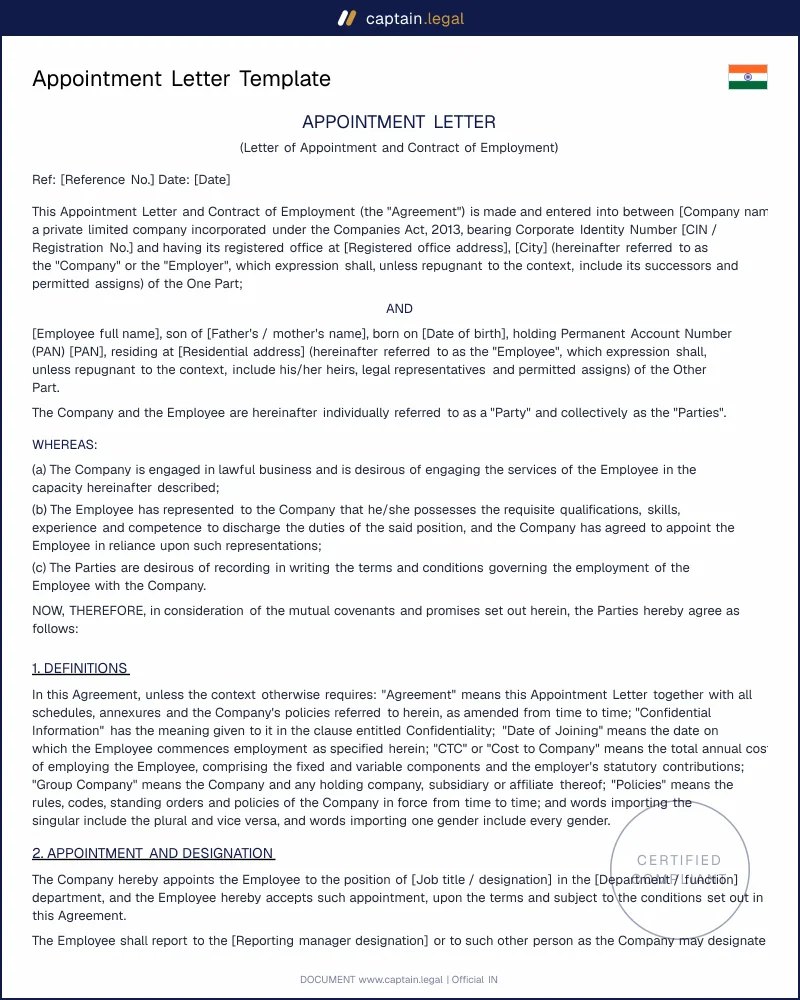
You begin by choosing whether the document is a full appointment letter or a shorter offer letter, since the level of detail differs. From there the form asks for the employer's registered name and the employee's full name, the designation, the department and the date of joining, which together form the identification block. You then enter the salary, and the template guides the split into basic pay, dearness allowance and allowances so that wages reach the statutory half of total remuneration required by the Code on Wages.

Next you set the working hours, the probation length and the notice each side will give, with the form prompting you toward the figures your State's Shops and Establishments Act recognises. You confirm whether the role is permanent or fixed-term, since that changes the benefit language, and whether the employee is likely to be a workman, which affects how the termination clause reads. The confidentiality and intellectual property terms are included by default and can be tightened for senior roles. Once the fields are complete, the document assembles into a clean letter you can review, then download as Word or PDF for signature. A short step-by-step guide to creating any document on the platform walks through the same flow if you are issuing several letters at once.

6

Common mistakes to avoid

The most expensive mistake in 2026 is a stale salary structure. Many Indian employers still draft basic pay at thirty or forty per cent of the package, a habit that worked under the old Acts but now breaches the uniform wage definition, where wages must be at least half of total remuneration. The excess allowance is simply reclassified as wages, and provident fund and gratuity costs rise on the spot. A second frequent error is treating the appointment letter as optional or informal; with the OSH Code making a written letter mandatory for every worker, a verbal hire or a one-line email no longer protects the company. A third trap is the over-broad non-compete: drafters still insert clauses banning the employee from joining a competitor for a year after exit, ignoring that Section 27 of the Indian Contract Act renders such post-employment restraints void in India.

Beyond those, employers repeatedly mishandle termination of a workman by treating it as an ordinary contractual exit and skipping the notice and procedure the Industrial Relations Code requires, which can make the termination itself invalid. The remaining recurring slip is the open-ended or undocumented probation, where confirmation by conduct is later read into the relationship. Getting the worker classification, the notice and the settlement right at the drafting stage is far cheaper than litigating them afterwards. If the role involves protecting business information, pairing the contract with a confidentiality agreement drafted for Indian enforceability closes the gap that a void non-compete leaves open.

Key takeaways

ENFORCEABILITY

Appointment letter turns an offer enforceable

In India, the appointment letter is usually the employment contract itself. Once signed and accepted, it records offer, acceptance, lawful consideration and free consent under the Indian Contract Act, 1872, so both sides have one version of the deal. It reduces later fights over role, working hours, leave, probation, confidentiality, and the notice required to resign or terminate.

COMPLIANCE

Wage structure must meet the 50% rule

The Code on Wages, 2019 uses a single definition of wages across the Labour Codes, and it affects how you draft pay in the appointment letter. Basic pay plus dearness allowance and any retaining allowance must be at least 50% of total remuneration. If allowances are pushed above that, the excess is treated as wages, increasing PF, gratuity and bonus exposure.

STATUTORY DUTY

Issuing the letter is no longer optional

Under the Occupational Safety, Health and Working Conditions Code, 2020, giving every worker a written appointment letter is a legal obligation, not just HR hygiene. Practically, this means the employer needs a ready, consistent format issued on or around the joining date, not an informal email trail. For employees, it is the document they can rely on when switching jobs and serving notice.

Frequently Asked Questions

Yes. An appointment letter signed by the employer and accepted by the employee is a contract enforceable under the Indian Contract Act, 1872, provided it has offer, acceptance, lawful consideration and free consent. Acceptance is usually shown by the employee signing and joining. Since the four Labour Codes came into force on 21 November 2025, issuing a written appointment letter is also a statutory duty on the employer under the Occupational Safety, Health and Working Conditions Code, 2020, so the document now carries both contractual force and a compliance function. A template built around these requirements is enforceable in the same way a lawyer-drafted letter would be, as long as the salary structure and notice terms are filled in correctly.

The Code on Wages, 2019 now defines wages as basic pay, dearness allowance and any retaining allowance, and these must together form at least fifty per cent of total remuneration. Allowances such as house rent or conveyance fill the remainder, but they cannot exceed half the package; if they do, the excess is treated as wages anyway. The practical effect is that the old habit of keeping basic pay low to reduce provident fund and gratuity no longer works. When you draft the appointment letter, set basic pay and dearness allowance so that wages clear the fifty per cent line. For incorporation papers and related setup, the business document templates for India cover the company-side filings.

In almost all cases, no. Section 27 of the Indian Contract Act renders any agreement that restrains a person from a lawful profession or trade void, and Indian courts apply this strictly to post-employment non-competes. A clause stopping an employee from working for a competitor after they leave will not hold. What does work is a reasonable confidentiality clause protecting trade secrets, drafted to survive termination, and a narrowly framed non-solicitation of clients and staff for a limited period. The appointment letter should lean on these instead of an outright ban, which is why the template carries confidentiality language rather than a sweeping restraint.

Notice is set partly by the contract and partly by the applicable State Shops and Establishments Act, which continues to apply while the final Labour Code rules are notified. For confirmed staff, thirty days is the most common figure, with a shorter period during probation, but the exact requirement depends on the State and on whether the employee is a workman. If the employee is a workman under the Industrial Relations Code, 2020, termination must also follow the statutory retrenchment procedure, including notice, notice pay and compliance with the prescribed steps, or the termination can be held invalid. Always document both the notice served and the full and final settlement.

The completed document is available as both Word and PDF. The Word version is useful when you need to adapt the letter for a specific role, add an annexure or issue it on company letterhead, while the PDF is the cleaner choice for signature and for storing in the employee file. Many Indian HR teams issue the PDF for signing and keep the Word file as the editable master for future hires. Both versions carry the full salary structure, hours, probation, confidentiality and notice clauses, so whichever you choose the legal content is identical.

Not strictly, but it is common and useful. An offer letter is the short document a candidate receives first, recording the position, the proposed compensation and the joining date, and it is often what the candidate relies on to resign from their current job. The appointment letter then follows on or near the joining date with the complete terms. You can issue only an appointment letter if the hire is straightforward, but for senior or competitive roles the two-step approach gives the candidate something firm to act on early. For the related closing document at the end of a tenure, see the employment and HR templates for India.

The difference is the legal relationship. An employment contract creates an employer-employee relationship with statutory benefits, provident fund, gratuity, leave and the protections of the Labour Codes. A consultancy or service arrangement is a contract for services between independent parties, with no employer-employee obligations and tax and compliance treated very differently. Misclassifying an employee as a consultant to avoid statutory cost is a frequent and risky shortcut, since authorities look at the substance of the relationship rather than the label. If the engagement is genuinely independent, a consultancy agreement drafted for the Indian Contract Act is the right instrument; if the person works under your direction, use the appointment letter.

4.8/5

27 verified reviews · 50 000+ downloads

Employment Contract India: New Labour Codes Compliant
  • Immediate access to the document
  • PDF + Word download
  • Compliant with 2026 legislation
  • Reviewed by lawyers
Fill in the template
Secure payment · No subscription
Updated on June 8, 2026

You might also like

Internship Agreement India
Offer Letter India