Create my document
Login

Choose country

FranceBelgiqueEspañaUnited StatesUnited KingdomMarocDeutschlandItaliaSchweiz
Personal & Family

Gift Deed India | TPA 1882, Sections 122-126

Voluntary property transfer under Sections 122-126 of the Transfer of Property Act 1882. Registered instrument, two witnesses, family stamp duty.
4.7/525 reviews50 000+ downloadsInstant download
Share

A gift deed is the legal instrument that records the voluntary transfer of property from one person to another without any consideration, made out of love, affection, or generosity rather than payment. In India it is the cleanest way to pass a house, a plot of land, jewellery, shares, or a bank balance to a child, spouse, sibling, or anyone else during your lifetime, sidestepping the disputes that so often follow a will. The document names the donor and the donee, describes the property in full, and records the donor's free intention and the donee's acceptance.

What separates a gift deed from a casual handover is form. For an immovable property, the law does not treat a verbal promise or an unregistered paper as a gift at all; it demands a registered instrument attested by two witnesses. Get the form right and ownership shifts cleanly and permanently. Get it wrong and the transfer is simply void, leaving the donee with nothing and the family with a quarrel.

Compliant

2026 Legislation

50,000+ clients

trust us

Affordable

From $4.90 / doc

Secure payment

Instant download

Gift Deed India | TPA 1882, Sections 122-126

Secure payment · No subscription

Fill in the template

What is a gift deed in India?

A gift deed is a written legal document by which a donor transfers ownership of existing movable or immovable property to a donee voluntarily and free of charge, with the donee accepting the gift during the donor's lifetime. The defining feature is the absence of consideration: no money, no exchange, no return obligation. The moment any payment or counter-promise enters the picture, the transaction stops being a gift and becomes a sale or an exchange, governed by different rules and taxed differently.

People often confuse a gift deed with a will, and the distinction matters enormously in practice. A will takes effect only after death and can be revised any number of times while the testator lives; a registered gift deed of immovable property takes effect immediately and, once complete, is generally irrevocable. That immediacy is the gift deed's strength and its risk. A parent who gifts the family flat to a child loses ownership at once, not at death. The deed is also distinct from a relinquishment deed, used when a co-owner gives up their share in jointly held property, and from a settlement deed, often used in family arrangements. Choosing the correct instrument for your situation is the first decision, and it shapes everything from stamp duty to revocability. When the intention is a straightforward, lifetime, no-strings transfer, the gift deed is the right tool, and our will and succession formats for Indian families sit alongside it for those who would rather pass property only after death.

2

When do you need a gift deed?

The most frequent use by far is the intra-family transfer of immovable property: a father gifting a flat to a son, a husband transferring a house to his wife, grandparents passing agricultural land to grandchildren. Families reach for the gift deed because most States grant generous stamp duty concessions on transfers between blood relatives, and because a registered deed forecloses the inheritance battles that an oral promise invites. The second common scenario is gifting movable assets of real value, shares, fixed deposits, gold, or a vehicle, where a written deed creates a clean paper trail for income tax and for the donee's own future dealings even when delivery alone would suffice.

Charitable giving is the third pillar. Donations of land or buildings to a temple trust, an educational society, or an NGO are routinely structured as gift deeds, and several States waive duty entirely for gifts to recognised charities. Beyond these, the deed surfaces in estate planning, where an ageing owner prefers to distribute property during life rather than leave it to a contested will.

Two edge cases reward attention. A gift of future property, something the donor does not yet own, is void under the Act; only existing property can be gifted, a trap for those trying to gift a flat still under construction or an expected inheritance. And a gift with an onerous condition attached, say, a transfer burdened with an obligation that outweighs the benefit, the donee may accept or reject in whole but cannot cherry-pick. Where the transfer carries genuine reciprocal obligations, what you actually need is a contract, and our contract formats drafted for the Indian Contract Act, 1872 cover that ground.

3

Key clauses included in our template

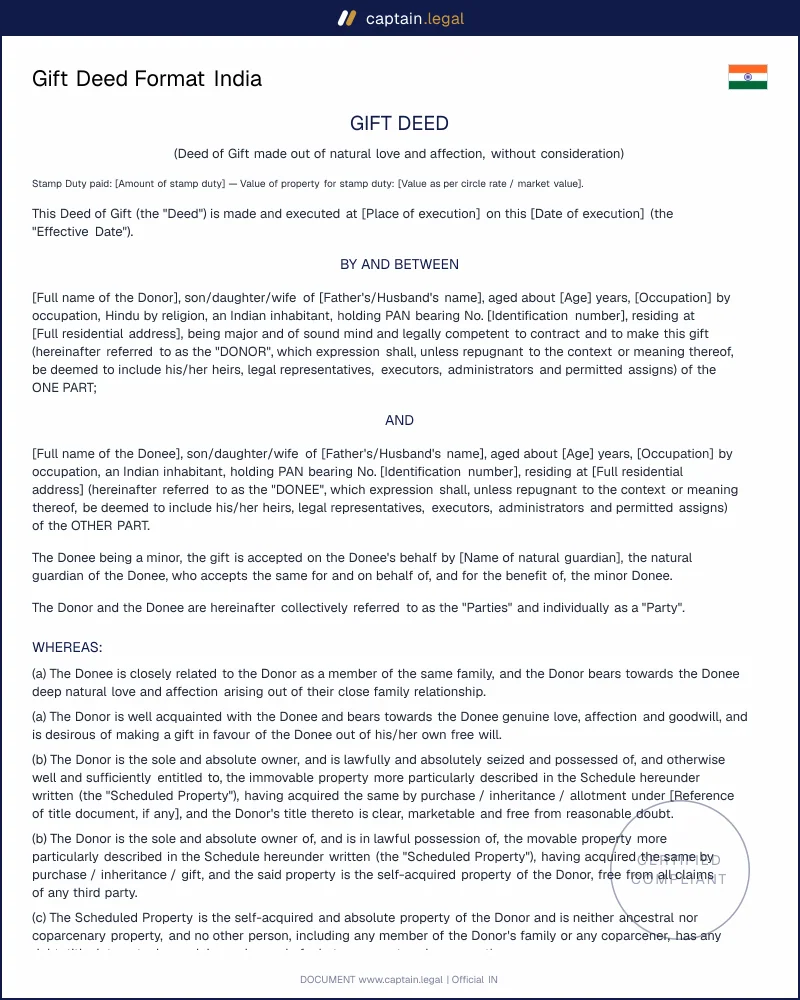
  • The identification of the parties sets out the full legal names, ages, parentage, and addresses of both donor and donee, along with their relationship where a family concession is claimed. Naming the relationship explicitly is what unlocks the concessional stamp duty rate at the Sub-Registrar's office, and omitting it can cost the donee several percent of the property's value.
  • The property schedule describes the gifted asset with the precision a registrar demands: for immovable property, the survey number, boundaries, built-up area, and registration district; for movables, an unambiguous description and, where relevant, the folio or account details. A vague schedule is a frequent ground for rejection at registration.
  • The declaration of voluntary transfer without consideration records that the donor acts of free will, out of natural love and affection, and that nothing of value passes in return. This clause is the legal heart of the deed and the line that distinguishes it from a sale.
  • The acceptance by the donee confirms, on the face of the document, that the donee has accepted the gift during the donor's lifetime, satisfying the Section 122 requirement that so many homemade deeds overlook.
  • The two-witness attestation block provides for at least two witnesses who saw the donor sign, as Section 123 requires for immovable property. Their full particulars are recorded, not merely their signatures.
  • The revocation and conditions clause, where the parties intend any, is drafted to fit within the narrow window Section 126 allows, since a condition not built in at signing cannot be added later.
4

State-specific considerations

Stamp duty on a gift deed is a State subject, so the cost of the same transfer swings widely across the country, and the family concession is where the real money is decided. Always verify the current rate on your State revenue portal before drafting, because circle rates and concession rules are revised regularly.

Maharashtra is among the most generous for family transfers. A gift of residential or agricultural property to a close blood relative attracts a flat duty in the region of ₹200 rather than a percentage of value, a saving that can run into lakhs on a high-value flat. Transfers to non-relatives, by contrast, attract duty around 3% of market value. The relationship must be clearly recited in the deed and supported by proof.

Delhi charges by the gender of the donee rather than the relationship, with the rate for a female donee set lower than for a male, computed on the higher of market value or circle rate. Gifts between spouses enjoy particularly favourable treatment, and the deed must spell out the marital relationship for the concession to apply at the Sub-Registrar's office.

Karnataka fixes a nominal duty, commonly cited around ₹1,000 to ₹5,000 for gifts within the defined family, against roughly 5% of market value for gifts to outsiders. The State requires documentary proof of the blood relationship, so birth or marriage certificates should be ready at registration.

Tamil Nadu applies a concessional rate near 1% of market value for gifts to family members, set against a standard 7% for non-relatives, plus a registration fee of about 1%. The gap between the two rates is among the widest in India, which makes correctly establishing the family relationship financially decisive.

5

How to fill out this gift deed

You begin by choosing whether you are gifting immovable or movable property, since that single choice drives the registration and attestation requirements the rest of the form applies. From there you enter the donor's and donee's full particulars, and where you are gifting to a relative you record the exact relationship so the form can flag the family concession available in your State. Next you describe the property in the schedule, with the form prompting you for the survey number, boundaries, and area for land or buildings, or the account and asset details for movables, so nothing the registrar expects is left blank.

The form then guides you through the voluntary-transfer declaration and the donee's acceptance, the two clauses that Sections 122 and 123 make non-negotiable, and provides the two-witness block ready for signature. If you want to attach a lawful condition under Section 126, the form gives you a place to draft it before signing rather than after, when it would be too late. You finish by downloading the deed in Word and PDF, ready to print on the appropriate stamp paper and carry to the Sub-Registrar. The same guided approach runs through our affidavit and declaration formats for official Indian use, so the experience is familiar across the personal category.

6

Common mistakes to avoid

The single costliest error is treating an immovable-property gift as complete on signing. It is not. Under Section 123 the gift only takes legal effect on registration with the Sub-Registrar, and an unregistered deed is void no matter how carefully it is written or how many witnesses sign it. Families discover this years later, often after the donor has died, when the donee tries to deal with property they never legally received. Closely related is the failure to record the donee's acceptance on the face of the deed; acceptance must happen during the donor's lifetime, and a deed silent on the point invites challenge. A third recurring slip is leaving the relationship unstated when claiming a family concession, which lets the registrar charge the full non-relative rate and quietly erases a substantial saving.

The other cluster of mistakes concerns intention and tax. Drafters sometimes try to gift property that does not yet exist or attach a condition the law will not allow, both of which can void the transfer or strip the condition. On the tax side, donors and donees forget Section 56(2)(x) of the Income Tax Act, 1961: a gift of property worth more than ₹50,000 from a non-relative is taxable in the donee's hands as income from other sources, while gifts between specified relatives are exempt. Confirm the relationship falls within the exempt category before assuming no tax arises. Finally, many overlook that a gift, once complete, cannot simply be taken back, and our sale deed format under Section 54 of the Transfer of Property Act is the right route when the parties actually intend a transfer for consideration.

Key takeaways

NO CONSIDERATION

Any payment breaks the gift deed

A gift deed works only when the transfer is voluntary and without any consideration. If money, a counter-promise, or a return obligation is part of the deal, it stops being a gift and starts looking like a sale or exchange, with different rules and tax outcomes. The deed should plainly show the donor’s free intention and the donee’s acceptance during the donor’s lifetime.

FORMALITIES

Immovable gifts need registration and witnesses

For a house, flat, or plot, the law requires form: a registered instrument signed by the donor and attested by at least two witnesses (Transfer of Property Act, 1882, Section 123). Registration is compulsory under the Registration Act, 1908 (Section 17). An unregistered gift deed for immovable property has no legal effect, even if stamp duty is paid.

EFFECT

It transfers now, and is hard to undo

A registered gift deed of immovable property takes effect immediately, unlike a will which operates only after death and can be changed many times. Once the gift is complete, it is generally irrevocable, so the donor loses ownership at once. That makes it a clean lifetime transfer, but it is risky if you still need control or income from the property.

Frequently Asked Questions

Yes, a gift deed is fully binding once it satisfies the Transfer of Property Act, 1882. For movable property, a registered deed or simple delivery of possession makes the gift valid. For immovable property the deed must be in writing, signed by the donor, attested by two witnesses, and registered with the Sub-Registrar under the Registration Act, 1908. An unregistered gift deed of immovable property has no legal validity at all, even if stamp duty is paid. The donee must also accept the gift during the donor's lifetime. Meet these conditions and the transfer of ownership is complete and enforceable in court.

Usually not. Under Section 126 of the Transfer of Property Act, 1882, a completed gift is generally irrevocable. There are only two exceptions. The first is where the donor and donee agreed in advance, and recorded in the deed, that the gift would be suspended or revoked on a specified future event not within the donor's control. The second is where the gift was obtained through fraud, coercion, undue influence, or misrepresentation, which makes it voidable at the donor's option. A simple change of mind is never a valid ground. This is exactly why any intended condition must be drafted into the deed before signing, because it cannot be added afterwards.

Yes, stamp duty is mandatory even for family gifts, but most States offer steep concessions for transfers to blood relatives such as a spouse, child, parent, or sibling. The relief is significant: Maharashtra levies a nominal fixed duty for family transfers against a percentage for outsiders, Tamil Nadu charges around 1% for relatives versus 7% for others, and Karnataka applies a small fixed sum within the family. The rates are set by each State and revised periodically, so confirm the figure on your State revenue portal. To claim the concession you must state the relationship clearly in the deed and produce supporting proof at registration.

A will takes effect only after the testator's death and can be changed any number of times while they live. A gift deed of immovable property, once registered, takes effect immediately and is generally irrevocable. With a will, you keep ownership and control until death; with a gift deed, you part with the property at once. A will requires no stamp duty and only two witnesses, while an immovable-property gift requires registration and State stamp duty. Choose a gift deed for a lifetime transfer you are certain about, and a will when you would rather direct who inherits only after you are gone.

You can download the completed gift deed in both Word and PDF formats. The Word file lets you make final edits, fill in any State-specific particulars, or adjust the schedule before printing, while the PDF gives you a clean, print-ready version for execution. You will then print the deed on stamp paper of the value your State requires, have the donor and at least two witnesses sign every page, and carry it to the Sub-Registrar for registration where the property is immovable. Having both formats means you can adapt the document and still produce a polished final copy for signature and registration.

It depends on the relationship. Under Section 56(2)(x) of the Income Tax Act, 1961, a gift of property whose stamp duty value exceeds ₹50,000 received from a non-relative is taxable in the donee's hands as income from other sources at the applicable slab rate. Gifts received from specified relatives, including a spouse, parents, children, siblings, and certain others, are fully exempt from income tax regardless of value. Stamp duty paid to the State is a separate matter and does not determine income tax liability. Before assuming no tax arises, confirm that the donor falls within the statutory definition of a relative.

Once the deed is drafted, printed on stamp paper, and signed by the donor and two witnesses, the registration itself is typically completed in a single visit to the Sub-Registrar's office, often within a day, provided the property schedule is accurate and all identity and relationship documents are in order. The donor and donee usually attend in person with the witnesses. Delays almost always trace back to an incomplete property description, missing relationship proof when a family concession is claimed, or an underpaid stamp duty that the registrar flags. Preparing the documents carefully in advance is the surest way to make registration quick and final.

4.7/5

25 verified reviews · 50 000+ downloads

Gift Deed India | TPA 1882, Sections 122-126
  • Immediate access to the document
  • PDF + Word download
  • Compliant with 2026 legislation
  • Reviewed by lawyers
Fill in the template
Secure payment · No subscription
Updated on June 9, 2026

You might also like

Gap Affidavit Format India
Power of Attorney India