Create my document
Login

Choose country

FranceBelgiqueEspañaUnited StatesUnited KingdomMarocDeutschlandItaliaSchweiz
Notices & Compliance

GST Compliance Declaration | CGST Act 2017 & Rule 96A

GST undertaking aligned with the CGST/SGST Acts 2017 and Rule 96A LUT. Built-in indemnity, signatory and Section 10 status clauses. PDF/Word.
4.7/529 reviews50 000+ downloadsInstant download
Share

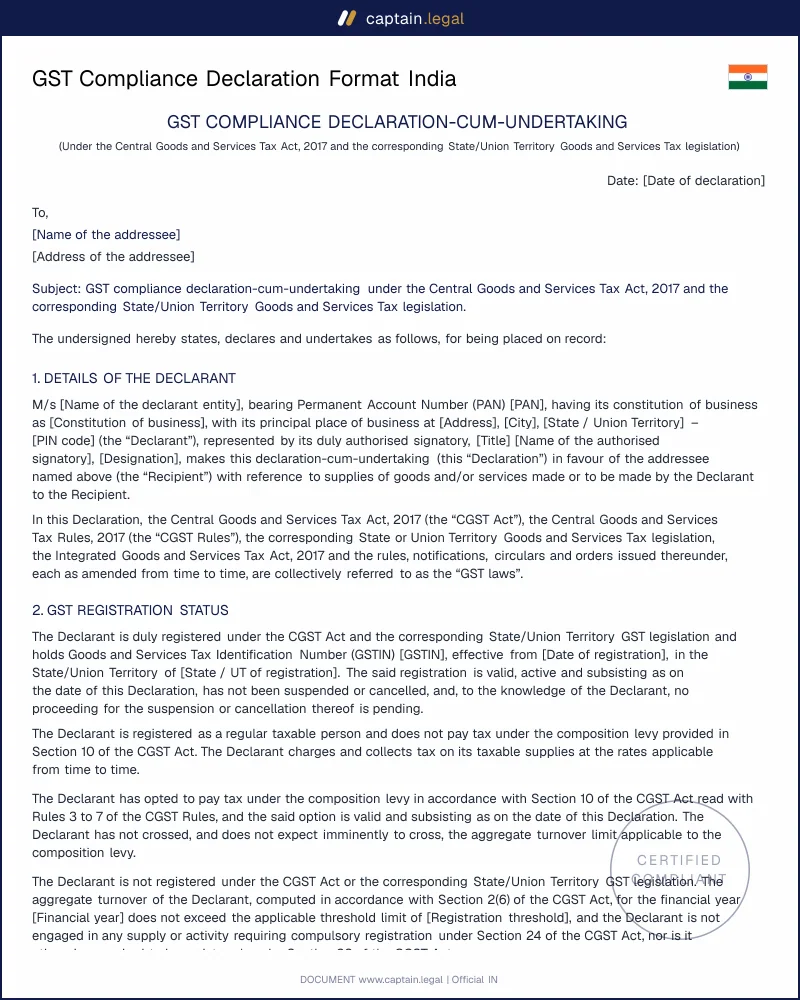
A GST compliance declaration, also called a GST undertaking, is a signed statement by which a registered taxpayer confirms its GST status, registration details or compliance position to a counterparty or to the tax administration. Vendors furnish it to large buyers during onboarding, exporters file it as a Letter of Undertaking before shipping without IGST, and composition dealers issue it to explain why their invoices carry no tax. This template gives businesses, proprietors and authorised signatories a format aligned with the Central Goods and Services Tax Act, 2017 and the parallel State GST Acts, ready to adapt to the exact declaration the situation demands and to download as a Word or PDF document.

Compliant

2026 Legislation

50,000+ clients

trust us

Affordable

From $4.90 / doc

Secure payment

Instant download

GST Compliance Declaration | CGST Act 2017 & Rule 96A

Secure payment · No subscription

Fill in the template

What is a GST compliance declaration?

A GST compliance declaration is a self-certification, made on letterhead and signed by an authorised signatory, recording facts that GST law or commercial practice requires a business to confirm in writing. The most common variants state that the declarant holds a valid GSTIN, that it files its returns in Form GSTR-1 and Form GSTR-3B on time, that it has opted into or out of the composition scheme under Section 10 of the CGST Act, 2017, that it falls below the e-invoicing threshold, or that it is unregistered because its aggregate turnover sits under the limits set by Section 22. Exporters know the format in its statutory form: the Letter of Undertaking filed in Form GST RFD-11 under Rule 96A of the CGST Rules, 2017, which permits zero-rated supplies without upfront payment of IGST.

The declaration differs from a general affidavit sworn under the Oaths Act in one practical respect: it does not normally require attestation before a notary or magistrate, because it operates as a commercial representation rather than judicial evidence. It still binds the signatory. A buyer who relies on a false GST declaration can recover denied input tax credit contractually, and the department can treat a false statement as an offence. The document is short, rarely more than two pages, but every line in it has fiscal consequences.

2

When do you need this document?

The most frequent trigger is vendor onboarding. Listed companies and large buyers will not release a purchase order until the supplier certifies its GSTIN, its return-filing regularity and its e-invoicing status, because a defaulting supplier puts the buyer's input tax credit at risk under Section 16(2)(c). The second scenario is the composition dealer explaining to clients why its bills of supply show no tax; without a written declaration, accounts teams flag the invoice and payment stalls. Exporters need the format every financial year, since the LUT filed in Form GST RFD-11 lapses on 31 March and a fresh undertaking must be in place before the first export invoice of the new year. A fourth situation is the unregistered supplier confirming that its turnover sits below the registration threshold, a declaration buyers archive to justify procurement without a tax invoice.

Two edge cases deserve attention. A business crossing the e-invoicing turnover limit mid-relationship must issue a corrective declaration promptly, because invoices raised without an IRN after the threshold date are not valid tax invoices under Rule 48(5) and the buyer's credit evaporates with them. And entities supplying through e-commerce operators are often asked to declare their registration status so the operator can apply the correct TCS treatment under Section 52; treating that request casually delays settlement of marketplace payouts. In each case the declaration sits on file with other regulatory notices and compliance formats the business maintains for audit.

3

Key clauses included in our template

  • The identification block records the legal name, trade name, GSTIN or its absence, principal place of business and the State of registration. Buyers cross-verify these details against the GST portal, so the template mirrors the registration certificate field by field rather than relying on informal trading names.
  • The declaration of registration status states whether the declarant is a regular taxpayer, a composition taxpayer under Section 10, or unregistered with turnover below the Section 22 threshold. The wording tracks the statutory language, because paraphrased status descriptions are the first thing a tax officer questions.
  • The return-filing and compliance confirmation certifies that GSTR-1 and GSTR-3B are filed within due dates and that no proceedings for cancellation of registration are pending. This is the clause that protects the recipient's input tax credit and the one most heavily negotiated.
  • The e-invoicing applicability statement declares whether aggregate turnover has crossed the notified threshold and, if so, that all B2B invoices carry a valid IRN and QR code under Rule 48(4).
  • The indemnity undertaking commits the declarant to make good any tax, interest or penalty the recipient suffers because a statement in the declaration proves false. It converts a compliance courtesy into an enforceable contractual promise.
  • The authorised signatory attestation closes the document with name, designation, date and place. Where the declarant is a company, the signatory's authority should trace back to a board resolution under Section 179 of the Companies Act 2013, and the template prompts for that reference.
4

State-level considerations

Maharashtra hosts the largest concentration of registered taxpayers, and its state machinery is correspondingly active: the Maharashtra GST Department runs frequent return-scrutiny drives, so declarations certifying filing regularity are checked against actual portal data more often than elsewhere. Businesses with units in Mumbai and Pune under a single PAN hold separate GSTINs per State, and a declaration must name the specific registration it covers, not the group. The intra-state e-way bill threshold of Rs. 1 lakh, higher than the national Rs. 50,000 default, also shapes the logistics declarations Maharashtra suppliers attach to despatches.

Delhi presents the classic multi-jurisdiction problem: a single business often bills from Delhi while warehousing in Haryana or Uttar Pradesh, and buyers ask for declarations confirming which GSTIN will appear on invoices for each supply. Delhi's enforcement wing has been aggressive on fake invoicing networks, which is why Delhi counterparties increasingly insist on the indemnity clause and verify the declarant's filing history before releasing credit terms.

Karnataka and its Bengaluru technology corridor generate the bulk of service-export declarations. Software exporters file the RFD-11 undertaking annually and furnish parallel declarations to clients confirming zero-rated treatment of supplies to SEZ units under Section 16 of the IGST Act. The Karnataka Authority for Advance Rulings has produced several divergent rulings on intermediary services, so exporters there often annexe a declaration of the precise nature of services to pre-empt classification disputes.

Gujarat combines heavy goods exports with a dense MSME base. Manufacturers in Ahmedabad and Surat lean on the LUT route to keep working capital free, and their buyers commonly request composition-status declarations from job workers in the textile chain, where the Section 10 scheme is widespread. Gujarat's officers are exacting on the three-month export window under Rule 96A; a declaration there should be backed by shipping bill discipline, not optimism.

5

How to fill out this GST compliance declaration

You start by selecting the capacity in which the declaration is made: regular taxpayer, composition dealer, unregistered supplier or exporter furnishing an undertaking. The form then adjusts the statutory recitals, pulling in Section 10 language for composition status or Rule 96A commitments for exports. Next you enter the identification details exactly as they appear on the registration certificate, including the 15-character GSTIN, the legal name as per PAN and the principal place of business. The tool prompts for the addressee, because a declaration to a buyer reads differently from an undertaking addressed to the jurisdictional officer. You then confirm the compliance statements that apply, strike the ones that do not, and complete the signatory block with designation and supporting authority. Businesses that supply under a written contract often pair the declaration with a service agreement drafted under the Indian Contract Act so the indemnity in both documents reads consistently. The finished declaration downloads in Word and PDF; print it on letterhead, sign in ink or affix a DSC, and keep a copy in your GST file for the financial year.

6

Common mistakes to avoid

The error seen most often in practice is the stale declaration. A vendor certifies return-filing regularity in April, defaults in August, and never issues a corrective statement; when the buyer's credit is questioned under Section 16(2)(c), the old declaration becomes evidence of misrepresentation rather than protection. Treat the document as a living certificate and refresh it whenever status changes, especially on crossing the e-invoicing threshold or switching out of the composition scheme. A second recurring fault is the unsigned or wrongly signed declaration: an accounts executive signing without authority gives the recipient nothing enforceable, and companies should always cite the resolution empowering the signatory.

Exporters make their own characteristic mistakes. Some raise export invoices before the fresh financial-year LUT is in place, then discover that every invoice in the gap attracts IGST with 18 per cent interest. Others copy a goods-export undertaking for a services business and miss the one-year realisation condition that applies to service proceeds. Finally, unregistered suppliers frequently declare sub-threshold turnover by looking at a single GSTIN's billing instead of aggregate turnover across all States under one PAN, the measure Section 2(6) actually prescribes. Compute the aggregate figure before signing, because an honest mistake on turnover still voids the declaration's protective effect.

Key takeaways

DECLARATION

This is a binding commercial representation

A GST compliance declaration is a self-certified statement on letterhead, signed by an authorised signatory, confirming facts like your GSTIN, return filing (GSTR-1 and GSTR-3B) or registration status under the CGST Act, 2017. It usually does not need notarisation like an affidavit, but it still creates contractual responsibility under the Indian Contract Act, 1872 if a counterparty relies on it.

EXPORTS

LUT under Rule 96A has timelines

If you export without paying IGST upfront, the Letter of Undertaking in Form GST RFD-11 under Rule 96A is the gateway. You undertake to export goods within three months of the invoice date and to realise service proceeds within one year. If you miss either, you must pay the tax along with interest at 18 per cent under Section 50.

RISK

False GST statements can cost money

Wrong declarations are not just a commercial issue. A buyer who loses input tax credit can seek recovery based on the declaration and related indemnity wording. On the tax side, furnishing false information attracts penalties under Section 122(1), and the general penalty under Section 125 can go up to Rs. 25,000 under both the central and the relevant State GST law, with serious cases risking Section 132 prosecution.

Frequently Asked Questions

Yes. Although most declarations are not sworn before a notary, they are written representations on which the recipient relies, and Indian contract law makes a false representation actionable as misrepresentation or breach of the indemnity clause the template contains. On the statutory side, Section 122(1) of the CGST Act, 2017 penalises furnishing false information, and the general penalty under Section 125 extends to Rs. 25,000 under each of the central and state Acts. Where the declaration is the Form GST RFD-11 undertaking, it binds the exporter directly to the department: failure to export within three months obliges payment of IGST with interest at 18 per cent under Section 50.

The completed declaration downloads immediately in both Word (.docx) and PDF. The Word version lets you place the text on your company letterhead, adjust the recitals to the addressee and insert the signatory's designation before printing. The PDF version is the fixed copy most buyers ask you to scan and upload to their vendor portals. Both formats print cleanly on A4, and you can regenerate the document whenever your registration status, turnover position or e-invoicing applicability changes during the year.

A commercial declaration to a buyer has no statutory expiry, but market practice treats it as valid for the financial year in which it is issued, and most procurement teams demand a fresh certificate every April. The statutory Letter of Undertaking is different: Rule 96A limits it to one financial year, so an exporter must file a new Form GST RFD-11 before the first export invoice after 1 April. Issue a corrective declaration immediately if any certified fact changes mid-year, because the protection the document gives both sides depends on it staying accurate.

Usually not. A GST compliance declaration operates as a commercial certification, and signature by an authorised signatory on letterhead is sufficient for buyers, e-commerce operators and most departmental filings. Notarisation becomes relevant only where a specific authority asks for a sworn statement, in which case the text is recast as an affidavit under the Oaths Act, 1969 and attested before a notary or magistrate. For companies and LLPs, what matters far more than notarisation is traceable signing authority, typically a board resolution or partner authorisation referenced in the attestation block.

Yes, and it frequently must. A supplier whose aggregate turnover sits below the Section 22 threshold issues the declaration to confirm that GST registration is not required, which lets the buyer document why the purchase carries no tax invoice. The critical point is the turnover computation: Section 2(6) aggregates all taxable, exempt and export supplies across every State under the same PAN. The declaration should also acknowledge the duty to register within thirty days of crossing the threshold, the timeline Section 25(1) prescribes, so the buyer knows the status will be corrected promptly if circumstances change.

The consequences run on two tracks. Contractually, the indemnity clause obliges you to compensate the recipient for any input tax credit denied, interest or penalty it suffers because your statement was untrue, and buyers do invoke it. Statutorily, the department can impose penalties under Section 122 and Section 125 of the CGST Act, 2017, and deliberate evasion above the monetary thresholds in Section 132 exposes the signatory to prosecution. For exporters, a breached Rule 96A undertaking means payment of the IGST that was never collected, with 18 per cent interest, and possible withdrawal of the LUT facility. Accuracy at signing is cheaper than any of these outcomes.

Declarations rarely travel alone. Vendor files typically pair them with the underlying contract, statutory notices and corporate authorisations, and the full catalogue of Indian legal document templates covers each of those layers, from demand notices to partnership and incorporation papers. For supply relationships, the declaration usually annexes to the purchase agreement or service contract so the representations and indemnities in both documents align. Keeping the set consistent matters during a departmental audit: officers read the declaration against the invoices, e-way bills and contracts on file, and discrepancies between them invite scrutiny far more than any single missing document.

4.7/5

29 verified reviews · 50 000+ downloads

GST Compliance Declaration | CGST Act 2017 & Rule 96A
  • Immediate access to the document
  • PDF + Word download
  • Compliant with 2026 legislation
  • Reviewed by lawyers
Fill in the template
Secure payment · No subscription
Updated on June 10, 2026

You might also like

Breach of Contract Notice India
Demand Notice for Money Recovery India