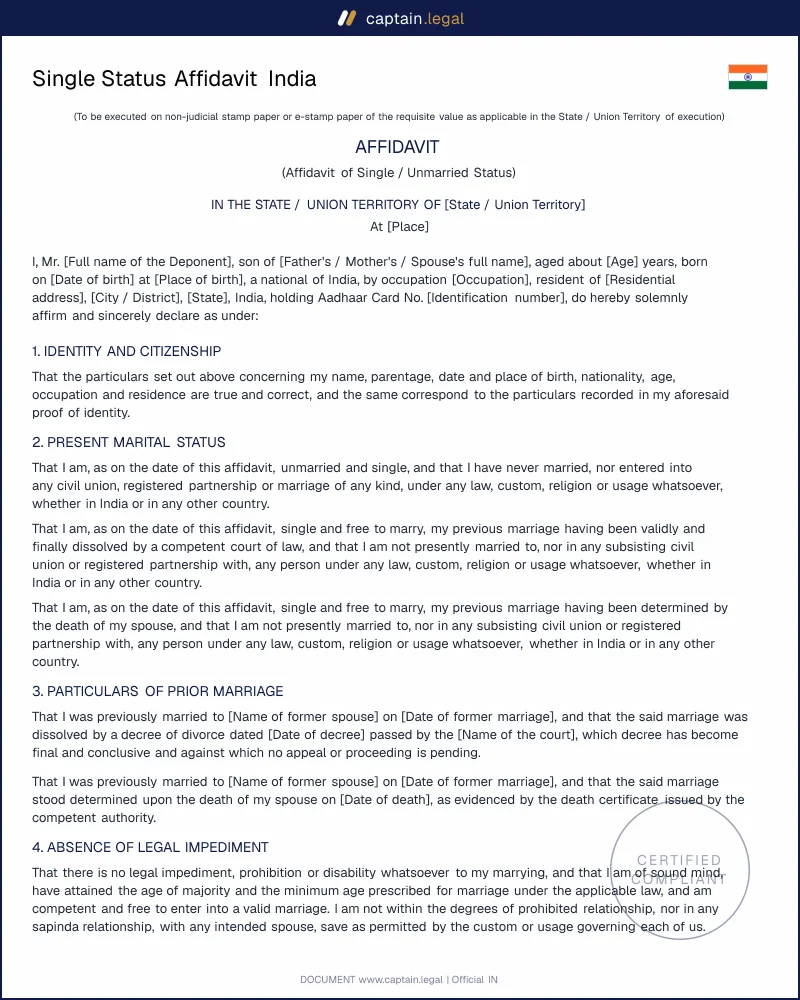
Affidavit execution is national in effect once notarised, but two variables follow State lines: the stamp-paper value and the State Home Department counter-attestation that precedes MEA apostille.
Maharashtra is among the more frequently used jurisdictions for NRI affidavits given Mumbai's consular traffic. Non-judicial stamp paper is governed by the Maharashtra Stamp Act, 1958, and affidavits are typically executed on stamp paper of a nominal value before a notary in the relevant district, with the document then routed through the State Home Department for counter-attestation ahead of MEA processing.
Delhi sees heavy demand because the MEA's central processing and most foreign missions sit there. Affidavits are commonly drawn on stamp paper under the Indian Stamp Act, 1899 as applied to the National Capital Territory, sworn before a Delhi notary or Oath Commissioner, and many applicants prefer Delhi precisely because the Sub-Divisional Magistrate and Home Department attestation steps can be completed in proximity to the apostille window.
Karnataka applicants, particularly from Bengaluru, execute the affidavit under the Karnataka Stamp Act, 1957, after which the document moves through the State Home Department's attestation cell before MEA apostille. The substantive declaration does not change; only the stamp duty figure and the counter-attestation office differ.
Tamil Nadu follows the same architecture under the Tamil Nadu Stamp Act, with affidavits notarised locally and then verified at the State level. Across all four States the lesson is identical: the affidavit itself is uniform in content, while the stamp value and the State counter-attestation route are what vary, and using the wrong State's stamp paper for where you actually execute the document invites rejection.