Create my document
Login

Choose country

FranceBelgiqueEspañaUnited StatesUnited KingdomMarocDeutschlandItaliaSchweiz
Personal & Family

General Affidavit India: Oaths Act 1969 Compliant

Sworn affidavit drafted for the Oaths Act 1969 and Notaries Act 1952. Notarise for address, DOB or lost documents. Download in PDF & Word.
4.8/537 reviews50 000+ downloadsInstant download
Share

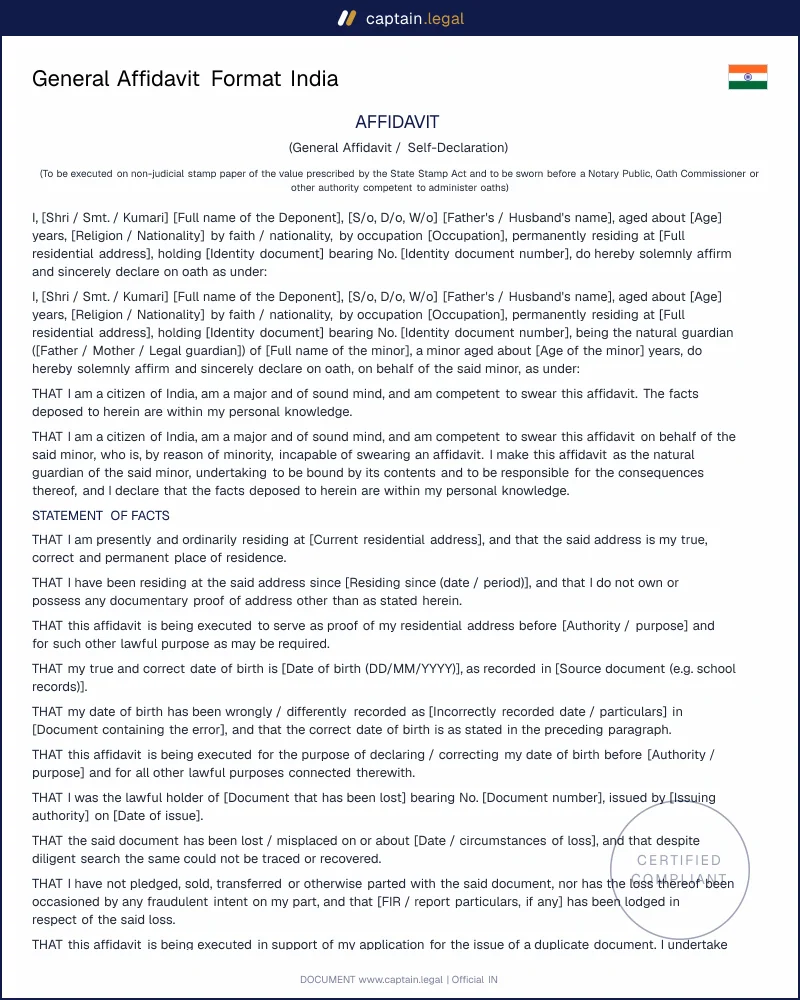
A self-declaration affidavit, often called a general affidavit, is a sworn written statement in which you (the deponent) confirm a fact to be true on oath before a notary or oath commissioner. People in India reach for one constantly: to prove a current address, confirm a date of birth, explain a gap in employment, declare that an original document is lost, or attest to a name spelling discrepancy across two records. It is the workhorse of Indian paperwork, the single page that turns a personal claim into something a bank, passport office, university or government department will accept on file. Our general affidavit format is drafted to the verification and attestation standards Indian authorities expect, so you can fill it, print it on the correct stamp paper, and notarise it the same day.

Compliant

2026 Legislation

50,000+ clients

trust us

Affordable

From $4.90 / doc

Secure payment

Instant download

General Affidavit India: Oaths Act 1969 Compliant

Secure payment · No subscription

Fill in the template

What is a self-declaration affidavit?

A self-declaration affidavit is a one-party instrument. There is no second signatory and no agreement being struck; you alone state facts you know personally to be true, and you swear to that truth before an authorised attesting officer. That single feature separates it from a contract, a deed or a notice, all of which bind two or more parties. It also separates it from a plain self-declaration letter, which carries no oath and therefore little legal weight when an institution demands proof.

The deponent must have personal knowledge of every fact stated. An affidavit built on hearsay, assumption or what someone else told you is liable to be rejected the moment it matters, because the whole evidentiary value of the document rests on the deponent vouching from first-hand knowledge. People often confuse a general affidavit with a notarised letter or a no objection certificate used in property and society matters; the distinction is that an affidavit is sworn, while an NOC merely grants permission. If the statement is not made on oath before a notary or oath commissioner, it is not an affidavit at all, whatever the heading says. That is why the attestation block at the foot of the page is not a formality you can skip.

2

When do you need this document?

The everyday driver is proof of address when you have no recent utility bill in your own name, a situation that hits tenants, students and new arrivals to a city most often. Banks opening an account, telecom operators issuing a postpaid connection, and Regional Transport Offices processing a licence will all accept a notarised address affidavit where a standard document is missing. Close behind is the date-of-birth affidavit, used when a birth certificate was never registered, a common reality for people born before municipal registration became routine; the affidavit then supports a passport, PAN or school admission file. A third recurring use is the lost-document declaration, sworn after a property paper, share certificate, educational mark sheet or policy bond goes missing, usually paired with a police complaint and a newspaper notice before a duplicate is issued.

Name and identity discrepancies make up much of the rest. A single deponent will swear that Sunil Kumar and Sunil Kumar Sharma are one and the same person, reconciling a passport against a property record, much as parties tidy up identity details before executing a special power of attorney for property transactions. Two edge cases earn their place here. First, an affidavit to declare an employment gap for a background-verification check, where an employer wants a sworn account of the missing months rather than a casual explanation. Second, an affidavit supporting a gazette name change, which is the sworn first step before publication and is itself only the foundation, not the completed change.

3

Key clauses included in our template

  • The title and description block opens the page with the word AFFIDAVIT followed by its precise subject, such as Affidavit for Proof of Residence or Affidavit for Lost Document. A general heading without a stated purpose is the first thing a verifying clerk queries, so the template forces you to name the object of the declaration up front.
  • The deponent identification captures your full legal name, parentage or spouse name, age, occupation and complete residential address, matched to the way your name appears on the supporting ID. Indian attesting officers check this against the PAN, Aadhaar or passport you produce, and a mismatch here is the most common reason an otherwise sound affidavit is sent back.
  • The statement of facts is the heart of the document, drafted in numbered first-person paragraphs that each assert one fact you know personally to be true. The template keeps each averment short and specific, because a vague paragraph weakens the whole instrument and invites the very Section 227 exposure you want to avoid.
  • The verification clause is the sworn confirmation, in which you affirm that the contents are true to your knowledge, that nothing material has been concealed, and that no part is false. This clause is what converts a written page into evidence and it is non-negotiable in Indian practice.
  • The attestation and jurat at the foot leaves space for the signature, seal and registration details of the Notary Public or Oath Commissioner, together with the place and date of swearing. Without a completed jurat the affidavit has no legal standing, however careful the body above it.
4

Regional considerations

Stamp duty and attestation practice on affidavits are set State by State, and the practical differences are real enough to catch people out. In Maharashtra, a general affidavit is typically executed on non-judicial stamp paper under the Maharashtra Stamp Act, 1958, and notaries in Mumbai and Pune are widely available for same-day attestation; the State's e-stamping through the authorised vendor network is now the norm rather than physical stamp paper. In Delhi, affidavits fall under the Indian Stamp Act, 1899 as applied to the National Capital Territory, and the requirement is usually a modest stamp value with attestation before a Delhi-empanelled notary or an Oath Commissioner attached to the district courts.

In Karnataka, e-stamping through the State's designated portal has effectively displaced traditional stamp paper, and a Bengaluru deponent will generate an e-stamp certificate before approaching a notary; the stamp value for a routine declaration is fixed under the Karnataka Stamp Act, 1957. Tamil Nadu follows a similar e-stamp route under its own stamp legislation, with notaries in Chennai accustomed to address and date-of-birth affidavits for passport and educational use. West Bengal retains a strong court-affidavit culture in Kolkata, where Oath Commissioners at the City Civil Court and High Court attest a high volume of declarations, while general-purpose affidavits go to notaries.

The unifying point across every State is that the affidavit must be on the correct stamp value for that State and attested by an officer authorised to act there. An affidavit stamped for one State and sworn in another, or attested by a notary outside his appointed jurisdiction, can be refused by the receiving authority. When the affidavit concerns immovable property or accompanies a rent agreement under the Model Tenancy framework, check the receiving office's stamp expectation before you print, because a property-linked declaration sometimes attracts a higher value than a plain identity affidavit.

5

How to fill out this self-declaration affidavit

You begin by choosing the purpose of the affidavit, because the template adapts the title and the statement-of-facts paragraphs to what you are declaring, whether that is residence, age, a lost paper or a name discrepancy. From there you enter your identity details exactly as they appear on the photo ID you will carry to the notary, since the attesting officer matches the two before applying the seal. The form then guides you through the numbered averments, prompting one clear fact per paragraph and steering you away from the loose phrasing that gets affidavits rejected. Once the facts are set, you complete the verification clause and leave the jurat block for the notary to fill at the moment of swearing.

After you generate the document, you print it on non-judicial stamp paper or an e-stamp certificate of the value your State requires, then sign it in front of a Notary Public or Oath Commissioner who administers the oath, witnesses your signature, and affixes seal and registration number. Keep the notarised original safe and carry photocopies, because most institutions retain a copy and return the original to you. If you are reconciling business records rather than personal ones, the same disciplined approach applies to a board resolution pack under the Companies Act, where precision in the recital decides whether a bank accepts it.

6

Common mistakes to avoid

The most frequent error is treating the affidavit as a formality and stating facts loosely or on hearsay. An averment that you "believe" something to be true, when the receiving officer expects personal knowledge, undermines the document, and an outright false statement exposes you to perjury under Section 227 of the Bharatiya Nyaya Sanhita. Almost as common is the stamp-value mistake: people print on the wrong denomination of stamp paper for their State, or on plain paper altogether, and the affidavit is bounced at the counter before anyone reads it. A close cousin is swearing before the wrong officer, taking a court-bound affidavit to a notary when an Oath Commissioner is required, or relying on a notary acting outside his appointed area.

Two further slips recur in practice. The first is a name or detail mismatch between the affidavit and the supporting ID, which is the single biggest reason an otherwise valid declaration is refused; the spelling, parentage and address must line up with the document you produce. The second is leaving the jurat incomplete, signing the affidavit at home and presenting it to the notary as a done deed rather than signing in his presence. An affidavit is sworn at the moment of attestation, not before, and a pre-signed page defeats the entire purpose. People preparing affidavits to support a transaction also forget to align them with the underlying paperwork, the way you would cross-check an agreement to sell that protects an advance payment against the sworn declarations filed alongside it.

Key takeaways

NATURE

It is a sworn one-person statement

A general affidavit is not an agreement or a two-party instrument under the Indian Contract Act, 1872; it is a one-person sworn statement by the deponent. That difference matters because offices treat it as evidence of your own facts (address, DOB, lost document, name mismatch), not as consent from someone else. It carries more weight than a self-declaration letter because it is made on oath.

ATTESTATION

No oath, no affidavit in law

An affidavit exists only when you swear or affirm the contents before an authorised officer and the attestation block is completed. For most administrative uses (bank, passport office, university), notarisation by a Notary Public under the Notaries Act, 1952 is the standard route; for court matters, an Oath Commissioner is typically used within jurisdiction. Without that oath and attestation, the document can be rejected on file.

RISK

Only state facts you personally know

Every statement must come from your own personal knowledge, not hearsay or assumptions, because the affidavit’s value rests on you vouching first-hand. If you knowingly swear something false, it can amount to giving false evidence (perjury) under Section 227 of the Bharatiya Nyaya Sanhita, 2023. In practice, a wrong claim about a “lost original” or date of birth can trigger scrutiny and delay.

Frequently Asked Questions

A self-declaration affidavit is legally valid and admissible once it is sworn on oath before a Notary Public or Oath Commissioner and executed on the correct State stamp value. The deponent's signature, taken after the oath is administered, is what gives the document its legal force. It binds the deponent to the truth of every fact stated, and a false averment is punishable as perjury under Section 227 of the Bharatiya Nyaya Sanhita, 2023, with imprisonment that can reach seven years under Section 229. An unsworn or unattested declaration, by contrast, carries no such weight and most institutions will not accept it.

You can download the affidavit in both Word and PDF formats. The Word version is useful when you need to adjust the averments or add a fact specific to your situation before printing, while the PDF gives you a clean, ready-to-print page for straightforward declarations. In both cases you print the finished document on non-judicial stamp paper or attach the State e-stamp certificate, then take it to a notary for attestation. Keep the editable Word file in case the receiving authority asks for a minor wording change, which saves you redrafting the whole page.

An affidavit does not carry a fixed statutory expiry; it speaks to facts true on the date it was sworn. In practice, receiving authorities apply their own freshness expectation. Banks, passport offices and educational bodies commonly want an affidavit sworn within the last three to six months, particularly for proof of address, since circumstances can change. For a fact that does not change, such as date of birth or a name reconciliation, an older affidavit is often still accepted. Always check the specific requirement of the office you are submitting to, because some departments insist on a recent date regardless of the subject matter.

Notarisation is what makes the affidavit an affidavit. Simply signing a declaration at home produces an unsworn statement with little evidentiary value, and almost every Indian institution that asks for an affidavit expects a notary's seal and registration number on it. You must sign in the presence of the Notary Public or Oath Commissioner, who administers the oath and then attests the document. For affidavits meant for court proceedings, attestation must be by an Oath Commissioner; for general purposes like identity, address or a lost document, a Notary Public appointed under the Notaries Act, 1952 is the correct officer. Compare this with a shareholders agreement under the Companies Act, which binds parties by signature without any oath.

Yes, affidavits are routinely used to support passport and PAN applications, most often to establish date of birth where no birth certificate exists, to confirm a current address, or to reconcile a name discrepancy across documents. The passport authority and the income-tax department both accept properly notarised affidavits in defined situations, though they also publish lists of preferred documents, so an affidavit is usually a supporting or substitute proof rather than the first choice. Make sure the deponent details on the affidavit exactly match the application form, because the verifying officer cross-checks the two and any mismatch causes delay.

A false sworn statement is treated as perjury. Under Section 227 of the Bharatiya Nyaya Sanhita, 2023, a person bound by oath who makes a statement he knows or believes to be false is giving false evidence, and the punishment under Section 229 can extend to seven years' imprisonment along with a fine. Beyond the criminal exposure, an institution that relied on a false affidavit can withdraw whatever benefit it granted, and a false affidavit before a court may also amount to contempt. This is why personal knowledge of every fact, and careful drafting of each averment, matters so much.

For a general-purpose affidavit such as proof of address, date of birth or a lost document, a Notary Public appointed under the Notaries Act, 1952 is the standard attesting officer. For affidavits filed in court proceedings, an Oath Commissioner appointed under the authority of the High Court attests within his jurisdiction. Magistrates can also administer oaths in appropriate cases. The key is that the officer must be authorised to act in the place where you swear the affidavit; an attestation by a notary acting outside his appointed area can be challenged or refused by the receiving authority.

4.8/5

37 verified reviews · 50 000+ downloads

General Affidavit India: Oaths Act 1969 Compliant
  • Immediate access to the document
  • PDF + Word download
  • Compliant with 2026 legislation
  • Reviewed by lawyers
Fill in the template
Secure payment · No subscription
Updated on June 9, 2026

You might also like

Power of Attorney India
Gap Affidavit Format India