A relieving letter is the document an Indian employer issues at the close of employment to confirm three things at once: that the employee's resignation has been accepted, that the notice period was served or settled, and that the full and final dues have been cleared. It is the document your next employer almost always asks for during background verification, and without it a clean exit can stall a new joining. This page explains what a relieving letter must contain to hold up under Indian labour practice, how it differs from an experience certificate, and the statutory timelines that now apply after the four Labour Codes came into force.
Most exits in India go wrong not because the parting was acrimonious but because the paperwork was loose. A relieving letter drafted to the standard of an Indian law firm protects the employer from later claims of wrongful withholding and gives the employee a clean record for background verification (BGV). The template here is built for that level of precision.
Compliant
2026 Legislation
50,000+ clients
trust us
Affordable
From $4.90 / doc
Secure payment
Instant download
Relieving Letter India: Clear Your Exit Cleanly
Secure payment
What is a relieving letter in India?
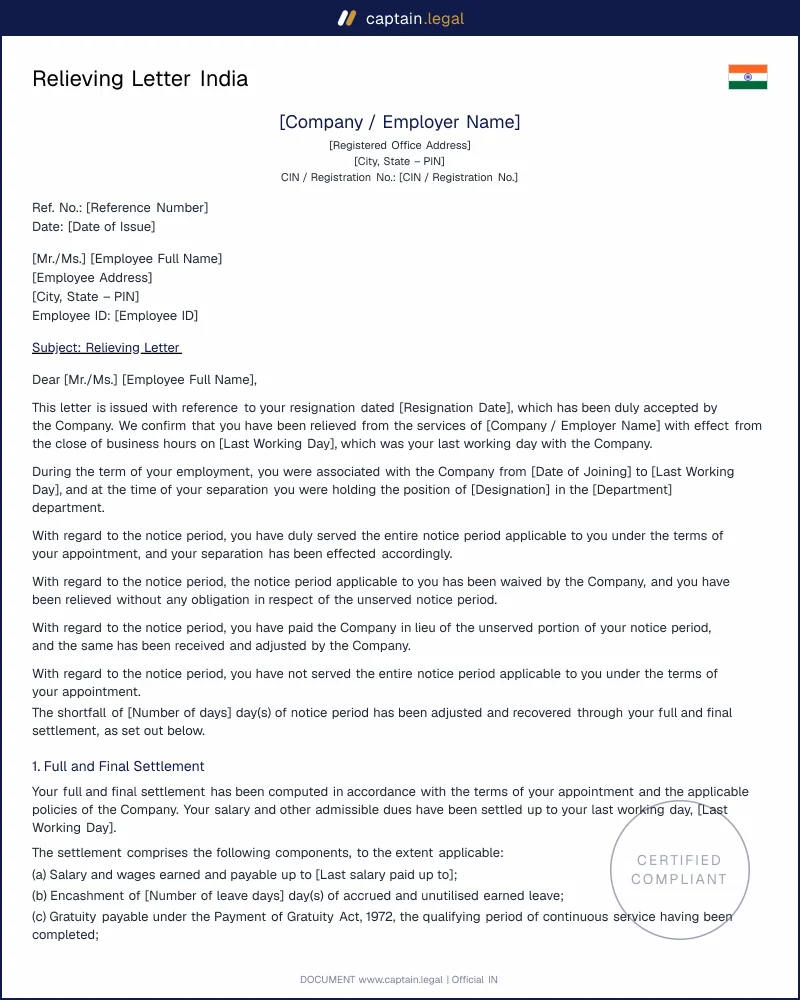
A relieving letter is a formal communication from the employer confirming that an employee has been relieved of all duties with effect from a stated last working day, that the notice obligation under the contract has been discharged, and that the relationship has ended on settled terms. In Indian HR practice it sits at the end of the exit sequence: resignation, acceptance of resignation, completion of notice, clearance from all departments, then the relieving letter alongside the full and final settlement. It is short by design, usually a single page, because its job is confirmation rather than narration.
People routinely confuse three exit documents, and the distinction matters in a dispute. The relieving letter confirms the date of release and that nothing remains pending. The experience certificate describes the role held, the tenure and sometimes conduct, and is the document a future employer reads for substance. The full and final settlement statement is the financial reconciliation that lists salary, leave encashment, gratuity, bonus and any recoveries. A well-run exit issues all three together, but they are not interchangeable. A relieving letter that tries to double as an experience certificate by adding performance commentary often creates ambiguity that a careful drafter avoids. For the contract that precedes all of this, see our employment contract format for India, which sets the notice terms a relieving letter later confirms.
Legal framework
India has no single statute that defines a relieving letter, which is precisely why drafting it well requires knowing which laws govern the underlying obligations it certifies. The starting point is the employment contract itself, enforceable under the Indian Contract Act, 1872, supplemented for most private commercial establishments by the relevant State Shops and Establishments Act, which fixes notice periods, wage payment timelines and record-keeping duties that vary materially from one state to another.
The most significant recent change is structural. India's four new Labour Codes, the Code on Wages, 2019, the Code on Social Security, 2020, the Industrial Relations Code, 2020 and the Occupational Safety, Health and Working Conditions Code, 2020, were notified into effect on 21 November 2025, consolidating twenty-nine earlier central labour laws. Two provisions reshape the exit document directly. First, full and final settlement must now be completed within two working days of the last working day, a sharp departure from the old practice where settlements drifted across thirty to forty-five days. A relieving letter that confirms settlement therefore cannot lag the exit by weeks without exposing the employer to a compliance claim. Second, the Industrial Relations Code makes a written appointment letter mandatory for every worker, which raises the documentary standard for the entire employment lifecycle, exit included. You can verify the official position in the Government of India's press release on the implementation of the four Labour Codes.
One trap deserves a flag. Where the contract embeds a post-employment restraint, Section 27 of the Indian Contract Act renders any agreement in restraint of a lawful profession void, so a relieving letter must never purport to revive or extend a non-compete that the law would not enforce. The exit confirms the end of obligations, it does not create new ones. Our non-disclosure agreement for India shows how confidentiality, which does survive, should be handled separately and reasonably.
When do you need this document?
The standard trigger is a voluntary resignation where the employee has served the contractual notice and the employer is closing the file. Here the relieving letter is the routine confirmation that the notice was honoured and the last working day is fixed, and it is the document the new employer will demand before onboarding. The second common scenario is a notice buyout, where the employee pays salary in lieu of the unserved portion of notice; the relieving letter then records that the shortfall was recovered through the settlement rather than served in time, which keeps the record honest and defensible.
A third situation arises on the employer side, when an engagement ends by mutual separation or on completion of a fixed term. Under the Industrial Relations Code, fixed-term employees now have parity with permanent staff and become eligible for gratuity after one year, so the relieving letter at the end of a fixed term should align with a settlement that reflects that entitlement. There are two edge cases a practitioner watches for. The first is the absconding employee who never formally resigns: issuing a relieving letter here is risky, because it implies an orderly exit that did not happen, and most employers issue a separation note instead. The second is termination for proven misconduct, where the relieving letter, if issued at all, is stripped of any language that could read as an endorsement of conduct. When the parting itself is contested, a formal legal notice or demand letter may precede or replace the relieving letter altogether.
Key clauses included in our template
- The identification block names the employee in full, the employee code, the designation held at exit and the department, then states the last working day as a fixed date rather than a relative phrase. A relieving letter that says "relieved after notice" without a calendar date leaves the notice calculation without an anchor, which is the single most common drafting weakness in Indian exit letters.
- The confirmation of resignation and notice records that the resignation dated a certain day was accepted and that the notice period required by the contract or the applicable Shops and Establishments Act was either served in full or settled by recovery. This is the clause that defeats a later allegation that the employee left without authority.
- The full and final settlement reference states that all dues, including salary up to the last working day, leave encashment, statutory bonus and gratuity where applicable, have been settled in accordance with the Code on Wages, 2019 and its two-working-day timeline. It cross-refers to the separate settlement statement rather than reproducing figures, keeping the letter clean.
- The no-dues and clearance confirmation records that company property, access cards, devices and any advances have been returned or reconciled, which is what allows the settlement to be released without a hold.
- The closing and authorised signature carries the date of issue, the signatory's name and designation, and the company seal where the establishment uses one. An undated or unsigned relieving letter routinely fails background verification, defeating its only purpose.
Regional considerations
India's exit rules are not uniform, because the notice period and wage-payment timeline that a relieving letter certifies are fixed by each state's Shops and Establishments Act, not by a central rulebook. Getting the state right is therefore part of getting the letter right.
Karnataka matters disproportionately because of Bengaluru's technology sector. The Karnataka Shops and Commercial Establishments Act, 1961 sets a shorter notice during probation, commonly seven days, while confirmed employees are typically held to one month under contract. Relieving letters for IT employees in the state should reflect the actual served notice precisely, since these are the exits most scrutinised during background verification.
Maharashtra, covering Mumbai and Pune, applies the Maharashtra Shops and Establishments (Regulation of Employment and Conditions of Service) Act, 2017, under which notice obligations scale with tenure and can extend to longer periods after a year of service. A relieving letter here should be careful to confirm the correct served period for the employee's length of service rather than a generic one-month line.
Delhi follows the Delhi Shops and Establishments Act, 1954, which requires one month's notice for employees who have completed three months of service. The relieving letter for a short-tenure Delhi employee should track that threshold rather than assume a uniform notice. Across all states the Code on Wages two-day settlement timeline now overlays the state notice rules, so the letter's settlement confirmation must respect both layers. For property-related no-dues such as company-leased accommodation, our property documents for India cover the parallel paperwork.
How to fill out this relieving letter
You begin by entering the employee's full legal name exactly as it appears on the appointment letter, the employee code and the designation held on the last day, because mismatched names are a leading cause of background verification failures. From there the form asks for the resignation date and the last working day, and it uses these to frame the notice confirmation language so the letter states clearly whether notice was served or bought out. You then select the state of employment, which adjusts the statutory reference to the correct Shops and Establishments Act and aligns the notice expectation with local rules.
The next step records the settlement position. You confirm that the full and final settlement has been completed and reference the separate settlement statement, rather than typing amounts into the letter, which keeps the document clean and avoids inconsistency. The form then captures the clearance and no-dues confirmation, the date of issue and the authorised signatory's name and designation. Once generated, the letter downloads as both Word and PDF, so you can issue it on company letterhead immediately or adapt the wording for a specific exit. The whole flow is built to produce a letter that survives the scrutiny of a future employer's verification team.
Common mistakes to avoid
The most damaging error is delay. Under the old regime employers routinely held the relieving letter for weeks while accounts processed the settlement, but with the Code on Wages now mandating full and final settlement within two working days, a letter issued late is no longer just poor practice, it signals non-compliance and invites a wage claim. The second frequent mistake is vague dating, where the letter omits a fixed last working day or uses relative phrasing; this destroys the notice calculation and is precisely the gap a disgruntled employee exploits later. A third recurring fault is letting the relieving letter drift into performance commentary, blurring the line with the experience certificate and creating statements the employer cannot later stand behind.
Two more catch employers out. Issuing a relieving letter to an absconding employee who never formally resigned manufactures a record of an orderly exit that did not occur, and it can undercut any recovery the employer wants to pursue. Finally, many letters still reference a post-employment non-compete as a live obligation, ignoring that Section 27 of the Indian Contract Act voids such restraints; a relieving letter should confirm the end of duties, not assert unenforceable ones. A clean, dated, correctly settled letter, issued on time and free of editorial commentary, is what protects both sides.
Frequently Asked Questions
26 verified reviews · 50 000+ downloads
- Immediate access to the document
- PDF + Word download
- Compliant with 2026 legislation
- Reviewed by lawyers
You might also like