Create my document
Login

Choose country

FranceBelgiqueEspañaUnited StatesUnited KingdomMarocDeutschlandItaliaSchweiz
Personal & Family

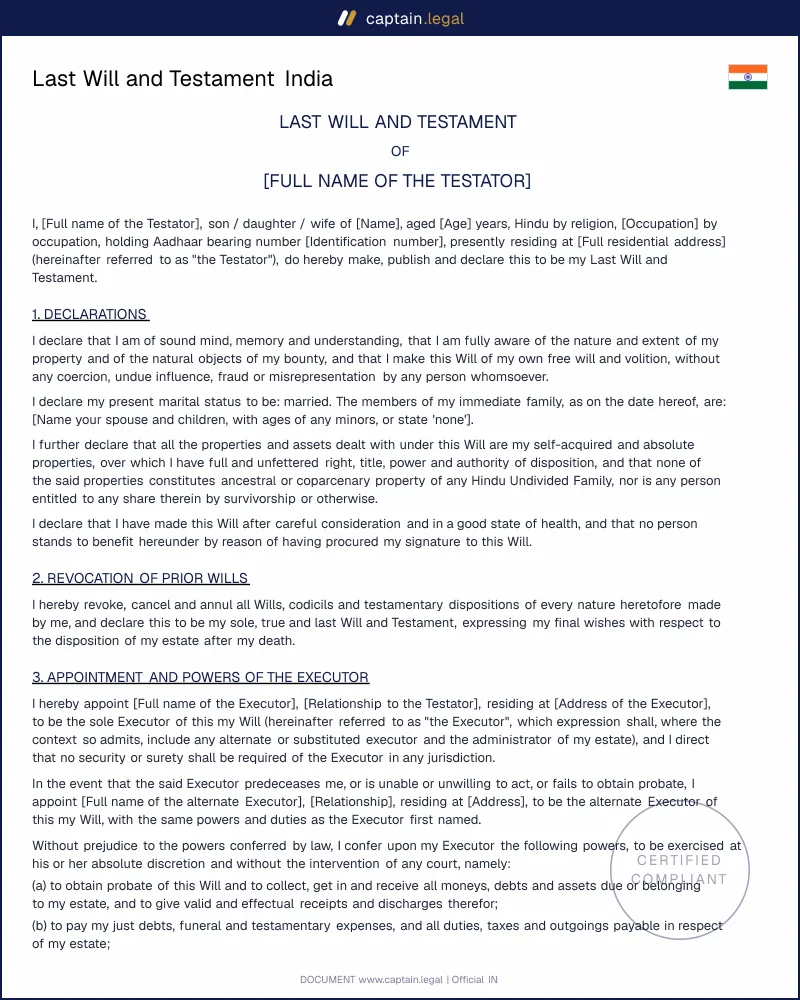
Last Will and Testament Format: Section 63, India

Will template drafted to Section 63, Indian Succession Act 1925. Correct two-witness attestation, optional registration, ready in Word and PDF.
4.9/532 reviews50 000+ downloadsInstant download
Share

A Last Will and Testament is the written instrument by which you, the testator, decide who inherits your assets after your death, appoint an executor to carry out your wishes, and record specific bequests to the people and causes you choose. Under Indian law it is a deceptively simple document: a single unwitnessed signature, an ambiguous clause about the residue, or a witness who also stands to inherit can be enough to drag your estate into years of probate litigation. This template is built for the Indian Succession Act, 1925, drafted so that the two-witness attestation the statute demands is correctly executed, and structured to leave no gap that a disappointed relative can later exploit.

Compliant

2026 Legislation

50,000+ clients

trust us

Affordable

From $4.90 / doc

Secure payment

Instant download

Last Will and Testament Format: Section 63, India

Secure payment · No subscription

Fill in the template

What is a Last Will and Testament under Indian law?

A will is a legal declaration of the intention of a testator with respect to his property, which he desires to take effect after his death. That definition comes straight from Section 2(h) of the Indian Succession Act, 1925, and every word of it matters. The disposition takes effect only on death, which means a will transfers nothing during your lifetime and stays fully revocable until your last breath. You can rewrite it, add a codicil, or tear it up entirely, and the most recent valid version is the one that governs.

People routinely confuse a will with a gift deed or a nomination, and the confusion is expensive. A gift deed passes property immediately and, for immovable assets, must be registered under the Transfer of Property Act, 1882. A bank or insurance nomination only tells the institution whom to pay; the Supreme Court has repeatedly held that a nominee is a trustee for the legal heirs, not the owner. A will is the only instrument that actually directs succession across your entire estate. Indian succession law is layered over personal law, so a Hindu, Buddhist, Sikh or Jain testator falls under the general scheme of the 1925 Act, while a Muslim testator can ordinarily bequeath only up to one-third of the estate without the heirs' consent. If you are setting up a business alongside your personal planning, the same care that goes into a founders' agreement aligned with the Indian Contract Act 1872 belongs in your will.

2

When do you need this document?

The clearest trigger is owning anything worth passing on: a flat, a plot of ancestral land, mutual funds, a small business, or simply the bank balance and jewellery that most families fight over. If you die intestate, that is without a valid will, your assets devolve under the Hindu Succession Act, 1956, or the relevant personal law, and the law's chosen heirs may not match your wishes at all. A second common situation is the blended or non-traditional family, where you want to provide for a second spouse, stepchildren, or a long-term partner whom intestate succession would ignore entirely. Writing it down is the only way to make those intentions binding.

Parents of minor children often draft a will less for the assets than to appoint a guardian and structure how the inheritance is held until the child comes of age. Business owners use a will to direct what happens to their shareholding, dovetailing it with a shareholders agreement under the Companies Act 2013 so that succession and the company's transfer rules do not contradict each other. An NRI with assets in India is a frequent edge case: a separate India-specific will covering only Indian property usually probates faster than relying on a single foreign will. One more scenario worth flagging is the testator who already has an old will. Marriage, divorce, the birth of a child, or the sale of a major asset can render parts of an existing will stale, and a fresh will that expressly revokes all earlier ones is far safer than a patchwork of codicils.

3

Key clauses included in our template

  • The declaration and revocation clause opens the will by identifying you, confirming you are of sound mind and acting without coercion, and expressly revoking all earlier wills and codicils. This single sentence prevents the most common dispute of all, two competing wills surfacing after death, by making the latest document unambiguously the operative one.
  • The appointment of the executor names the person who will collect your assets, pay your debts, and distribute the estate, with a substitute executor in case your first choice predeceases you or declines. Choosing a willing and competent executor matters because this is the individual who will, if needed, apply for probate and deal with banks, registrars and the court.
  • The specific bequests carve out named assets to named people: a particular property to one child, jewellery to another, a fixed sum to a dependent. Each beneficiary is identified precisely enough that no two people could be confused, because vague phrasing like "my house" invites litigation when a testator owns more than one.
  • The residuary clause sweeps up everything not specifically gifted and directs where it goes. Wills fail in practice not because the big assets are forgotten but because a forgotten bank account or a later-acquired asset falls outside every specific bequest; a clean residuary clause closes that gap.
  • The attestation clause records that the will was signed by you in the simultaneous presence of two witnesses who then signed in your presence, capturing the Section 63 formalities on the face of the document and making the will far easier to prove later.
4

Regional considerations

Will law itself is central, but the practice around registration, probate and stamp duty shifts by State, and those differences decide how smoothly an estate settles.

Maharashtra makes the distinction sharpest because probate is effectively unavoidable for many estates. Under the Indian Succession Act, probate of a will is mandatory where the will is made by a Hindu, Buddhist, Sikh or Jain within the ordinary original civil jurisdiction of the Bombay High Court, or relates to immovable property situated there. Testators in Mumbai routinely register the will with the Sub-Registrar to ease that later probate, and the Maharashtra registration fee for a will is modest and fixed rather than ad valorem.

West Bengal sits under the same probate rule for the territory of the Calcutta High Court's original jurisdiction, so a Kolkata testator should expect probate to be required for Hindu wills there. The state's registration offices are well used to depositing wills in sealed cover under Section 42 of the Registration Act, an option that adds secrecy on top of authenticity.

Tamil Nadu, covering the Madras High Court's original jurisdiction, completes the trio of presidency towns where probate of Hindu wills is compulsory. Outside these original-side jurisdictions, across most of Karnataka, Delhi, Uttar Pradesh and the rest of the country, probate is generally optional and an executor can act on the will directly, though banks and registrars often ask for it before transferring high-value assets.

Across every State the constants hold: no stamp duty on the will, registration optional under Section 18, and the two-witness rule of Section 63 non-negotiable. What changes is only how strongly local institutions push for registration or probate before they release assets, and in the four presidency-jurisdiction cities that push is strongest.

5

How to fill out this Last Will and Testament

You begin by entering your full legal name, address and a confirmation that you are making the will freely and of sound mind, which the template turns into the opening declaration and revocation clause. From there you name your executor and a substitute, then move through your assets one by one, recording specific bequests to each beneficiary with enough identifying detail that no later reader could mistake who gets what. The form then builds your residuary clause automatically so that anything you have not specifically mentioned still has a home. Once the dispositive part is complete, the template generates the Section 63 attestation clause and an execution block laid out for your signature and for the two witnesses, with a clear reminder that those witnesses must not be beneficiaries. You download the finished will in Word and PDF, print it on plain paper, and sign it in the simultaneous presence of both witnesses, who then sign in your presence. If you also need someone to manage affairs while you are alive, the same care applies to a property power of attorney drafted under the 1882 Act, which complements rather than replaces the will.

6

Common mistakes to avoid

The single most damaging error is using a beneficiary as a witness. Under Section 67, the gift to that witness or their spouse is void, and families discover this only when the estate is being distributed and a major bequest collapses. Closely related is the half-attested will, signed by the testator but witnessed by only one person or by witnesses who never actually saw the signing; this is not a minor defect but a failure of Section 63 that can invalidate the entire document. Another frequent slip is leaving out the revocation clause, so that an old will from a decade ago resurfaces and the heirs litigate over which one controls.

People also forget the residue. A will that lovingly distributes the house and the gold but says nothing about the savings account leaves that account to pass by intestacy, splitting it among heirs the testator may never have intended to benefit. Vague descriptions cause their own chaos: "my property in the city" means little when a testator owned three. Finally, many testators draft a sound will and then never tell anyone where it is. An unfindable will is functionally no will at all, so the original should be kept somewhere the executor can reach it, and registration or sealed deposit with the Sub-Registrar is the surest safeguard. If you are documenting a related family transfer at the same time, do it with the same rigour you would bring to a legal notice or demand letter rather than relying on an informal note.

Key takeaways

EXECUTION

Two witnesses are a validity condition

Section 63 of the Indian Succession Act, 1925 sets the minimum formalities for an unprivileged will. You must sign (or mark) the will with the clear intention to give it effect, and it must be attested by two or more witnesses. Each witness should see you sign or receive your acknowledgement, and then each witness must sign in your presence. Miss this sequence and the will can fail.

BENEFICIARIES

Keep witnesses completely independent

Who witnesses the will can decide whether a gift survives. Under Section 67, any bequest made to an attesting witness, or that witness’s spouse, is void even if the rest of the will stands. The practical rule is simple: do not use a beneficiary, or a beneficiary’s spouse, as either witness. Otherwise, you may accidentally cancel the very bequest you meant to protect.

REGISTRATION

Registration is optional, plain paper works

A will does not need registration to be valid. Section 18 of the Registration Act, 1908 makes registration purely optional, even when the will covers immovable property. The document can be executed on plain paper, and the text notes there is no stamp duty payable on a will. Use registration only as an added layer of formality, not as a substitute for proper attestation.

Frequently Asked Questions

Yes, provided you execute it correctly. The template is drafted to Section 63 of the Indian Succession Act, 1925, which sets the conditions for a valid unprivileged will: you must sign it, and it must be attested by two witnesses who each saw you sign or received your acknowledgement of the signature, and who then sign in your presence. A will that meets these formalities is fully binding whether or not it is registered, because registration under Section 18 of the Registration Act, 1908 is optional. The document only becomes vulnerable if the attestation is botched, the testator's capacity is genuinely in doubt, or a beneficiary acts as a witness in breach of Section 67. Follow the execution instructions and your will holds.

No on both counts. Registration of a will is optional under Section 18 of the Registration Act, 1908, even when the will deals with immovable property, and there is no stamp duty on a will anywhere in India, so it can be written on plain paper. Registration is still worth considering because a registered will is harder to challenge as a forgery and cannot easily be tampered with or destroyed. The law also exempts wills from the normal four-month presentation deadline, so you may register at any time, including years after signing. In the presidency-jurisdiction cities of Mumbai, Kolkata and Chennai, where probate of Hindu wills is compulsory, many testators register precisely to smooth that later process.

You download the completed will in both Word and PDF, so you can make final edits in Word if needed and print the clean PDF for signing. A will in India must be a written, signed document; there is no validity to an oral will except in the narrow privileged cases of soldiers and mariners. Print it on plain paper, then sign it in the simultaneous presence of your two witnesses, who must immediately sign in your presence. Use witnesses who are not beneficiaries and ideally younger than you, since at least one of them may need to give evidence to prove the will. Keep the signed original somewhere your executor can find it.

Yes, freely and as often as you like. A will is ambulatory and revocable for your entire lifetime, meaning it has no legal effect until you die and you can alter it at any point before then. You revoke an old will most cleanly by making a fresh one that expressly states it cancels all earlier wills and codicils, which is exactly how this template opens. You can also make a codicil for small changes, but a brand-new will is usually safer than stacking amendments. Major life events such as marriage, divorce, the birth of a child or the sale of a significant asset are the standard prompts to revisit and rewrite.

Your estate devolves by intestate succession under the personal law that applies to you, not according to your wishes. For most Hindus, Buddhists, Sikhs and Jains that means the Hindu Succession Act, 1956, which distributes assets among Class I heirs such as the spouse, children and mother in fixed shares you cannot adjust. The result frequently surprises families: a long-term partner you never married, a favourite charity, or a stepchild may receive nothing, while estranged relatives take a share by operation of law. Intestacy also forces heirs to obtain a succession certificate or letters of administration, often a slower and more contentious process than acting under a clear will with a named executor.

Your executor should be someone you trust, capable of handling paperwork and dealing with banks and registrars, and ideally younger than you so they outlive you. The template lets you name a primary executor and a substitute. Whether they need probate depends on where you live and what assets are involved. In the original civil jurisdictions of the Bombay, Calcutta and Madras High Courts, probate of a Hindu will is mandatory, so executors in Mumbai, Kolkata and Chennai must apply to court before distributing. Elsewhere probate is usually optional, though many banks and sub-registrars insist on it before transferring high-value assets. A registered will and a properly drafted affidavit or declaration often speed up whatever process the institution requires.

4.9/5

32 verified reviews · 50 000+ downloads

Last Will and Testament Format: Section 63, India
  • Immediate access to the document
  • PDF + Word download
  • Compliant with 2026 legislation
  • Reviewed by lawyers
Fill in the template
Secure payment · No subscription
Updated on June 9, 2026

You might also like

Power of Attorney India
Name Change Affidavit India