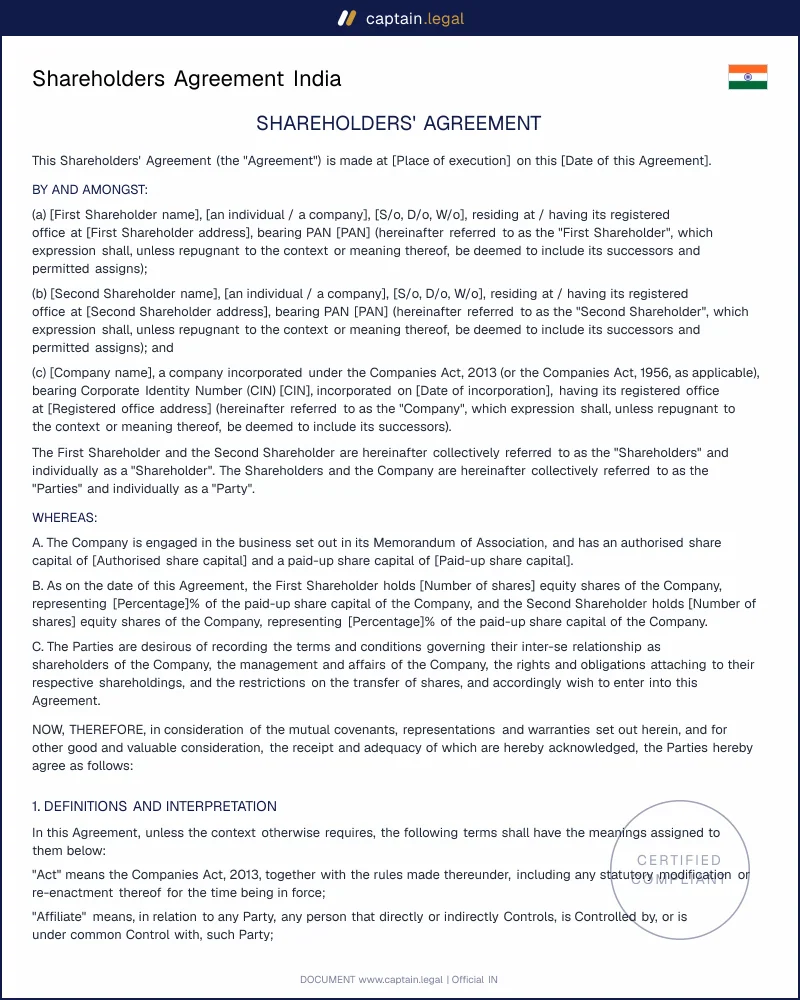
The SHA draws its force from contract law, but its enforceability against the company turns on the Companies Act, 2013. Under Section 2(68), a private company is one that restricts the right to transfer its shares through its articles of association, so transfer restrictions are not just permitted, they are part of what defines the structure. For a public company the position is different. Section 58(2) declares that the securities of a member in a public company are freely transferable, with a proviso that any contract or arrangement between two or more persons in respect of transfer of securities shall be enforceable as a contract. That proviso was added specifically to settle conflicting court decisions and to give statutory legitimacy to private arrangements between shareholders of a public company, provided they comply with the statute, the rules and the articles.
The case law tells the rest of the story. In Vodafone International Holdings B.V. v. Union of India, the Supreme Court took the view that restrictions in an SHA, even when consistent with company legislation, are enforceable against the company only when incorporated in the articles. Earlier, in Messer Holdings Ltd. v. Shyam Madanmohan Ruia, the Bombay High Court upheld a right of first refusal between shareholders. The Division Bench held that while shares of a public company are in general freely transferable, nothing in law stops two or more shareholders from agreeing to pre-emption clauses such as a right of first refusal, and that this is now embodied in the proviso to Section 58(2). A SEBI notification of 3 October 2013 reinforced the point for listed securities, expressly carving out contracts for pre-emption including right of first refusal, tag-along or drag-along rights contained in shareholders agreements or articles of association from the prohibition on private securities contracts.
Stamping is a separate question that catches drafters out. An SHA does not need to be registered, and stamping is not a condition of validity, but Section 35 of the Indian Stamp Act, 1899 makes an under-stamped instrument inadmissible as evidence until the deficit duty and penalty are paid. The rate is fixed by each state, so a Mumbai SHA and a Bengaluru SHA carry different stamp liabilities. For the underlying statute and the current incorporation process, the Ministry of Corporate Affairs maintains the authoritative position through its MCA portal guidance on the Companies Act, 2013.