British Columbia has the most detailed regime in the country. The landlord must offer at least two opportunities to inspect, between 8 a.m. and 9 p.m., the second on the approved Notice of Final Opportunity to Schedule a Condition Inspection, under section 17 of the Residential Tenancy Regulation. A copy of the signed report goes to the tenant within 7 days of a move-in inspection, and within 15 days of the later of the move-out inspection or receipt of the forwarding address, under section 18. A landlord who skips these steps loses the right to claim against the deposit for damage under sections 24(2) and 36(2) of the Act, although a separate claim for damages remains open. The deposit itself must be returned or claimed within 15 days under section 38(1), failing which section 38(6) exposes the landlord to paying double the deposit.
Alberta requires the parties to inspect within one week before or after the tenant takes possession, and within one week before or after the tenant gives it up, under section 19 of the Residential Tenancies Act. The report must carry the signed statements prescribed by the Residential Tenancies Ministerial Regulation, and the landlord keeps it for at least three years. The deposit, capped at one month's rent, must be returned with interest or accompanied by a statement of account within 10 days of the tenant giving up possession.
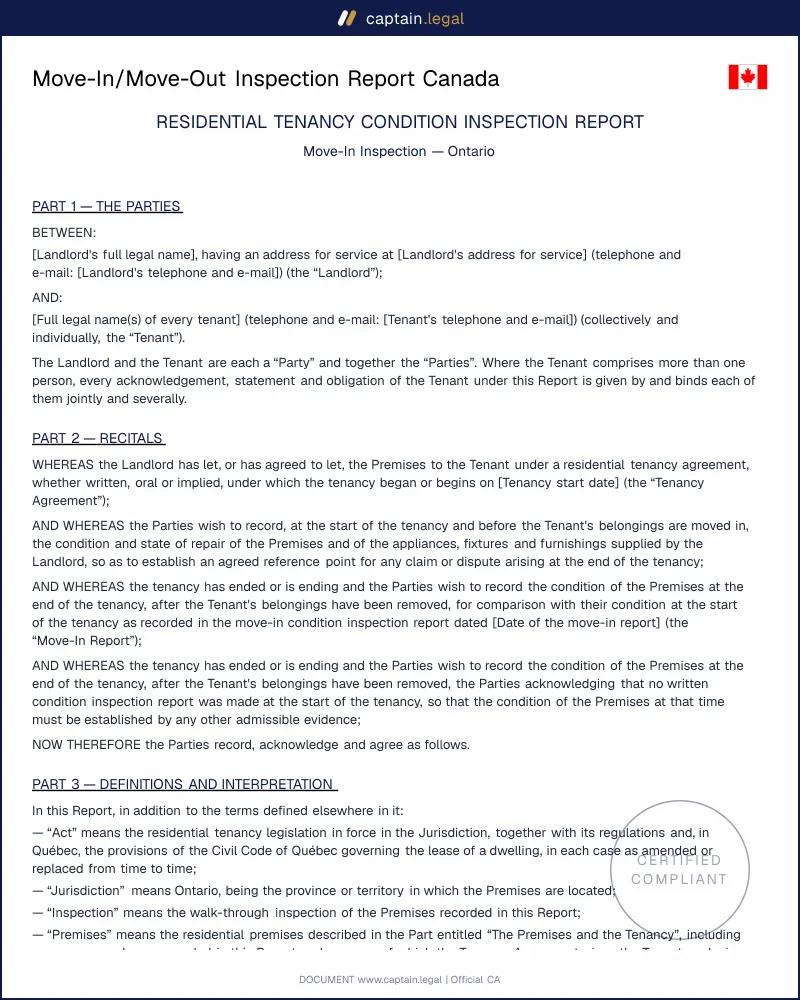
Ontario does not require an inspection report, and landlords cannot collect a damage deposit: sections 105 and 106 of the Residential Tenancies Act, 2006 allow only a rent deposit and a refundable key deposit. The mandatory standard lease contains no inspection clause, so the report supports a damage application under section 89, which can be brought against a former tenant within one year of the move-out.
Quebec prohibits any deposit beyond the first month's rent under article 1904 of the Civil Code of Québec, so the report serves as proof rather than as a deposit tool. Absent a description, article 1890 presumes the tenant received the dwelling in good condition, which makes the report above all the tenant's protection.