Family & Divorce

Notice of Relocation | Divorce Act s.16.9 & Form 1

Relocation notice drafted to Divorce Act s.16.9 and SOR/2020-249 Form 1, with Ontario CLRA, BC FLA and Nova Scotia rules. 30-day objection explained.
4.7/5— 11 reviews50 000+ downloadsInstant download
Share

A notice of relocation is the written notice a parent must give before moving with a child in a way that is likely to significantly affect the child's relationship with the other parent. Under section 16.9 of the Divorce Act, it must reach the other parent at least 60 days before the expected moving date and set out the new address, contact details and a concrete proposal for parenting time and decision-making responsibility after the move. This template is built for separated and divorced parents across Canada who are moving for work, a new partner, family support or more affordable housing, and who would rather follow the statutory process than defend a unilateral move in court.

Compliant

2026 Legislation

50,000+ clients

trust us

Affordable

From $4.90 / doc

Secure payment

Instant download

Notice of Relocation | Divorce Act s.16.9 & Form 1

Secure payment

Fill in the template

What is a notice of relocation?

The Divorce Act draws a sharp line between two kinds of moves. A simple change of residence, such as moving across town with no effect on the schedule, only requires written notice of the date and new address under section 16.8. A relocation is different. Section 2(1) defines it as a change in the place of residence of the child, or of a person who has parenting time, decision-making responsibility or a pending application for a parenting order, that is likely to have a significant impact on the child's relationship with another person holding one of those roles or contact under a contact order. Distance alone is never the test; the effect on the parenting schedule is.

A notice of relocation is not an agreement and does not need the other parent's signature. It is a unilateral statutory notice that starts two clocks: the 60-day minimum before the move and the 30-day window to object. What separates a usable notice from an ordinary letter is the parenting proposal. A notice of relocation that simply announces a move to Calgary at the end of the school year, without explaining how the other parent will keep a meaningful relationship with the child, gives a judge an easy reason to find the plan unreasonable.

When do you need this document?

The most common trigger is a job offer or transfer in another city or province, especially in health care or the Canadian Armed Forces. The second is a move back towards family. After a separation, many parents need grandparents nearby for child care, and courts accept that support network as a legitimate reason when the proposal still protects the other parent's time. Housing costs drive the rest: a parent priced out of Vancouver or Toronto who moves to a smaller centre will almost always cross the significant impact threshold. Timing matters as much as the reason. If you rent, your notice to end a residential tenancy should line up with the relocation timeline, and giving up a lease before the 30-day objection window closes can leave you without a home and without permission to move.

Two edge cases surprise people. The obligation is not limited to the parent with primary residence: a parent who exercises every second weekend and plans to move provinces is also relocating and must serve a notice of relocation on the other parent. And where there is a history of family violence, an application under section 16.9(3) to waive or modify notice is often safer than disclosing a new address.

Key clauses included in our template

  • The identification of the parties and children lists every child affected and every person entitled to notice. Omitting a grandparent with a contact order is a common defect, and it reopens the question of whether proper notice was ever given.
  • The expected relocation date anchors the 60-day count, and the template builds in a margin for delivery delays because the notice must actually reach the other parent in time.
  • The new address and contact information must be complete. If you are still choosing between two rentals, wait until you have the civic address, since a notice missing information required by section 16.9(2) is open to challenge.
  • The proposed parenting schedule sets out regular time, holidays, summer blocks and video calls at the new distance. It follows the structure of a full parenting plan with a geographic mobility clause, so the proposal can later become a consent order without rewriting.
  • The decision-making clause addresses school enrolment, health care providers and activities in the new community.
  • The travel and cost clause proposes who transports the child and who pays. Section 16.95 allows a court that authorizes a relocation to apportion these costs, so a fair offer at the notice stage often avoids an application.
  • The service paragraph records how and when the notice was delivered and reminds the recipient of the 30-day right to object.

Provincial considerations

Ontario parents involved in a divorce proceeding use the federal regime. Where parenting arrangements rest on an order under the Children's Law Reform Act, sections 39.1 to 39.4 apply instead, with the same 60-day notice and 30-day objection period. Unlike the federal regulation, O. Reg. 155/21 requires the official provincial Notice of Relocation Form and sets the permitted methods of service, with proof by affidavit or written confirmation from the recipient. Section 39.4 reproduces the federal burden of proof rules.

British Columbia regulates relocation by guardians under sections 65 to 71 of the Family Law Act, where an agreement or order on parenting arrangements is in place. Section 66 requires at least 60 days' written notice to every other guardian and person with contact, stating the date and proposed location. An objection is made by court application within 30 days. Under section 69, the relocating guardian must show good faith and reasonable, workable arrangements to preserve the child's relationships, and must also prove best interests where parenting time is substantially equal.

Alberta has no provincial relocation notice regime. The Family Law Act applies the general best interests test, so the federal model is the benchmark for good practice even between unmarried parents. Alberta divorce judgments now include a paragraph on how future notices will be given, and an existing separation agreement drafted to the Divorce Act may already contain a geographic restriction you must respect.

Nova Scotia codified relocation in sections 18E to 18H of the Parenting and Support Act, amended in 2021 to align with the federal reform. Section 18E(2) imposes 60 days' notice, section 18H(1A) allocates the burden of proof, and section 18H(3) bars the "would you move without the child" question.

Quebec is a civil law jurisdiction. The Divorce Act still governs married parents in divorce proceedings, while unmarried parents who disagree on a move bring the dispute before the court under article 604 of the Civil Code of Québec.

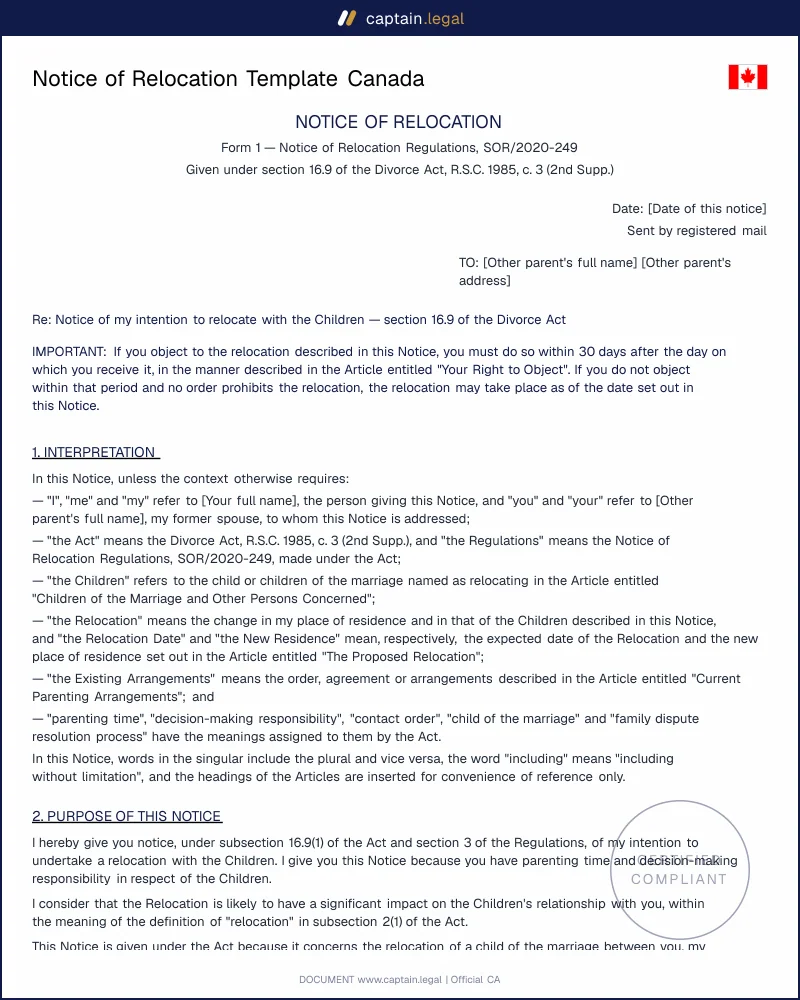
How to fill out this notice of relocation

You start by selecting your province and confirming which statute governs your family. Parents within a divorce proceeding or under a Divorce Act order follow the federal rules, other parents follow provincial legislation, and the template adjusts its citations accordingly. You then enter each child's name and date of birth, followed by every person who must receive the notice, including anyone holding a contact order. The next screen covers the move itself: the current address, the full new address, the expected date and your reasons. The questionnaire flags any date less than 60 days after your planned delivery.

You then build the parenting proposal, where most of the drafting effort goes. Finally, you download, sign and serve the notice of relocation. Keep proof of delivery a court will accept, such as a signed acknowledgment, courier tracking with signature or an affidavit of service.

Common mistakes to avoid

The mistake we see most often is the notice by text message. A parent mentions the move in a chat thread, assumes the other parent is on notice and starts counting. A message without the address, date and parenting proposal is not the prescribed notice, and a judge will treat the clock as never having started. The second mistake is counting from the wrong day. The notice must reach the other parent 60 days before the move and the objection period runs from receipt, so a notice mailed before a long weekend can lose several days.

A vague proposal offering "liberal parenting time" with no schedule is the third. The remaining errors happen after service. Some parents move before the 30 days have run, or despite a filed objection, and a move made in breach of the process becomes evidence against you under section 16.92(1)(d). Others forget to check an existing order or agreement for a geographic restriction, which the court must consider. Parents also overlook money. A relocation changes travel costs and can support an undue hardship claim under section 10(2)(b) of the Federal Child Support Guidelines, so your child support agreement under the Federal Child Support Guidelines may need revisiting at the same time.

Key takeaways

Relocation test

Impact, not distance, drives the notice

A move becomes a relocation when it is likely to significantly affect the child's relationship with another parent or contact-order holder. Under the Divorce Act, a move across town may be only a change of residence, while a farther move that disrupts parenting time triggers section 16.9. The parenting schedule is the practical measuring stick.

60-day notice

Form 1 must do more than announce

Section 16.9 requires notice at least 60 days before the expected moving date. The notice must include the new address, contact information and a concrete proposal for parenting time, decision-making responsibility or contact after the move. Under SOR/2020-249, Form 1 is the standard federal format for a relocating parent.

Objection window

Silence can let the move proceed

Once proper notice is received, the other parent has 30 days to object using the Divorce Act process, including Form 2 under the regulations. If no objection is made, no order blocks the relocation and the court has not said otherwise, section 16.91 can allow the move on the stated date.

Frequently Asked Questions

There is no distance threshold in Canadian law. The test is whether the move is likely to have a significant impact on the child's relationship with another person who has parenting time, decision-making responsibility or contact. A move between two Toronto neighbourhoods that keeps the same school and schedule is usually a change of residence under section 16.8, which only requires notice of the date and new address. A move that adds an hour to every exchange or forces a school change will usually qualify. Related documents are grouped among our Canadian family and divorce templates.

Yes, when completed accurately and properly served. Under the Notice of Relocation Regulations, a parent gives notice by providing the information set out in Form 1, and the template reproduces every element required by that form and by section 16.9(2) of the Divorce Act. Validity depends on the content, the 60-day lead time and proof of receipt. In Ontario, a notice under the Children's Law Reform Act must be given on the official provincial form, and the template serves as your drafting base. If an order in your file prescribes a specific form or method of service, follow that order.

The recipient has 30 days from receiving the notice under section 16.91. Federally, the objection is made in Form 2, stating the reasons and the objecting parent's views on your proposal, or by court application. In British Columbia, the objection is made by court application. If no objection arrives within 30 days and no order prohibits the move, you may relocate on the date stated in your notice. Once an objection is filed, the move waits for a court decision or a written agreement between the parents.

You receive the notice in Word and PDF. The Word version lets you adjust the parenting proposal after a first conversation with the other parent, or add the civic address once a lease is signed. The PDF is the version to sign and serve, because its layout stays fixed and gives you a clean copy for your records and the court file.

Moving without notice does not automatically mean the child must return, but it seriously weakens your position. Compliance with notice is a factor the court must weigh under section 16.92(1)(d), and a judge hearing an urgent motion can order the child's return pending a full hearing. If you have already moved, serving a complete notice right away is still better than waiting for an application. Other forms you may need are in our document catalogue for all Canadian provinces.

Yes. An international move is almost always a relocation, and the same 60-day notice and 30-day objection rules apply. Canada is a party to the Hague Convention on the Civil Aspects of International Child Abduction, and removing a child without consent or a court order can trigger return proceedings. Your proposal should cover passport consent, school breaks long enough for overseas visits and video contact across time zones.

4.7/5

11 verified reviews · 50 000+ downloads

Notice of Relocation | Divorce Act s.16.9 & Form 1
  • Immediate access to the document
  • PDF + Word download
  • Compliant with 2026 legislation
  • Reviewed by lawyers
Fill in the template
Secure payment
Updated on October 9, 2026

You might also like

Marriage Contract Template Canada
Child Support Agreement Template