Business

E-commerce Terms Canada: Returns, Refunds & Liability Rules

E-commerce terms built on Ontario CPA s.38-40, Quebec CPA s.54.1 and BC BPCPA s.46: disclosure, 15-day copy and cancellation rules. Word and PDF.
4.6/5— 15 reviews50 000+ downloadsInstant download
Share

Website terms and conditions for an online store are the contract that governs every order placed on your site: how the sale is formed, when payment is taken, how goods are shipped, what happens on a return and where your liability stops. In Canada, that contract sits on top of provincial consumer protection statutes that no merchant can contract out of. This e-commerce terms of sale template is written for Canadian merchants selling online to consumers in the common-law provinces and in Quebec. It builds in the internet agreement disclosures, cancellation rights and chargeback rules that provincial law attaches to every online sale, and keeps your limitation of liability within what a Canadian judge will enforce.

Compliant

2026 Legislation

50,000+ clients

trust us

Affordable

From $4.90 / doc

Secure payment

Instant download

E-commerce Terms Canada: Returns, Refunds & Liability Rules

Secure payment

Fill in the template

What are website terms and conditions for an e-commerce store?

In Canadian practice, the expression covers two documents that are often merged. The terms of use govern access to the site itself: user accounts, acceptable conduct, intellectual property in your photos and copy, and the licence granted to visitors. The terms of sale form the contract of purchase between the merchant and the buyer. Our template combines both in one instrument with clearly separated parts. How the buyer accepts the terms matters as much as their content. When a customer ticks a box or clicks "Place order" after being shown the terms, Canadian courts treat the result as a binding clickwrap agreement, a position settled since Rudder v. Microsoft Corp. (1999), 2 C.P.R. (4th) 474 (Ont. S.C.J.). A footer link the buyer never has to acknowledge, known as browsewrap, is far weaker.

These terms are also a contract of adhesion, and Canadian law compensates for the buyer's lack of bargaining power. Ambiguous clauses are read against the drafter under the contra proferentem rule, unconscionable terms can be struck under Uber Technologies Inc. v. Heller, 2020 SCC 16, and consumer statutes override any clause that reduces statutory rights. Wholesale portals selling only to businesses face a lighter regime. Merchants usually keep these terms alongside the other business and incorporation templates for Canadian companies that structure their operations.

When do you need this document?

The obvious trigger is the launch of an online store, whether on Shopify, WooCommerce or a custom build. Platform default terms govern the platform's relationship with you, not your sales to customers, and they rarely address Canadian cancellation rights. The second scenario is expansion into a new province. A retailer that sold only within Alberta and starts shipping to Montreal takes on the Quebec Consumer Protection Act and French language requirements overnight. Subscription models are a third case, because recurring deliveries and memberships trigger renewal disclosures that a one-off checkout never raises.

Businesses selling services need terms adapted to performance dates, deposits and cancellation fees, often paired with a service agreement template for Canadian businesses for larger mandates negotiated off the site. Marketplace operators must state clearly who the seller of record is, because a consumer who cannot identify the supplier will pursue the platform. One edge case worth flagging is the site rebuild: when a freelancer rebuilds your store, the acceptance checkbox sometimes disappears unnoticed, so an independent contractor agreement for your web developer should list the acceptance mechanism among the deliverables. Another is the pre-order page, where the cancellation right for late delivery becomes a live risk from the first sale.

Key clauses included in our template

  • The merchant identification block sets out your legal name, operating name, business address, telephone number and email address. Provincial internet sales rules make these items mandatory disclosure.
  • The order formation clause fixes the moment the contract is concluded and explains how obvious pricing errors are handled. Its effect is limited in Quebec, where s. 224(c) of the Consumer Protection Act bars charging more than the advertised price, so the clause is drafted to work as a safety net rather than a general escape route.
  • The pricing and taxes clause itemizes the total price, shipping charges, mandatory fees, GST/HST and provincial sales tax. Every unavoidable charge must sit in the advertised price to stay clear of the drip pricing rules.
  • The shipping and delivery clause states a delivery date or period, allocates the risk of loss in transit and explains the process for lost parcels. It preserves the consumer's statutory right to cancel when delivery is more than 30 days late.
  • The returns and refunds policy separates statutory cancellation rights from your voluntary return policy. Restocking fees and final-sale items attach to the voluntary policy only.
  • The warranty and liability clause caps damages for business customers while carving out the statutory warranties consumers keep, so the cap survives judicial review instead of falling as a whole.
  • The governing law and dispute resolution clause chooses the applicable province and handles arbitration carefully. After Douez v. Facebook, Inc., 2017 SCC 33, a forum selection clause in a consumer contract can be set aside for strong public policy reasons.

Provincial considerations

Ontario applies Part IV of the Consumer Protection Act, 2002 to internet agreements. The merchant discloses the information listed in s. 38, and s. 39 requires a copy of the agreement within 15 days. Under s. 40, a disclosure failure lets the consumer cancel until 7 days after receiving the copy, while a missing copy opens a 30-day cancellation window from the date of the agreement. Late delivery is handled separately by the future performance rules of s. 23. Under s. 99, an unrefunded consumer can ask the card issuer to reverse the charge. Any clause forcing an Ontario consumer into arbitration or barring a class action is invalid under ss. 7 and 8, whatever the checkout says.

Quebec treats online sales as distance contracts under ss. 54.1 to 54.16 of the Consumer Protection Act (CQLR, c. P-40.1), with the same disclosure, copy and cancellation sequence and a cancellation right under s. 54.9 when delivery is more than 30 days late. Section 10 prohibits exclusions of liability for the merchant's own acts, and s. 11.1 voids arbitration clauses against consumers. The new warranty of good working order in ss. 38.1 to 38.9 now covers appliances and electronics, and its duration must appear near the advertised price. The Charter of the French Language, as amended by Bill 96, requires French on the site and the French version of a contract of adhesion first, so an English-only checkout is not a valid option for Quebec consumers.

British Columbia regulates distance sales contracts in ss. 46 to 51 of the Business Practices and Consumer Protection Act, SBC 2004, c. 2, following the harmonized sequence, with a refund due within 15 days of a valid cancellation and a credit card reversal right in s. 51. In Seidel v. TELUS Communications Inc., 2011 SCC 15, the Supreme Court held that an arbitration clause cannot block a consumer's court action under s. 172, which makes broad arbitration language largely ineffective against BC buyers.

Alberta implements the template through the Internet Sales Contract Regulation, Alta. Reg. 81/2001, made under the Consumer Protection Act, RSA 2000, c. C-26.3. Disclosure, the express opportunity to accept or decline, the 15-day copy and the cancellation rights follow the harmonized pattern. Section 16 of the Act prevents mandatory arbitration of consumer disputes unless the Minister has approved the process, and consumers may sue for damages caused by unfair practices.

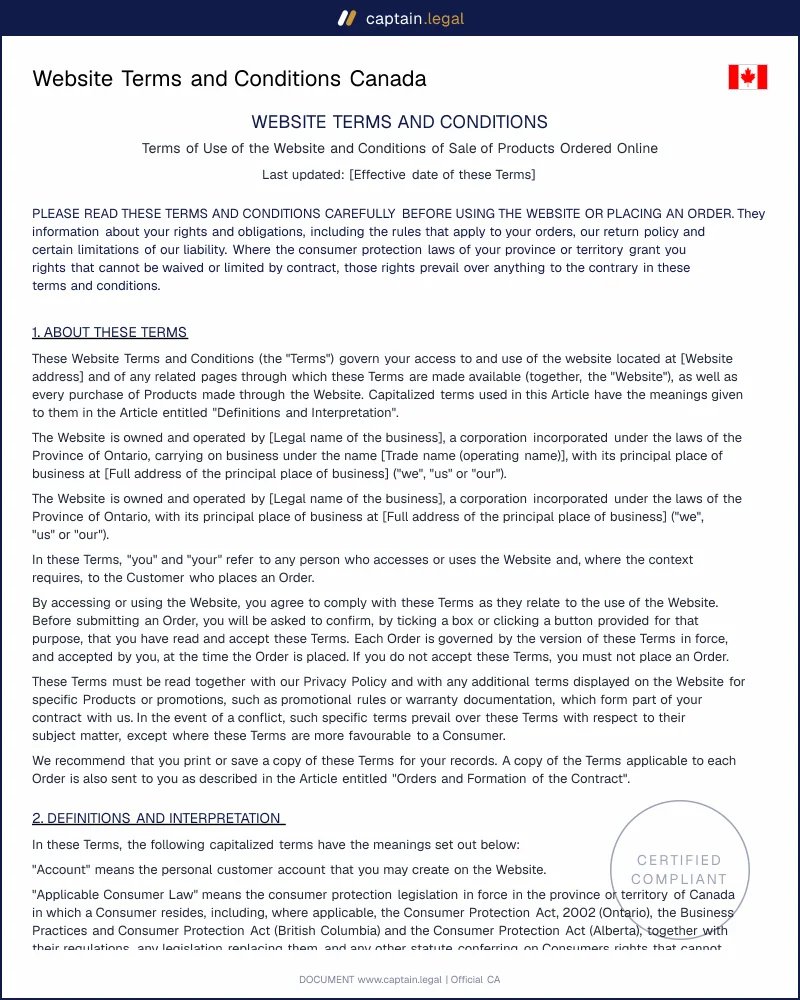
How to fill out these website terms and conditions

You start by entering the legal identity of the business: its registered name, the operating name customers see, the head office address and a contact email that is actually monitored. The form then asks whether you sell to consumers, businesses or both, because that answer switches the liability and dispute resolution clauses between consumer and B2B versions. Next comes the list of provinces you ship to. Selecting Quebec adds the distance contract disclosures, the warranty of good working order notice and the language provision, while Ontario, British Columbia or Alberta insert the matching statutory cancellation wording. You then describe what you sell (physical goods, digital products, services or subscriptions) and set your commercial choices: the return window, final-sale categories, who pays return shipping and how orders are confirmed. Once the answers are complete, the template generates a coherent set of terms with defined terms used consistently throughout. You review the draft, adjust wording in Word if needed, and publish it with a mandatory acceptance checkbox at checkout. Keep a dated copy of each version, because a dispute will turn on the text the customer accepted.

Common mistakes to avoid

The most frequent error is the borrowed template. Merchants copy terms from a large American retailer, complete with a warranty waiver, a liability cap at the order value and mandatory arbitration in Delaware. In Ontario, Quebec and British Columbia, each of those clauses is unenforceable against consumers, and once the Consumer Protection Act, 2023 is in force, merely including such terms will expose an Ontario merchant to penalties. The second mistake is displaying the terms without capturing acceptance: a footer link alone gives the buyer an argument that the terms never formed part of the contract. A related problem is the confirmation email that omits half the prescribed information and so fails the copy requirement.

The costliest mistake is treating the voluntary return policy and the statutory cancellation rights as the same thing. A "no refunds on sale items" rule is a lawful commercial choice, but it cannot defeat a consumer's right to cancel for late delivery or missing disclosure. A retailer operating both an online store and a showroom under a commercial lease for a physical retail location should keep separate return terms for each channel. Finally, many merchants change their terms silently. Unilateral amendments bind existing customers only if the original contract allowed them and the customer received proper notice, and Quebec adds strict conditions on top.

Key takeaways

Consumer rights

Provincial rules set the floor

Online consumer sales are governed province by province, not by a single federal e-commerce code. The template builds around Ontario Consumer Protection Act sections 38 to 40, Quebec CPA section 54.1 and BC BPCPA section 46: required pre-contract disclosure, a clear chance to accept or correct the order, and a copy delivered within 15 days.

Acceptance

Clickwrap beats a footer link

The terms only help if the buyer actually accepts them before ordering. A checkbox or Place order flow shown with the terms is treated as a stronger clickwrap contract, supported by Rudder v. Microsoft. A passive footer link the customer never acknowledges is weaker, leaving returns, payment and shipping clauses harder to enforce.

Liability limits

You cannot contract around statutes

Consumer statutes and Sale of Goods Acts override terms that try to cut back statutory rights. For example, selling goods as is to an Ontario consumer is void under section 9(3) of the Consumer Protection Act, 2002. Pricing also carries risk: mandatory checkout fees can trigger drip pricing concerns under Competition Act sections 52(1.3) and 74.01(1.1).

Frequently Asked Questions

Yes, provided the customer has a real opportunity to read them and expresses acceptance before the order is concluded. Canadian courts have enforced clickwrap terms since Rudder v. Microsoft Corp., and enforceability then depends on content. Clauses that conflict with consumer statutes, such as warranty waivers or mandatory arbitration in Ontario and Quebec, are void even if accepted, while a severability clause keeps the rest of the agreement in force.

You need specific provisions and a French version. The Quebec Consumer Protection Act imposes its own disclosure list for distance contracts, prohibits liability exclusions and arbitration clauses against consumers, and now adds the warranty of good working order for many durable goods. The Charter of the French Language requires the French version of a contract of adhesion to be presented first. Our template inserts the Quebec clauses automatically when you select that province, giving a single structure for both language versions.

Canada has no general cooling-off period for online purchases; statutory rights are triggered by the merchant's failures. If the required disclosure is missing, the consumer can cancel until 7 days after receiving the copy of the agreement. If no copy arrives within 15 days, the window becomes 30 days from the order. If goods are not delivered within 30 days of the promised date, the consumer can also cancel before delivery. The merchant then has 15 days to refund, failing which the card issuer can reverse the charge.

You can, within your voluntary return policy. Canadian law does not oblige merchants to take back conforming goods delivered on time. A restocking fee, a short return window or final-sale categories are lawful if clearly displayed before checkout. What you cannot do is apply those conditions to defective goods or to a statutory cancellation, because the Sale of Goods Acts and consumer statutes take priority.

The document is generated in Word and PDF. The Word file lets you adjust wording and paste the text into your e-commerce platform, while the PDF serves as a dated reference copy proving which version a customer accepted. For related documents, the complete catalogue of Canadian legal templates groups them by area of law.

For business customers, a cap tied to the order value is generally enforceable if it is clear and not unconscionable. For consumers, it depends on the province. Ontario and Quebec prevent merchants from limiting liability for breaches of statutory warranties, and Quebec also prohibits exclusions for the merchant's own acts. Our template drafts the cap with express consumer carve-outs so the whole clause is not struck.

4.6/5

15 verified reviews · 50 000+ downloads

E-commerce Terms Canada: Returns, Refunds & Liability Rules
  • Immediate access to the document
  • PDF + Word download
  • Compliant with 2026 legislation
  • Reviewed by lawyers
Fill in the template
Secure payment
Updated on October 12, 2026

You might also like

Corporate By-Law No. 1 Template Canada
Non-Disclosure Agreement Canada