Personal

Release of Liability & Hold Harmless | 50-State Waiver

Release and hold harmless agreement drafted to Cal. Civ. Code 1668, NY GOL 5-326 and the Texas fair notice rule. Minor-participant clauses, 50 states.
4.6/513 reviews50 000+ downloadsInstant download
Share

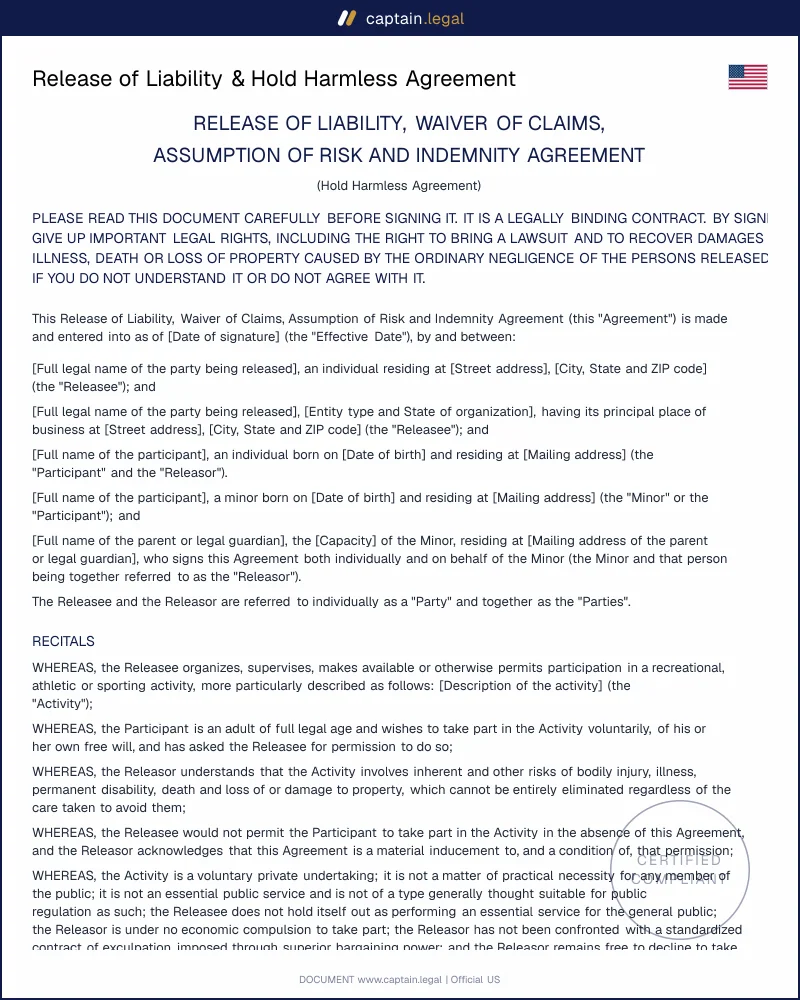
A release of liability and hold harmless agreement is a signed contract in which a participant accepts the risks of an activity and gives up the right to sue the organizer, owner, or instructor if something goes wrong. Race directors, gym operators, equipment lenders, and homeowners who let a neighbor borrow a chainsaw all rely on the same instrument. American courts enforce a release of liability, but only inside limits that shift at the state line. A waiver drafted for a California climbing gym will not survive in Virginia, and a parent signature that binds a child in Colorado is worth nothing in New Jersey. This template is built around those limits: assumption of risk, express negligence language, indemnity, and a minor participant clause keyed to the state you select.

Compliant

2026 Legislation

50,000+ clients

trust us

Affordable

From $4.90 / doc

Secure payment

Instant download

Release of Liability & Hold Harmless | 50-State Waiver

Secure payment

Fill in the template

What is a release of liability and hold harmless agreement?

The document does two separate jobs, and the names get used loosely. The release is prospective: the participant agrees, before anything happens, to give up claims against the provider for injuries arising out of the activity. Courts call this an exculpatory clause, and it works as an affirmative defense once a lawsuit is filed. The hold harmless and indemnity half faces outward instead of inward, obliging the participant to cover the provider's defense costs and any judgment if a third party sues over the participant's own conduct. A cyclist who signs a waiver cannot sue the race organizer for a badly marked turn. If that same cyclist crashes into a spectator, the indemnity paragraph pushes the spectator's claim back onto the cyclist.

Confusion with neighboring documents costs people real money. A settlement release is signed after an injury, in exchange for payment, and discharges a claim that already exists. A covenant not to sue promises silence without technically extinguishing the underlying duty. A bare assumption of risk acknowledgment recites the dangers of an activity but never uses the word release, and more than one court has refused to read a waiver into that recital. Our template carries all three functions in one instrument, each drafted to stand alone, so a judge who strikes one paragraph leaves the rest intact.

2

When do you need this document?

Organized athletic events produce the highest volume of signed waivers in the country. Road races, obstacle courses, adult league games, martial arts gradings, group rides: each puts a participant next to a hazard the organizer partly controls. Fitness businesses come second, and the pattern repeats for a trampoline park, a climbing wall, or a riding stable. A third cluster has nothing to do with sport. Lending physical property creates exposure a standard homeowner policy may not absorb, and pairing the release with a personal property rental agreement drafted to UCC Article 2A covers both the injury risk and the condition in which the equipment comes back.

Unpaid help on a private job site is the fourth situation, and the one most people ignore. A friend who spends a Saturday on your roof has no workers' compensation coverage and no employer to sue, so the whole loss lands on your policy and then on you. Two edge cases deserve attention. Youth programs need a parental release that names the child and tracks the wording the state legislature actually approved; programs that move minors across state lines usually collect a child travel consent form signed by both parents alongside the waiver. The second is the participant who is also on your payroll. Workers' compensation exclusivity overrides any waiver an employee signs.

3

Key clauses included in our template

  • The identification of released parties goes past the business name. Owners, officers, employees, volunteers, sponsors, equipment suppliers, and the landowner hosting the event are all named, because a plaintiff blocked from suing the organizer looks for the next defendant standing nearby.
  • The description of the activity is written narrowly and factually. A release covering "recreational activities" invites an argument that the injury fell outside its scope; naming the discipline, the venue, the equipment, and the date range removes that argument in advance.
  • The assumption of risk recital lists the inherent dangers in plain language, including risks created by other participants. It does independent work in states with recreational activity statutes, where inherent risk remains a defense even after a release is voided.
  • The express negligence release states in specific terms that claims arising from the provider's own negligence are released, set in contrasting type. Both elements are required in Texas under the fair notice doctrine, and neither hurts anywhere else.
  • The hold harmless and indemnity clause shifts third party claims, defense costs, and attorney fees onto the signer, with the drafting discipline you would find in a master services agreement between commercial parties. Gross negligence and willful misconduct are carved out.
  • The minor participant provision adapts to the state you select, because parental authority to waive a child's future claim is statutory in Colorado and Florida, judicially rejected in New Jersey, and unsettled elsewhere.
4

State-specific considerations

California enforces recreational waivers routinely, and the reason is Tunkl. Courts run the six factors, find that a yoga studio or a skydiving operator provides nothing of practical necessity, and let the release stand. The limits come from Civil Code §1668 and from City of Santa Barbara v. Superior Court, 41 Cal.4th 747 (2007), which held that gross negligence cannot be released even in a recreational setting. Courts have voided waivers buried in small type on the back of a registration card.

New York is the hardest state in this group. General Obligations Law §5-326 voids the waiver whenever the signer paid a fee to use a pool, gym, amusement venue, or comparable recreational facility. A New York gym waiver is unenforceable no matter how well it is drafted. The statute has edges. Courts have enforced releases where the payment was an entry fee for a competitive event rather than an admission fee for facility use, and where the venue served an instructional purpose.

Texas looks permissive until the fair notice rules bite. Under Dresser Industries, the release must say in specific terms that it covers the released party's own negligence, and it must be conspicuous: bold, capitals, contrasting color, or a very short document. Compliance is a question of law for the judge, so a defective clause dies on summary judgment.

Florida allows a natural guardian to release a commercial activity provider from claims arising out of the inherent risks of an activity under section 744.301(3) of the Florida Statutes, the legislative answer to Kirton v. Fields, 997 So. 2d 349 (Fla. 2008). That authority stops at inherent risk. A parent cannot sign away a child's claim for the provider's own negligence, and the statute prescribes specific warning language.

Colorado codified parental waivers at section 13-22-107 of the Colorado Revised Statutes after Cooper v. Aspen Skiing Co., 48 P.3d 1229 (Colo. 2002), went the other way. The parent's decision has to be voluntary and informed, a higher bar than the four-factor test in Jones v. Dressel, 623 P.2d 370 (Colo. 1981). Willful and reckless conduct stays outside the release.

Virginia, Louisiana, and Montana sit in a category of their own. Pre-injury releases of personal injury claims are void in all three, so the document keeps value only for property damage, for the indemnity obligation, and as evidence the signer understood the risks it described.

5

How to fill out this release of liability

You begin by choosing the state whose law will govern the agreement, and that single choice reshapes the rest of the form. Select New York and the questionnaire flags the recreational facility problem, then shifts the strategy toward assumption of risk. Select Texas and the negligence language is set in conspicuous type automatically. From there you identify the releasing party and every entity you want protected, then describe the activity with enough specificity that a judge reading it two years later understands what was contemplated.

The minor participant section opens only if a child is involved, and it loads the statutory wording your state requires rather than generic parental language. You add the emergency medical authorization, decide whether the signer must carry insurance, and set the venue for any dispute. The finished agreement downloads in Word and PDF, with signature blocks and a witness line already positioned. Anyone assembling a full set of paperwork for an event or a household will find related forms in the personal legal documents catalog for US users.

6

Common mistakes to avoid

The most expensive error is using one form nationwide. Operators who run events in several states routinely serve a California waiver in Virginia and learn at deposition that the document was void the day it was signed. Close behind is hiding the release in fine print at the bottom of a registration page, which fails the conspicuousness test in Texas and the clarity requirement almost everywhere else. A third recurring failure is the vague activity description: a waiver for "gym use" does not obviously cover the parking lot, the sauna, or a coach driven road trip, and plaintiffs' counsel will argue exactly that.

Two more mistakes come from misunderstanding who is signing. Parents are asked to sign for children in states that never authorized it, producing a form that binds the parent's derivative claims and nothing else. And unpaid helpers are handed a waiver when the real relationship is employment or contracting; if someone works for you, the waiver does not displace workers' compensation, and the arrangement belongs in an independent contractor agreement built for 1099 workers instead. Never ask an injured person to sign a pre-injury release after the fact. Backdating a waiver is fraud.

Key takeaways

Scope

A release and an indemnity are different

This document does two jobs. The release is a pre-injury promise not to sue the organizer, owner, or instructor if you get hurt during the activity. The hold harmless/indemnity clause is separate: it can require the participant to pay defense costs and damages if a third party sues because of the participant’s conduct, like crashing into a spectator at a race.

State law

Enforceability changes at the state line

There is no federal rule for pre-injury waivers, so state contract law and public policy control. Some states reject these releases entirely for personal injury claims (Virginia, Louisiana, and Montana). New York also voids waivers for fee-based pools, gyms, and places of amusement or recreation under GOL 5-326. A form that works in one state can fail fast in another.

Drafting

Clear language and carve-outs drive outcomes

Even where waivers are allowed, courts read exculpatory language narrowly against the party who drafted it, so wording quality matters. The template is built to use express negligence language, assumption of risk, indemnity, and minor-participant terms keyed to the selected state. In California, Civil Code 1668 is the hard stop: you cannot waive fraud, willful injury, or violations of law.

Frequently Asked Questions

Yes, when a competent adult signs it voluntarily and the governing state permits pre-injury waivers. The template follows the standards courts actually apply: clear wording, conspicuous placement of the negligence release, a specific activity description, and a severability clause that saves the rest of the document if one paragraph falls. Enforceability is never absolute. No waiver reaches gross negligence, recklessness, or intentional harm, and Virginia, Louisiana, and Montana void personal injury releases entirely. In those three states the form still carries weight as proof of informed consent.

It depends on the state. Colorado and Florida authorize parental releases by statute, with conditions: Colorado requires the decision to be voluntary and informed, and Florida limits the release to inherent risks rather than provider negligence. Other states, New Jersey among them, hold that a parent cannot bargain away a minor's future claim at all. The template asks where the child lives and where the activity happens, then loads the wording that jurisdiction recognizes. Where parental releases are void, the form still binds the parent's own claims for medical expenses.

Both. The agreement downloads as an editable Word file and as a print ready PDF from the same order. Most organizers use the Word version to add a logo, a bib number field, or a photo consent paragraph, then export a fresh PDF for signature collection. The PDF keeps the conspicuous formatting of the negligence release intact, which matters in Texas and in any state applying a similar fair notice standard. Print it for on site signing or circulate it through an electronic signature service. Related templates sit in the full library of US legal documents.

Sign it before the participant sets foot on the site or touches the equipment, and give the person genuine time to read it. A release signed at the starting line while a marshal waits is more vulnerable to an unconscionability argument than the same form emailed a week earlier. For multi session programs, use a term covering the full season and state the end date on the face of the document. For a single event, tie the release to that date and location. A waiver signed after an injury protects nobody.

No. Every state that enforces exculpatory agreements draws the line at gross negligence, and most also exclude recklessness, willful misconduct, and statutory violations. California confirmed the point in City of Santa Barbara v. Superior Court, and Colorado wrote the carve out into section 13-22-107. A waiver defeats an ordinary negligence claim, such as a wet floor or a poorly marked course. It does nothing against a claim that you knew about a broken anchor bolt and let people climb anyway.

Neither is legally required in any state for an ordinary recreational waiver. A signature and a date form the contract. The template still includes an optional witness line, and two situations make it worth using: when a participant later claims the signature is not theirs, and when a parent signs for a minor and the decision will be examined for whether it was informed. Notarization adds nothing here, though some venues and insurers request it as internal policy. Keep the signed originals for the length of your state's limitation period.

4.6/5

13 verified reviews · 50 000+ downloads

Release of Liability & Hold Harmless | 50-State Waiver
  • Immediate access to the document
  • PDF + Word download
  • Compliant with 2026 legislation
  • Reviewed by lawyers
Fill in the template
Secure payment
Updated on September 3, 2026

You might also like

Temporary Guardianship Agreement for a Minor
Living Will & Advance Directive