Employment

Pregnancy & Lactation Policy | PWFA & PUMP Act Compliant

Accommodation policy drafted to 42 USC 2000gg, 29 CFR Part 1636 and FLSA section 7(r). Covers CA, NY, IL and TX lactation rules. Editable Word and PDF download.
4.7/521 reviews50 000+ downloadsInstant download
Share

A pregnancy and lactation accommodation policy is the written HR document that tells your managers what to do when an employee announces a pregnancy, returns from childbirth with a lifting restriction, or needs to pump milk during a shift. It fixes how a request is received, who reviews it, what documentation may be demanded, and how break time and a private space are provided. Two federal statutes drive the content: the Pregnant Workers Fairness Act and the PUMP for Nursing Mothers Act. Employers with fifteen or more employees need the accommodation half; employers of every size need the lactation half, because the pumping rules reach almost every workplace covered by federal wage law.

Compliant

2026 Legislation

50,000+ clients

trust us

Affordable

From $4.90 / doc

Secure payment

Instant download

Pregnancy & Lactation Policy | PWFA & PUMP Act Compliant

Secure payment

Fill in the template

What is a pregnancy and lactation accommodation policy?

The document is an internal policy, not a contract with an individual employee. It states the company's duty to accommodate known limitations related to pregnancy, childbirth, and related medical conditions, and it fixes the procedure that turns a passing remark into a documented, reviewable file. Most HR teams keep it inside the handbook, though several states require distribution as a standalone policy at hire and after each birth.

Two neighboring documents get confused with it. A disability accommodation policy under the Americans with Disabilities Act answers a different trigger: pregnancy itself is not a disability, but conditions like gestational diabetes or preeclampsia usually are, and one employee can qualify under both statutes at once. A parental leave policy answers how much time off she gets and who pays, which the Pregnant Workers Fairness Act does not address. Our template merges the accommodation procedure with the lactation rules, because a nursing employee who also needs a modified schedule is asserting both sets of rights in one conversation, and split policies produce two inconsistent answers from two managers.

2

When do you need this document?

The first trigger is the disclosure itself. An employee tells a supervisor she is pregnant and mentions, almost in passing, that she can no longer lift the heavy trays. That sentence is a request for accommodation, and the clock starts whether or not anyone fills in a form. Without a policy the supervisor improvises, and improvisation produces the retaliation charge four months later. The second is the return to work, where a postpartum lifting restriction collides with an attendance system that counts every absence.

Lactation drives the third and most litigated scenario. An employee comes back nursing, the only free room has a glass panel in the door, and she ends up pumping in her car. That fails section 7(r) on both space and break time, turning a facilities problem into a wage claim. Applicants count too, so a policy written only for current staff misses the interviewee who asks for a seated assessment. Recovery from miscarriage or stillbirth also falls inside related medical conditions, and managers who treat it as ordinary sick leave deny accommodations the law requires.

3

Key clauses included in our template

  • The scope and coverage clause states the headcount trigger for the accommodation duty, confirms that the lactation provisions apply regardless of company size, and extends coverage to applicants, which most handbook language omits.
  • The request and interactive process clause accepts requests in any form, verbal or written, from the employee or someone acting for her, and names a single accommodation coordinator instead of routing everything through line supervisors. It sets a response target and requires interim accommodation while a request is under review.
  • The medical documentation clause bars documentation for any predictable assessment, restricts inquiries to the condition and the adjustment needed, and prohibits demanding a diagnosis, a specific form, or a named provider.
  • The lactation break and space clause commits to a location that is not a bathroom, shielded from view, free from intrusion, and available as needed, with a seat, a work surface, and electricity. It states the compensation rule and explains how the room is booked without broadcasting a schedule to the floor.
  • The confidentiality and anti-retaliation clause keeps pregnancy and lactation records separate from the personnel file, applying ADA confidentiality standards by analogy, and tracks the statutory bar on retaliation, interference, and coercion. It states that no employee will be forced onto leave when another reasonable accommodation would let her keep working, which is the most common violation of the statute.
4

State-specific considerations

California goes further on both fronts. Government Code section 12945 gives an employee disabled by pregnancy or childbirth up to four months of pregnancy disability leave, separate from any FMLA entitlement, and the Fair Employment and Housing Act reaches employers with five or more employees. Labor Code sections 1030 through 1034 require a lactation room close to the work area, not a bathroom, with a seat, a surface, electricity, and a sink and refrigeration nearby, and make a written policy mandatory. Denying a compliant break triggers premium pay of one hour at the regular rate under section 226.7.

New York imposes paid lactation breaks. Under Labor Law section 206-c, employers of every size must give thirty minutes of paid break time each time an employee reasonably needs to express milk, for up to three years after childbirth, with existing paid break or meal time available for longer sessions. The state lactation policy goes out at hire, annually, and on return from a birth. Labor Law section 196-b separately gives employees twenty hours of paid prenatal leave in any fifty-two week period, from the first day of employment.

Illinois pays for the break as well. The Nursing Mothers in the Workplace Act, at 820 ILCS 260, requires reasonable paid break time for one year after the birth and forbids any reduction in compensation for the time used. The Illinois Human Rights Act, at 775 ILCS 5/2-102, imposes a pregnancy accommodation duty on employers with as few as one employee, listing more frequent breaks, seating, and temporary transfer.

Texas has no state pregnancy accommodation statute layered over federal law, so the PWFA and section 7(r) do the work for private employers. Public employers carry a separate duty under Government Code section 619.005 to adopt a written lactation policy and provide a suitable room. A Texas company that reads the state's lighter regulatory touch as permission to skip the policy still carries full federal exposure.

5

How to fill out this pregnancy and lactation accommodation policy

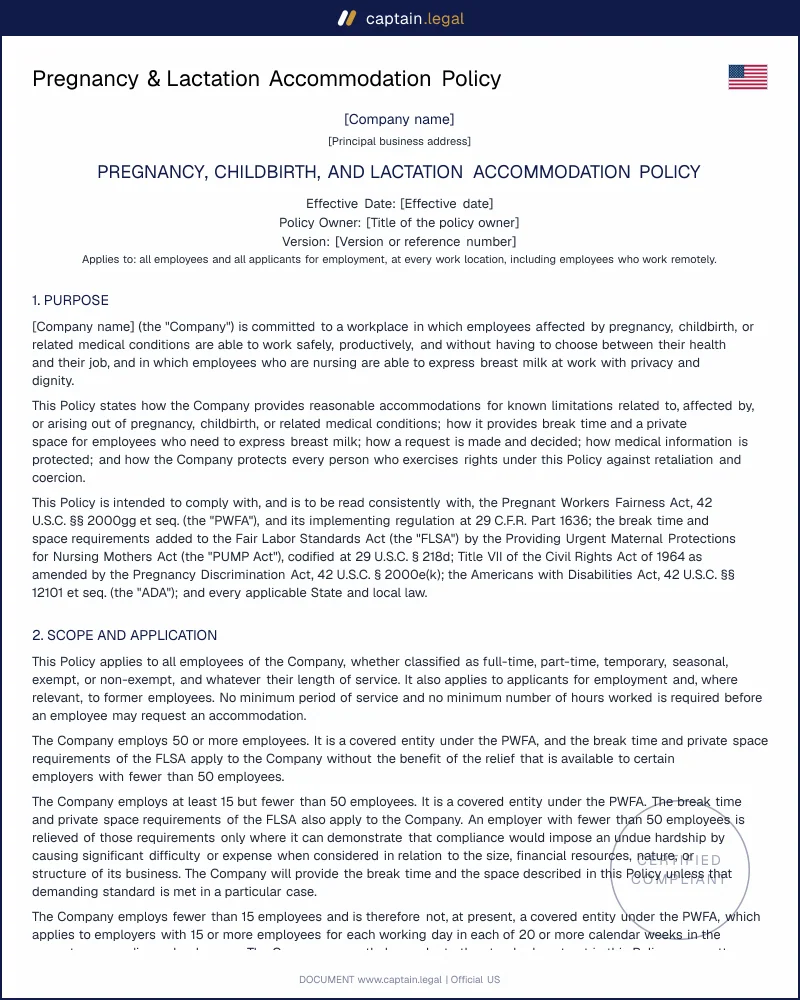
You start by entering the legal entity name, the headcount band, and the primary work states, and the form adjusts from there. Choosing California adds the section 1034 distribution language and the premium pay reference; choosing New York switches the lactation break to thirty minutes paid. You then name the accommodation coordinator by job title rather than by individual, which keeps the policy usable after turnover, and you set the response target for acknowledging a request.

The next screen handles facilities. You describe the lactation space by location, confirm the seat, surface, and outlet, and state how the room is reserved. With multiple sites the template repeats the block, so each location gets its own entry instead of a vague reference to a room at headquarters. The final screens cover documentation limits, recordkeeping, and the internal complaint route. You then download the policy in Word and PDF and fold it into your employee handbook covering all 50 states, or issue it standalone with an acknowledgment. Other employment agreement templates for US employers follow the same state-aware logic.

6

Common mistakes to avoid

The most expensive error is treating a pregnancy request like an ADA request and demanding a doctor's note for everything. Asking for documentation to support a water bottle at a workstation or an extra restroom break is not merely unnecessary under 29 CFR Part 1636, it is evidence of interference. A close second is forced leave: sending a pregnant employee home because nobody could think of an adjustment violates the statute if any reasonable accommodation would have kept her working. Third is the attendance system that keeps counting occurrences during an accommodated absence, which is why this policy has to be reconciled with your workplace attendance policy rather than filed beside it.

Two lactation mistakes recur. Employers designate a room that technically is not a bathroom but has a window, a glass door, or no lock, when the test is whether the space is shielded from view and free from intrusion. And employers dock the pay. If she answers email or watches a queue while pumping, she was never relieved of duty and the time is compensable. Do not treat a lactation break as automatically unpaid, and remember that in New York and Illinois it is paid by statute regardless.

Key takeaways

Coverage

Two federal laws, two different thresholds

This policy combines pregnancy accommodations under the Pregnant Workers Fairness Act and lactation breaks under the PUMP Act, and the coverage rules are not the same. PWFA applies to employers with 15 or more employees. The lactation requirements apply to almost any workplace covered by federal wage law, so many smaller employers still have to provide break time and a compliant pumping space.

Process

Set the intake and documentation rules

The document is an internal HR policy, not an individual contract, and its value is consistency: who receives a request, who reviews it, and what gets documented. Under the EEOC rule at 29 CFR Part 1636, some “predictable assessments” like water, restroom breaks, sitting or standing as needed, and breaks to eat should rarely trigger an undue hardship analysis, and employers should not require medical documentation for them.

Lactation

Break time plus a private space

The PUMP Act amends FLSA section 7(r) (29 U.S.C. 218d) and requires reasonable break time each time an employee needs to express milk for one year after birth. You also must provide a place shielded from view and free from intrusion, and it cannot be a bathroom. Break time is paid if the employee is not fully relieved of duty, and smaller employers may claim undue hardship only under the statute’s conditions.

Frequently Asked Questions

Yes, once you adopt and distribute it. A workplace policy binds the employer as a statement of its own practices, and courts read it alongside the handbook when assessing whether the company met its statutory duties. That cuts both ways: a policy promising a forty-eight hour response makes an eight-week delay harder to defend. The template tracks 42 U.S.C. 2000gg and 29 U.S.C. 218d without over-promising, so the commitments you make are the ones the law already imposes, and it preserves at-will status without creating a contract.

Both formats come with the download. The Word file is the working copy you edit to insert lactation room locations, your coordinator's title, and any benefits you offer beyond the statutory floor. The PDF is the distribution copy for the handbook and the acknowledgment packet. Keep the signed acknowledgments, because proving distribution defeats a claim that an employee never knew how to ask. Related forms sit in the full catalog of US legal templates.

Neither statute sets a numeric deadline, but the EEOC treats unnecessary delay as a denial. An acknowledgment within two business days and a decision inside a week or two is defensible for a straightforward request. For the four predictable assessments the expected turnaround is immediate, since there is no documentation to review. Where a request needs facilities work or a schedule rebuild, grant an interim accommodation while you sort out the permanent one. Silence is the pattern that generates charges.

It applies to you. The small employer provision is an undue hardship defense, not an exemption you claim by counting heads, and you carry the burden of showing that break time or space would cause significant difficulty or expense given your size, finances, and structure. Every employee across every worksite counts toward the fifty, and the defense is read narrowly.

Sometimes, and less often than you think. Documentation may be sought only when it is reasonable to determine whether the limitation relates to pregnancy and what adjustment is needed. That is not reasonable for the four predictable assessments, for an obvious limitation, or when the employee has already given enough information. You may not require a specific form, a named provider, or a diagnosis, and you may not condition the accommodation on an exam by a company physician.

Only if she asks for it, or if no other reasonable accommodation exists without undue hardship. Placing an employee on leave, paid or unpaid, when a modified schedule, a temporary transfer, or suspension of one essential function would let her keep working is a violation, and the statute was written largely to stop the practice. Document the alternatives you weighed and record her own preference in writing. Nonprofit employers face the identical standard and should align this policy with their nonprofit employment contract template.

4.7/5

21 verified reviews · 50 000+ downloads

Pregnancy & Lactation Policy | PWFA & PUMP Act Compliant
  • Immediate access to the document
  • PDF + Word download
  • Compliant with 2026 legislation
  • Reviewed by lawyers
Fill in the template
Secure payment
Updated on September 6, 2026

You might also like

Employee Relocation Repayment Agreement
Training Repayment Agreement Template