
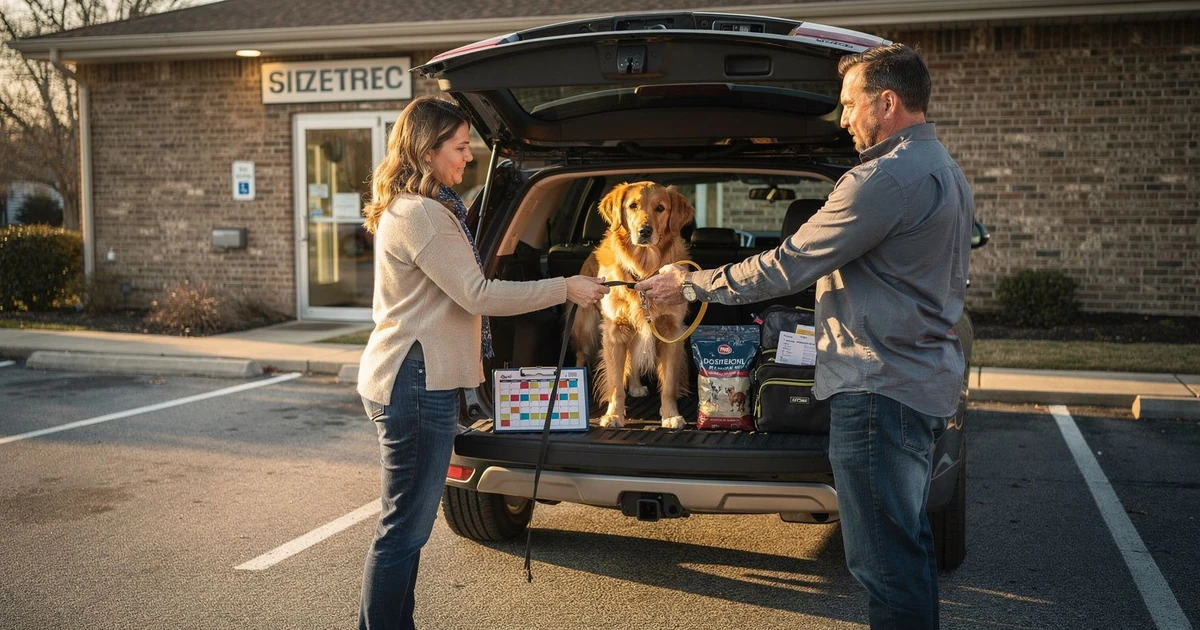
A pet custody agreement is a written contract between two people who share a dog, cat or other companion animal and are about to stop sharing a home. It settles where the animal lives, when the other person sees it, who pays the vet, and who signs the consent form at 2 a.m. when something goes wrong. Most follow a breakup between unmarried partners, a divorce, or the end of a roommate arrangement. The need is real: in most states, a court still treats the family dog as personal property, no different in principle from the couch. This guide explains how state law handles pet ownership, where the rules have changed, and how to draft a pet custody agreement that holds up.
What a pet custody agreement covers
Strictly speaking, nobody holds "custody" of an animal under American law. A dog is owned, and ownership can be sole or shared like any other asset. A pet custody agreement borrows the vocabulary of family law because that is how owners think, but legally it is a contract allocating possession, expenses and decision-making over property both parties have an interest in. A judge enforcing it asks the usual contract questions: what did the parties promise, did both sign, and has one side breached.
The document names a primary custodian, the person with whom the animal lives by default, and gives the other party a defined right of access. It splits routine costs such as food, grooming and preventive care, treats emergency veterinary bills separately, and says who may authorize surgery or euthanasia. The better agreements also cover what breaks informal deals: a move out of state, a landlord who refuses pets, the death of one owner.
It differs from a cohabitation agreement covering shared property and expenses, which may mention the pet in one line but rarely sets a schedule. It also differs from a parenting plan, because no court supervises time with a cat the way it supervises time with a child. For unmarried owners and in most divorces, the pet custody agreement is the only source of shared-access rights the parties will ever have.
Legal framework: property law and the states that changed it
The default rule is simple. Companion animals are personal property, and disputes over them turn on property evidence: who adopted or bought the animal, whose name appears on the adoption contract, the microchip registry and the veterinary file, and who paid the bills. Florida's First District Court of Appeal put it bluntly in Bennett v. Bennett, 655 So. 2d 109 (Fla. 1st DCA 1995), reversing a divorce judgment that gave the former wife visitation with the couple's dog because no authority lets a court grant custody or visitation over personal property. Where that approach holds, a spouse who wants shared time with the animal has to secure it by agreement.
A minority of states have rewritten the rule for divorce. Alaska went first: AS 25.24.160(a)(5), in force since January 2017, lets the court provide for the ownership or joint ownership of an animal, taking its well-being into consideration. Illinois followed on January 1, 2018 with Public Act 100-0422, which added 750 ILCS 5/503(n): when a companion animal is a marital asset, the court allocates sole or joint ownership and must consider the animal's well-being, service animals excepted. California's Family Code §2605, effective January 1, 2019, allows the court to assign sole or joint ownership of a community property pet "taking into consideration the care of the pet animal," and to order one spouse to care for it while the case is pending. New York added a best interest factor to Domestic Relations Law §236(B)(5)(d)(15), signed on October 25, 2021; the enacted text is in the New York Senate record of bill S4248 on companion animals in divorce. Maine applies a well-being test under 19-A M.R.S. §953(10) but must award the animal to a single party, and Delaware's 13 Del. C. §1513(g), approved on June 27, 2023, lists welfare factors such as each spouse's ability to care for the animal.
Every one of these statutes applies to divorcing spouses, and only to animals that are marital or community property. A dog one spouse owned before the wedding, or a cat adopted by an unmarried couple, falls back under ordinary property and contract law.
Who needs a pet custody agreement
Unmarried couples have the most to lose. Without a divorce court, the partner who leaves with the dog has simply taken possession of shared property, and the other must sue in civil court to get it back, often months later. Domestic violence protective orders are the exception: many states let a judge award temporary possession of a pet to the protected party, but that remedy exists for safety, not for ordinary breakups. Partners who bought a house together face the problem twice, and a co-ownership agreement for jointly owned real estate handles the home while the pet custody agreement handles the animal.
Roommates are an underestimated case: two people adopt a cat, both names go on the shelter paperwork, and the end of a lease turns that shared signature into a dispute. Blended families, adult siblings who inherit a parent's dog and older co-owners fit the same pattern. Divorcing spouses at least have a court, but even in California or Illinois the judge decides ownership and will not draft a weekly rotation, a vet-cost threshold or a relocation rule. If you want those terms, you have to write them yourself.
Fitting a pet custody agreement into a divorce settlement
In a divorce, the pet terms usually travel inside or alongside the marital settlement agreement dividing your property and debts. Illinois makes this a requirement in one procedure: under 750 ILCS 5/452, spouses seeking a joint simplified dissolution must certify that they signed a written agreement allocating ownership of and responsibility for any companion animal. Property-only states raise the opposite problem. After Bennett, a family court may refuse to supervise a visitation schedule for a dog, so draft the terms to stand on their own as a contract enforceable in civil court.
Timing matters too. In California, a dissolution cannot become final until six months after service of the summons or the respondent's appearance under Family Code §2339, and interim arrangements tend to harden into the final deal. In New York, the court in Travis v. Murray (N.Y. Sup. Ct. 2013) had already moved past a pure property analysis with a "best for all concerned" hearing before the legislature acted. A pet custody agreement that records who walked the dog and who handled vet visits gives any court concrete facts. If the animal belonged to one spouse before the marriage, say so and state that the parties still choose to share it, because the California and Illinois statutes will not reach that animal.
The clauses that do the real work
Start with identification: name, species, breed, approximate age and microchip number. Agreements that refer to "the dog" in a household with two dogs end up in court. Next comes the residence and schedule clause, covering the default home, the rotation, the handover location and holidays. Keep it mechanical. A promise to "cooperate in good faith on visits" settles nothing.
Money is where most disputes start. Split routine costs by percentage, then set an emergency veterinary threshold: below it, the custodian decides alone and the other party reimburses a share; above it, both must consent unless the other cannot be reached within a fixed window. Pair it with a medical authority clause naming who may sign surgical and end-of-life consents, since that is the first question a clinic asks. A relocation clause should require written notice before either party moves beyond a set distance and give the other a right of first refusal. Then add a housing clause, a survivorship clause, a governing law clause, a mediation step before any lawsuit, and a rule that changes must be written and signed by both.
Drafting your pet custody agreement on Captain.Legal
The pet custody agreement template for all 50 states walks you through these decisions in the order a lawyer would raise them. You first indicate the context, a divorce, a separation between unmarried partners or co-owners living apart, because the recitals and dispute-resolution defaults differ for each. You then select the governing state. For a California couple, the document can track the care-based factors of §2605; in a property-only state, it relies on contract remedies and an express acknowledgment of each party's ownership interest.
The form then collects the animal's details, the default residence, the rotation, the cost split and the emergency threshold, with optional clauses for relocation, survivorship and mediation. Each answer feeds the matching clause, so you are not editing boilerplate written for someone else. The finished document downloads in Word and PDF, ready for both signatures. Keep the Word file: when the animal ages or one of you moves, an amendment is easier to draft from the original.
Mistakes we see in practice
The most damaging mistake is leaving the emergency threshold blank or setting it so low that every ear infection needs two signatures. The first time the dog swallows a sock at night and the other owner does not answer, the clinic waits and the animal pays for it. The second is never updating the microchip registry. A registry entry is evidence of ownership rather than title, but shelters and clinics rely on it, and an outdated one sends a lost dog to the wrong door. Update the registry the week you sign.
The third is informal drift: weekends get swapped by text, the swaps become routine, and a year later the real schedule looks nothing like the signed pet custody agreement. A court enforcing the contract follows the writing, so record changes in a short signed amendment. The fourth is borrowing a template drafted for another state, for example copying California's care language into an agreement governed by Florida law, where it has no statutory hook. The last is assuming a court will split things fairly without paperwork. For an unmarried couple in most states, the court asks whose name is on the adoption contract and stops there.
Frequently asked questions
Is a pet custody agreement legally binding?
Yes, if both parties sign it and each gives something in return, which mutual promises about access and expenses usually satisfy. Outside a divorce, a court enforces it under ordinary contract law and can order the animal returned or award damages for costs incurred. Inside a divorce, the terms are usually folded into the settlement the judge approves, and in the states with pet statutes any issue the spouses leave contested is decided with the animal's welfare in view. No state requires notarization, though a notary seal heads off later claims that a signature was forged.
What format will I receive the agreement in?
The completed document downloads in Word and PDF. The Word version lets you adjust a clause before signing, such as a holiday rule or a feeding instruction for an older animal; the PDF is the clean copy to sign, scan and share. Each party should keep a signed original, and the veterinary clinic named in the agreement should get a copy so its staff know who can authorize treatment. You can generate both files from Captain.Legal's Word and PDF pet sharing contract.
How long do I have to sue if my ex breaks our pet custody agreement?
The deadline is your state's statute of limitations for breach of a written contract, and it varies. California allows four years under Code of Civil Procedure §337(a); New York allows six years under CPLR 213(2). The clock generally starts at the breach, for instance the day the other party refuses a scheduled handover or stops paying a share of vet bills. Waiting is still a mistake even when the legal deadline is distant. Send a written demand within days, because an animal that lives with one person for a year builds a caregiving record that will weigh in that person's favor.
What happens to the pet if one co-owner dies?
Without a clause on the point, the deceased owner's share passes through the estate like any other personal property, and the executor or heirs become your new co-owners. A survivorship provision makes the surviving party sole owner instead. Because pets cannot inherit, align that clause with each party's last will and testament, since a later bequest of the animal to someone else sets up a conflict between the two documents. Owners who want money reserved for the animal's care can add a pet trust, which every state authorizes in some form.
Do these rules cover service animals and emotional support animals?
Not in the same way. Illinois expressly excludes service animals from 750 ILCS 5/503(n), referring to the definition in its Humane Care for Animals Act, and Delaware's companion animal definition also leaves out service and working animals. Under the federal ADA regulations, an emotional support animal is not a service animal, so a dispute over one is handled like any other pet dispute. If the animal serves one party's medical needs, say so in the agreement and give that party primary residence, which avoids a later fight over classification.