Family & Divorce

Child Support Variation | Guidelines s.14 & Divorce Act

Variation agreement built to Federal Child Support Guidelines s.14, Divorce Act s.17 and the 2025 tables. ON, BC, AB filing ready. Word and PDF.
4.5/5— 13 reviews50 000+ downloadsInstant download
Share

A child support variation agreement is a written contract in which two parents update an existing child support order or agreement after a change in income, parenting time or a child's needs. It records the new incomes, the recalculated table amount under the Federal Child Support Guidelines, the revised sharing of special expenses and the date the change takes effect. It lets both parents adjust support without a contested motion to change. Our template is built for the common law provinces and territories and produces a document ready to file with the court or your provincial support enforcement program.

Compliant

2026 Legislation

50,000+ clients

trust us

Affordable

From $4.90 / doc

Secure payment

Instant download

Child Support Variation | Guidelines s.14 & Divorce Act

Secure payment

Fill in the template

What is a child support variation agreement?

In Canadian family law, child support is never truly final. Section 17 of the Divorce Act and the matching provincial statutes allow the amount to be revisited whenever a change in circumstances occurs, and the Guidelines define what that change means. A child support variation agreement is the consensual route to that revision. Instead of one parent serving a motion and both sides filing affidavits, the parents exchange financial disclosure, agree on the new figures and sign a document that replaces the support terms of the earlier order or agreement.

The document is often confused with two neighbours. An original child support agreement for Canadian parents creates the obligation for the first time, usually at separation, and must establish entitlement and the parenting arrangement from scratch. A consent order is what a judge signs after reviewing an agreement; it carries the court's authority but requires a filing. The variation agreement sits between the two. It assumes an obligation already exists, focuses on what has changed since, and is drafted so it can be converted into a consent order or filed for enforcement without being rewritten.

When do you need this document?

The most common trigger is a change in the payor's income. A new job, a promotion, lost overtime or a move to self employment all change the line 15000 figure that drives the table amount. Under Colucci, a payor seeking a decrease must give effective notice and disclose the drop before relief generally starts, so a payor who keeps paying the old figure while quietly earning less rarely recovers the overpayment.

The second scenario is a change in parenting time. When a parent exercises parenting time with a child at least 40 per cent of the time over the course of a year, section 9 of the Guidelines shifts the calculation to a shared parenting analysis. In Contino v. Leonelli-Contino, 2005 SCC 63, the Supreme Court held that the simple set off of the two table amounts is only a starting point, to be adjusted for the actual costs of each household. A renegotiated schedule belongs in an updated parenting plan template for Canadian families.

Other triggers are quieter. A child turns the age of majority and starts university, which allows a departure from the table under section 3(2) and moves tuition into section 7 special expenses. A second child moves in with the other parent, creating split parenting under section 8. The 2025 table update is a trigger on its own for orders made under the 2017 tables. Above the upper income limit of the tables, section 4 gives the court discretion, so the agreement needs a written rationale for the figure chosen.

Key clauses included in our template

  • The recitals identify the existing order or agreement by date, court file number and the support terms being replaced. Enforcement offices will not act on a document that is vague about what it varies.
  • The statement of change in circumstances names the specific ground under section 14 of the Guidelines and the date it occurred. This paragraph is the legal hinge of the whole agreement.
  • The income declaration sets out each parent's Guidelines income under section 16, the tax year relied on and any income imputed under section 19.
  • The table amount clause states the monthly figure, the number of children and the table of the payor's province of residence, as section 3(3) requires. For shared or split arrangements, it shows the calculation rather than just the result.
  • The special expenses clause lists each section 7 expense (childcare, activities, post secondary costs, medical premiums) with each parent's proportional share. It also sets a reimbursement deadline and the receipts required.
  • The effective date and arrears clause fixes when the new amount starts and how any overpayment or shortfall is reconciled. It also confirms that payments remain tax neutral, neither deductible for the payor nor taxable for the recipient.
  • The annual disclosure clause requires both parents to exchange income documents each year and adjust support without a new negotiation.

Provincial considerations

Ontario applies the Child Support Guidelines, O. Reg. 391/97, which mirror the federal text, to claims under the Family Law Act. A variation agreement is a domestic contract, so section 55(1) requires it to be in writing, signed by both parties and witnessed. If support is set by a court order, a private agreement does not replace that order on its own. You must file a consent motion to change (Form 15C, or Form 15D where only child support changes) so the Family Responsibility Office enforces the new figure instead of the old one. A contract originally filed under section 35 should be varied and filed the same way.

British Columbia governs child support agreements under sections 148 and 150 of the Family Law Act, and court orders under section 152. A written agreement can be filed in the Provincial Court or the Supreme Court and enforced as if it were an order, and the Family Maintenance Enforcement Program collects from the filed version. In Davey v. Davey, 2022 BCCA 232, the Court of Appeal confirmed that a court replacing agreed terms under section 148(3) can do so retroactively, which makes thorough disclosure your best protection.

Alberta uses the Alberta Child Support Guidelines, Alta Reg 147/2005, which adopt the federal tables in Schedule 1, and its Family Law Act imposes child support on every parent regardless of marital status. The Child Support Recalculation Program updates eligible orders annually from tax information, and the Maintenance Enforcement Program only enforces the amount on its file.

Quebec is the exception, and our template is not designed for it. Support is calculated under the Civil Code of Québec and the Regulation respecting the determination of child support payments, not the federal tables, and payments are collected by Revenu Québec. Quebec parents use the provincial calculation form and either court homologation or the administrative adjustment service (SARPA). Related separation and spousal support documents sit among our Canadian family and divorce templates.

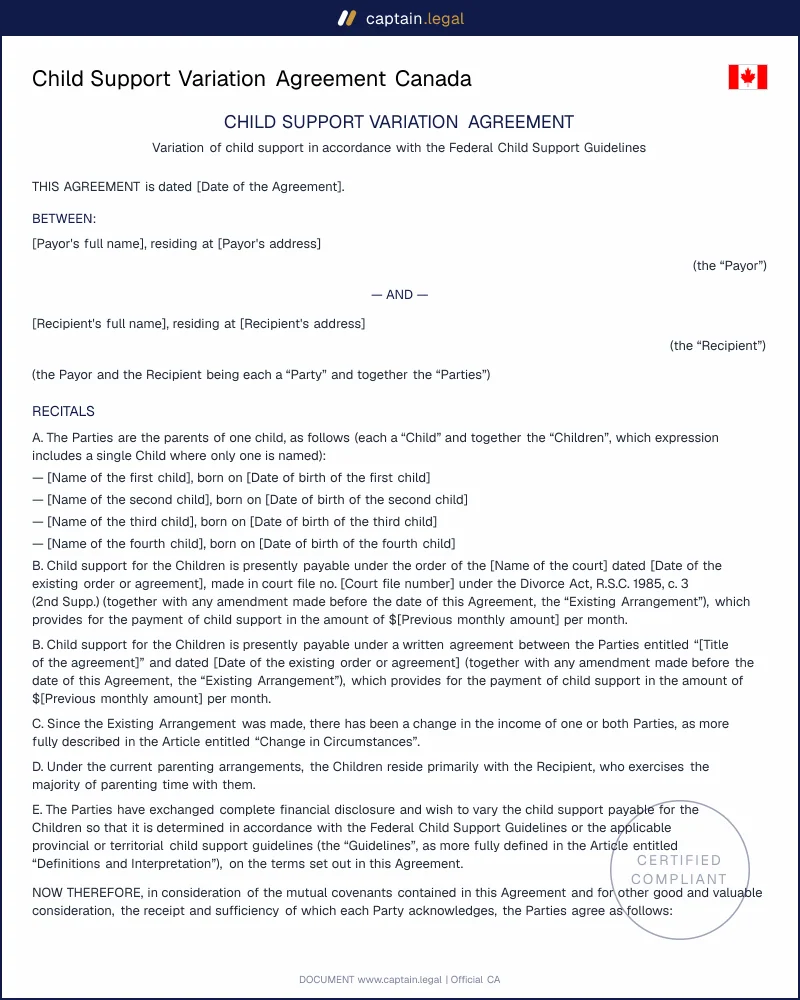
How to fill out this child support variation agreement

You start by identifying the document being changed: its date, the court and file number if there is one, and the monthly amount currently paid. You then select the ground for variation, and the questions adapt. An income change opens the income declaration, a parenting time change opens the shared or split calculation fields, and a table update opens a comparison between the 2017 and 2025 figures.

Next comes the income data. Each parent enters line 15000 income from the latest notice of assessment, plus any Schedule III adjustments. If you have not yet exchanged documents, complete a financial disclosure statement under Guidelines section 21 first, because an agreement signed without disclosure is the easiest kind to set aside. You then enter the new table amount from the Justice Canada lookup tool, list the section 7 expenses and set the effective date. The final screen generates the witnessed signature blocks, the independent legal advice acknowledgment and the disclosure schedule.

Common mistakes to avoid

The most expensive mistake is signing the agreement and never filing it. Parents agree on a lower amount, the payor pays it, and two years later the enforcement office claims arrears under the original order. The second is agreeing to a figure below the tables without explaining why. Courts routinely set aside variations where one parent accepted far less than the table amount in exchange for something else, since child support is the right of the child and cannot be bargained away by the parents. Any departure must be stated and justified in the document.

Disclosure is the third trap. A payor who reports salary but leaves out bonuses, holding company dividends or rental income has signed an agreement that can be reopened, often retroactively, the moment the other parent finds out. The fourth is the wrong effective date: parents pick the signature date when the change happened months earlier. The last is omitting the annual review clause, so every future raise restarts the negotiation.

Key takeaways

LEGAL TEST

A real change opens the door

A variation agreement depends on a change in circumstances, not simply second thoughts. Under Divorce Act section 17 and Federal Child Support Guidelines section 14, a new income, different parenting time or changed child needs can justify revised support. If the table amount would now be different, the parents have a legal basis to replace the earlier support terms.

2025 TABLES

New tables do not update automatically

The Federal Child Support Tables in force from October 1, 2025 can change the calculated amount, but they do not automatically rewrite an existing order or agreement. Parents still need a variation, consent order or court process. For retroactive changes, cases such as Colucci tie the likely start date to effective notice, usually capped at three years before formal notice.

FILING READY

Agreement first, enforcement after filing

The agreement records the updated incomes, table amount, special expenses and start date so it can be filed with the court or a provincial support enforcement program. That practical step matters in Ontario, British Columbia, Alberta and other common law provinces because a signed deal is easier to enforce when it is clear, current and aligned with the Guidelines.

Frequently Asked Questions

Yes, provided it meets your province's formal requirements and rests on proper disclosure. In Ontario, section 55(1) of the Family Law Act requires a domestic contract to be written, signed and witnessed, and British Columbia allows a written agreement to be filed and enforced under section 148. A court can still replace a term that is unreasonable having regard to the guidelines. An agreement that follows the tables, explains any departure and attaches the income documents relied on is very difficult to challenge.

You receive the agreement in both Word and PDF. The Word file lets you adjust wording or correct a figure before signing. The PDF is the clean version you print, sign in front of a witness and file with the court or your enforcement program.

Under section 25 of the Federal Child Support Guidelines, a parent subject to a child support order must provide updated income documents within 30 days of a written request, or 60 days if living outside Canada and the United States. The request can be made no more than once a year. If it is ignored, a court can impute income and award costs against the non disclosing parent. Our template builds that annual exchange into the agreement itself, so it also applies when no court order exists.

No. The updated tables came into force on October 1, 2025 but do not rewrite orders or agreements made before that date. If the new table amount for your income differs from what you pay, that difference counts as a change in circumstances under section 14, and either parent can propose a variation. Quebec parents are not affected, since Quebec uses its own model.

Independent legal advice is not a statutory requirement in most provinces, but it is strongly recommended, and the template includes an acknowledgment block for it. It makes a later claim of pressure or misunderstanding much harder to sustain. If you are also updating a will or a guardianship document after the change, see our Canadian personal and family legal forms.

The agreement only works by consent. If negotiation fails, the parent seeking the change must bring a motion to change or an application to vary, supported by financial disclosure. Where an order qualifies, an administrative recalculation service in provinces such as Ontario or Alberta may also update the amount from tax information. A written proposal with the draft agreement still counts as effective notice under Colucci. For any other paperwork you may need, browse the complete catalogue of Canadian legal documents.

4.5/5

13 verified reviews · 50 000+ downloads

Child Support Variation | Guidelines s.14 & Divorce Act
  • Immediate access to the document
  • PDF + Word download
  • Compliant with 2026 legislation
  • Reviewed by lawyers
Fill in the template
Secure payment
Updated on October 9, 2026

You might also like

Divorce Application Canada
Cohabitation Agreement Canada