Employment

Resignation Letter Canada | ESA Notice & SCC Case Law

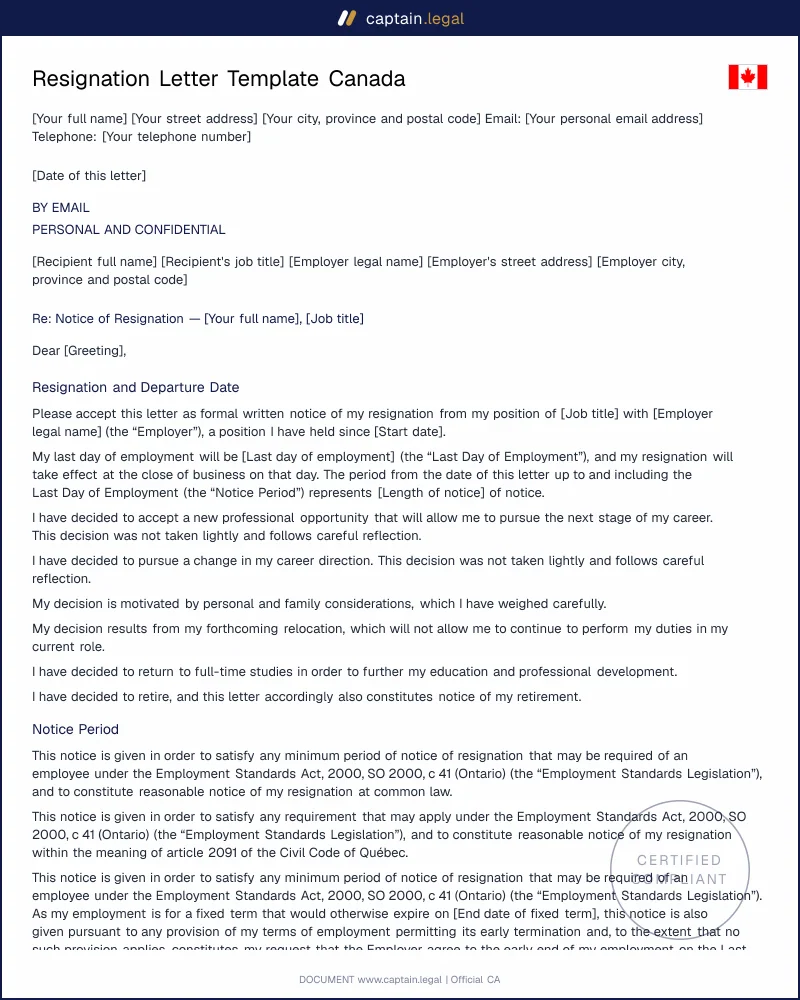
Resignation letter drafted to Alberta ESC s.58, Manitoba s.62.1, Ontario ESA and RBC v. Merrill Lynch (2008 SCC 54). Correct notice, final pay, ROE.
4.7/5— 18 reviews50 000+ downloadsInstant download
Share

A resignation letter is the written notice an employee gives to end their employment voluntarily, stating the last working day, the notice period being honoured and how outstanding entitlements will be settled. The letter fixes the date used to calculate your final pay, accrued vacation pay and Record of Employment. It also proves that you met any notice obligation under provincial Employment Standards legislation, the Canada Labour Code or your own contract. Our template is drafted for employees in the common-law provinces and in federally regulated workplaces who want to leave on clean terms and keep every entitlement they have earned.

Compliant

2026 Legislation

50,000+ clients

trust us

Affordable

From $4.90 / doc

Secure payment

Instant download

Resignation Letter Canada | ESA Notice & SCC Case Law

Secure payment

Fill in the template

What is a resignation letter in Canada?

Legally, a resignation is a unilateral act: it takes effect when it is communicated, and the employer's acceptance is not a condition of its validity. Canadian courts nonetheless insist that the intention to resign be clear and unequivocal, assessed both subjectively and objectively. In Kieran v. Ingram Micro Inc. (2004, Ontario Court of Appeal), words spoken in the heat of an argument were not treated as a resignation because a reasonable observer would not have understood them as a final decision. A signed letter with a fixed last day removes that ambiguity. The flip side is that withdrawal becomes difficult: once the employer has accepted the resignation or relied on it, for example by recruiting a replacement, you can only retract it with the employer's consent.

The document is often confused with neighbouring ones. A termination letter issued by the employer triggers statutory termination pay and, very often, common-law reasonable notice; a resignation triggers neither. An employee who leaves because the employer unilaterally cut pay or demoted them is not resigning at all but alleging constructive dismissal, the doctrine restated in Potter v. New Brunswick Legal Aid Services Commission, 2015 SCC 10. Signing a resignation letter in that situation can seriously weaken a constructive dismissal claim, so the choice of document matters before the first line is written.

When do you need a resignation letter?

The most common situation is a new job offer accepted elsewhere, and the letter lets you plan a start date that does not overlap with your notice period. The second is retirement, where the letter coordinates with pension administrators and group benefits carriers. Employees also resign to relocate with a spouse or to care for a family member, both recognised as just cause under section 29(c) of the Employment Insurance Act, so the reason deserves accurate wording. Leaving to return to full-time studies is different: federal case law generally refuses just cause in that situation. Another frequent case is the move to self-employment, where a salaried professional who resigns to work as a contractor will sign a consulting agreement with new clients and needs the resignation to land cleanly first.

Three edge cases deserve attention. An employee on a fixed-term contract who leaves before the term expires may be liable for the employer's losses unless the contract contains an early termination clause, so the letter should reference that clause expressly. An employee resigning during or just after a protected leave should confirm in writing that the decision is voluntary. And a unionized employee must check the collective agreement first, because its resignation and seniority provisions govern and disputes go to grievance arbitration rather than to court.

Key clauses included in our template

  • The identification of the parties names the employer's legal entity rather than its trade name, along with the person receiving the notice. The Record of Employment and final pay come from that legal employer, not the brand.
  • The statement of resignation is drafted to be clear and unequivocal. It meets the Kieran v. Ingram Micro standard and leaves no room for later debate about whether you really meant to leave.
  • The notice period and last working day are calculated from your province, your length of service and any contractual clause. The template applies the longer of the statutory and contractual periods, since giving too little notice is what creates liability.
  • The handover commitment describes how files, credentials, client relationships and pending work will be transferred. It is strong evidence of good faith if the employer later alleges losses.
  • The return of company property clause lists laptops, phones, access cards and confidential documents. It sets a return date and asks for written confirmation of receipt.
  • The final pay and entitlements clause asks the employer to confirm outstanding wages, accrued vacation pay, overtime and commissions. It also requests the Record of Employment, which must be issued within the deadlines in section 19 of the Employment Insurance Regulations.
  • The continuing obligations acknowledgement confirms that confidentiality survives the departure and refers, where relevant, to any non-compete and non-solicitation covenants you signed.

Provincial considerations

Ontario imposes no general statutory notice on a resigning employee, so the common-law duty and your contract govern. The Employment Standards Act, 2000 does protect your final pay: under section 11(5), wages owed are due by the later of seven days after employment ends or the next regular pay day, and accrued vacation pay is payable on departure. One statutory exception exists: an employee who has received notice of a mass termination may resign early on one or two weeks' written notice without losing statutory termination pay. Ontario has also banned most non-compete clauses through section 67.2, introduced by the Working for Workers Act, 2021, which shapes the continuing obligations clause for Ontario employees.

British Columbia follows a similar model. The Employment Standards Act requires no notice from the employee, but section 18(2) obliges the employer to pay all wages owing within six days after the employee terminates the employment. Under section 63(3)(c), no compensation for length of service is owed when the employee is the one who ends the relationship. The common-law duty of reasonable notice applies in full.

Alberta is stricter. Section 58 requires written notice of at least one week for an employee employed more than 90 days but less than two years, and two weeks after two years, subject to limited exceptions such as personal health or safety concerns. Under section 59, an employer who wants you gone before the end of a valid notice period must pay wages for the remainder, capped at the employer notice the Code would require. Section 10 then sets short deadlines for final earnings, tied to whether proper notice was given. An Alberta resignation given only verbally does not satisfy section 58.

Manitoba sets its own thresholds in section 62.1 of The Employment Standards Code: no notice in the first 30 days, one week from 30 days to one year of service, and two weeks after one year. Many employees wrongly assume the Alberta thresholds apply nationally. Employees in every province can browse the full range of Canadian employment and HR templates for related documents.

How to fill out this resignation letter

You start by selecting your province, or the federal option if your employer is federally regulated. That single choice adjusts the statutory notice references, the final pay deadline cited in the letter and the vacation pay wording. You then enter your start date and the date you intend to deliver the letter, and the form calculates the minimum notice from your length of service. A longer contractual period replaces the statutory figure. The next screen covers the practical side of leaving: whether you offer a handover period, who takes over your files and which company property you hold. You can state a short reason for leaving or keep the letter neutral, and the guidance explains when a reason helps, such as an employment insurance claim based on relocation.

You then review the full letter on screen and adjust any sentence. Date the letter on the day you actually deliver it, because the notice period runs from receipt, not from drafting. Deliver it by email with a read receipt or by hand against a signed copy.

Common mistakes to avoid

The most expensive mistake is giving less notice than required because you assumed two weeks is a universal rule. It is not. Alberta counts from 90 days of service, Manitoba from 30 days, and your contract may require a month or more for a management role. The second mistake is writing an ambiguous letter. A phrase like "I may need to leave by the end of the month" is not a resignation, and leaves you exposed whether the employer treats it as one or ignores it.

Employees also routinely forget to request their final entitlements in writing, although unpaid commissions and accrued vacation pay are far easier to recover when the letter itself asked for them. Another error is resigning in reaction to a demotion, a pay cut or a toxic workplace without first taking advice. A resignation letter can be read as acceptance of the change, which undermines a constructive dismissal claim and, through section 30 of the Employment Insurance Act, can cost you benefits. Finally, many departing employees copy client lists or internal files to a personal drive on their last day. That breaches confidentiality obligations even without a non-compete, and it turns an orderly exit into litigation.

Key takeaways

Clear intent

Make your exit unmistakable

A resignation takes effect when it is communicated; the employer does not need to accept it first. The wording must show a clear and unequivocal intention to leave, especially after disputes or heated conversations. A signed letter with a fixed last day reduces the risk seen in Kieran v. Ingram Micro Inc.

Notice

Match notice to your jurisdiction

Notice rules depend on your workplace and province. The Canada Labour Code, Ontario ESA and B.C. ESA impose no general statutory notice on resigning employees, while Alberta ESC s.58 and Manitoba ESC s.62.1 do. Even where a statute is silent, RBC v. Merrill Lynch confirms a common-law duty to give reasonable notice unless a clear employment contract clause replaces it.

Final records

Keep entitlements from slipping

Your letter anchors the dates payroll and HR use to close the file: last working day, notice period, final pay, accrued vacation pay and Record of Employment. Do not use it for a constructive dismissal situation, such as a unilateral pay cut or demotion. Under Potter, that choice can weaken the claim before it starts.

Frequently Asked Questions

Yes. A clear resignation takes effect once it is communicated to the employer, and after the employer has accepted it or relied on it you can only withdraw it with the employer's agreement. In Alberta, written form is a legal requirement under section 58 of the Employment Standards Code. Elsewhere, the letter is the best evidence you can produce if the departure is later disputed before an employment standards officer or a court.

Not everywhere, and sometimes more. Alberta requires one week after 90 days and two weeks after two years. Manitoba requires one week after 30 days and two weeks after one year. Ontario, British Columbia and the Canada Labour Code set no statutory minimum, but the common law still expects reasonable notice, typically two to four weeks and longer for senior roles. A longer period in your employment contract always prevails over these minimums.

The employer can release you early, but usually not for free. In Alberta, section 59 of the Employment Standards Code requires payment for the remainder of a valid notice period, capped at the employer notice the Code would require. In Ontario and the other common-law provinces, cutting short your notice is generally treated as a termination, which can trigger statutory termination pay for the period lost.

Generally not, because section 30 of the Employment Insurance Act disqualifies claimants who leave voluntarily without just cause. Section 29(c) recognises situations such as harassment, accompanying a spouse or dependent child to another residence, caring for a family member, unsafe working conditions, significant changes to wages or duties and reasonable assurance of another job in the immediate future. If one of those grounds applies, state it accurately in your letter, because Service Canada will compare it with the reason your employer records on the Record of Employment.

Each jurisdiction sets its own deadline. In Ontario, section 11(5) of the Employment Standards Act, 2000 requires payment by the later of seven days after the last day or the next regular pay day. In British Columbia, the employer has six days after an employee resigns, and in Alberta section 10 of the Employment Standards Code sets a short deadline that depends on whether you gave proper notice. Your letter should ask the employer to confirm the payment date and the issuance of the Record of Employment.

You receive the finished letter in Word and PDF. Word lets you adjust the date or a sentence; the PDF is the version to email or sign for delivery. For your next role, the complete catalogue of Canadian legal templates covers employment, business and personal matters.

4.7/5

18 verified reviews · 50 000+ downloads

Resignation Letter Canada | ESA Notice & SCC Case Law
  • Immediate access to the document
  • PDF + Word download
  • Compliant with 2026 legislation
  • Reviewed by lawyers
Fill in the template
Secure payment
Updated on October 12, 2026

You might also like

Termination Letter Template Canada
Full and Final Release Agreement Canada