
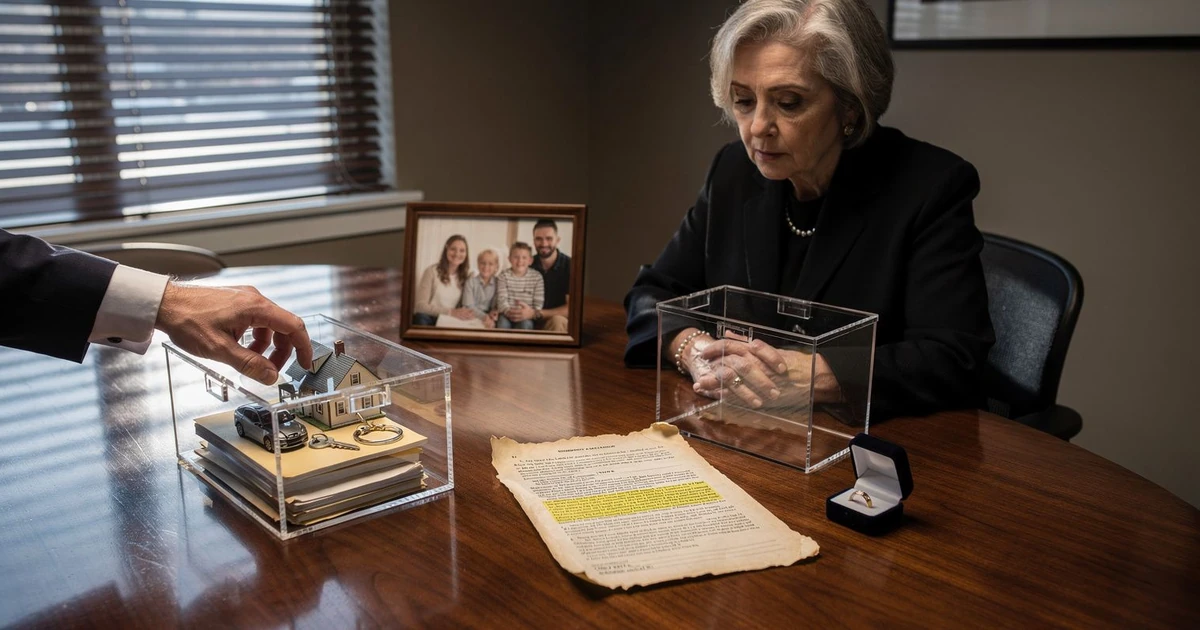
A will written in 2004 can be perfectly valid and still produce a result its author would have hated. The reason is usually one sentence buried in the dispositive provisions: a formula clause that funds a trust with the largest amount that can pass free of federal estate tax. That sentence had a modest number attached to it when the ink dried. Since January 1, 2026, it carries $15 million. For families whose entire net worth sits below that figure, the arithmetic now pushes everything toward the children or into a bypass trust and leaves the surviving spouse with nothing outright. This guide covers how the federal estate tax exemption reached that level, why old formula language misfires, and what a review should look for.
What a formula clause does when the estate tax exemption moves
A formula clause is a funding instruction expressed as a variable rather than a number. Instead of naming a dollar amount, the drafter writes something like "an amount equal to the largest sum that can pass free of federal estate tax," and directs that amount into a credit shelter trust (also called a bypass trust, family trust, or B trust). Whatever is left over falls into the marital share, which qualifies for the unlimited marital deduction under Internal Revenue Code § 2056 and defers tax until the second death.
The design was elegant for its era. In 2004 the exclusion was $1.5 million, so a couple with $4 million saw $1.5 million shelter the children and $2.5 million support the widow. Nobody had to guess at future values. The formula recalculated itself at death.
That is exactly the problem. A formula clause has no ceiling and no common sense. It reads the exclusion in force on the date of death and funds accordingly. When the exclusion was small the marital share absorbed most of the estate. Now the same words, unchanged, hand the credit shelter trust everything an ordinary estate contains. Practitioners see this constantly on documents drafted between 2001 and 2018, a period when the exclusion climbed from $675,000 to $11.18 million. The drafter is often retired. The testator is dead. The surviving spouse learns the plan at the reading, and the plan does not include her.
Legal framework: the permanent $15 million exclusion
The federal transfer tax system runs on a unified credit expressed as a basic exclusion amount under § 2010(c)(3). The Tax Cuts and Jobs Act of 2017 doubled the base from $5 million to $10 million and indexed it, producing an exclusion of $13,990,000 for decedents dying in 2025. That doubling was temporary and carried a sunset that would have cut the figure roughly in half.
Public Law 119-21, signed on July 4, 2025, changed the structure rather than extending it. The Act struck the sunset provision and rewrote the base amount in § 2010(c)(3) to $15,000,000, effective for estates of decedents dying and gifts made after December 31, 2025, with inflation indexing running from a 2025 base year. The IRS confirmed the figure in Rev. Proc. 2025-32, and its published summary of the change is worth reading directly on the IRS page on estate and gift tax updates. The top rate stays at 40% under § 2001(c), and the annual exclusion for present-interest gifts sits at $19,000 per recipient under § 2503(b).
Two related figures moved with it. The generation-skipping transfer exemption under § 2631(c) tracks the basic exclusion amount and also reaches $15 million, though it remains non-portable between spouses. Portability itself was untouched: a surviving spouse may still claim the deceased spousal unused exclusion by electing under § 2010(c)(5)(A) on a timely Form 706. Permanence here means the absence of a scheduled expiration, not immunity from future legislation. Congress can lower the exclusion at any time, and a plan built on the assumption that it never will is a plan with a single point of failure.
How a will drafted in 2004 can disinherit a spouse today
Run the numbers on a typical estate. A husband dies in 2026 owning $5 million in his own name: a house, retirement accounts, brokerage assets, and an interest in a small business. His will directs the maximum amount passing free of federal estate tax into a trust for his children from a prior marriage, with the residue to a marital trust for his wife.
The maximum amount passing free of federal estate tax is now $15 million. The estate is $5 million. The entire estate funds the children's trust and the marital trust receives nothing. No tax is owed, the executor has followed the document precisely, and the surviving spouse has been cut out by a clause her husband signed specifically to take care of her.
The mirror image is just as common and only slightly less damaging. Where the credit shelter trust names the surviving spouse as a discretionary beneficiary alongside the children, she is not disinherited outright, but she loses outright ownership. Every distribution then depends on a trustee's discretion, an ascertainable standard, and often a co-trustee who happens to be a stepchild. A spouse who expected to control the family assets instead has to ask permission for them. Where the trustee is a bank, she also inherits an administration burden that the estate size never justified. A properly drafted last will and testament template built for all 50 states avoids the whole problem by stating dispositions the way the testator actually thinks about them.
Blended families and the second-marriage trap
The risk concentrates in second marriages. In a first-marriage family with joint children, overfunding a credit shelter trust is an inconvenience: the money still ends up with the same people, one generation later, after some friction over distributions. In a blended family the beneficiaries genuinely diverge, and the formula picks a winner.
Stepchildren who receive an unexpected windfall have no incentive to agree to a fix, and the surviving spouse's leverage is limited to her statutory rights. Most states give her a right of election against the estate, commonly one-third of the probate or augmented estate, or a percentage scaled to the length of the marriage in Uniform Probate Code jurisdictions. Those rights are real but slow, adversarial, and capped well below what a marital trust would have delivered. The election also runs on a short clock, and missing it forfeits the claim entirely. Couples who mean to protect a survivor without litigating for it are usually better served by a marital agreement signed during the marriage, such as a postnuptial agreement covering property and inheritance rights, paired with dispositive language that says what it means.
Basis step-up and the states that ignore the federal number
Overfunding costs money even where nobody is disinherited. Property included in a decedent's gross estate takes a new basis equal to date-of-death value under § 1014. Assets in a marital trust are included in the surviving spouse's estate and step up a second time when she dies. Assets sitting in a credit shelter trust are deliberately excluded from her estate, so they never receive that second adjustment. On appreciated real estate or long-held stock, the capital gains cost of a needless bypass trust can exceed the estate tax it was designed to avoid, particularly when the estate was never going to owe federal tax in the first place.
State law cuts the other way. Roughly a dozen states plus the District of Columbia impose their own estate tax with thresholds far below the federal figure, Oregon at $1 million and Massachusetts at $2 million among the lowest, and most of them do not offer portability. In those states a credit shelter trust still earns its keep, just not at $15 million. The right answer is often a capped formula or a disclaimer trust that lets the survivor decide after the first death. Where a closely held business is in the mix, the governing document matters as much as the will, since an LLC operating agreement setting out transfer of membership interests can override what the estate plan assumed about who ends up holding the company.
Rewriting the will or restating the trust
Fixing a stale formula does not require rebuilding a plan from scratch. In most cases the estate is now comfortably under the federal threshold and the tax-driven architecture is simply unnecessary. A new will that leaves property outright to the surviving spouse, with a straightforward remainder to children, achieves what the old formula was trying to approximate.
On Captain.Legal the flow starts with your state of residence, since testamentary formalities and spousal rights vary, then moves through marital status, children from current and prior relationships, specific bequests, residuary beneficiaries, and the appointment of an executor and guardian. The generated will names beneficiaries and shares in plain terms rather than tying them to a moving tax figure, and the execution instructions reflect your state's witness and self-proving affidavit requirements. Where probate avoidance matters more than tax planning, a revocable living trust template drafted for all 50 states can be restated the same way, replacing the old A-B split with a single-fund design. Both documents download in Word and PDF, so an attorney can review the draft and mark it up before signing.
Where these plans go wrong
The most frequent error is treating an old will as maintenance-free because it was drafted by a competent lawyer. It was competent for the law of its day. Close behind is the funding mismatch: a couple retitles assets into joint tenancy or names the spouse as beneficiary on every retirement account, which leaves the probate estate too small for the formula to work as intended, then wonders why the trust is empty.
A third mistake is skipping the portability election on the first death because no tax was owed. The election requires a Form 706 filed within nine months, and while Rev. Proc. 2022-32 allows a simplified late filing up to the fifth anniversary of death for estates not otherwise required to file, families routinely discover the omission after that window closes. Fourth, people amend the will and forget the revocable trust, or vice versa, leaving two documents with contradictory formulas. Finally, some try to correct an overfunded trust through informal family agreement. A qualified disclaimer under § 2518 has to be in writing, irrevocable, made within nine months of death, and executed before the disclaimant accepts any benefit. Handshake fixes after distribution has started create gift tax exposure for the very people trying to help.
Frequently asked questions
Does the $15 million estate tax exemption mean I no longer need a trust?
Not necessarily, though the tax reason for one has largely disappeared for most families. With a $15 million exclusion per person and portability available to married couples, federal estate tax now reaches a very small share of estates. Trusts still earn their place for probate avoidance, incapacity planning, privacy, creditor protection for beneficiaries, second-marriage arrangements, and state estate tax in the dozen or so jurisdictions that impose one. What changed is the default: a bypass trust built solely to capture the federal exclusion is now more likely to cost basis step-up than to save tax.
How do I know whether my will contains a formula clause?
Look at the article that divides the estate after debts and expenses. If it refers to an amount that can pass free of federal estate tax, to the applicable exclusion amount, to the unified credit, or to the maximum amount not subject to tax, you have a formula clause. Language naming a specific dollar figure or a percentage of the residue is not a formula clause and does not carry the same risk. Wills and revocable trusts signed before 2018 are the ones most likely to contain the problematic version, since the exclusion has risen sharply since then.
Is a will created online legally valid?
Yes, provided it satisfies your state's execution requirements. Validity in every state depends on the signing ceremony rather than on who typed the document: the testator must have capacity, sign voluntarily, and sign in the presence of the required number of witnesses, generally two disinterested adults. Many states also allow a self-proving affidavit before a notary, which spares the witnesses from testifying later in probate. A template that reflects your state's rules and is executed correctly stands on the same footing as one prepared in a law office.
What file format do I get, and can my attorney edit it?
Documents download in both Word and PDF. The PDF is the print-ready version for signing, and the Word file is the working copy, which matters if an attorney wants to adjust language, add a specific bequest, or tailor a trustee provision before execution. Keeping the editable file also makes future updates simpler, since a change in marriage, residence, or family circumstances usually calls for a fresh signing rather than a handwritten amendment on the original.
What is the deadline for the portability election?
Form 706 is due nine months after the date of death, extendable by six months with a timely filed extension request. For estates below the filing threshold that only need the return in order to elect portability, Rev. Proc. 2022-32 provides a simplified path allowing the return up to the fifth anniversary of death, with a specific statement required at the top of the form. Miss both windows and the deceased spouse's unused exclusion is gone permanently, which can matter enormously if the survivor's estate later grows or if Congress lowers the exclusion.
Can a surviving spouse who was cut out by a formula clause do anything?
Yes, though the routes are imperfect. The children or trustee can execute a qualified disclaimer within nine months, redirecting the excess to the marital share. Many states permit a non-judicial settlement agreement among all interested parties, or a court petition to reform the instrument to reflect the testator's demonstrated intent. Failing that, the surviving spouse can assert her statutory elective share. All of these are slower and costlier than a fifteen-minute review during life. Couples entering a marriage with children from a prior relationship often address the issue in advance through a prenuptial agreement setting out inheritance and property rights.
How often should an estate plan be reviewed?
Every three to five years, and immediately after any marriage, divorce, birth, death of a named beneficiary, move to another state, or significant change in the value or composition of assets. A change in the exclusion amount belongs on that list too, since the plans most exposed are the ones whose drafting assumptions have quietly stopped holding. A review does not always end in a new document, but reading the formula against today's figure takes minutes, and the alternative is discovering the mismatch when nobody can fix it. Other core documents worth revisiting at the same time are collected in the personal legal documents section.