Personal

Deed of Separation Ireland: Template in Word and PDF

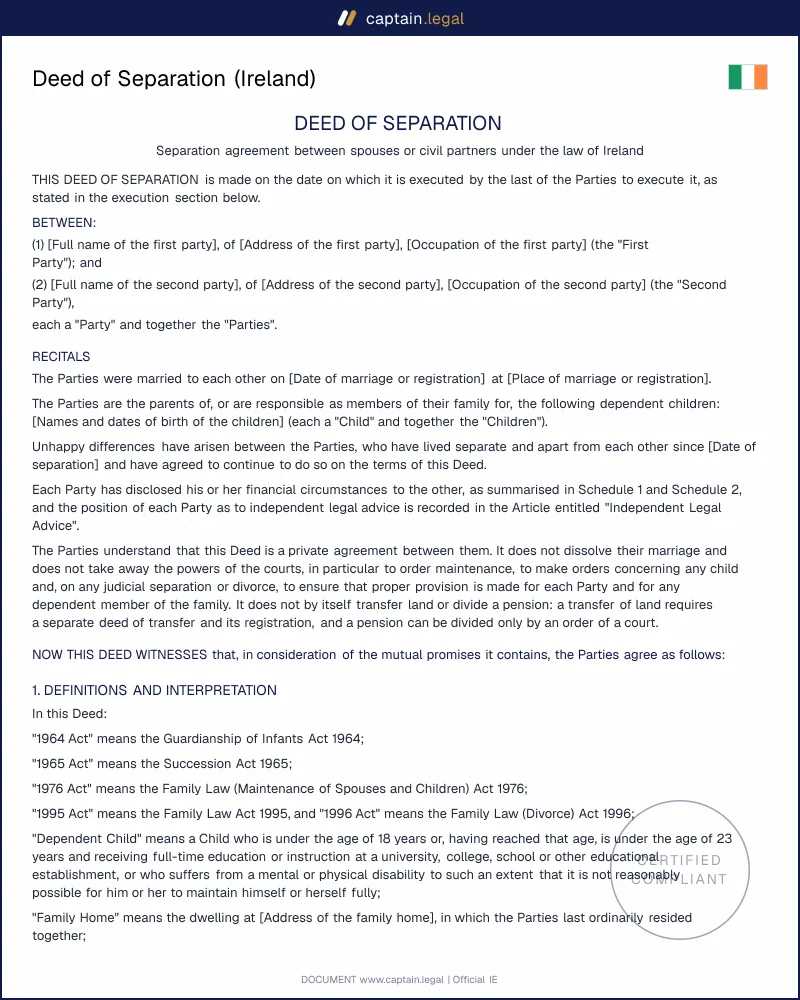
Irish deed of separation for spouses and civil partners: joint custody and access, child and spousal maintenance, family home buy-out or sale, pensions, succession waivers, financial disclosure schedules and solicitor's certificates, ready to be made a rule of court.
4.8/5— 18 reviewsIrish law 2026Instant download
Share

A deed of separation in Ireland is the written agreement two spouses, or two civil partners, sign when they decide to live apart without going to court. It records who keeps the family home, what maintenance is paid, how the children divide their time and whether each of you gives up inheritance rights against the other. It suits couples who can still negotiate, and who want certainty now rather than a contested judicial separation. Signed and witnessed as a deed, it is a binding contract that can later be made a rule of court for enforcement. This template follows Irish family law only, for spouses and civil partners.

Compliant

2026 Legislation

50,000+ clients

trust us

Affordable

From €4.90 / doc

Secure payment

Instant download

Deed of Separation Ireland: Template in Word and PDF

Secure payment

Fill in the template

What is a deed of separation in Ireland?

The deed is a private contract, executed as a deed under section 64 of the Land and Conveyancing Law Reform Act 2009: each party signs in front of a witness who attests the signature. It does not end the marriage or the civil partnership, which is why neither of you can remarry until a decree of divorce, dissolution or nullity is granted. What it does is fix, in one document, the arrangements a judge would otherwise impose: residence and access for the children, child maintenance, maintenance between you, the family home, savings, debts, pensions and succession rights.

People use "separation agreement" and "deed of separation" interchangeably. An informal agreement can be a signed letter; a deed adds witnessed signatures, which makes later denial much harder. It also differs from a judicial separation, a court decree under the Judicial Separation and Family Law Reform Act 1989, on which the judge can also make property and pension orders. Unmarried couples sit outside this framework: their tool is a cohabitants' agreement under the 2010 Act, which has its own validity rules.

When do you need this document?

The classic case is a couple who separated months ago and now need the mortgage, the joint account and the school costs pinned down. A second trigger is a buy-out: one spouse keeps the house and pays the other for his or her share, which only works if the agreement, the mortgage release and the deed of transfer run on the same timetable. Some couples sign mainly to avoid the cost of a judicial separation; others treat the deed as the first step towards divorce, because it records the date you began living apart and gives the divorce court a ready settlement. Older couples often sign one for succession, so each can leave the estate to the children rather than to a spouse they no longer live with.

There are edge cases. Spouses still under the same roof can be living apart in law if they no longer live together as a couple. Where the home is rented, the deed allocates the rent and the deposit, and whoever stays may need a new letting from our Irish tenancy and property documents. A deed is the wrong tool where one spouse hides assets or where there is a risk of violence: safety and barring orders under the Domestic Violence Act 2018 stay available whatever the deed says.

Key clauses included in our template

The deed of separation template for Ireland opens with recitals stating the marriage or registration, the children and the date you began living apart, then definitions and the separation and non-molestation clauses. Article 4 explains what a private agreement can and cannot do, and each party consents in advance to an application to make it a rule of court. Financial disclosure goes into two schedules, one per party, because a deed signed on the basis of hidden assets can be set aside.

  • For the children, joint custody is the base, with the main residence placed with either parent or shared equally, an access schedule you write yourselves, and a travel clause requiring written consent and fourteen days' notice for holidays abroad.
  • Child maintenance runs while each child is a dependent child, meaning under 18, under 23 in full-time education or unable to self-support through disability, with optional CSO Consumer Price Index indexation.
  • Maintenance between you can be nil, weekly or monthly, or a single lump sum, and the tax wording follows section 1025 of the Taxes Consolidation Act 1997 (section 1031J for civil partners).
  • Your choice for the home sets the clause: a buy-out with a completion date and mortgage release, an immediate sale, a deferred sale, or a rented home.
  • Pension wording either confirms each keeps his or her own scheme or records an agreed pension adjustment order to be sought later.

The closing articles cover succession, reconciliation, variation, mediation and governing law, with a solicitor's certificate in Schedule 3 for each party who took advice. More family paperwork sits in our Irish personal legal documents category.

How to fill out this deed of separation

You start by stating whether you are married or civil partners, because the form then switches the statutes cited throughout the deed, then give the date of the marriage or registration and the date you began living apart. Names, addresses with Eircodes and occupations come next. If you have dependent children, you list them, choose where they mainly live and describe the weekly routine and the holidays in your own words.

Money comes next, in the order a solicitor would use: child maintenance, maintenance between you, the family home, then other assets and debts. Amounts are typed as text, so you can write "per week for each child" or "per month in total". The home step asks one question and adapts the rest: a buy-out needs a sum and a completion date, a deferred sale needs the event that ends the right to stay. Pensions, inheritance rights and legal advice come next, and the two disclosure schedules close the questionnaire. The preview updates as you answer, and the downloaded deed goes to your solicitor before anyone signs.


Common mistakes to avoid

The most expensive mistake is treating the deed as if it moved the house. The keeping spouse still needs a deed of transfer registered with Tailte Éireann, and the lender must agree to release the departing spouse from the mortgage; a buy-out date set without checking the bank's timeline is a common reason these clauses fail. The second mistake is assuming the pension has been split because the deed says half each. Trustees act only on a court order, so the deed records the intention and the order comes later.

Couples also undervalue disclosure. A schedule that says "some savings" invites a challenge, while attached statements make a deed of separation in Ireland hard to attack for non-disclosure. Signing without independent advice is another trap: one solicitor cannot act for both of you, and a judge asked to make the deed a rule of court looks closely at an unadvised signature. Finally, people renounce succession rights and forget the will. An old will in favour of the spouse still operates, so update yours with our last will and testament template for Ireland once the deed is signed.

Key takeaways

MAINTENANCE ACT 1976

A private deed that a court can enforce

A deed of separation is a contract, not a court order. Under section 8 of the Family Law (Maintenance of Spouses and Children) Act 1976, the High Court or Circuit Court can make it a rule of court if it is fair and protects both spouses and the children, and its maintenance terms are then enforced like a maintenance order. Section 27 voids any clause excluding maintenance, so either spouse may still apply to court.

PENSIONS AND LAND

Pensions and land need a further step

The deed cannot split a pension: trustees act only on a pension adjustment order made by a court under section 12 of the Family Law Act 1995, section 17 of the Family Law (Divorce) Act 1996 or section 121 of the 2010 Act. It records the agreed split for that later order. Nor does it transfer the family home: a buy-out needs a separate deed of transfer registered with Tailte Éireann and the lender's release of the departing spouse.

SUCCESSION ACT S.113

Giving up the legal right share in writing

A separated spouse or civil partner generally keeps a legal right to one-third or one-half of the other's estate until divorce or dissolution, whatever a will says. Section 113 (spouses) and section 113A (civil partners) of the Succession Act 1965 allow this right to be renounced in writing, which the template does if you both choose it. Each party then makes a new will, because an old will in favour of the other still operates.

Frequently Asked Questions

It is a binding contract once both parties sign it as a deed in front of a witness. If one of you stops paying, the other can sue on the contract, and if the deed has been made a rule of court under section 8 of the 1976 Act (section 48 of the 2010 Act for civil partners), arrears can be enforced like a maintenance order, including by attachment of earnings. What the deed cannot do is take away the court's powers: either of you may still apply for maintenance, and a divorce court must check that proper provision exists, although it must have regard to the deed.

Strongly recommended. The law does not make advice a condition of validity for a deed between spouses, unlike a cohabitants' agreement, but a court asked to make the deed a rule of court checks that it is fair and reasonable. A party who signed without advice can later argue pressure or misunderstanding. The template records whether both, one or neither of you took advice, and Schedule 3 holds the solicitor's certificate. Each solicitor should also check the disclosure schedules, where most later disputes start.

Completing the questionnaire usually takes 30 to 45 minutes once you have your figures, and you can download the deed straight away. The real timetable depends on your solicitors' review, often one to three weeks, and on the lender if the home is being transferred. For a later divorce the clock is separate: you must have lived apart for at least two years during the previous three, counted from the date you actually separated, which the deed records, and not from the date you sign it.

No. Pension trustees divide benefits only under a pension adjustment order made by a court on judicial separation, divorce or, for civil partners, dissolution. The template lets you record the split you agreed and commits both of you to ask the court for that order later. In the meantime the member should not transfer or draw down the benefit without consent. When applying to make the deed a rule of court, either party can also seek an order protecting benefits that normally require you to live together.

Under the deed, a holiday abroad needs the other parent's written consent and fourteen days' notice of the dates, destination, accommodation and contact details, and consent cannot be unreasonably refused. Taking a child under 16 out of the State without the consent of each parent or guardian can be an offence under section 16 of the Non-Fatal Offences Against the Person Act 1997. Airlines and border officers sometimes ask for proof, so many families pair the deed with a signed child travel consent letter for trips abroad each time.

Yes. The finished deed downloads as a Word file you can edit with your solicitor and as a PDF ready to print for signing. Print two originals, sign both in front of an independent adult witness, and keep one each with the disclosure schedules attached. If related paperwork follows, such as a will or a power of attorney, the full catalogue of Irish legal templates has them ready in the same formats.

You can, by a written variation signed by both of you, ideally after fresh advice. The deed also obliges you to review maintenance in good faith after a significant change, such as a job loss, illness or a child ceasing to be dependent, though not more than once a year unless the change is exceptional. If you cannot agree, either of you can apply to court for maintenance; the judge decides on current needs and means but takes the deed into account.

4.8/5

18 verified reviews · Irish law 2026

Deed of Separation Ireland: Template in Word and PDF
  • Immediate access to the document
  • PDF + Word download
  • Compliant with 2026 legislation
  • Reviewed by lawyers
Fill in the template
Secure payment
Updated on November 6, 2026

You might also like

IOU / Acknowledgement of Debt (Ireland)
Statutory Declaration (Ireland)