Personal

Child Travel Consent Letter Ireland (Travelling with One Parent or Without Parents)

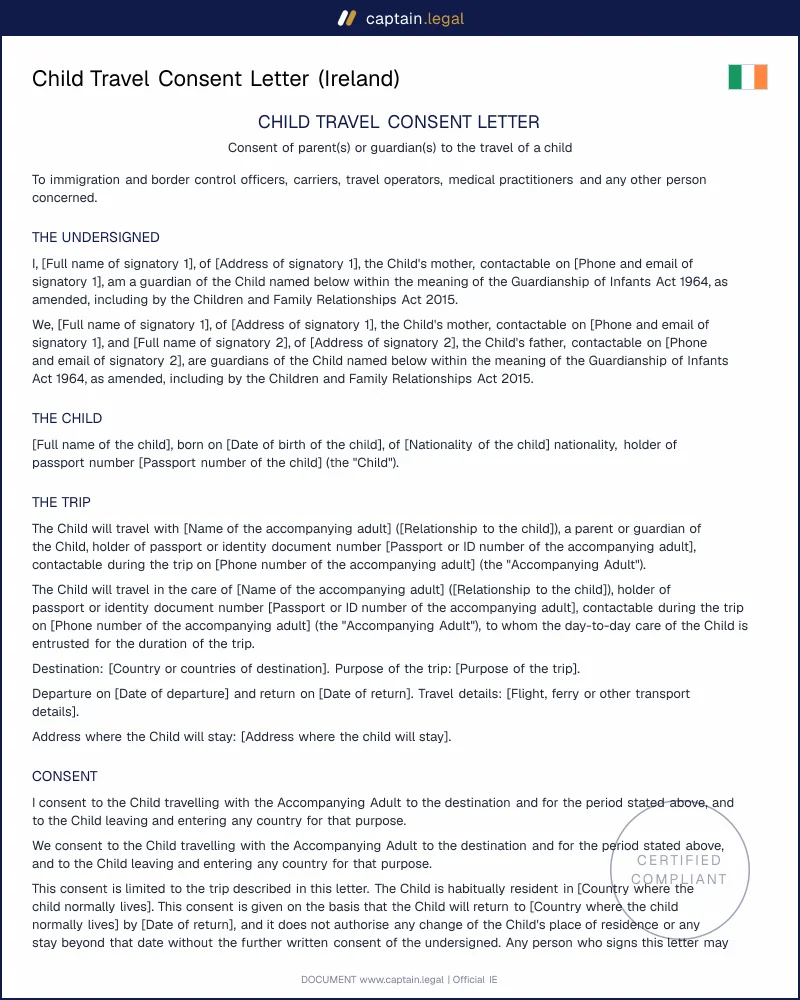
Give written consent for a child under 18 to travel abroad with one parent or another adult: guardians, child and passport, trip dates, return date, optional emergency medical authority, court orders and an optional witness or certification block.
4.6/5— 32 reviews50 000+ downloadsInstant download
Share

A child travel consent letter is a short signed statement in which a parent or guardian agrees that a child under 18 may travel abroad without them, either with the other parent or in the care of another adult such as a grandparent, a teacher or a family friend. Irish families use it for sun holidays with one parent, school tours, sports trips and summer visits to relatives overseas. Nothing in Irish law obliges you to carry one, but immigration officers, airlines and foreign border staff regularly ask for evidence of parental consent, and a clear letter with the right documents attached usually settles the question at the desk.

Compliant

2026 Legislation

50,000+ clients

trust us

Affordable

From €4.90 / doc

Secure payment

Instant download

Child Travel Consent Letter Ireland (Travelling with One Parent or Without Parents)

Secure payment

Fill in the template

When do you need this document?

Separated parents meet the most common case every summer: a child flying with one parent while the other stays at home. Irish immigration guidance says an officer may seek evidence of consent from the child's other parent, and the same question comes up at Spanish, Portuguese and American borders, particularly where the child and the travelling parent have different surnames. Married couples who simply travel at different times face it too.

Trips with no parent at all form the second group. Grandparents taking a grandchild to see family in Poland or Nigeria, an aunt bringing a teenager to New York, a family friend driving to France on the ferry: in each case both guardians should normally sign, and the adult needs authority to deal with a doctor if something goes wrong. School tours and sports trips run by clubs and youth groups belong here too, and organisations that already keep constitutions and governance documents for Irish clubs and charities often ask parents for a consent letter as part of their trip pack.

Two edge cases come up regularly. Irish visa guidance asks for an original consent letter from both parents when a child travels into Ireland with an adult who is not a parent, and some embassies want it notarised. And a trip within the Common Travel Area to the UK, Northern Ireland included, is still a trip out of the State for the purposes of section 16, even though there is no checkpoint on the land border.

Key clauses included in our template

Our template keeps the letter to one or two pages, because officers read short documents. The clauses that do the real work are these:

  • Each signatory confirms that he or she is a guardian of the child within the meaning of the 1964 Act, and gives an address, a phone number and an email that work from abroad.
  • Identification of the trip is precise: destination, purpose, departure and return dates, flight or ferry details and the address where the child will stay.
  • Where the consent ends matters most in a dispute. The letter states the country of the child's habitual residence, says the child will return there by the return date and excludes any change of residence, which closes off the argument that a parent agreed to a move.
  • An optional medical clause authorises the accompanying adult to consent to urgent medical, surgical or dental treatment if you cannot be reached; the alternative wording reserves those decisions to you.
  • Declarations cover the agreement of every other guardian and of anyone else whose consent the law requires, any court order on custody or access, and a list of documents to carry, including a death certificate where a parent has died.

A trip that turns into a longer stay needs different paperwork altogether, from a fresh agreement between the parents to tenancy documents for the family home if the household moves.

Common mistakes to avoid

Most often, the weak letter we see is signed by the travelling parent. That proves nothing: the officer wants the consent of the parent who is not there. A close second is a letter without a working phone number, or with an Irish mobile written without the +353 prefix, so the officer cannot reach anyone. Parents also forget the attachments. A consent letter on its own is weak; with a copy of the signatory's passport showing the signature and the child's birth certificate, it is persuasive.

Open-ended wording causes the most serious trouble. "I consent to my son travelling with his mother" with no dates or destination can be read as consent to a relocation, which is exactly what the Hague Convention cases turn on. Always fix a return date and the country the child returns to. Unmarried fathers sometimes sign as "father" without being a guardian, and that signature adds little if the mother is the only guardian. Finally, check the destination's rules early: some countries ask for a notarised or apostilled letter, and booking a notary the day before departure rarely works.

Key takeaways

CRIMINAL LAW

Each parent and guardian must agree to an under-16 trip

Under section 16 of the Non-Fatal Offences against the Person Act 1997, a parent or guardian who takes a child under 16 out of the State in breach of a court order, or without the consent of each parent, guardian or person granted custody, commits an offence unless a court consents. Trips to the UK and Northern Ireland count. The letter records the consent of the guardian at home and confirms that the others whose consent is required agree.

GUARDIANSHIP

Not every parent is a guardian under Irish law

Married parents are joint guardians and the mother is always a guardian. An unmarried father usually becomes a guardian by statutory declaration with the mother, by court order, or after living with her for 12 consecutive months after 18 January 2016, including 3 consecutive months with the child after the birth. The person signing must be a guardian, otherwise the letter proves little. The form explains who qualifies before anyone signs.

HAGUE CONVENTION

Limit the consent to one trip and a return date

The Hague Convention, given the force of law by the Child Abduction and Enforcement of Custody Orders Act 1991, lets a court refuse to return a child where the other parent consented to the removal. Open wording such as "I consent to my son travelling with his mother" can be read as agreement to a move. The letter fixes the destination, the return date and the country of habitual residence, and excludes any change of residence.

Frequently Asked Questions

It is a valid written consent given by a guardian, and it carries real weight as evidence, but it is not a contract and no Irish law requires it. Its value lies in proving that each guardian agreed to the trip, which answers the question an immigration officer may ask and protects the travelling parent against any suggestion of an offence under section 16 of the 1997 Act. It does not override a court order, and the parent who signed it can withdraw it. For countries with strict rules, a certified signature adds weight.

Irish law does not require either. Many families sign at the kitchen table and attach a copy of their passport, which is enough for most European trips. Some countries, carriers and embassies want the signature certified by a solicitor, notary public, commissioner for oaths or peace commissioner (the same people who take a statutory declaration and other personal documents), and an apostille usually means going to a notary first. The optional block covers signatures made together; where two parents sign separately, the letter adds a line for a second witness.

Irish and British citizens move freely within the Common Travel Area and there is no checkpoint at the border with Northern Ireland, but immigration officers at Irish airports and ports still check identity, and carriers set their own rules. A child travelling with one parent or with a grandparent is exactly the situation in which a short letter saves time. The criminal rule on taking a child under 16 out of the State covers Belfast and London as much as Spain. Carry the letter, the child's passport or accepted identification, and a birth certificate if surnames differ.

Sign it once the flights and accommodation are booked, usually two to four weeks before departure, so the dates and transport details are final. A letter signed months earlier often carries the wrong flight numbers, and officers notice. The consent ends on the return date written in the letter. If the return is delayed, prepare a new letter, because an expired letter is worth little at a border. If you are travelling with the child yourself, book the time off early with our annual leave and parent's leave requests for Irish employees.

Start with a conversation about dates, destination and contact during the trip, because most refusals are about trust rather than the trip itself. If that fails, a guardian can apply under section 11 of the Guardianship of Infants Act 1964 for a court direction on any question affecting the child's welfare, usually in the District Court, and travel abroad is a common subject of these applications. Travelling without the other guardian's consent or a court order risks an offence where the child is under 16.

Yes. Once you click Finish, the letter is available as a PDF ready to print and sign and as an editable Word file, so you can correct a flight number or a date without starting again. Print one signed original for the accompanying adult and keep a scanned copy on their phone. Officers abroad generally prefer paper, but a clear scan has helped families whose bags went missing. Keep the attachments together: passport copies, the birth certificate and any court order.

4.6/5

32 verified reviews · 50 000+ downloads

Child Travel Consent Letter Ireland (Travelling with One Parent or Without Parents)
  • Immediate access to the document
  • PDF + Word download
  • Compliant with 2026 legislation
  • Reviewed by lawyers
Fill in the template
Secure payment
Updated on November 3, 2026

You might also like

Private Loan Agreement (Ireland)
Statutory Declaration (Ireland)