Personal

Car Sale Agreement Ireland (Private Sale)

Sell or buy a used car privately in Ireland with a signed contract: VIN and mileage, NCT status, seller's declarations on finance, accidents and faults, full payment or deposit, change of ownership on the VRC, motor tax and insurance, and a handover receipt.
4.9/5— 18 reviews50 000+ downloadsInstant download
Share

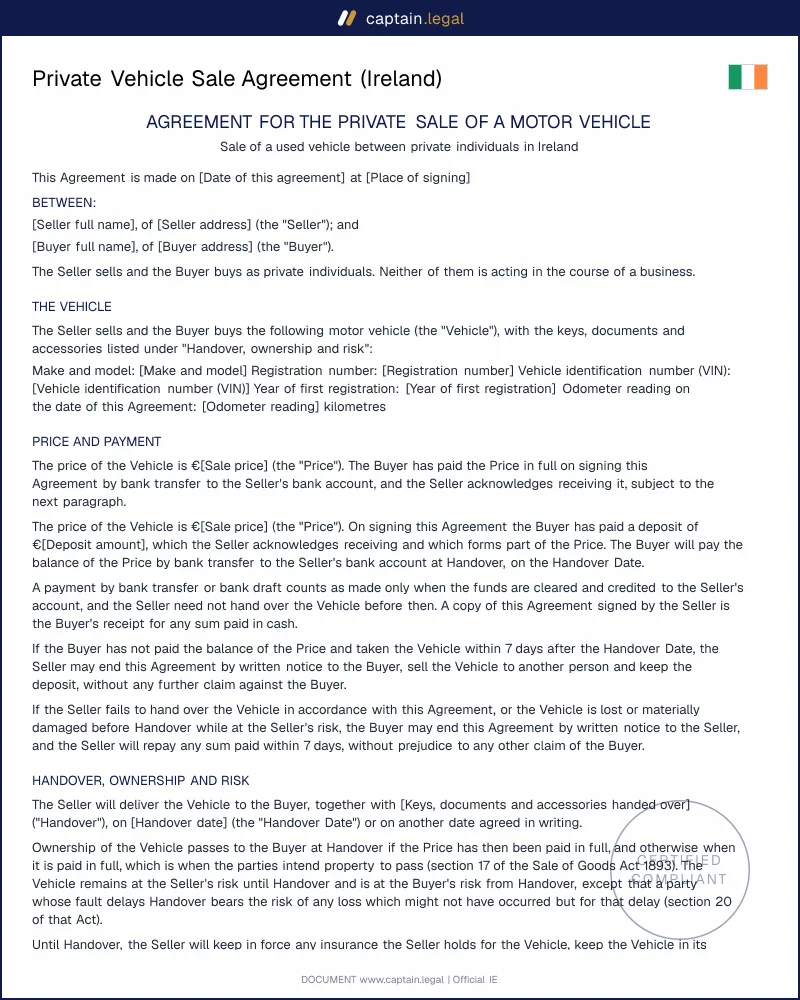
A car sale agreement is the written contract that records the private sale of a used car between two individuals in Ireland: who sells, who buys, which vehicle, at what price and on what terms. This template is built for private sellers and buyers who meet through an online listing or a family connection, and who want more than a handshake and a cash receipt. It identifies the car by registration number and VIN, records the odometer reading and the NCT status, sets out the seller's declarations on finance and condition, and organises the change of ownership on the Vehicle Registration Certificate so that fines and tolls stop landing on the wrong person.

Compliant

2026 Legislation

50,000+ clients

trust us

Affordable

From €4.90 / doc

Secure payment

Instant download

Car Sale Agreement Ireland (Private Sale)

Secure payment

Fill in the template

What is a car sale agreement in Ireland?

In legal terms it is a contract for the sale of goods, governed mainly by the Sale of Goods Act 1893 and the Sale of Goods and Supply of Services Act 1980. Nothing obliges two private individuals to put a car sale in writing, and plenty of cars still change hands on a verbal deal. The written version earns its place when something goes wrong. Outstanding finance, a toll the new owner ran up, a dispute over what was said about the clutch: each turns on evidence, and a signed document with the date, time and mileage at handover is the best there is. It is also a receipt for the price, which settles any later argument about how much was paid and how.

The Vehicle Registration Certificate (VRC) is a different thing: it is the Department of Transport's record of the registered owner. The VRC does not prove ownership and says nothing about price, condition or promises made. A dealer's invoice is different again, because a garage sells in the course of a business and owes the buyer far more under consumer law. Our template covers genuine private sales only, which is why it sits among the personal and family legal documents for Ireland rather than the business range.

When do you need this document?

The classic case is a car sold through an online listing to a stranger who turns up with a bank draft on a Saturday afternoon, after which the only link between you is the registration record. A short contract signed in two copies settles what was sold and when responsibility moved across. Family sales are the second big group: parents selling to an adult child, or siblings passing on a car after a bereavement, often skip the paperwork because there is trust, then fall out over a repair that showed up a month later.

Deposits are another trigger, because both sides need to know what happens if one of them walks away before the balance is paid. People emigrating sell the car in a hurry, usually in the same weeks as they hand back a rented home with one of our tenancy and property documents, and want proof that they no longer own it. A non-runner or a car sold for parts is the edge case: the section 13(3) statement is the only lawful way to sell it without the roadworthiness condition.

The template does not cover a sale by someone acting in business. A sole trader selling a van used in the business should look at our Irish business templates, and a club selling its minibus should first record the committee's approval with one of our club and charity governance documents.

Key clauses included in our template

The opening clauses identify both parties, record that each acts as a private individual, and describe the car by make and model, registration number, VIN, year of first registration and odometer reading in kilometres or miles. The price clause adapts to the deal: either the full price is paid on signing, or a deposit is paid now and the balance at handover. A transfer or draft counts only once the funds are cleared, and cash is receipted by the signed car sale agreement itself. Risk passes at handover, and ownership passes at the same moment if the price has been paid in full, or otherwise once it is, which protects the seller against a bounced payment.

Most disputes turn on the seller's declarations. The seller confirms ownership and the VRC in their name, no hire purchase, PCP or other finance, no theft and no odometer tampering. Where the seller cannot vouch for the mileage, an honest reservation with a reason replaces the guarantee. Accident or write-off history and known faults are either declared absent or described. The NCT position is stated as valid until a given date, not required, or missing. Each declaration is a contract term, so an untrue one gives the buyer a claim.

Protections the law will not let anyone remove are preserved word for word in the closing clauses. The seller must complete the change of ownership without delay and within seven days at the latest, and fines and tolls are split at the time of handover. Any motor tax disc stays with the car, while insurance does not. Signatures and a handover receipt recording the date, time and mileage close the document.

How to fill out this car sale agreement

The form asks one thing at a time, and the preview updates as you answer. You start with the seller's and buyer's names and addresses, using the buyer's current home address because the new VRC will be posted there. Next comes the car: copy the registration number, VIN and year of first registration from the VRC, then check the VIN against the car itself.

On the odometer step you give the reading and say whether you can vouch for it. If the instrument cluster was replaced or the car was imported with patchy records, choose the reservation and give the reason. Three NCT positions follow, and a valid certificate opens a field for its expiry date. On the history step you either confirm that no accident or fault is known, or describe what you know.

Whether the car is sold to be driven or as a project is the question that switches on the signed section 13(3) statement. You then enter the price, choose full payment or a deposit, pick the payment method, and finish with the date, place, handover date and the items changing hands. Once you click Finish, print two copies and both sign each one. Related paperwork is in the full catalogue of Irish legal templates.

Common mistakes to avoid

The most expensive mistake belongs to buyers: paying for a car that is still on hire purchase or PCP. Under those arrangements the finance company owns the car until the last payment, and section 21 of the Sale of Goods Act 1893 means a buyer acquires no better title than the seller had. The finance house can take the car back, leaving the buyer chasing a seller who may have vanished; a vehicle history check costs little by comparison. Sellers make the second classic error by handing the VRC to the buyer "to sort out". Until the Department of Transport records the change, the seller stays the registered owner for tolls, parking fines and fixed charge notices.

Many sellers also overestimate sold as seen. It removes no protection on title, and it cannot exclude the roadworthiness condition unless the project car statement is used properly; writing "spares or repair" on a car with a fresh NCT that is plainly driven away is unlikely to look fair and reasonable to a judge. Letting the buyer drive off on the seller's insurance is another frequent error, because the policy does not follow the car. Finally, a car sale agreement signed without the time of handover and the mileage at that moment leaves both sides exposed when a speed camera notice arrives a fortnight later.

Key takeaways

SGSSA 1980 S.13

Sold as seen cannot remove the safety condition

Every car sale, even between private individuals, implies a condition that at delivery the car is free from any defect making it a danger to the public, passengers included (section 13(2) of the Sale of Goods and Supply of Services Act 1980), unless the buyer is a motor dealer. Any clause excluding it is void. The one way out: a car agreed not to be used as delivered, a statement signed by both parties and a fair and reasonable deal.

HIRE PURCHASE

A car on finance is not the seller's to sell

Under hire purchase or a PCP the finance company owns the car until the last payment. A buyer acquires no better title than the seller had (section 21 of the Sale of Goods Act 1893), so the lender can reclaim the car. The agreement makes the seller declare that no finance is outstanding and turns that declaration into a contract term, but a vehicle history check before paying remains the buyer's real protection.

CHANGE OF OWNERSHIP

The seller sends the VRC, not the buyer

In a private sale both parties sign the change of ownership section of the Vehicle Registration Certificate, and it is the seller's job to send it to the Department of Transport or to use the online service through motortax.ie. Until the record changes, tolls, fines and fixed charge notices go to the registered owner, so the agreement sets a seven-day deadline and records the exact time of handover and the mileage.

Frequently Asked Questions

A signed agreement is a binding contract of sale under the Sale of Goods Act 1893, and the signatures are your proof of its terms. No witness, solicitor or stamp is needed for a private sale. The seller's declarations become terms of the contract, so a false statement about finance or mileage gives the buyer a claim for the loss it causes. Some protections apply whatever the document says: the right to sell under section 12 and the roadworthiness condition in section 13 of the 1980 Act cannot be signed away, save through the project car statement.

Both formats are available as soon as you click Finish. The PDF is the version to print and sign, because its layout stays fixed and both copies match line for line. The Word file is useful if you want to adjust a detail with the other party before signing, such as adding a towbar to the list of accessories. If you edit it, reread the whole document so that one change does not contradict another passage.

The regulations place the duty on the transferring owner, and the agreement adds a firm outer limit: the seller sends the signed VRC to the Department of Transport, or completes the online change of ownership through motortax.ie, within seven days after handover. Doing it on the day is better, and the online route gives the seller a confirmation. Until the record changes, tolls and fines can still be sent to the seller.

A car on hire purchase or PCP belongs to the finance company until the agreement is paid off, so the seller has no right to sell it and the finance company can reclaim it from the buyer. The agreement makes the seller declare that no finance is outstanding, and an untrue declaration gives the buyer a claim, but a claim is only worth something if the seller can be found and can pay. Careful buyers run a vehicle history check and ask for the lender's settlement letter when finance was recently cleared.

They are treated differently. Any motor tax disc in force stays with the car and is handed over with it; the buyer taxes the car in their own name once that disc expires, and the agreement records that the seller will not seek a refund. Insurance does not pass at all. The seller's policy covers the seller, and the buyer must arrange cover before any use of the car in a public place, including the drive home.

The template handles a deposit followed by the balance at handover, which covers most private sales. Paying over several months after taking the car changes the deal: the seller is in effect lending money and may never see the rest. The safer course is to complete the sale only when the full price is paid, or to pair it with a written loan agreement from our other private agreements between individuals, setting repayment dates and what happens if a payment is missed.

4.9/5

18 verified reviews · 50 000+ downloads

Car Sale Agreement Ireland (Private Sale)
  • Immediate access to the document
  • PDF + Word download
  • Compliant with 2026 legislation
  • Reviewed by lawyers
Fill in the template
Secure payment
Updated on November 3, 2026

You might also like

General Power of Attorney (Ireland)
Statutory Declaration (Ireland)